
The Backrooms Ending Explained: Captain Clark, Mary, Async, and the Monster’s True Meaning
Kane Parsons transforms the viral internet nightmare into a disturbing psychological horror story about trauma, addiction, memory, and the terrifying consequences of refusing to change.

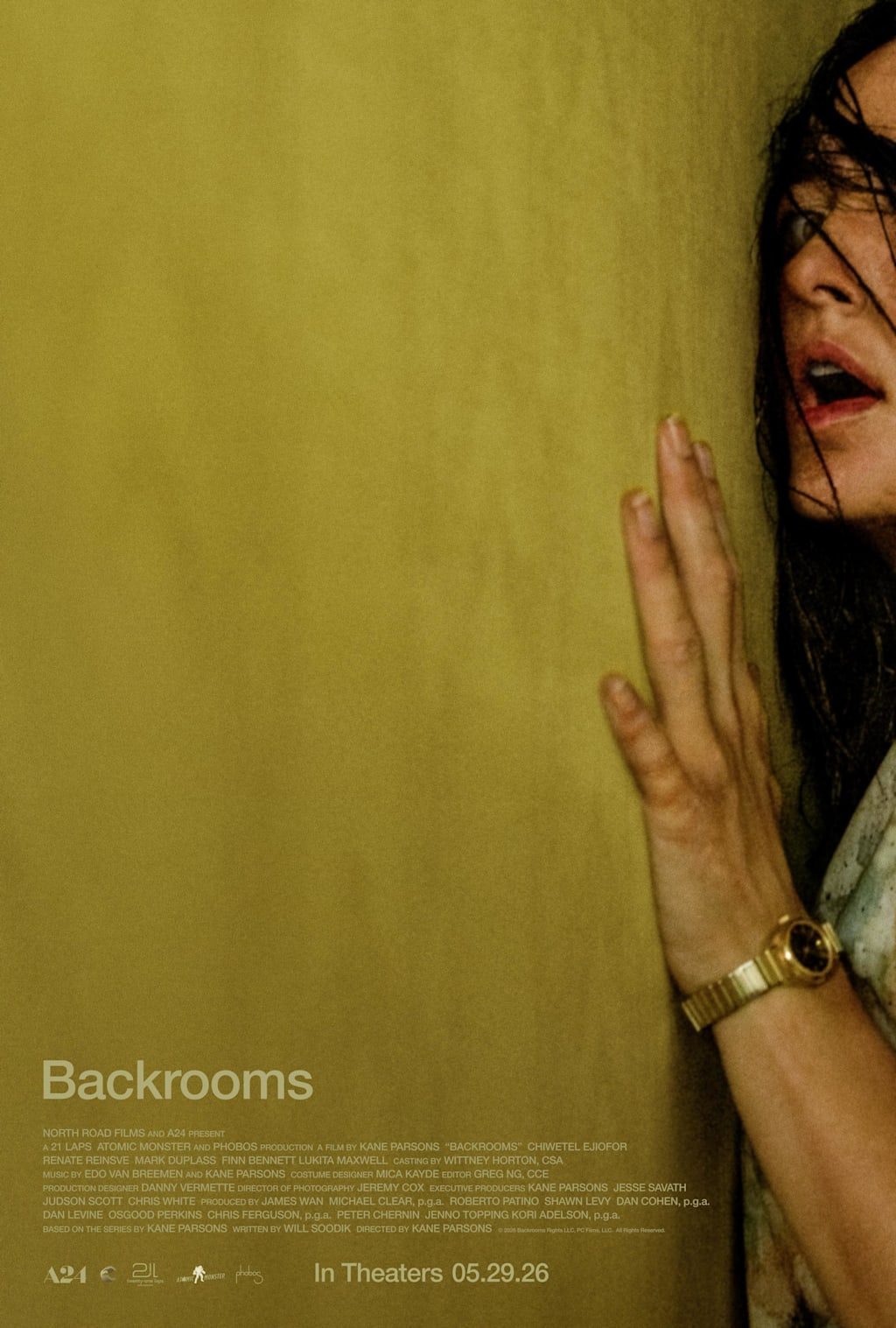
Spoiler Warning: This article reveals the complete story, major deaths, ending, hidden symbolism, and final twist of The Backrooms.
What began as a disturbing photograph of an empty yellow room eventually became one of the internet’s most famous horror legends. The idea was simple: if someone accidentally “no-clips” out of reality, they may fall into an endless collection of yellow hallways, damp carpets, buzzing fluorescent lights, and creatures hiding beyond human sight.
In The Backrooms, director Kane Parsons takes that concept and turns it into something much more personal. This is not simply a movie about people getting chased through an infinite maze. It is a psychological horror story about the memories, habits, addictions, and emotional wounds that trap people long before they enter the actual Backrooms.
What Are the Backrooms?
The movie connects the Backrooms to Async, a research company that originally manufactured MRI technology. With government funding, Async develops a system capable of opening a doorway into another dimension.
However, this experiment creates serious consequences. People begin randomly disappearing—or “no-clipping”—from the normal world and entering the endless complex.
The film opens in 1990 with an Async researcher named Narin Warren exploring a newly discovered section. While searching for a way back, Warren encounters strange objects, furniture, tropical wallpaper, and a terrifying shadowy creature with a peg leg.
The entity attacks Warren, and Async scientists later watch his recovered footage. This opening immediately establishes that the Backrooms are not empty. Something inside them is watching, learning, and remembering.
Clark Is Already Trapped Before Entering
The main character, Clark, owns a struggling furniture shop called Captain Clark’s Ottoman Empire. His business is failing, his marriage has ended, and he spends his nights drinking inside the store.
Clark once dreamed of becoming an architect, but his office is now filled with unpaid bills and abandoned designs. He surrounds himself with reminders of the person he could have become.
His therapist, Mary, tries to help him accept responsibility and create a new path. Clark, however, constantly presents himself as the victim. He admits that he hurts people but excuses his behaviour by saying that it is simply the way he is “wired.”
That sentence becomes one of the movie’s most important ideas. Clark does not genuinely believe he can change. More importantly, he does not want to accept the responsibility required to change.
Clark Discovers the Entrance
After experiencing repeated power failures, Clark investigates the basement of his furniture store. There, he discovers a strange doorway hidden inside the wall.
He enters and finds himself surrounded by familiar yellow rooms, impossible corridors, misplaced furniture and architecture that appears to have been incorrectly reconstructed from memory.
Many objects inside the Backrooms come from Clark’s store. However, they are twisted, duplicated or fused together. Chairs merge into cabinets, lamps grow through shelves, and doors lead to spaces that should not physically exist.
Instead of escaping and sealing the entrance, Clark becomes fascinated.
He begins stealing furniture from the Backrooms and bringing it into the real world. At first, he may be trying to prove that the place exists. Soon, however, exploring the complex becomes another addiction.
The Backrooms offer Clark something reality cannot: excitement, control and a place where his failures no longer matter.
What Happens to Bobby and Cat?
Clark eventually convinces his employees, Bobby and Cat, to join his exploration. He does not properly warn them about the creature or reveal how dangerous the place has become.
During the expedition, Bobby is tied to a rope and lowered into a deeper level. He discovers strange piles of clothing, broken objects and signs that the Backrooms are copying the group’s memories.
The entity appears and violently drags Bobby into the darkness.
Clark and Cat attempt to find him, but the Backrooms begin separating them. Cat can see Clark through what appears to be glass, but he cannot see her. This reveals that the complex does not look the same to everyone. It creates a different experience for each person based on their memories and fears.
Bobby and Cat disappear, yet Clark does not return to reality or accept responsibility. Instead, he remains inside and becomes increasingly connected to the creature.
Mary’s Personal Backrooms
Mary’s childhood gives the film its emotional foundation.
She grew up with a deeply troubled mother who kept their home boarded shut. Chairs blocked the doors, newspapers covered the windows, and Mary was forced to move carefully through the house to avoid upsetting her mother.
For Mary, that house was her own version of the Backrooms—an enclosed world controlled by fear and trauma.
At the beginning of the movie, Mary watches the house being demolished. She keeps a piece of concrete containing a handprint made during her childhood. Although it represents pain, it also proves that she survived.
Clark and Mary are therefore reflections of one another. Both experienced emotional suffering, but they responded differently. Mary accepted the past and worked toward a healthier future. Clark used the past as an excuse to continue hurting himself and everyone around him.
Who Is Captain Clark?
When Mary enters the Backrooms to find Clark, she discovers that he has created a new home among artificial human figures called “still lives.” These beings are distorted copies produced from memories.
Clark prefers them because they cannot challenge him, leave him or hold him accountable. In his mind, they are an improvement over real people.
Captain Clark, the peg-legged monster, is the physical manifestation of Clark’s worst qualities. It is built from his anger, cruelty, self-pity and pirate-themed advertising character.
Clark eventually admits that he and the creature are essentially the same. The monster is not simply chasing him—it is the version of himself he has chosen to become.
The film also suggests that Clark and Captain Clark worked together. Clark helps trap Mary, while a photograph later confirms that the man and the entity had previously been seen together.
The Backrooms Ending Explained
Mary continues trying to save Clark, but he demands that she tell him he never did anything wrong.
That is all Clark truly wants. He does not want forgiveness earned through change. He wants permission to remain exactly as he is.
Mary finally refuses to carry responsibility for saving him. Clark then admits the truth: he does not think he wants to change.
Mary tells him to stay in the Backrooms. She understands that forcing someone to change is impossible when that person refuses to take the first step.
Clark briefly performs one humane act by allowing Mary to leave. However, this decision causes Captain Clark to turn against him. The monster represents Clark without compassion, so even one moment of kindness becomes a betrayal.
Captain Clark attacks and consumes Clark before dragging his mutilated body through the corridors. Symbolically, Clark is destroyed by the worst version of himself—the version he repeatedly protected and fed.
Mary runs through shifting rooms until she reaches a recreated version of Clark’s furniture store. During the final confrontation, she uses the concrete handprint from her childhood against the entity.
The object that once represented her trauma becomes the weapon that helps her survive. Mary does not erase her past. She uses what she learned from it to escape someone else’s destructive cycle.
What Happens to Mary?
Mary eventually reaches an Async exploration team and is taken into the company’s facility. Inside, researchers are already examining the remains of Captain Clark.
Phil, an Async scientist, questions Mary about her experience. He also shows her an image of Clark standing beside the monster, confirming their connection.
Phil warns that entrances are opening in more locations. This explains the growing number of disappearances and creates a clear setup for future stories.
The final montage shows locations and memories from the film being recreated inside the Backrooms. Mary also appears as a still life, but this does not mean the real Mary is dead or trapped. It is a copied version created by the complex from its memory of her.
The True Meaning of the Movie
The Backrooms represent the human subconscious—an endless collection of memories that become less accurate each time they are revisited.
Clark becomes trapped because he refuses to leave the emotional loop he has created. Mary survives because she accepts that the past cannot be changed, but its control over the present can be broken.
The most frightening monster in The Backrooms is therefore not an unknown creature wandering through yellow hallways. It is the version of ourselves that grows stronger every time we avoid responsibility, repeat destructive behaviour and convince ourselves that change is impossible.
The movie’s ultimate message is simple but powerful: trauma may explain a person’s behaviour, but it does not excuse the harm they choose to cause.
About the Creator
parwinder singh
🎬 Movie & Entertainment Writer sharing reviews, ending explanations, story breakdowns, plot twists and hidden details from Bollywood, Hollywood, South Indian cinema, Korean dramas and OTT releases.
Enjoyed the story? Support the Creator.
Subscribe for free to receive all their stories in your feed.
Comments
There are no comments for this story
Be the first to respond and start the conversation.