
The 9‑Year Vindication
How a drama once condemned as “morally bankrupt” became 2026’s biggest comeback story.
I
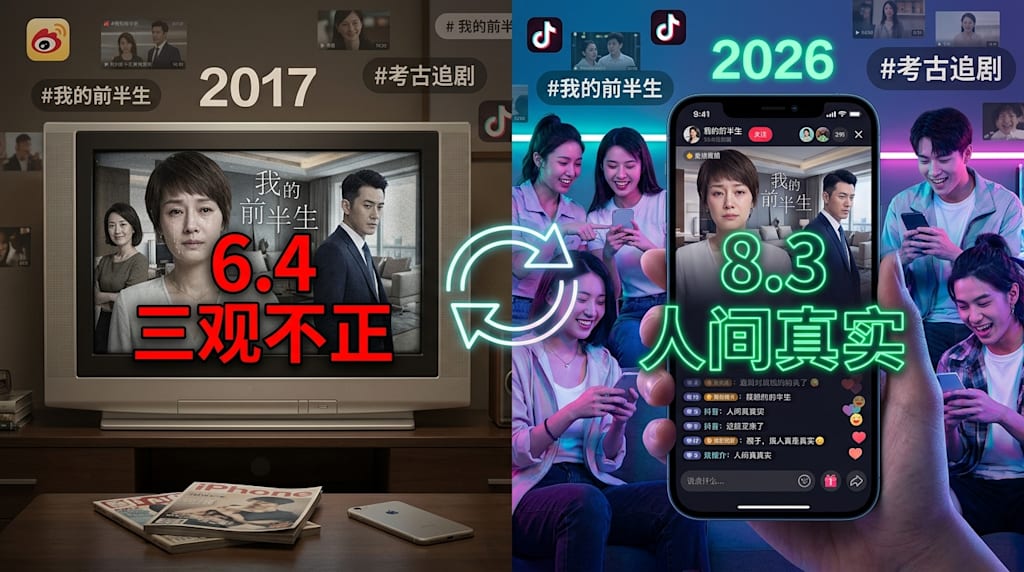
In the summer of 2026, a nine-year-old television drama came back.
No new-season promotion. No cast reunion. No sequel announcement. It just showed up – in Douyin's recommendation feeds, on Weibo's trending charts, and on countless young viewers' "archaeology" watchlists.
The First Half of My Life.
In a single month, it generated 4.9 billion new views and over 5 billion topic impressions. Its Douban score climbed from 6.4 in 2017 to 8.3. The show's official account, silent for nine years, reactivated on August 22, and the playful label "one of the internet's new four great classics" hit number two on Weibo's trending list.
The bullet comments scrolled past: "2026 archaeology crew," "Gen Z reporting in," "I was too young back then."
A drama once condemned as "morally bankrupt" was vindicated nine years later.
II
In the summer of 2017, The First Half of My Life was a hit from its very first episode.
Lei Jiayin's portrayal of the weak, conflicted "ex-husband" launched him into the front ranks of Chinese leading men. Wu Yue's Ling Ling – divorced, plain-looking, climbing her way up with a soft but relentless cunning – was the first "other woman" in Chinese television to break the stereotype that mistresses must be young and beautiful. Audiences hated her, and they talked about her. Ma Yili, in real life, was in the thick of her own marital storm – her husband's infidelity and her famous "yet we must carry on" response – and the echo between her real life and her character Luo Zijun gave the role a peculiar, extra-textual glow from the start.
The first half was genuinely good. A pampered housewife kicked into the mud by life, struggling back to her feet with the help of her best friend Tang Jing and Tang's boyfriend He Han. Real. Unflinching. The character of Xue Zhenzhu – that Shanghai auntie who never internalizes conflict and will flip a table for her daughter – is still a "speed bump" on short-video platforms: you scroll past, you stop, you watch.
The second half took a different turn.
After Ling Ling marries Chen Junsheng, the woman who once held everyone in the palm of her hand suddenly becomes a stereotypical wicked stepmother – favoring her biological son, mistreating her stepson. Chen Junsheng rekindles feelings for Luo Zijun. The most explosive twist: Luo Zijun falls for He Han – her best friend Tang Jing's boyfriend.
What had Tang Jing done in the first half? Lent Luo Zijun money. Found her a job. Listened to her cry through the night. Used her connections to pull Luo Zijun out of the mud. He Han was also a driving force. And Luo Zijun's repayment? She fell for her best friend's man.
Audiences in 2017 were furious. The "stealing your best friend's boyfriend" plotline erased every ounce of goodwill the show had built. Low Douban scores. Angry bullet comments. Media condemnations of "twisted values." Everyone said the same thing: what a waste.
III
Nine years later, the same characters were reopened by the next generation of the same audience.
The bullet comments had changed.
Chen Junsheng was no longer just a "cheater." "A middle-aged man crushed by work and two child-support payments," the comments read. "His blank stare after overtime – I see myself in that mirror."
Ling Ling was no longer just a "villainess." "She just wanted to carve out a spot for her child," the comments read. "Her methods were wrong, but her anxiety – I get it."
Luo Zijun was no longer a "fake independent woman." "She didn't get a power-up; every step she took was a slog through mud," the comments read. "Yes, she went after her best friend's boyfriend – but her struggle is real, not manufactured by the writers."
Even He Han had his "perfect elite man" veneer peeled away. Comments dissected his need for control, his arrogance, his indecisiveness in love – "He didn't love Luo Zijun; he loved the sense of mastery."
Same drama. Same shots. Same lines. In 2017 and in 2026, readers drew entirely different meanings.
The viewers had changed.
Nine years ago, audiences slapped on labels. Cheater. Home-wrecker. Schemer. Saint. Label applied, judgment delivered, case closed. Nine years later, audiences asked: Why did this person end up here? What were their circumstances? Did they have another choice? Would I have done any better?
Over those nine years, economic growth slowed. Workplace competition intensified. Marriage grew more fragile. The call for "independent women" was sounded again and again, yet the concrete challenges remained as stubborn as ever. When this new generation of young viewers had themselves been roughed up by life, they understood one thing: life is not a black-and-white true-false test; it is a series of gray, multiple-choice questions with no easy answers.
The characters condemned in 2017 became "real-life truths" in 2026.
IV
Short videos were the fuse.
The summer 2026 revival was not a slow, organic groundswell – it was pushed to the crest by short-video platforms.
The scene where Xue Zhenzhu confronts Ling Ling was crowned an "internet speed bump" – the algorithm pushes it, you stop and watch. That Shanghai auntie, cursing, flipping tables, going all-out for her daughter, became the "internet mouthpiece" for countless young people.
The "He Han picking me up in the rain" meme exploded because of the summer typhoons. On stormy nights, netizens shouted in unison on social media: "He Han, can you come get me?" – a line stripped from its original context, becoming a meme that belonged solely to that summer.
"Chen Junsheng swaying in the wind" – that still of Lei Jiayin's disheveled expression in a gust – became a new internet "skin." Young people used it as their avatar to express their own unsteady state in life.
A serious emotional drama was dismantled into countless pieces that could be spliced, reassembled, and interpreted in any number of ways. Young viewers watched with magnifying glasses: the unactivated Word document on Tang Jing's computer, He Han's shabby PowerPoint slides, the tape on Luo Zijun's moving boxes – every detail trended. This "archaeological" style of bingeing turned an old show into an open text that viewers could co-author.
V
One more reason: the cast is too formidable.
Lei Jiayin won the Magnolia Award for Best Supporting Actor for his "ex-husband" role and later completed the "Grand Slam of the Three Major TV Awards." Ma Yili won the Magnolia for Best Actress for Luo Zijun. Wu Yue's acting was repeatedly confirmed in later works like County Party Committee and Blossoms Shanghai. Yuan Quan and Jin Dong also held their positions.
Over nine years, the lead cast accumulated at least 13 major awards. In the 2026 Chinese drama market, an "all-award-winning cast" lineup is hard to come by. New viewers came to the show with trust in these actors – a group of people who would go on to win so many accolades, performing together nine years ago – it couldn't be bad.
Add to that the collective flop of the summer 2026 new dramas – with soapy plots, embarrassing performances, or outdated values – and audiences naturally turned to older shows that had stood the test of time.
The First Half of My Life is the kind of show that doesn't make you feel good – it makes you feel pain. And that pain is the texture of life.
VI
Nine years later, The First Half of My Life was seen anew.
Not because the show changed. Because its viewers completed a long, slow coming-of-age – from craving "satisfaction" and "rightness" to being willing to understand "difficulty" and "hurt."
On the hot searches of the summer of 2026, the show waited nine years for a belated vindication. This vindication reflects a shift in perspective – over those nine years, the entire society had changed the angle from which it views the world.
The First Half of My Life finally got that day in the summer of 2026.
About the Creator
Jin
Writer of reamstories
https://reamstories.com/jin
Enjoyed the story? Support the Creator.
Subscribe for free to receive all their stories in your feed. You could also become a paid subscriber, letting them know you appreciate their work.
Comments
There are no comments for this story
Be the first to respond and start the conversation.