
The 2026 National Day Box Office Just Hit a 12-Year Low. Here’s What Nobody Is Saying
Thirteen new films. No film that could carry the market. A three-month blank slate ahead.
1. The Brakes Hit the Floor
On October 1, the opening day of China’s National Day holiday, nationwide box office was 176 million yuan. The same day in 2025 brought in 321 million yuan. In one day, 145 million yuan disappeared. That is a 45.2 percent drop. Admissions fell by 3.52 million.
It was the first time since 2014 that opening day fell below 200 million yuan. In 2022, when cinemas were still under pandemic restrictions, opening day managed 267 million yuan. In 2026, cinemas are fully open. No capacity limits. No testing requirements. The box office was still one-third lower than during the worst of the pandemic.
The seven-day holiday total will likely land between 1.1 billion and 1.2 billion yuan. In 2014, the total was 1.117 billion yuan. Twelve years later, China has more than 80,000 screens, up from 20,000. The box office is back where it started.
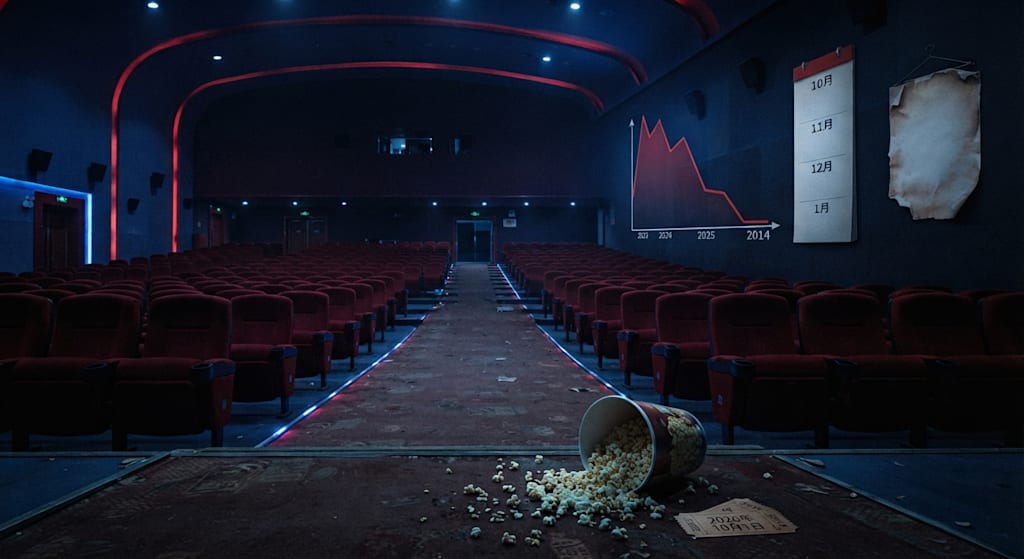
This is not a single bad year. In 2023, the National Day holiday grossed 2.734 billion yuan. In 2024, 2.104 billion. In 2025, 1.835 billion. In 2026, roughly 1.16 billion. The line has fallen for four years. In the first half of 2026, nationwide box office was 17.356 billion yuan. That is down 40.6 percent from a year earlier and down 27.4 percent from the same period in 2024. Qingming: 304 million yuan, down 19.6 percent. Dragon Boat Festival: 397 million yuan, down 13.6 percent. Mid-Autumn Festival: 269 million yuan, down about 30 percent. Every short holiday has lost ground.
One explanation keeps coming back: people went traveling. Short videos took them away. But during the 2024 National Day holiday, domestic trips reached 765 million, a record. That same year, the National Day box office sold 2.104 billion yuan and 52.09 million tickets. Travel and movies have never been an either/or choice. Short video was not a new variable in 2026. The variable that mattered was simpler. The films that could carry the market disappeared.
2. Thirteen New Films, No Film That Could Fight
The holiday had 13 new releases. The number was not small. The genres were mixed. But scan the lineup and you will not find a single true big film.
As of September 30, total presales for National Day releases were 50 million yuan. Only one film, Traces of the Detective, crossed 10 million yuan. At the same point in 2025, presales had passed 100 million yuan. Presales are the market’s thermometer. The reading had already passed sentence on the holiday.
Compare with earlier years. In 2019, the National Day slot had My People, My Country, The Captain, and The Climbers going head-to-head. Opening day brought in 815 million yuan. In 2021, The Battle at Lake Changjin alone took 5.775 billion yuan. In 2026, the holiday champion, Traces of the Detective, grossed about 400 million yuan during the slot. Its final forecast is around 700 million yuan. Put that number in 2021 and it looks like pocket change next to The Battle at Lake Changjin.
The more troubling sign is how filmmakers now treat the big holiday slots. In 2026 as a whole, nine films have crossed 1 billion yuan, more than the eight that did so in all of 2025. Pegasus 3 took 4.42 billion yuan. Welcome to Dragon Restaurant took 2.356 billion. Love Letter to Grandma took 2.005 billion. Good films exist. They just do not want to come to National Day. Quality projects either choose another window or refuse to set a date. The industry’s confidence in the holiday is visibly collapsing.
Behind this is the bankruptcy of holiday-slot dependency. For a decade, China’s film market ran on one rule: squeeze into a major holiday, and even a bad film can rely on holiday crowds for a baseline. So a dozen films crammed in. Audiences were on vacation. Someone would buy a ticket. The 2026 National Day holiday proved that rule is dead. When “it’s a holiday” no longer turns into movie tickets, eating off the calendar stops working.
3. One Film’s Withdrawal, and an Industry’s Silence
The Stakeout is the sharpest footnote to the 2026 National Day holiday.
The crime thriller starred Louis Koo, Ci Sha, Simon Yam, and Tse Kwan-ho. It began shooting in Hong Kong in June 2024. Reported investment passed HK$150 million. After five days in release, cumulative box office was 4.47 million yuan. It ranked eighth among new National Day releases, separated from seventh place by tens of millions. On the morning of October 5, the film’s official Weibo account announced it was canceling this round of theatrical release. Then it deleted the post. Audiences were left in the comments asking each other: did it withdraw or not?
A film with more than 100 million yuan in investment and Louis Koo in the lead pulled out after five days. Five years ago, that would have been almost unthinkable. The producer list is stranger still. Among the 15 investing companies, not one is a well-known major film company. Among marketing and distribution companies, there is no Maoyan, no Taopiaopiao. Louis Koo’s own One Cool Film Production usually participates in even his small Hong Kong films. This time, it is absent.
This is not one film failing. It is an industry going silent as the market collapses.
The holiday champion, Traces of the Detective, has a Douban score of 6.8. Within Chen Sicheng’s filmography, that is upper-middle. On Maoyan and Taopiaopiao it scored 9.6 and 9.5. As a commercial genre film, it did its basic job. But a 6.8 Douban score means it could not break out of its niche. It could not pull back casual viewers who have already grown distant from cinemas. A head film that is merely fine cannot carry a market that needs very good to come alive.
The Douban scores of major new releases formed clear layers. Resident Evil: Outbreak Night at 7.3, Heart of the Beast at 7.2, and Living Color, Living Fragrance at 7.2 belonged to imported films and small literary titles with acceptable reputations. What Do You Mean, Couple? at 6.4, Rebirth 2 at 6.7, and Peppa Pig: Perfect Holiday at 6.2 hovered near the passing line. The Stakeout at 4.3 was the lowest of the holiday.
When audiences realize that during the most important golden window of the year, their money and time may buy a long-shelved, expired product, the rational choice is to stay home. The audience did not leave. They learned to vote only for films worthy of the ticket.
4. After National Day, Three Months of Blank Space
The dismal National Day box office is not the most alarming part. The blank space after the holiday is.
Open the release calendar for 2026. From the end of the National Day holiday to the eve of the 2027 Spring Festival, more than three months, almost no major film has set a date. The final forecast for the National Day champion, Traces of the Detective, is around 755 million yuan according to Lighthouse Pro and around 631 million yuan according to Maoyan Pro. After the holiday ends, the market will lack any film with sustained drawing power to keep overall heat alive.
The only confirmed savior is The Wandering Earth 3 (Part One), set for the 2027 Spring Festival. Directed by Guo Fan and starring Wu Jing, Shen Teng, Andy Lau, and Li Xuejian, the whole industry is waiting for it. But one The Wandering Earth 3 can only save the seven days of the Spring Festival slot. Can it solve the structural contradiction of a market that lacks quality content over the long term?
When audiences lose trust in holiday releases, and producers do not dare set dates because of market risk, a vicious cycle tightens. The fewer good films there are, the fewer people go. The fewer people go, the fewer good films dare to be made. The bleak 2026 National Day holiday is a concentrated outbreak of a content trust crisis triggered by supply-side quality. Repairing it will not require one or two savior films. It will require the industry to regain its reverence for content quality.
The holiday slot is still the holiday slot. The vacation is still the vacation. Audiences do not have less free time. They lack something worth paying for.
The 1.1 billion yuan of the 2026 National Day box office is a mirror. It reflects a question China’s film industry must face after years of crude expansion: when audiences no longer pay simply because it is a holiday, what reason does cinema have left to bring them back?
The answer will be written after 2026, in every choice every filmmaker makes next.
About the Creator
Jin
Writer of reamstories
https://reamstories.com/jin
Enjoyed the story? Support the Creator.
Subscribe for free to receive all their stories in your feed. You could also become a paid subscriber, letting them know you appreciate their work.
Comments
There are no comments for this story
Be the first to respond and start the conversation.