
The $1,000 Movie That Broke China's Film Industry
How a former renovation company turned a 2008-style 3D render into a state-approved cinematic "masterpiece."
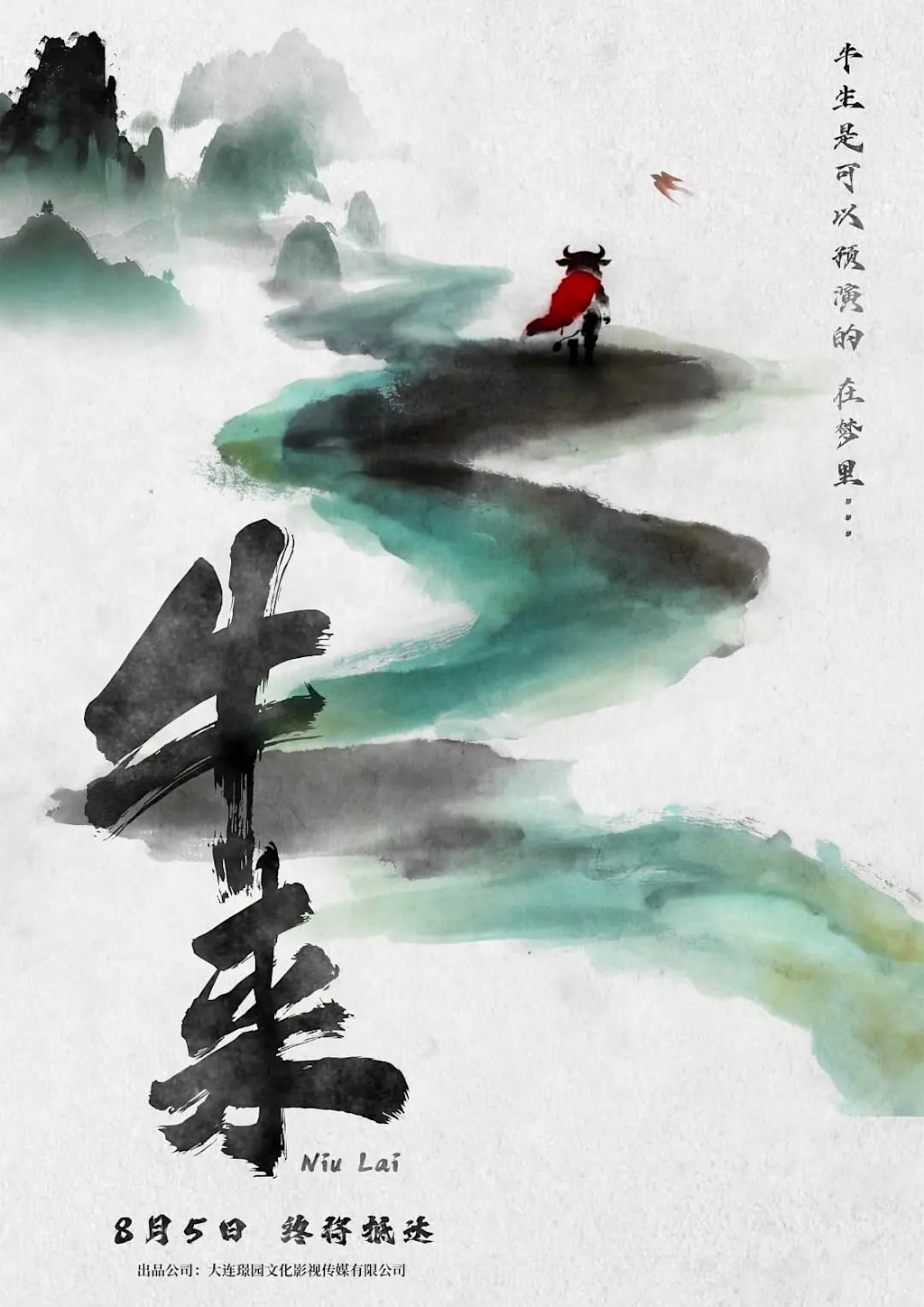
August 2026. An animated film called Niu Lai (The Ox Comes) hit Chinese theaters.
Nine days later, its cumulative box office stood at 7,169 yuan (about $1,000 USD). Across the country, barely two hundred people had seen it.
How small is that? In Beijing, it would not buy a single square metre of apartment space. In a normal cinema, it might not even cover one screening room’s electricity bill for a day.
Yet it was a domestically produced animated feature that had obtained the official “Dragon Stamp” (China’s film censorship certificate) and secured theatrical distribution nationwide.
That is where the story becomes curious.
I. A Poster That Writes Poetry, a Film That Does Homework
The first batch of Niu Lai’s audience was almost certainly lured in by its poster.
Ink‑wash style, poetic, vast. The silhouette of an ox stood between heaven and earth. The official synopsis read:
“A newborn calf leads a lark, just arrived from the desert, into a dream. In that dream, the lark witnesses Niu Lai, guided by multiple forces, gradually grow into a courageous warrior who dares to take responsibility and face life and death.”
It sounded like an ambitious, art‑house animation.
Then the screen lit up.
One viewer later recalled online: “I thought I’d time‑traveled back to 2008.” The modelling looked like a student project from someone who had just learned Blender three days ago. The characters moved in jerky, stuttering motions. Textures were smeared together. The animals and the environment shared almost identical surface details. The voice acting sounded like someone reading a script cold, with no emotional inflection.
On Douban, someone left just four characters: “That’s it? Gone?”
But it was this catastrophic gap between promise and delivery that kept Niu Lai alive on the internet.
II. The More People Mock It, the More Famous It Becomes
Before its release, Niu Lai had virtually zero promotion. No trailer, no stills, no interviews, no preview screenings. It walked quietly into theatres, like a person entering an empty room with no intention of greeting anyone.
Then someone took a photo of the screen and posted it.
Then another.
Then someone made a comparison graphic: on the left, Niu Lai’s poster (ink‑wash, evocative, full of negative space); on the right, the actual film (polygonal, stiff, as if it had not finished rendering).
The spread began.
Douban’s short‑review section turned into a collective performance art piece. A flood of five‑star reviews poured in, dripping with irony: “A milestone for Chinese animation.” “You won’t understand it until ten years later.” “The director is playing four‑dimensional chess.” No one actually believed any of it, but everyone said it. A film that should have died in silence, precisely because it was “so bad it’s earnest,” became fodder for a cyber‑carnival.
Some even went out of their way to check in at theatres that still had screenings. On its ninth day in release, Niu Lai’s single‑day box office “hit a new high” – because it had been so low before.
It is an absurd paradox: great films grow through word‑of‑mouth; Niu Lai broke through via “anti‑word‑of‑mouth.” Audiences were not going to see an animation. They were going to see a legend.
III. Who Made This Film?
If Niu Lai were just an amateur’s hobby project uploaded to Bilibili, no one would raise an eyebrow. The problem is that it made it to theatres.
That requires the Dragon Stamp, a production company, and the full official procedure for theatrical release.
Trace the production company, and things get interesting.
The credited production house is “Dalian Jingyuan Culture Film and Television Media Co., Ltd.” Registered capital: 100,000 yuan. Number of employees with social insurance: one. The company’s previous business scope had little to do with film – it used to be a renovation contractor.
The core creative team behind the entire film reportedly consisted of just the director himself. Director, screenwriter, voice actor, animator – one person did it all.
This raises an unavoidable question: How did a work whose technical quality clearly falls below market standards obtain the Dragon Stamp?
China’s film censorship review focuses primarily on content compliance – no illegal or rule‑breaking material, no crossing of red lines. As long as the content is unobjectionable, even the roughest production can, in theory, receive the certificate.
The original intent of this system was to leave a door open for independent creators, so they would not be shut out by the high production barriers of big studios. But as Niu Lai shows, that same door has also let in something else.
Which brings us to a second interpretation: Is it possible that this film’s goal was never about box office at all?
IV. An Insider’s Unspoken Assumption, an Outsider’s Guessing Game
Making a film – no matter how crude – costs money. Personnel, equipment, submission fees, distribution arrangements. The 7,169‑yuan box office take would not even cover a fraction of the break‑even point.
So why do it?
A widely circulated guess: to secure official government film subsidies.
To encourage film production, governments at various levels offer special funds or support policies. Applying for these usually requires several hard conditions: the work must obtain a Film Screening Permit, must be released in theatres, and must meet certain duration standards.
Niu Lai happened to satisfy all of them.
Dragon Stamp + theatrical release = ticket to apply for subsidies. How much the box office grosses is not part of the review criteria. In this logic, 7,169 yuan and 71.69 million yuan are functionally the same.
This is not a proven accusation. It is a possibility repeatedly discussed both inside and outside the industry. Its believability comes precisely from the fact that it explains something no other explanation can: why anyone would put effort into completing something they know has no audience.
Because the audience was never the target.
V. When “Completion” Replaces “Excellence”
What makes Niu Lai uncomfortable is not its technical shoddiness. Technically awful independent works appear every year; most never even get a chance to be seen.
What makes Niu Lai uncomfortable is that it obtained the credentials to be seen – the Dragon Stamp and the theatrical slots – but delivered nothing worthy of that qualification.
In the audience’s understanding, the Dragon Stamp signifies a qualified product – a work that has passed basic production standards and possesses fundamental viewing value. But Niu Lai ripped open that perception: the Dragon Stamp certifies whether content is “compliant,” not whether it is “qualified.” The former is a legal concept; the latter, an industrial one. Between them lies an entire supply chain of distance.
That door was opened for independent creators. But once opened, it does not let only idealists through.
If a film’s goal is not to please the audience but to “complete the process”; if the true value of a Dragon Stamp lies not in public screening but in checking an extra box on a funding application – then Niu Lai is not an isolated case. It is an extreme sample.
It takes something the industry tacitly understands and lays it bare on the table.
VI. The Line Between One Kind of Roughness and Another
Some might try to place Niu Lai alongside “low‑budget but great” films.
Take Pulp Fiction at Cannes in 1994. Tarantino made a non‑linear, anti‑genre, B‑movie‑infused film for about $8 million. Was it rough? From certain technical angles, yes. But that roughness was a deliberate aesthetic choice – his script was as precise as a clock, every line polished, every seemingly casual character serving an exact structural function.
Closer to home, consider The Summer of the Mermaid, another animated film that became an internet meme for its crudeness. Yet that film had a complete story arc, a clear beginning‑middle‑end, and traces of an attempt to connect emotionally with the audience. Its famous “scaring myself” scene became a meme precisely because it tried to generate emotion – it just failed.
Niu Lai is different. It is not “tried and failed.” It is more like “didn’t try.”
This is not aesthetics. This is absence.
You can say Pulp Fiction’s roughness was intentional. The Summer of the Mermaid’s roughness was a capability issue. Niu Lai’s roughness – from everything known – is a goal issue.
When your target is not to be seen but to be “completed,” then roughness is no longer a flaw to be fixed; it is an acceptable by‑product.
VII. A Play for No One – Who Was It For?
As of this writing, Niu Lai’s box office might still inch up a little. After all, it has become famous. But that fame is poison – everyone who goes to see it goes not to “watch a good film,” but to “confirm with their own eyes just how bad it really is.”
It has become a performance art piece with no curtain call. The audience comes for the absurdity itself.
But we need to think clearly about one thing:
A film can fail in many ways – commercial failure, critical failure, technical failure. What makes Niu Lai peculiar is that it seems to sidestep all these definitions at once, because from the start it was operating in a different coordinate system.
Measured by box office, it failed. But its costs were never meant to be covered by ticket sales.
Measured by reputation, it was mocked across the internet. But mockery is itself traffic, and traffic today is a convertible asset.
If “success” is defined as “completed the prescribed process,” then it succeeded.
The question is: since when did filmmaking become a business where “just going through the motions” counts as enough?
VIII. A Mirror
Niu Lai is an unflattering mirror.
What it reflects is uncomfortable: behind the glamorous data of the film industry lies a grey zone. There, you find good‑faith policy intentions being exploited, industrial thresholds bypassed, and audience trust eroded. It is not large enough to shake the whole industry – but it is real.
That mirror will not shatter by itself.
Those who genuinely want to make animation, tell stories, and spend years honing a work – what do they feel when they see Niu Lai get a Dragon Stamp and a theatrical release?
“So this also works.”
That sentence cuts deeper than any box office figure. Because once “this also works” is proven feasible, it becomes a path – one that requires no talent, no sincerity, no polish. The threshold is low; the walk is easy. But at the end of that path, what remains is not a work – it is an empty shell.
Niu Lai will eventually be forgotten. Its 7,169‑yuan take will become a trivial footnote on some Baidu encyclopedia page. But the path that has been proven viable – that is what will truly remain.
Unless someone closes it.
About the Creator
Jin
Writer of reamstories
https://reamstories.com/jin
Enjoyed the story? Support the Creator.
Subscribe for free to receive all their stories in your feed. You could also become a paid subscriber, letting them know you appreciate their work.
Comments
There are no comments for this story
Be the first to respond and start the conversation.