
Still Watching The Sky: Why Independence Day Still Endures
A look back at optimism, destruction, and American myth making in alien invasion cinema

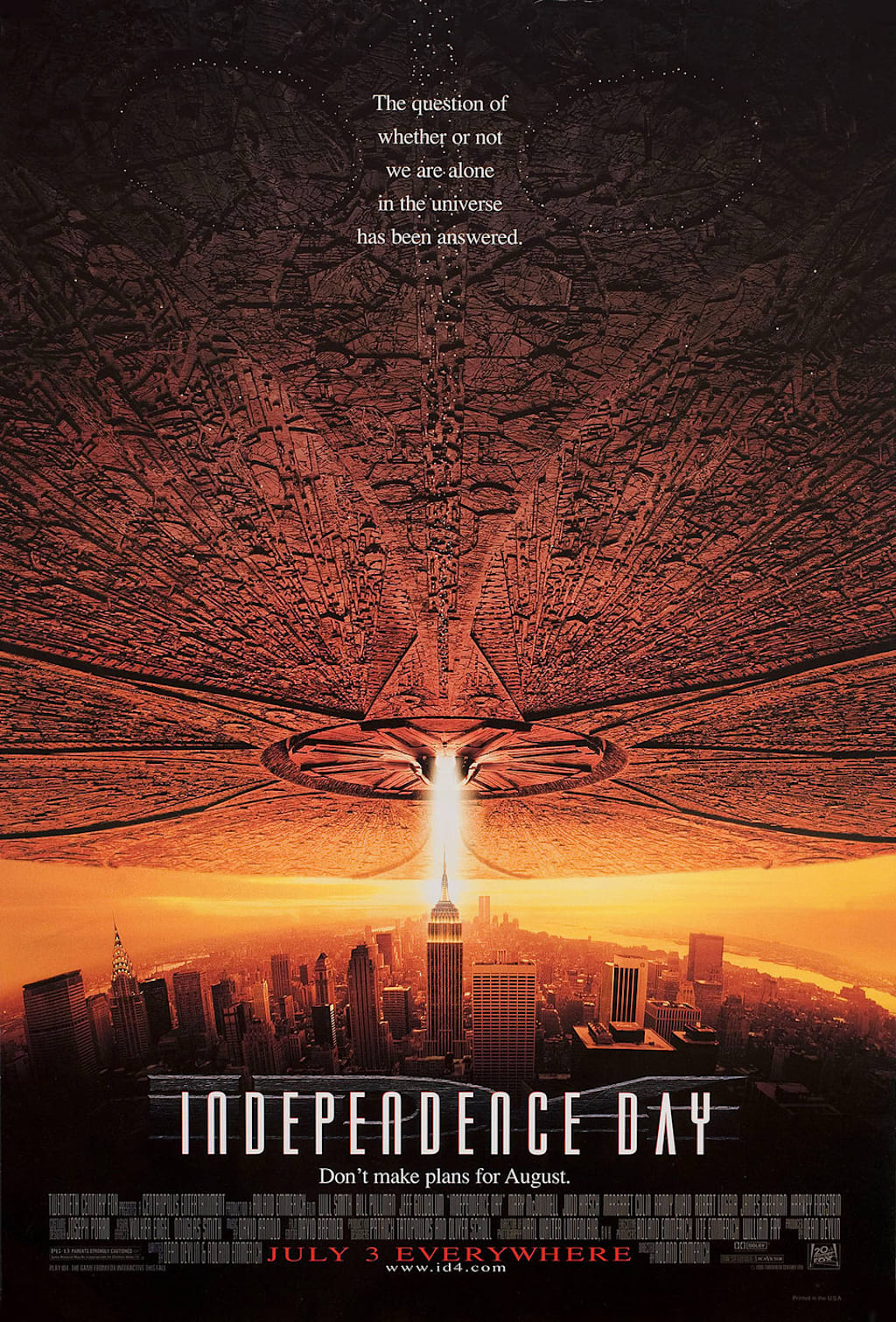
The Sky Opens: The Arrival of the Alien Threat
The plot of Independence Day follows a sudden and overwhelming extraterrestrial attack that sends Earth into chaos. Massive alien motherships appear across the globe, unleashing coordinated attacks that destroy major cities within moments. As communication networks collapse and governments scramble to respond, humanity is forced into a desperate battle for survival. What begins as unexplained phenomena quickly escalates into a full-scale global crisis. The invasion becomes not only a battle for Earth, but also a fight to preserve civilization itself.
The Day We Fought Back: The Cast of Survival
One of the greatest strengths of the movie is its amazing ensemble cast, whose performances help balance the film’s spectacular visual effects with genuine emotion and memorable characters. Will Smith delivers a charismatic performance as Captain Steven Hiller, a courageous Marine fighter pilot whose confidence, humor, and determination make him one of the film’s most memorable heroes. His natural charm and quick wit provide welcome moments of lightheartedness without undermining the gravity of the global threat.
Jeff Goldblum is equally compelling as David Levinson, a brilliant satellite engineer whose intelligence and resourcefulness become essential to humanity’s survival. Goldblum’s unique delivery and sense of humor make David both relatable and believable as the unlikely architect of Earth’s defense.
As President Thomas J. Whitmore, Bill Pullman delivers one of the movie’s most iconic performances. He convincingly portrays a leader burdened by a powerful crisis yet determined to persevere. His calm yet firm demeanor culminates in one of the most iconic speeches in cinema history.
Vivica A. Fox brings warmth and resilience to Jasmine Dubrow, who proves to be far more than a romantic interest. Her courage and compassion shine as she protects survivors and reunites with her family during the invasion.
Additionally, James Rebhorn plays Albert Nimzicki as a cynical government official whose skepticism and bureaucratic influence create friction within the response effort. He represents institutional hesitation at a moment where decisive action is critical, adding an extra layer of conflict.
Finally, the supporting cast, including Judd Hirsch, Randy Quaid, Margaret Colin, Robert Loggia, and Brent Spiner further enrich the movie’s scope, adding political tension, civilian perspectives, and institutional conflict that help transform the alien invasion into a fully human story of panic, resistance, and unity.
Best Moments of Survival and Resistance
Independence Day is packed with memorable moments that combine thrilling action, suspense, humor, and inspiring heroism. One of the movie’s most memorable scenes occurs when the enormous alien spacecraft arrive over major cities, including New York. As thousands gather beneath them in awe, excitement quickly turns into horror when the aliens unleash their deadly energy weapons, revealing the true scale of the danger facing humanity.
The aerial combat scenes are among the film’s greatest highlights. Fighter pilots launch daring attacks against the alien forces, creating spectacular dogfights filled with courage and sacrifice. Captain Steven Hiller’s encounter with an alien pilot is especially iconic. After shooting it down, Steven knocks the surviving alien unconscious, drags it across the sand, and presents it to the terrified guards at Area 51 while demanding entrance.
Another standout scene takes place inside Area 51. David demonstrates his idea of utilizing a computer virus to neutralize the aliens’ defenses by placing a Coca-Cola can on top of a captured alien spacecraft and asking Secret Service agent Mitchell to shoot it. The first bullet bounces off the active shield. After David uploads the virus, he asks Mitchell to fire again, and this time the bullet knocks the can clean off the spacecraft, proving the ingenuity of his strategy.
President Thomas J. Whitmore’s inspiring speech before the final battle unites the fighter pilots and gives humanity one last surge of hope before facing the alien fleet. It serves as the emotional high point of the film’s climax.
Facts You Didn’t Know About Independence Day
The production of Independence Day is filled with intriguing behind-the-scenes facts that helped shape the blockbuster. One lesser-known fact is that the film’s title was nearly Doomsday. According to an article from People magazine, the change came after it was discovered that another studio already held rights to a project with a similar title.
Ultimately, the filmmakers settled on Independence Day, a decision reinforced by its connection to President Whitmore’s iconic final speech, which gave the title stronger emotional and thematic impact.
The script was reportedly written in roughly three weeks, sold immediately after it was completed, and principal photography was completed in just 72 days — an unusually rapid turnaround for a visual-effects-heavy production of its scale.
Early in development, the U.S. military was initially supportive of the project and even provided cooperation during production. However, once references to Area 51 and classified technology became more prominent in the script, they withdrew their assistance, forcing the filmmakers to rely more heavily on independent research and design.
Finally, the film’s marketing campaign sparked unexpected controversy overseas. In Spain, promotional broadcasts showing massive alien ships hovering over New York reportedly caused brief public confusion, despite clearly being labeled advertisements. One advertising executive later noted that viewers can struggle to simultaneously watch, listen, and read — contributing to the confusion.
United We Stand: The Core Message
At its core, the film is about the importance of unity and teamwork. The president’s speech, where he expresses a need for humanity to set aside its petty differences and fight not against tyranny or oppression, but annihilation itself, becomes the emotional turning point of the narrative. It reinforces the idea that survival depends on collective action rather than individual strength.
Another key theme is human ingenuity. David Levinson’s discovery of the alien communication system and his proposal of a computer virus illustrate how intelligence and creative problem-solving can challenge even a technologically superior enemy. Rather than relying solely on brute force, the film suggests that adaptability and strategic thinking are essential for survival. This idea gives the human resistance an underdog quality, turning information and innovation into weapons of equal importance to military prowess.
Family is also a central emotional anchor throughout the narrative. President Thomas J. Whitmore, Captain Steven Hiller, and David Levinson are all driven by a desire to protect their loved ones, and their personal stakes heighten the emotional intensity of the global crisis. These relationships ground the large-scale conflict in human experience, reminding the audience that the invasion is not only a battle for the planet, but also a struggle to maintain human connection.
Together, these themes combine to elevate the film beyond spectacle. It becomes a story about resilience, cooperation, and hope under pressure.
The Legacy of Independence Day
The balance between large-scale disaster and intimate human motivation is what has allowed Independence Day to remain culturally significant, influencing later disaster and science fiction films. Its blend of spectacular destruction and character-driven storytelling can be seen in films such as Armageddon, Godzilla, The Day After Tomorrow, and 2012, which expand on the idea of global catastrophe as both entertainment and emotional drama. Beyond its effect on disaster cinema, the film helped redefine the modern summer blockbuster by proving that spectacular visual effects, memorable characters, and an emotionally resonant story could coexist. Nearly three decades later, it remains one of the most influential and enduring alien invasion films ever made.
About the Creator
TheScreenAnalyst
I am a passionate movie and TV enthusiast, devoted to analyzing storytelling, characters, visuals, and performances. I provide thoughtful critiques and insights, exploring both mainstream and independent works to engage audiences.
Enjoyed the story? Support the Creator.
Subscribe for free to receive all their stories in your feed.
Comments
There are no comments for this story
Be the first to respond and start the conversation.