

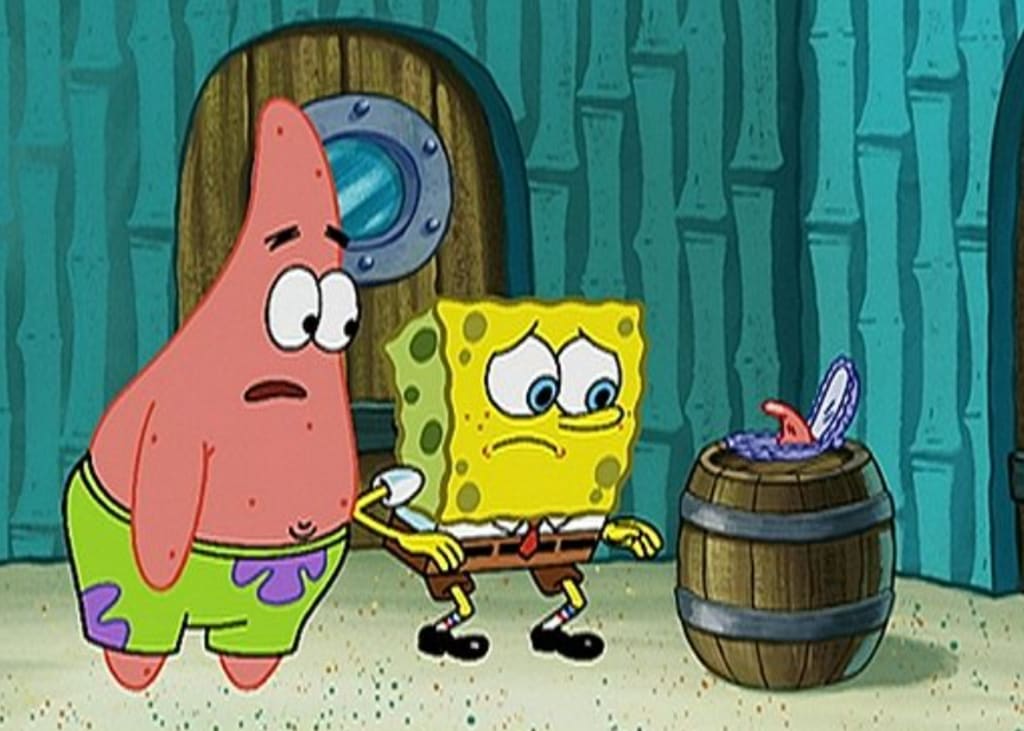
"Rock-a-Bye Bivalve" stands as a quintessential example of peak SpongeBob SquarePants humor, masterfully blending domestic satire with the show’s trademark surrealism. The episode begins with a chance encounter when SpongeBob and Patrick discover an abandoned baby scallop, whom they affectionately name Junior. This catalyst sets the stage for a delightful role-playing scenario where the duo dives headfirst into the responsibilities of parenthood, with SpongeBob donning the apron as the doting mother and Patrick clumsily stepping into the role of the breadwinning father. The comedic friction arises immediately from the contrast between their childlike enthusiasm and the exhausting reality of raising an infant. SpongeBob’s obsession with maternal care is hilariously over-the-top, involving obsessive cleaning and constant nurturing, while Patrick’s interpretation of a "working father" is a parody of 1950s tropes. Every morning, he leaves home—or rather, the rock—to go to "work," which merely consists of him sitting on his own front porch, completely oblivious to the fact that his "job" provides absolutely no income or support for his growing family.
As the days progress, the episode expertly illustrates the rapid burnout that comes with raising a child. The domestic bliss begins to fracture as Junior’s needs become increasingly demanding, leading to the famous sequence where SpongeBob finds himself utterly frazzled by the constant crying and feeding. The stress of the situation transforms their cozy play-acting into a genuine struggle, mirroring the real-world exhaustion of parents who suddenly find their lives consumed by the needs of a dependent life form. One of the most memorable aspects of this episode is its sharp, witty dialogue that manages to be both funny to children and deeply relatable to adults. The way Patrick dismisses his parental duties by prioritizing his own comfort, only to be dragged back into the madness by a frantic SpongeBob, provides a hilarious look at the division of labor. The writers perfectly capture the tension between the two friends, making the audience laugh at their incompetence while simultaneously feeling the weight of their misguided but earnest attempts to do what is right for Junior.
The visual storytelling in this episode is top-tier, particularly in the way the animators depict Junior’s rapid growth and chaotic antics. From the scallop learning to fly to the destruction of their improvised household, every frame serves to heighten the absurdity of the situation. The physical comedy, especially when Patrick attempts to "help" with childcare or household chores, serves as a testament to the animators' ability to turn simple domestic blunders into high-stakes comedic disasters that keep the viewer engaged. Furthermore, the episode serves as a clever commentary on the idealism of marriage and parenthood. By forcing two immature characters into a high-responsibility role, the show highlights how quickly the novelty of a "fun" domestic life wears off when faced with the harsh realities of sleepless nights and constant compromises. It is a brilliant piece of character study disguised as a cartoon, showing that even the most well-intentioned parents—even starfish and sponges—are rarely prepared for the sheer scale of the commitment required to raise a child.
As Junior eventually begins to display the natural predatory instincts of an adult scallop, the episode shifts from pure comedy into a bittersweet realization about the nature of growth and independence. Watching SpongeBob and Patrick struggle to teach Junior how to fly and fend for himself is a poignant closing chapter to their brief parenting journey. It forces the two friends to confront the fact that their "child" has evolved beyond their limited care, leading to a conclusion that is as touching as it is wildly hilarious. Ultimately, "Rock-a-Bye Bivalve" remains a fan favorite because it grounded Patrick and SpongeBob in a recognizable human experience while keeping their iconic personalities intact. It showed that the show could tackle complex themes like responsibility, relationship dynamics, and personal sacrifice without losing its frantic, high-energy charm. The episode manages to balance the slapstick antics of Patrick’s "workday" with the genuine emotional stakes of SpongeBob’s maternal heart, creating a narrative that is both profoundly silly and surprisingly thoughtful. In conclusion, this episode is a masterclass in episodic television, proving that SpongeBob SquarePants was at its best when it placed its characters in mundane, relatable scenarios and watched the chaos unfold. By the time Junior finally flies away, leaving the exhausted pair to return to their simple lives of jellyfishing and Krabby Patties, the audience is left with a memorable, laughter-filled exploration of the difficulties of family life. It stands as a timeless reminder that while parenting may be one of the hardest jobs in the world, doing it with a best friend makes the struggle infinitely more bearable.
About the Creator
Forest Green
Hi. I am a writer with some years of experiences, although I am still working out the progress in my work. I make different types of stories that I hope many will enjoy.
Enjoyed the story? Support the Creator.
Subscribe for free to receive all their stories in your feed.
Comments
There are no comments for this story
Be the first to respond and start the conversation.