

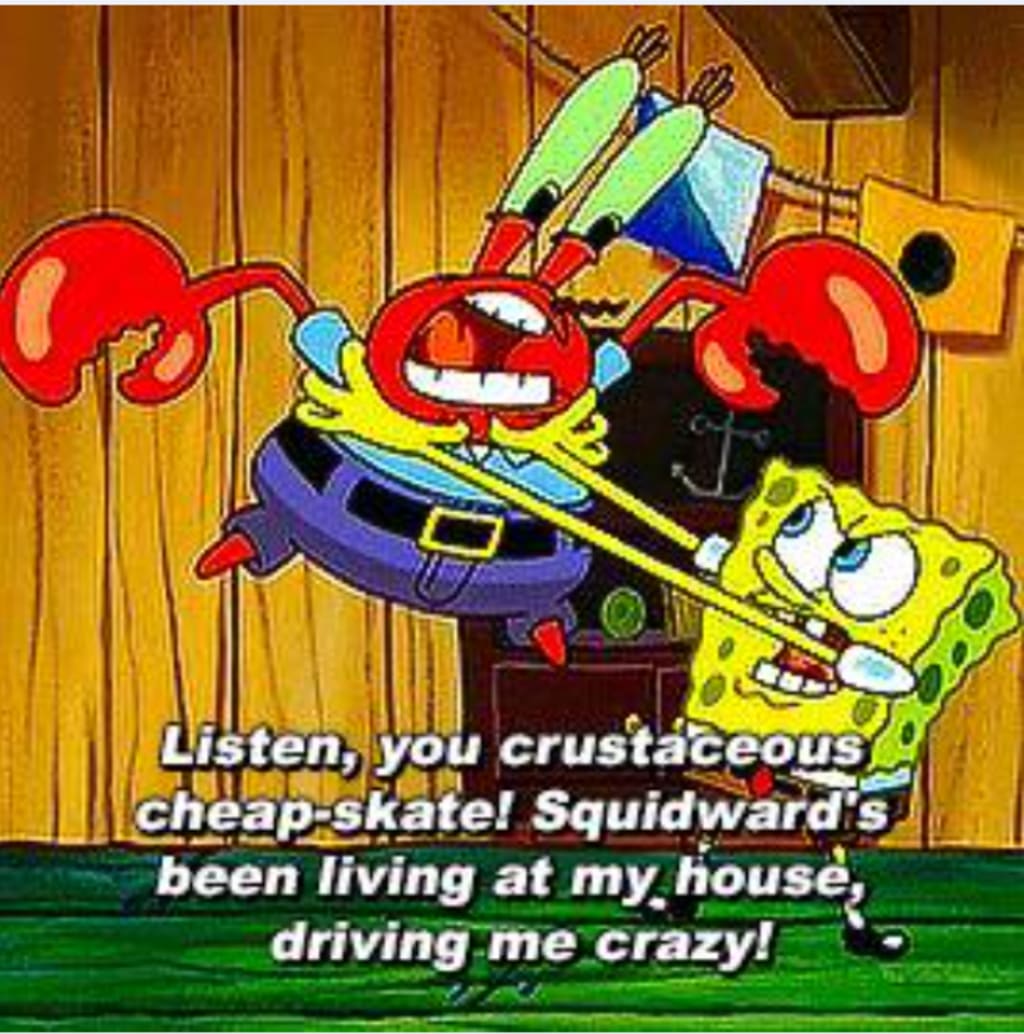
In the iconic SpongeBob SquarePants episode "Can You Spare a Dime?", the narrative centers on a petty conflict that spirals into a complex study of workplace dynamics and personal boundaries. It all begins when Mr. Krabs, driven by his pathological greed, loses his very first dime earned and immediately points an accusatory finger at Squidward. Despite the lack of any substantial evidence, Krabs treats his employee with such profound disrespect that Squidward finally reaches a breaking point, resulting in him dramatically quitting his position with the arrogant assumption that he will effortlessly land a more prestigious career elsewhere. The humor in the episode takes a sharp, satirical turn as Squidward rapidly descends into a state of total financial ruin. His hubris is swiftly dismantled by the harsh reality of the job market, forcing him to drain his life savings until he is left destitute. With nowhere else to turn, Squidward resorts to moving into SpongeBob’s pineapple home, where he proceeds to live the life of a parasitic houseguest. His entitlement reaches new heights as he treats his neighbor not as a friend, but as a submissive servant, demanding that SpongeBob cater to his every whim and comfort.
SpongeBob, initially blinded by his own naive kindness, soon finds himself utterly exhausted by the relentless demands of his roommate. The dynamic shifts from one of friendly hospitality to a taxing labor that drains the fry cook physically and emotionally. Seeing his friend’s spirit being crushed by Squidward’s blatant selfishness, SpongeBob realizes that the only way to restore balance to his life—and to mend the broken professional life of his neighbor—is to secure Squidward’s return to the Krusty Krab. The resolution of the mystery surrounding the missing dime serves as one of the episode’s most memorable comedic beats. After an exhaustive investigation, it is revealed that the dime was not only present but was actually glued to the underside of the register all along, appearing cartoonishly large and proving that Mr. Krabs’ paranoia was entirely unfounded. This revelation serves as a biting commentary on Krabs’ irrational nature, as he is forced to confront the reality that he pushed a valuable employee away over a trivial, non-existent theft.
However, the return to status quo is short-lived and characterized by a cyclical brand of insanity. Upon re-hiring Squidward, Mr. Krabs barely misses a beat before launching into yet another baseless accusation, suggesting that Squidward has once again mismanaged his precious currency. The utter lack of character growth from the employer highlights the show’s penchant for dark, repetitive comedy, emphasizing that some environments are destined to remain perpetually toxic regardless of past conflicts. The final scene provides a dark, hilarious punctuation to the entire ordeal. As Squidward’s penchant for tyranny resurfaces, SpongeBob anticipates the impending cycle of servitude that will inevitably follow this new conflict. In a moment of resigned, quiet defeat, SpongeBob dons the humiliating maid uniform that Squidward had forced upon him during his stay. This visual gag perfectly encapsulates the codependent, often blurred lines of the friendship between the two coworkers and the enduring absurdity of their nautical lives.
Throughout the episode, the writers masterfully balance the tension between Squidward’s unearned arrogance and Mr. Krabs’ soul-crushing stinginess. It is a brilliant critique of the service industry, illustrating how a lack of appreciation can turn a disgruntled worker into a literal nightmare for those around them. By highlighting the extremes of both characters, the story creates a compelling vacuum where SpongeBob’s excessive goodness becomes both his greatest strength and his most debilitating weakness. The pacing of the episode is relentless, moving from the initial workplace dispute to the domestic claustrophobia of SpongeBob’s home with seamless efficiency. Every interaction is loaded with character-driven humor that highlights the specific flaws that make these icons so endearing yet frustrating. We see the depths of Squidward's laziness and the height of SpongeBob's devotion, creating a narrative arc that feels both chaotic and strangely grounded in the familiar tropes of their long-standing relationship. Ultimately, "Can You Spare a Dime?" remains a standout installment because it refuses to offer a clean, moralistic ending. Instead, it leans into the idea that life in Bikini Bottom is a never-ending cycle of minor grievances and absurd misunderstandings. By ending on the image of SpongeBob in the maid outfit, the episode reminds the audience that while Squidward may play the villain and Krabs the tyrant, it is SpongeBob who ultimately bears the weight of their combined eccentricities.
About the Creator
Forest Green
Hi. I am a writer with some years of experiences, although I am still working out the progress in my work. I make different types of stories that I hope many will enjoy.
Enjoyed the story? Support the Creator.
Subscribe for free to receive all their stories in your feed.
Comments
There are no comments for this story
Be the first to respond and start the conversation.