
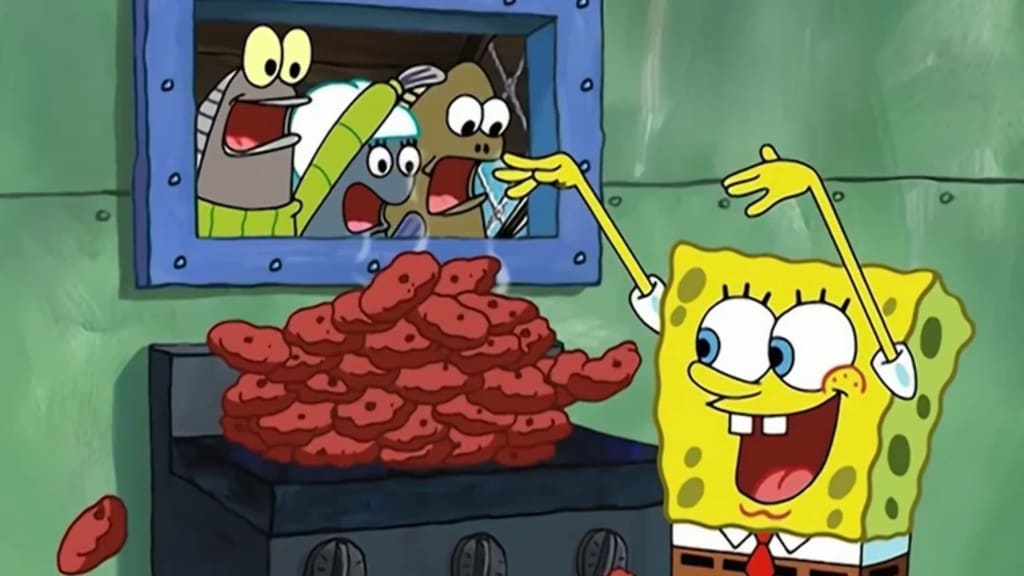
The episode "As Seen on TV" serves as a quintessential exploration of SpongeBob’s boundless, yet often misguided, enthusiasm, centering on his desperate yearning for stardom after a fleeting, blink-and-you-miss-it appearance in a Krusty Krab commercial. The irony is palpable from the very first frame, as our protagonist is barely visible in the corner of the screen, eclipsed by the sheer spectacle of a mustard-squirting machine. Despite the minuscule nature of his contribution, SpongeBob instantly convinces himself that he has ascended to the ranks of global iconhood, effectively weaponizing his delusions of grandeur to alter the workplace atmosphere entirely. The catalyst for his insufferable ego trip arrives in the form of a confused elderly patron who mistakenly identifies SpongeBob as a mascot for a generic brand of cereal rather than the fry cook he actually is. Instead of correcting the record, SpongeBob embraces this bizarre mistaken identity with fervent intensity, viewing it as the ultimate validation of his burgeoning celebrity status. This moment of clarity for the audience—seeing just how little the world actually cares about his commercial debut—stands in stark contrast to the heightened reality SpongeBob constructs within his own porous mind.
As the fame begins to go to his head, the Krusty Krab transforms from a humble dining establishment into a stage for SpongeBob’s increasingly unsolicited and irritating performances. He abandons his post at the grill, which is his true calling, to engage in over-the-top antics meant to charm the patrons who, quite frankly, just want their Krabby Patties in peace. Every movement he makes is calculated to invite applause or recognition, yet these actions only serve to drive away the very customers he is supposedly trying to delight with his newfound, albeit imaginary, charisma.The tension within the restaurant grows exponentially as SpongeBob’s behavior becomes more flamboyant and intrusive, forcing his coworkers to deal with the fallout of his ego. Squidward, typically the voice of cynical reason, is forced to watch in horror as his neighbor degrades the professional integrity of the kitchen for the sake of a few confused stares. This shift highlights the tragedy of SpongeBob’s ambition; he possesses an earnest desire to be loved, but he conflates the basic human need for appreciation with the shallow, fleeting nature of television notoriety.
One must admire the show’s writers for how they handle the pacing of SpongeBob’s decline, as he goes from a hardworking fry cook to a full-blown nuisance who demands to be treated like royalty. He begins to see the restaurant floor not as a place of service, but as a runway for his ego, wearing absurd costumes and delivering lines that nobody asked for. The customers, who were initially indifferent, shift toward genuine annoyance, creating a relatable atmosphere of social awkwardness that viewers can feel through the screen as SpongeBob refuses to read the room. The visual humor during this middle act is particularly sharp, emphasizing how out of place SpongeBob looks when he tries to adopt a "celebrity" persona while still wearing his grease-stained uniform. By juxtaposing his grandiose posturing with the mundane, dirty realities of the Krusty Krab, the episode perfectly encapsulates the absurdity of someone chasing a dream that doesn't actually exist. It is a cautionary tale about the perils of ego, wrapped in the vibrant, chaotic animation style that made the early seasons of the show such a cultural phenomenon.
As the episode progresses toward its climax, the sheer level of irritation SpongeBob causes becomes the focal point, making the audience cringe in sympathetic embarrassment for him. He interrupts meals, dominates conversations, and insists on signing napkins as if he were a Hollywood A-lister, oblivious to the fact that he is becoming the personification of a social pariah. The writers masterfully balance his inherent kindness with this temporary, hubristic blindness, ensuring that while we find him insufferable, we never truly lose our underlying sympathy for his character. The brilliance of "As Seen on TV" lies in its ability to take a tiny, inconsequential event—a momentary shot in a low-budget commercial—and expand it into a character study on the fragility of fame. It serves as a reminder that SpongeBob’s greatest strength is his identity as a cook, yet his biggest weakness is his gullible, childlike desire to be perceived as something "more." When he finally realizes that his fame is a fiction, the comedown is as sudden as his rise, forcing the narrative to pivot toward a resolution that feels both earned and inevitable. Ultimately, this episode stands out as a high-water mark for character-driven comedy, proving that even a tiny cameo can carry the weight of an entire transformation. By forcing the characters to confront the reality of their own mediocrity, the show creates a scenario where SpongeBob must eventually return to the grill, humbled and perhaps a little wiser. It is a funny, frantic, and deeply relatable exploration of how easily we can lose sight of our actual value when we are blinded by the shimmering, false promise of the spotlight.
About the Creator
Forest Green
Hi. I am a writer with some years of experiences, although I am still working out the progress in my work. I make different types of stories that I hope many will enjoy.
Enjoyed the story? Support the Creator.
Subscribe for free to receive all their stories in your feed.
Comments
There are no comments for this story
Be the first to respond and start the conversation.