

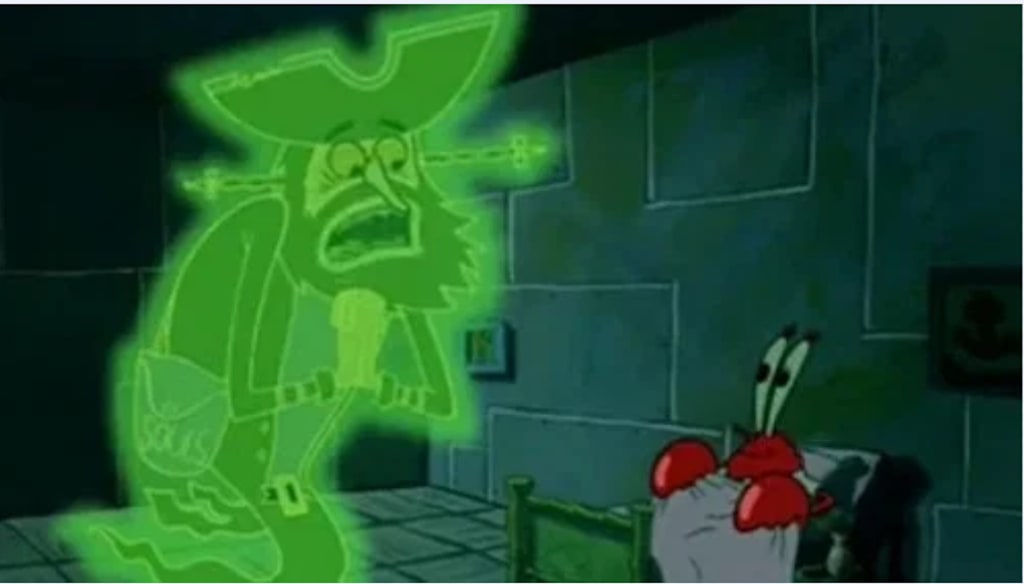
The SpongeBob SquarePants episode "Born Again Krabs" serves as a quintessential exploration of Mr. Krabs’ insatiable greed, opening with a stomach-turning premise where he attempts to sell a literal, decaying Krabby Patty to a health inspector. Driven by his singular desire to save a few measly cents, Krabs decides to consume the toxic burger himself to prove its vitality, a catastrophic error that lands him in the hospital with severe food poisoning. The narrative takes a supernatural turn when the Flying Dutchman appears at his bedside, issuing a chilling ultimatum: Krabs must fundamentally alter his miserly ways or face the eternal forfeiture of his soul to the ghost’s locker. Initially, the threat seems to have a profound, albeit temporary, impact on the crustacean’s psyche as he experiments with forced generosity to appease his supernatural visitor. Krabs’ sudden shift in demeanor leaves his employees and loyal customers in a state of bewildered joy, as he begins bestowing free meals and genuine kindness upon those he previously viewed only as walking dollar signs. For a brief, shining moment, the Krusty Krab feels like a transformed establishment, suggesting that perhaps the fear of damnation is the only force powerful enough to curb his deeply ingrained, profit-driven compulsions.
However, the episode deftly illustrates the instability of Krabs’ moral compass, as he quickly swings from extreme hoarding to reckless, performative spending, ultimately driving his beloved restaurant into total bankruptcy. As his financial empire crumbles, Krabs stubbornly convinces himself that this nightmare scenario is merely a vivid, stress-induced hallucination. When he wakes to find the devastating reality of his lost fortune confirmed by a solemn SpongeBob, his veneer of reform shatters completely, and his rage replaces any lingering shred of philanthropic sentiment or spiritual introspection. The climax reaches a fever pitch when the Flying Dutchman returns to collect on his promise, presenting Krabs with an impossible, cruel choice: he must trade his star employee, SpongeBob, for a measly sixty two cents or face absolute spiritual ruin. With his eyes gleaming with his signature, unrepentant avarice, Krabs chooses the coins without hesitation, only to be immediately struck by a tidal wave of genuine remorse as the crushing weight of his decision becomes clear. The transaction highlights the tragic absurdity of his character, proving that his love for money is a sickness that supersedes even his most cherished professional connections.
The tension of the scene is brilliantly undercut by Squidward’s sharp, cynical commentary, which acts as the voice of reason while openly shaming Krabs for his callous betrayal of SpongeBob. The Dutchman, however, is not interested in the nuances of human—or crustacean—emotion; he finds the entire situation tedious and displays a surprising level of irritation at SpongeBob’s incessant, optimistic rambling about the value of the Krusty Krab. It is a moment of dark comedy that underscores the Dutchman’s lack of patience for the absurdity of the fry cook’s undying loyalty. In a surprisingly anticlimactic move, the Dutchman drops off an unharmed SpongeBob, clearly having grown tired of the fry cook’s chatter and deciding that the bargain is far more trouble than it is worth. The return of SpongeBob serves as a reset for the status quo, yet the emotional resonance of the betrayal lingers, casting a long shadow over the supposedly happy ending. The audience is left to witness Krabs, unfazed by his brush with the afterlife, simply reverting to his old, penny-pinching self as if the entire harrowing experience were nothing more than a minor annoyance.
The episode stands out for its willingness to portray Mr. Krabs not as a lovable curmudgeon, but as a genuinely flawed individual whose greed is a bottomless pit that no amount of supernatural intervention can permanently fill. By juxtaposing the high stakes of his immortal soul against the pathetic sum of sixty-two cents, the writers effectively mock the futility of his obsession. It is a cynical, hilarious, and ultimately self-contained morality play that reinforces why Krabs will always be defined by his wallet rather than his conscience. Ultimately, "Born Again Krabs" is a masterclass in character consistency, ensuring that lessons of growth and empathy are intentionally discarded to maintain the comedic rhythm of the series. The audience is reminded that SpongeBob’s unwavering dedication is often placed in the hands of a man who would gladly sell him out for the price of a candy bar, a dynamic that keeps the show’s underlying tension alive. It remains a fan favorite precisely because it refuses to let Krabs change for the better, leaning into his villainous quirks for laughs. In the final analysis, the episode serves as a brilliant character study that balances existential dread with the typical hijinks of Bikini Bottom. Through the lens of the Flying Dutchman’s threats, we see the true extent of the owner’s fixation, proving that in his world, a nickel will always outweigh a friend. The lasting impression is one of comedic nihilism, leaving the viewers to laugh at the absurdity of a crab who would rather risk eternal damnation than lose a single cent of his profit margin.
About the Creator
Forest Green
Hi. I am a writer with some years of experiences, although I am still working out the progress in my work. I make different types of stories that I hope many will enjoy.
Enjoyed the story? Support the Creator.
Subscribe for free to receive all their stories in your feed.
Comments
There are no comments for this story
Be the first to respond and start the conversation.