
Scott Douglas Jacobsen’s Opening Address to the Fifth International Conference on Holography and Its Applications (ICHA 2026)
How Does Holography Connect Quantum Physics and Gravity?

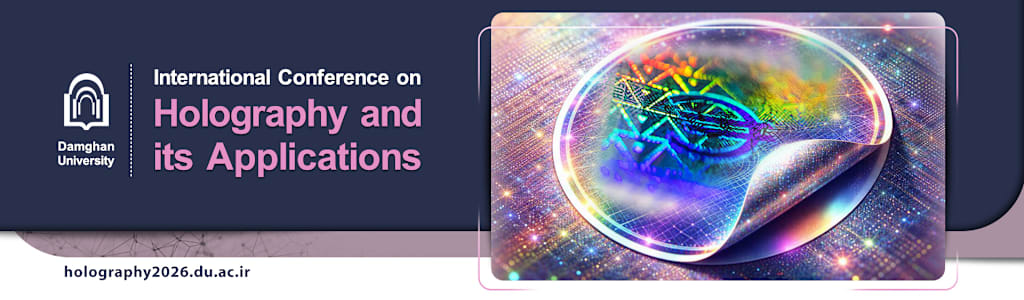
Scott Douglas Jacobsen opens International Conference on Holography and its Applications (ICHA) 2026, hosted by Damghan University, highlighting holography, quantum information, cosmology, machine learning, and emergent gravity. He thanks organizers, advisers, and speakers, emphasizing international collaboration and the shared scientific effort to understand connections among geometry, matter, information, and gravity through rigorous discussion, research, and scholarly publication.
--
Keynote speakers, members of the Scientific Advisory Committee and the Organizing Committee, colleagues, researchers, students, and guests from Iran and around the world: good morning from Kyiv, Ukraine, where I am joining you remotely. Welcome to the fifth International Conference on Holography and its Applications, ICHA 2026, hosted by Damgan University.
It is a privilege to open this meeting in the historic city of Damgan and to welcome a community brought together by ambitious ideas in modern theoretical physics, particularly in quantum cosmology and holography. I'm honored to participate, so thank you all very much.
Our core areas of focus over the next two days are the foundations of the holographic principle and the AdS/CFT correspondence, holographic aspects of quantum information and quantum computing, holography in strongly correlated systems, holography and cosmology, and machine learning for the holographic principle. Ideally, these topics will provide a basis for further collaboration, discussion, and submissions for peer-reviewed publication to advance the field with experts like you.
All of these are deep and difficult subjects that require years of training and expertise. This conference represents a common effort to understand how geometry, information, matter, and gravity fit together.
I'd first like to thank and recognize Professor Zahra Chaghani of Damgan University, Chair of the Organizing Committee, together with Bebek Khanbabe, Ahmed Nagedokht, Shahab Shahidi, and Martezah Tavakoli, for the considerable work required to bring this conference together.
I would also like to acknowledge Professor Kazem Betakzir Fedefan, Chair of the Scientific Advisory Committee, and all members of that committee. Their scientific guidance helped shape the conference into something both focused and international.
Among our distinguished keynote speakers this year, Professor Yonghui He will open the scientific program with a journey from Calabi-Yau geometry and fundamental physics to AI-driven discovery in mathematics. Professor Mohsen Ali Shahia will take us beyond Krylov complexity, exploring the organization and persistence of memory in quantum systems.
Professor Mukun Rangamani will examine how the imprint of a black hole singularity may appear in field theory observables. Professor Mohammed Mehdi Sheikh Jabari will present “GR from RG,” or general relativity from the renormalization group, addressing the provocative possibility that gravity can emerge from renormalization group flow.
Professor Han Lu will bring the keynote program to a close with Euclidean wormholes, quantum chaos, and the factorization puzzle in AdS/CFT. These subjects illustrate how a black hole becomes a question in thermal field theory, a problem in geometry becomes one in quantum information, and a puzzle in gravity can lead directly into statistical mechanics or number theory.
To all speakers, poster presenters, session chairs, students, early career researchers, and participants joining us from different institutions and countries: thank you for your participation and for continuing to show the scientific community at its best, engaged in a truly global and human enterprise exploring fundamental and derivative physical truths about reality.
On behalf of the organizers and Damgan University, I warmly welcome you all to ICHA 2026. I hope the next two days bring rigorous discussion, new collaborations, difficult questions, surprising answers, and perhaps a few calculations that work on the first attempt. However, that may be asking too much of theoretical physics.
Thank you for being here. I wish you a productive and memorable conference. It is my great pleasure to welcome you to the fifth International Conference on Holography and its Applications. Thank you all very much.
Special thanks: I extend my sincere thanks to everyone who contributed to the fifth International Conference on Holography and its Applications, ICHA 2026, with particular appreciation to the following individuals:
Zahra Haghani (Chair of the Organizing Committee and member of the Scientific Advisory Committee); Babak Khanbabaei (Organizing Committee member); Ahmad Naghidokht (Organizing Committee member); Shahab Shahidi (Organizing Committee member); and Morteza Tavakkoli (Organizing Committee member).
Kazem Bitaghsir Fadafan (Chair of the Scientific Advisory Committee); Hamid Reza Afshar (Scientific Advisory Committee member and session chair); Babak Haghighat (Scientific Advisory Committee member); Shailesh Lal (Scientific Advisory Committee member); Mohammad Reza Mohammadi Mozaffar (Scientific Advisory Committee member and session chair); Suvrat Raju (Scientific Advisory Committee member); Andrei Starinets (Scientific Advisory Committee member); Bayram Tekin (Scientific Advisory Committee member); and Mohammad Hassan Vahidinia (Scientific Advisory Committee member).
Yang-Hui He (keynote speaker); Mohsen Alishahiha (keynote speaker); Mukund Rangamani (keynote speaker); Mohammad Mehdi Sheikh-Jabbari (keynote speaker); and Hong Liu (keynote speaker).
Behnam Pourhassan (session chair); and Mohammad Reza Garousi (session chair).
Mehdi Sadeghi (contributed speaker); Jonas Mager (contributed speaker); Ebrahim Yusofi (contributed speaker); Moisés Bravo-Gaete (contributed speaker); Sedigheh Farahzad (contributed speaker); Sayyed Mehrab Ramezani (contributed speaker); Zaharia Adrian (contributed speaker); Narmin Nasibova (contributed speaker); Xun Chen (contributed speaker); Hiwa Abubakr Ahmed (contributed speaker); and Vahid Taghiloo (contributed speaker).
Fatemeh Khosravani Amiri (poster presenter); and Bahman Khanpour (poster presenter).
I also thank Damghan University (host and organizer), the Canadian Quantum Research Center (supporting institution), the Physics Society of Iran (supporting institution), and all students, researchers, participants, and others whose contributions made this international scientific exchange possible.
Scott Douglas Jacobsen is the Founder and Publisher of In-Sight Publishing (ISBNs: 978–1–0692343, 978–1–0673505) and Editor-in-Chief of In-Sight: Interviews (ISSN: 2369–6885). An accomplished journalist, his portfolio includes over 10,000 publications across 200+ outlets, including International Policy Digest, The Humanist, Basic Income Earth Network, Humanist Perspectives, and rabble.ca. He has served in leadership and board roles across global media and humanist organizations and holds memberships with the Canadian Association of Journalists, PEN Canada, and Reporters Without Borders.
Image Credit: ICHA.
About the Creator
Scott Douglas Jacobsen
Scott Douglas Jacobsen is the publisher of In-Sight Publishing (ISBN: 978-1-0692343) and Editor-in-Chief of In-Sight: Interviews (ISSN: 2369-6885). He is a member in good standing of numerous media organizations.
Enjoyed the story? Support the Creator.
Subscribe for free to receive all their stories in your feed.
Comments
There are no comments for this story
Be the first to respond and start the conversation.