
Salt, Soup, and Self Sacrifice: Sanji and Tohru as caregivers
Chapter one -A Guest Who Smelled Like the Sea

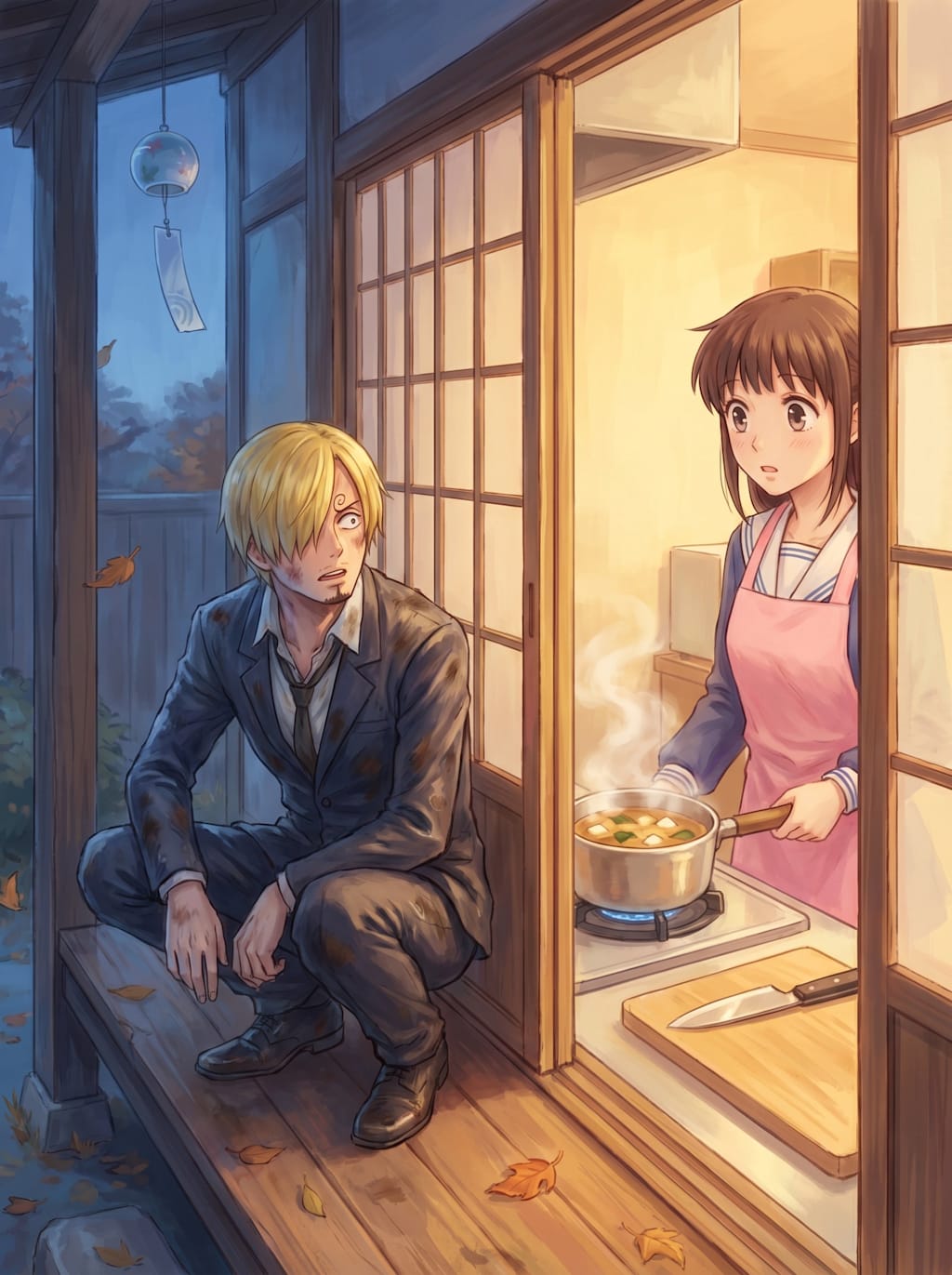
The first thing he noticed was the smell of **rice and miso**.
The second was that he was very, very hungry.
Sanji lay still for a moment with his eyes closed, letting the scents curl into his brain: steamed rice, miso soup, something pan‑fried with soy and ginger, and—he swallowed—daikon simmered slowly until it was soft. It didn’t smell like Baratie, or the Sunny, or any port he knew. It smelled like a **home kitchen**, the kind where someone cooked the same recipes so many times the steam had woven itself into the walls.
His stomach growled.
“…All right, all right,” he muttered.
He opened his eyes.
The sky above him was pale blue, framed by leaves. Birdsong. A breeze. No mast, no rigging, no shouting from Luffy, no complaints from Zoro. Just trees, dirt under his back, and the distant murmur of…was that a river?
Sanji sat up too fast. The world tilted. His head throbbed like he’d taken a cannonball to the temple.
“Where the hell—”
Memory hit in fragments: a storm on the Grand Line, waves like mountains, a fog so thick it swallowed the Sunny. Luffy laughing into the wind, Zoro yelling for him to tie things down, Nami swearing at the log pose. Then a wave had reared up, impossibly high, slamming into the side of the ship.
Sanji remembered shoving Luffy away from the rail, the slick feel of wet wood under his boots, the moment his grip had slipped.
Then nothing.
He looked around now and saw no sea in sight. Just a sloping hillside, trees, and, down below, the tiled roof of a house nestled among them.
The smell of cooking drifted from that direction on the breeze, warm and gentle.
Sanji’s stomach growled again, louder.
“Well,” he said. “If this is the afterlife, at least they’ve got decent miso.”
He pushed himself to his feet, wincing as bruises complained. His suit was damp and streaked with dirt, but intact. Cigarettes? Gone. Lighter? Also gone.
“Cruel world,” he muttered. “No respect for a man’s vices.”
He started down the hill toward the house.
It was a modest place—wood and paper walls, a wrap‑around veranda, a small garden neatly kept. Wind chimes tinkled softly by the entrance. Shoes were lined up in pairs near the door, set with careful order.
Sanji stopped in the shadow of the eaves, suddenly aware that, wherever he was, he had no idea what kind of people lived here. Marines? Civilians? Some new world’s version of nobles?
Inside, the faint clatter of dishes and the soft rhythm of a knife on a cutting board.
He edged along the veranda to where a sliding door stood half‑open, then crouched and peered in.
The kitchen was simple but tidy: wooden countertops, a low table, a gas stove with a single pot steaming on top. Sunlight poured through the window, catching in the rising steam.
At the counter, her back to him, stood a girl.
She wore a plain apron over a school uniform, long brown hair gathered back in a loose ponytail. Her movements were quick and practiced: tap, tap, tap went the knife as she sliced green onions with economical strokes. She hummed under her breath, terribly off‑key and terribly earnest.
Sanji watched, instinct taking over. Knife grip: a little choked up, but safe. Elbow position: room for improvement. Cutting board: secure. Pot on the stove: simmering at just below a boil. She was paying attention, adjusting the flame without even looking.
There was nothing fancy in front of her. No rare fish, no exotic spices, no showy plating. Just miso, tofu, rice, vegetables.
But the air in the room felt…full. Like she’d poured something of herself into the food, and it lingered there, fragrant as steam.
The kind of cooking that keeps people alive in more ways than one.
Sanji’s heart, which had been pounding from confusion, settled into a different rhythm.
He leaned a little closer, just to see how she seasoned the soup.
The floorboard creaked.
The girl jumped. The knife clattered down. She spun around, wide‑eyed.
Sanji’s brain, unhelpfully, supplied: **She’s cute**.
“Ah!” she yelped. “I—I’m sorry! I mean—oh no, did you need something? Are you lost?”
Sanji straightened up so fast he nearly hit his head on the door frame.
“Ah! Pardon me, mademoiselle!” he said, hands up, heart already flipping into familiar automatic patterns. “I didn’t mean to startle you—I was just, ah, appreciating the artistry of your miso—!”
He stopped.
Because now that she was facing him, he could see the flour smudge on her cheek, the slight flush from standing over the stove, the worry already gathering in her eyes—not for herself, but for him.
Her gaze darted over his state: damp suit, scratches, a bruise darkening along his jaw.
“You’re hurt!” she exclaimed. “Oh no—did you fall? Are you okay? Please wait here!”
She darted away before he could answer, vanishing through an inner door. A moment later, she returned with a small box in her arms, kneeling right there on the veranda in front of him.
“Um—if you don’t mind, I’d like to clean that cut,” she said, voice mild. “If it’s not too forward. I’m sorry, I don’t mean to be rude.”
Sanji stared for half a second.
Then he remembered he was, presumably, a gentleman.
“Miss,” he said, forcing his brain to reboot. “You are an angel sent to a dying man.”
“I—I don’t think I’m an angel,” she said quickly, flustered. “I’m just Tohru Honda. Ah—pleased to meet you?”
“Tohru…” He tasted the name. Simple. Sweet. “I’m Sanji. Cook. At your service.”
“Cook?” she repeated, eyes brightening. “You’re a cook? That’s wonderful!”
She began dabbing gently at the scrape on his cheek with a cotton pad. Her hands were careful, surprisingly steady.
“You must be very good,” she added earnestly. “Anyone who loves cooking is wonderful, I think.”
Sanji had heard a lot of reactions to his profession. Praise, jealousy, hunger, dismissal. He had not heard that particular brand of pure, unfiltered delight before.
He laughed, a little shakily.
“I do my best,” he said. “But right now I’m just a man who fell off something he shouldn’t have and woke up to the smell of heaven.”
“Oh!” she said, cheeks pink. “It’s not heaven. It’s just dinner. I mean, I hope it tastes good. I’m still learning. I’m sorry if it smells too strong—”
“It smells perfect,” he said, and meant it.
She ducked her head, smiling.
“Thank you,” she said. “We, um, we always try to eat together here. So I like to make enough for everyone.”
“We?” he asked.
As if on cue, a voice floated in from the hall.
“Tohru—we’re back.”
A tall man with a lazy grin and a yukata wandered into view, followed by two boys in the same school uniform as Tohru’s. One had orange hair and a scowl. The other had gray hair and a tired, elegant air.
All three stopped when they saw Sanji on the veranda and Tohru kneeling in front of him with a first‑aid kit.
“Ah,” the man said. “We’ve acquired a stray.”
“It’s not like that!” Tohru said, waving her hands. “He was hurt outside, and I—um—this is Sanji‑san. He’s a cook. He fell. I mean, I don’t know where he came from, I’m sorry, I should have asked—”
Sanji pushed himself to his feet and bowed as best he could.
“My apologies for intruding,” he said. “I washed ashore, more or less. Your…daughter? Friend? saved me from bleeding pathetically outside your lovely home.”
Tohru flapped her hands more frantically, face scarlet.
“I didn’t save you, I just—anyone would have—”
The orange‑haired boy snorted.
“She would,” he said. “Most people would pretend they didn’t see.”
“That’s uncharitable, Kyo,” the gray‑haired one said mildly. He stepped forward, bowing slightly. “I’m Yuki Sohma. This is Kyo, and that’s Shigure.”
The man in the yukata wiggled his fingers in a little wave.
“Welcome to the Sohma residence,” he said cheerfully. “We have tea, miso, and more emotional baggage than you can shake a stick at.”
“Shigure!” Tohru squeaked.
Sanji filed the names away.
“So,” Shigure continued. “You fell. From the sky? From a cliff? From a particularly enthusiastic date?”
“From a ship,” Sanji said.
Their expressions did something interesting.
“A…ship,” Yuki repeated.
“On the sea,” Sanji clarified. “Which I’m guessing is…not near here.”
Kyo frowned.
“We’re not that close to the ocean,” he said. “You’d have to walk a while.”
“Yet you washed up in our backyard,” Shigure mused. “How curious. Perhaps the gods sent you to us as a cooking spirit.”
Tohru brightened.
“Oh!” she said. “Sanji‑san is a cook. Maybe he could help sometimes? Ah, I mean—I wouldn’t want to impose, and I love cooking, but if you want to, of course you don’t have to—”
Sanji stared at her.
“You…like cooking?” he said. “Every day?”
She nodded, smiling.
“Yes,” she said. “It makes everyone happy. And I get to use my mom’s recipes. So it feels like she’s here, too.”
Something in his chest went very, very soft.
“I see,” he said quietly.
Shigure clapped his hands.
“Well, mysterious shipwrecked cook,” he said. “It would be rude to throw you back into the storm when you’ve just hit land. Why don’t you stay for dinner? You can tell us more about where you came from, and we can decide whether you’re a demon, a ghost, or just another of Tohru‑kun’s strays.”
“I’m the stray,” Kyo muttered.
Yuki sighed.
“Shigure,” he said. “Don’t tease.”
Tohru beamed.
“Yes, please stay!” she said. “You must be very hungry. Um, unless you need to get back right away, in which case we can help you ask around for—”
“I’d be honored to stay,” Sanji cut in, more quickly than he meant to. “If you’ll allow me to help in the kitchen as payment. I can’t sit while a lady cooks alone.”
Tohru blinked at him.
“Oh,” she said. “You don’t have to—”
“I insist,” he said.
He turned to the others, standing a little straighter.
“It’s a cook’s duty to repay kindness with food,” he said. “Let me assist Miss Tohru with dinner tonight. After that, we can talk about how to get me out of your hair.”
Shigure’s grin widened.
“Oh, this will be fun,” he murmured.
Yuki gave a small, resigned smile.
“As long as you don’t burn the house down,” he said.
Kyo squinted at Sanji.
“You better not make her do all the work,” he warned.
Tohru flapped again.
“He just said he wouldn’t—”
Sanji placed a hand over his heart.
“I swear on my knives,” he said. “I will not allow Miss Tohru to lift a finger more than she wants to.”
Tohru glanced between them, overwhelmed but pleased.
“Then…please take care of me,” she said, bowing.
Sanji’s ears felt hot.
He stepped into the kitchen, rolling up his sleeves.
The stove was old, the knives not quite to his liking, the ingredients simple. But when Tohru handed him a bowl with shy trust in her eyes, asking, “Would you mind slicing these, Sanji‑san?” it felt like stepping into a restaurant that smelled like possibility.
He took the bowl.
“It would be my pleasure,” he said.
Outside, the last light of the day slid behind the trees. Inside the little house, two cooks who had never existed in the same world before began to move around each other in the narrow kitchen, awkward at first, then gradually in quiet sync.
Sanji didn’t know yet how he’d gotten here, or how he’d get back.
For the moment, there was a stove, a girl who smiled like warmth, and a chance to cook in a kitchen that felt strangely like it had been waiting for him.
That was enough.
About the Creator
Sun Pirate Essasys
I write about what One Piece teaches us about politics, trauma, community, and the real world we live in — and I write cross‑anime fanfiction about tired adults, found family, and slow‑burn healing (Sanji × Tohru, Law × Maomao, and more).
Enjoyed the story? Support the Creator.
Subscribe for free to receive all their stories in your feed.
Comments
There are no comments for this story
Be the first to respond and start the conversation.