
Revisiting Romeo + Juliet: The Endurance of Baz Luhrmann’s Take on Shakespeare’s Classic
Celebrating A Different Angle on A Tragic Love story on its 30th anniversary

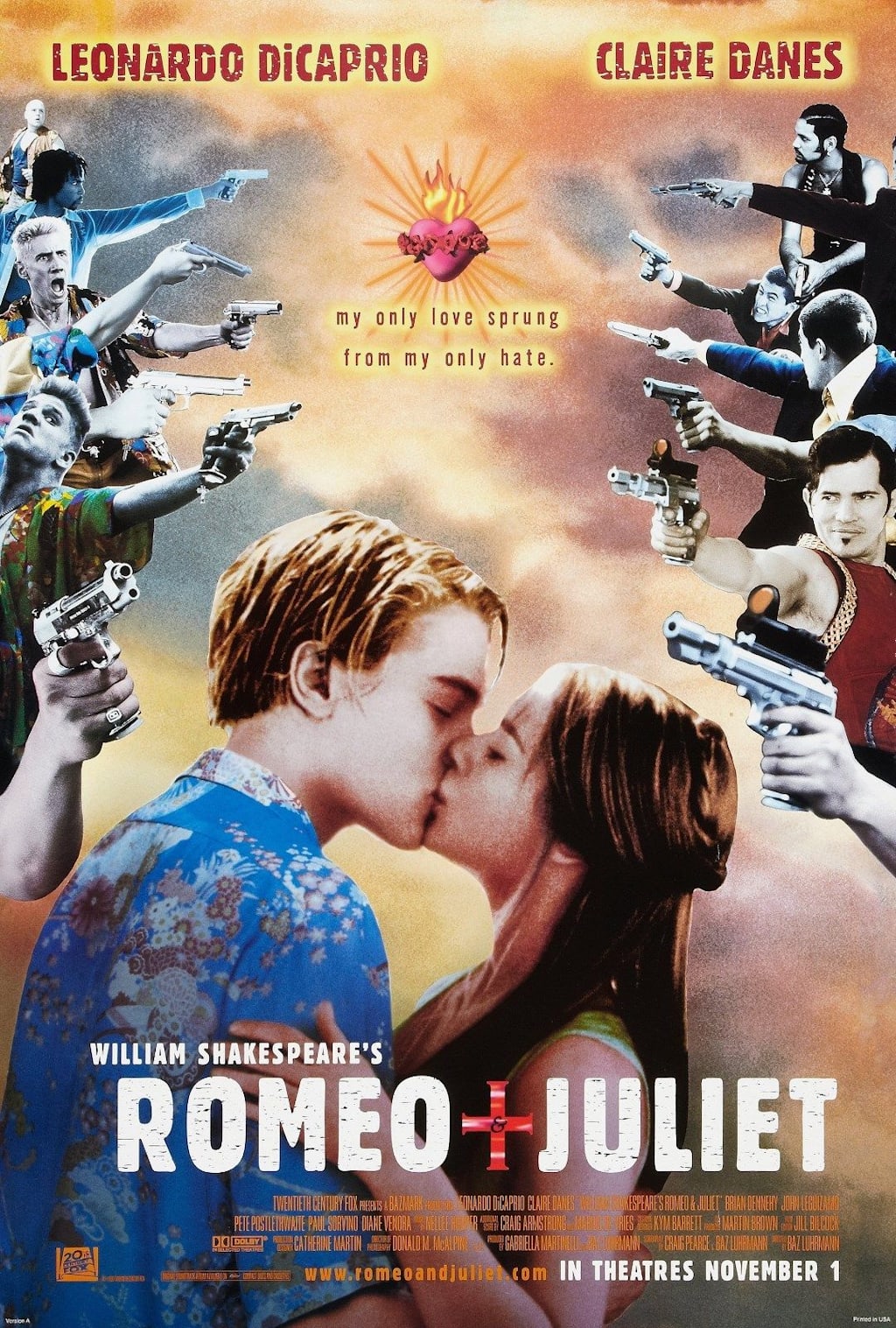
The 1996 cinematic retelling that defined a generation.
Over the years, Romeo and Juliet has had several different movie adaptations. What makes Baz Luhrmann’s vision unique is how it took elements of Shakespeare’s original story and placed them in a 1990s setting, transforming the feud between the Montagues and Capulets into a violent gang war. By blending Shakespeare’s classic tragedy of forbidden love with contemporary violence, Luhrmann offers a distinctive approach that explores the fatal consequences of feuds and rivalries.
Breathing Life Into Shakespeare’s Characters
Leonardo DiCaprio does a great job capturing Romeo’s youthfulness and vulnerability, especially amid the hostile conflict between his family and Juliet’s. Although his character behaves like a 1990s adolescent, he manages to stay true to Shakespeare’s original characterization.
As for Claire Danes, her portrayal of Juliet as a love-stricken yet heartbroken young woman is on point. Danes being older than Juliet in the original play adds an interesting dimension because the film presents their romance as two adolescents falling in love despite the hostility surrounding them, rather than showing importance to their age gap. Juliet is approximately 13 years old in Shakespeare’s original play, although Romeo’s exact age is not established.
Paul Sorvino and Brian Dennehy do a good job portraying the patriarchs of the Montague and Capulet households, respectively. Interestingly, when I rewatched the film (I first saw it during my freshman year of high school), I noticed that although the two actors share the screen, they never speak to each other, which makes their mutual animosity feel real.
John Leguizamo portrays Tybalt as an angry, hot-headed person. His intimidating gangster appearance and facial expressions make him particularly memorable during a shootout with the Montagues.
Vondie Curtis-Hall portrays Police Chief Escalaus with a sense of authority. Just like his original counterpart, he’s had enough of the constant violence in the streets and tells Montague and Capulet to knock it off or face the consequences.
Finally, Pete Postlethwaite portrays Friar Laurence as a sympathetic figure who wants to help Romeo and Juliet. His willingness to support their relationship demonstrates his hope that their love might finally end the blood feud between their families.
Love, Violence, and Fate: Moments That Defined The Film
The opening shootout between Tybalt’s gang and Benvolio’s gang at the gas station, rather than a traditional sword fight, gives off a 90s gangster vibe. What’s even more fascinating is that the guns are engraved with names associated with Shakespeare’s original weapons, such as Sword, Dagger, and Rapier. It demonstrates the ingenuity of Baz Luhrmann adding a contemporary twist to Shakespeare’s original play.
Romeo and Juliet falling in love at first sight at the party, especially after seeing each other through a fish tank, shows that their families’ rivalry does not define their feelings for one another. However, Romeo must escape from the Capulet mansion because, if he’s caught, he could face the consequences. This symbolizes the risks people take when they fall in love with someone their family or faction hates. The fish tank also creates a memorable visual moment, separating them from the party around them.
When Father Laurence gives Juliet a potion to fake her death, he’s feeling sorry for her because Juliet is forced to abide by her parents’ wishes. This shows the great lengths people are willing to go in pursuit of happiness and personal autonomy. It also shows what can happen when people are pressured into living according to someone else’s expectations.
Finally, when Romeo kills Tybalt, he’s acting out of rage and vengeance for his friend Mercutio. Rather than thinking about the consequences, Romeo allows his emotions to take control. This moment marks a turning point in the story and how the tragedy becomes increasingly difficult to avoid.
How Luhrmann’s Vision Stays Faithful To The Source Material and Where it Differs
When looking back at Shakespeare’s original text, one major difference stands out involving Paris. In the original play, Paris visits Juliet’s tomb to pay his respects, only to encounter Romeo. He confronts Romeo over Tybalt’s death, and the two engage in a fight. In the movie, however, Romeo goes to the church while evading the authorities. It’s possible that such a showdown between Paris and Romeo was cut to keep the focus on the tragic outcome, and it was likely unnecessary since Paris has a minor role in the movie.
Another difference noticed while rewatching Romeo + Juliet is that, at the end of the movie, the patriarchs of the Montague and Capulet families do not reconcile, and Father Laurence does not fully explain his role in the events. These changes may have been made to give more weight to the consequences of the families’ hatred towards one another.
However, most of Shakespeare’s original dialogue is preserved. For example, when Juliet asks the Nurse about Romeo’s identity, the Nurse responds, “He is the son of your only enemy.” Another memorable line comes from Mercutio as he lies dying: “A plague o’ both your houses!” These moments demonstrate how Luhrmann retains elements of the original play despite changing its setting.
Furthermore, just like in Shakespeare’s play, Lord Capulet allows Romeo to remain at the party and even calls out Tybalt for attempting to pick a fight with him. Lord Capulet doesn’t want any disorder at his gathering since he and Montague were warned by the Prince to not fight anymore.
The Making Of A Retelling: Facts You Didn’t Know About Romeo and Juliet
Romeo + Juliet has many interesting facts that might surprise fans of this retelling. Production records show that the storm approaching as Romeo runs to his car to chase Tybalt, following Mercutio’s death, was entirely real. A hurricane was moving toward the area, and it eventually demolished the film’s sets. It’s remarkable that an actual weather event became part of the production’s story.
Behind-the-scenes casting records also state that Natalie Portman was originally considered for Juliet and even took part in a screen test. However, the age gap between Portman and DiCaprio at the time made it inappropriate for them to play love interests.
Another interesting fact is that DiCaprio helped secure the film’s financing and was Baz Luhrmann’s top choice for Romeo. Luhrmann reportedly first noticed him in a photograph and wondered whether he could act. DiCaprio later helped the project move forward by traveling to Australia and creating a video to secure the film’s financing.
Finally, Luhrmann wanted to challenge the arrogant idea that Shakespeare could only be enjoyed by a particular group of people. He wanted to make the story accessible to a younger audience without losing the original play’s language and themes. That ambition helps explain why the film blends Shakespeare’s dialogue with modern music, fashion, and imagery.
These behind-the-scenes details offer a glimpse into the decisions and unexpected circumstances that helped bring this unique adaptation to life.
For Never Was a Story of More Woe
Romeo + Juliet demonstrates an adaptation can remain faithful to its source material while adding new ideas to the table. For some, watching this movie is a rite of passage during freshman year of high school, whether as part of a classroom discussion or a unit on Shakespeare. Ultimately, Luhrmann’s take has stood the test of time, introducing new generations to one of the greatest tragedies in fiction
About the Creator
TheScreenAnalyst
I am a passionate movie and TV enthusiast, devoted to analyzing storytelling, characters, visuals, and performances. I provide thoughtful critiques and insights, exploring both mainstream and independent works to engage audiences.
Enjoyed the story? Support the Creator.
Subscribe for free to receive all their stories in your feed.
Comments
There are no comments for this story
Be the first to respond and start the conversation.