
Resident Evil: Outbreak Night Doesn’t Adapt the Plot. It Adapts the Fear.
The highest-rated video game movie on Rotten Tomatoes barely follows a single game’s story. That is why it works.
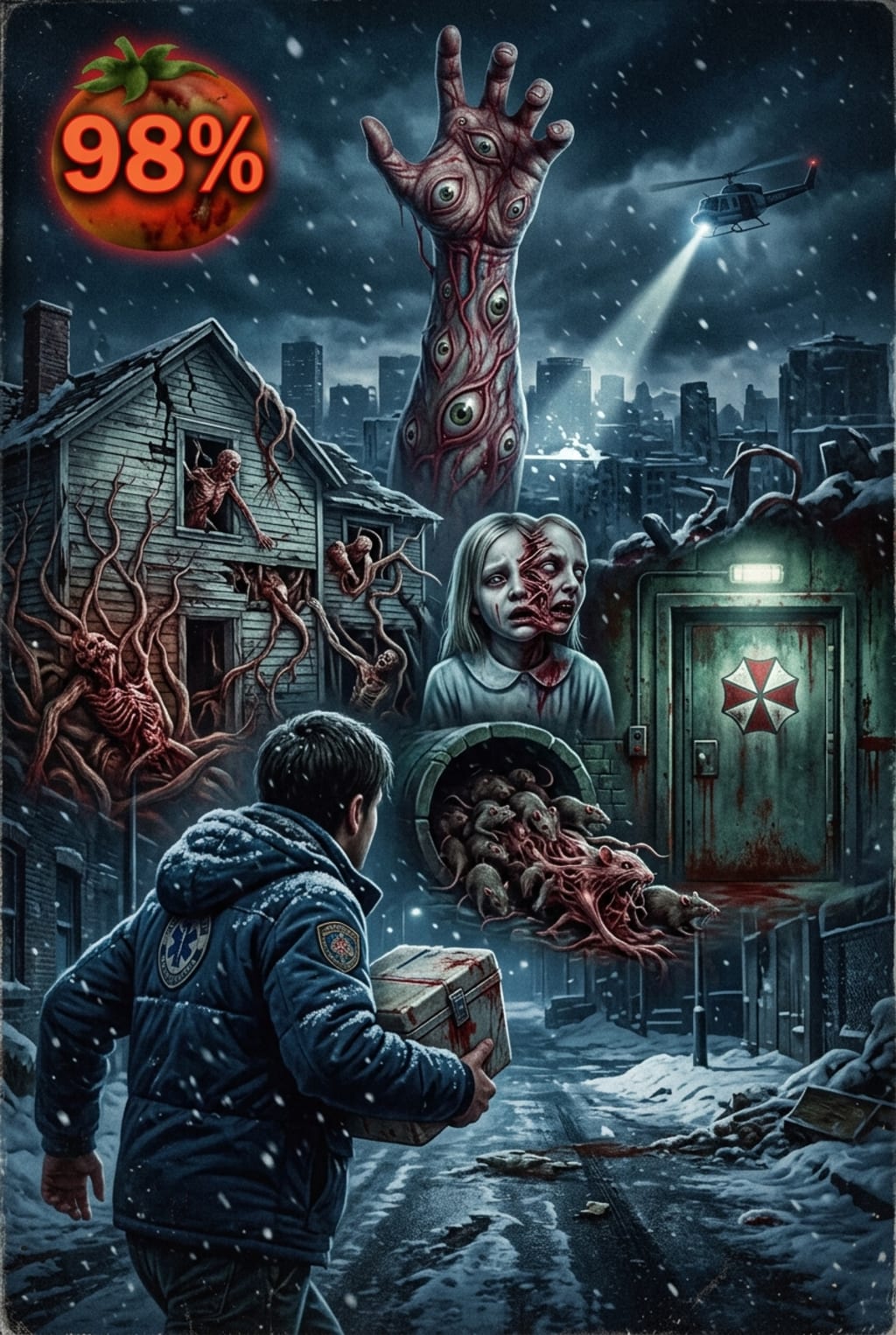
I. The 98% and the Wrong Decision
On September 18, 2026, Resident Evil: Outbreak Night opened in North America. Rotten Tomatoes: 98%. Metacritic: 82. IMDb: 7.8. Later, Rotten Tomatoes settled at 96%, audience score 91%, CinemaScore B+.
The numbers are good. The more interesting fact: the highest-rated video game adaptation in Rotten Tomatoes history barely adapts the plot of any Resident Evil game.
Director Zach Cregger did not remake Leon’s escape from Raccoon City. He did not bring in Chris or Jill. The Umbrella Hive lab is a blur in the background. He created a medical courier who takes a package into Raccoon City on a snowy night, then spent ninety minutes filming his escape. That choice sounds heretical for a video game adaptation. It is also why the film understands what “Resident Evil” means.
II. What Went Wrong with the Six Milla Jovovich Movies
Starting with the first Resident Evil in 2002, Hollywood’s logic for video game adaptations has been fidelity. Faithful characters. Faithful plot. Faithful locations. Milla Jovovich made six films. Alice wakes in a red dress, dual-wields pistols, mows down the infected, and fights the Umbrella army. The box office held for a while. By The Final Chapter in 2017, reviews and ticket sales collapsed. The 2021 reboot, Welcome to Raccoon City, promised loyalty to the games. It failed with critics and audiences. The planned series died.
Fidelity is not the problem. Games and films are different media.
The core experience of a game is operation and decision. You make choices with limited information, live with the consequences, and struggle to survive with scarce resources. That experience creates tension through uncertainty. If a film simply moves characters and plot to the screen, the audience becomes a passive observer. You watch Leon headshot zombies with practiced ease. You do not feel afraid. You think, “That looks cool.”
Cregger understands this because he is a player.
In interviews, he said he started playing Resident Evil in high school but never finished the six Milla Jovovich films. That blank space became his advantage. He did not have to surpass Alice, continue a cinematic universe, or carry previous canon. He only had to answer one question:
What did it feel like when I played Resident Evil?
The answer: never enough bullets, never enough light in the hallway, never knowing if you will make it to the next save point.
He turned that answer into a creative rule. The right way to adapt Resident Evil is not to copy characters and plot. It is to restore the survival horror experience of too many zombies and too few bullets.
III. A Protagonist Who Can’t Hold a Gun Steady
That rule starts with the protagonist.
Milla’s Alice is a superhero. Leon and Chris are elite agents. Brian, the protagonist of Outbreak Night, is a medical courier. He takes the job for double pay. He has no combat training. He does not know how to use a gun. When he meets a monster, he does not counterattack with style. He panics, falls, mutters, and gets wrecked by ordinary obstacles.
Austin Abrams, who plays him, described the role with precision. He said he was playing someone who “feels like he just opened the game for the first time and hasn’t even memorized the buttons yet.”
Brian’s weakness is deliberate. A Douban review offered one reading: Brian takes the last delivery job because he is avoiding his pregnant girlfriend and the family responsibility waiting for him. He is not a hero. Neither is anyone he meets. “Everyone is greedy and scared and runs when things go bad. No cooperation. No discussion.”
That setup gives Brian’s fear two roots. The surface fear comes from zombies and monsters. The deeper fear comes from an adult who cannot face his own life choices. In the hospital basement, he leaves a message for his girlfriend. For a moment, guilt and a desire for family surface. Then the film cuts to a bloody nursery. A baby’s hand reaches out of an embryo and becomes something ugly. It is the coldest possible mockery of warmth.
Cregger told IGN plainly: “I’m not using Resident Evil as an IP to get a budget. This is a Resident Evil story made from the heart.” He understands that fans want Leon. He is even sorry about it. But he also knows that in 2026, if a zombie film still has a protagonist mowing down everything in sight, that is the dead end.
Brian’s incompetence is not a flaw. It is the source of the film’s horror. The audience is no longer watching a hero defeat monsters. They are watching someone like themselves try not to die. Those two things are not on the same level of tension.
IV. The Camera Is the Controller
The protagonist choice answers who is afraid. The camera language answers how the audience enters the fear.
Outbreak Night uses many over-the-shoulder shots close behind the character. The audience follows Brian the way they would control a game character. The choice looks simple. Executing it requires high-level staging. Over-the-shoulder means blocked sightlines. The audience, like Brian, cannot see what is around the corner or behind the door. The director does not use god’s-eye wide shots to spoil where the danger is. He locks the audience inside Brian’s limited field of view.
That restriction creates structural tension. You are not watching a horror film. You are going through one. You follow Brian into the farmhouse and do not know what is inside. You follow him into the tunnel and do not know what waits in the dark. You follow him through a door and do not even know if it leads to a way out or a dead end.
The location design follows the same logic. Farmhouse, tunnel, abandoned cars, Raccoon City streets, laboratory, sewers. These are familiar level types for players. Cregger does not use them as easter eggs. He uses them as pressure chambers. Every location drains Brian’s resources, shrinks his space, and adds to his exhaustion. For ninety minutes, the audience calculates bullets with him, looks for exits with him, and worries about what is behind the next door.
One Douban review put it well: “It leads the audience into the worldview of a video game through the eyes of an ordinary player.” Like a game you cannot save-scum. This is using film to re-experience what it felt like to play that game.
V. Parasites, Fused Bodies, and the Biology of Despair
The visual breakthrough is in the monster design.
The virus in Outbreak Night is closer to the Las Plagas parasite from the fourth game. Cregger expands it far beyond the source. The farm couple’s corpses are fused together by the parasite. The girl in the RV disguises herself as normal, then her face splits open. Rat remains in the sewer merge with each other. These scenes follow one logic: the virus does not simply kill the host and puppet the corpse. It keeps the host conscious while the parasite controls it, using the host’s living advantages to hunt and infect.
Players have noted that this fusion trait is closer to Uroboros from the fifth game, which “collects corpses to create stronger individuals.” The parasite’s control over the host echoes the real-world phenomenon of snails being controlled by parasites and driven to be eaten by birds. That borrow from biology gives the horror a rational foundation. You cannot say “that’s not scientific,” because nature already has this control mechanism. The film just magnifies it.
The monster forms borrow from The Thing. Critics noted “rolling movement made of stacked limbs, babies bursting out of flesh, swollen corpses releasing swarms of rats, octopus tentacles shaping the infection.” These designs break the visual inertia of zombie films. They pull Resident Evil out of the zombie box and push it toward The Thing or body horror.
The protagonist’s final mutation, multiple eyes on his left arm, one huge eye dominating, his consciousness fighting the parasite, directly references William Birkin’s G-virus form in the second game. Cregger adds a key emotional dimension: the audience witnesses the entire mutation. Before Brian is fully controlled, he keeps struggling, resisting, trying to finish his task.
The audience spends ninety minutes with this ordinary man. They watch him fear, fall, get up. They watch him almost give up and keep going. Then, just before he reaches the end, the virus wins. You are watching someone you know and care about become a monster.
VI. He Doesn’t Make It
The ending caused debate. Brian fights his way to the hospital lab with the antidote components. The moment he steps into the lab, the mutation fully takes over. He becomes a fused creature like William Birkin. The syringe is knocked away in the chaos and falls from a high window. The last shot is the fully transformed Brian screaming at an approaching National Guard helicopter.
Critics called the ending rushed. The Umbrella scientist does not give Brian the antidote, and the motive is unclear. One Douban user put it fairly: “A villain does not need coolness, but he needs logic.” A single line, “This is a prototype; we need to mass-produce the serum; we can’t waste it on one infected person,” would have helped. The criticism stands. The ending is rough in its logical connective tissue.
From a narrative structure standpoint, the ending has an internal necessity. Abrams called the finale a “bold risk” in interviews. He said: “You follow this one guy the whole film, you love watching him smile, you root for him, and then you brutally kill him. That’s a big risk.” He added: “A lot of movies are too afraid to do that. They can’t bear to kill a character the audience genuinely likes. Even if they do, they cushion the pain somehow.”
Cregger’s original ending was darker. The scientist pulls the needle out. As Brian grabs the woman’s face, the needle falls and shatters. Brian completely loses control and massacres everyone in the lab. Test audiences found it too dead and not satisfying enough, so the current version exists.
The core is the same in both versions: Brian does not survive. He becomes another nameless casualty in the series. One of those monsters players headshot without a second thought, never wondering who they were before they turned.
This is what Cregger calls the “very cool tragic perspective.” It explains why the disaster in Raccoon City cannot be stopped, and why so few survivors make it out. The ordinary people who try to do the right thing are often the first to fall.
VII. Ordinary People in 2026 Don’t Need Another Hero Movie
If you reduce the success of Outbreak Night to “the director understands games,” you undersell it.
Cregger’s insight is that he did not just make a Resident Evil film. He made a horror film about what it is like to be an ordinary person in the 2020s.
The Douban review hits the mark. Brian is “a quiet working stiff.” The reason he takes the job is to avoid facing his pregnant girlfriend and the life decisions ahead. “He doesn’t want to grow up, and he doesn’t want to face a family, so work becomes an excuse to run away.” That is the state of countless young people in 2026: in a shrinking economy with no clear future, using “busy” to avoid “thinking,” using “work” to postpone “facing.”
Every character’s behavior follows that undertone. No one is a hero. Everyone is “greedy and scared, running when things go bad.” Brian pushes a companion toward death in a crisis. Brian’s own instincts when danger hits. Even the parasite disguised as an injured girl. They all sit on the same spectrum: under extreme pressure, survival instinct overrides everything.
One Douban review called the film “a horror version of 1917” and offered a sharper summary. Its theme, the reviewer wrote, is “the same as a certain billion-yuan box office champion: I don’t care if I live or die, but I want you to die.”
That judgment may be extreme. But it captures an emotional structure. When Brian is handed a flamethrower at the end and finally becomes “the invincible man in the literal sense,” the audience feels more than horror. They feel release after being pressed to the limit. This is an ordinary person’s collapse and reversal under systemic pressure.
In a BBC interview, Cregger admitted he felt like he was on an “apology tour.” Facing fans who asked “Why not Leon?”, he said: “Even if you put a game’s story on screen, those fans would probably still be disappointed, because I would inevitably screw up somewhere.” Behind that line is a clear recognition: there is no correct answer called “perfect fidelity” in video game adaptations. Fidelity is not what film should be doing.
What film should do is create an experience. The experience Outbreak Night creates is the one 2026 audiences can empathize with most: an ordinary person, inside a system he cannot understand or control, doing his best to do one thing he believes is right, and then being crushed by that system.
VIII. A Different Approach, Not a Fluke
The success of Resident Evil: Outbreak Night is not an accident. It points to a different approach for video game adaptations. The approach can be summed up in one line: adapt the game, not the game’s plot. Adapt the experience, not the game’s characters.
Cregger did not try to surpass Leon or Alice. He knew that was impossible. The games have already built those characters too well. Any film version would only be another version, not a better version. He chose a different road. Create a new character. Put him through the fear, scarcity, and despair players felt in the game.
That road works because it solves a fundamental contradiction. Audiences for video game adaptations are not there to see the story. They are there to feel what that story once made them feel. If you film characters and plot, you are competing with the game. You will not win. If you film the feeling, you are echoing the game. You can win.
Outbreak Night is almost completely independent from any game in narrative terms. But it restores the emotional curve of playing Resident Evil with precision: tense exploration, brief breathing room, sudden scares, decision anxiety under scarcity, and the constant pressure of “I might not survive this section.” When the audience leaves the theater, they do not remember a specific scene or line. They remember the feeling of being soaked in fear for ninety minutes.
IGN’s review summarized it well. The film “leans toward restoring and honoring the feel of the game rather than the specific plot, successfully elevating the classic play experience into the rhythm of a horror film, with a depth far beyond simple fan service.”
That may be the biggest lesson Outbreak Night offers video game adaptations. The best adaptation does not let you see the game on screen. It lets you play through the game again in the theater. Only this time, you have no controller, no save file, and no chance to restart.
About the Creator
Jin
Writer of reamstories
https://reamstories.com/jin
Enjoyed the story? Support the Creator.
Subscribe for free to receive all their stories in your feed. You could also become a paid subscriber, letting them know you appreciate their work.
Comments
There are no comments for this story
Be the first to respond and start the conversation.