
Raw Courage (1984): Ronny Cox’s Desert Passion Project
Before Beverly Hills Cop made him a familiar face to movie audiences, Ronny Cox risked his own money, creative ambitions, and considerable physical discomfort on a low-budget survival thriller filmed under the punishing New Mexico sun.

A Hometown Gamble in the New Mexico Desert
Hollywood loves a good underdog story. Preferably one with a happy ending, a little redemption, and somebody standing on a mountain while the music swells.
Real life is less accommodating.
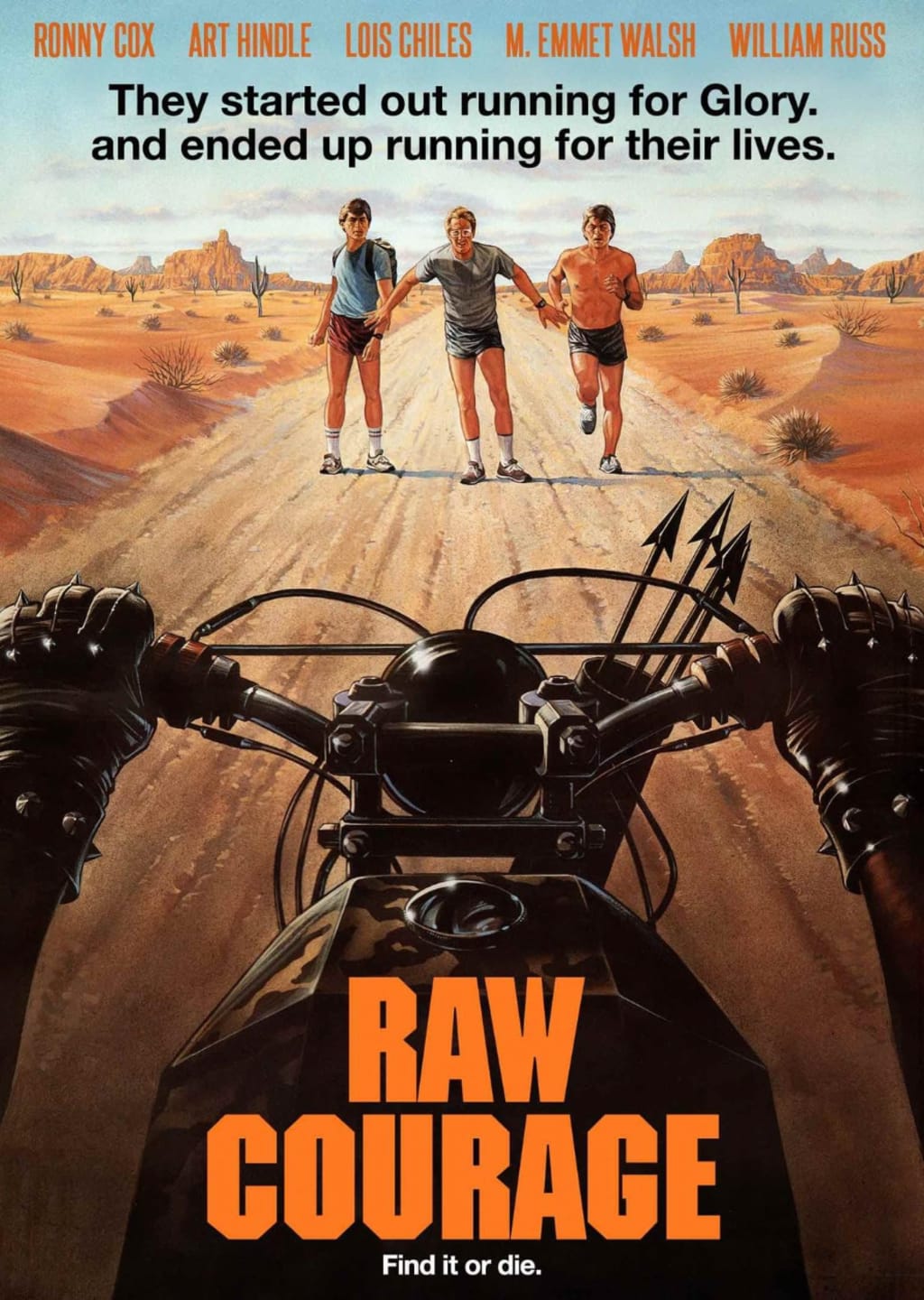
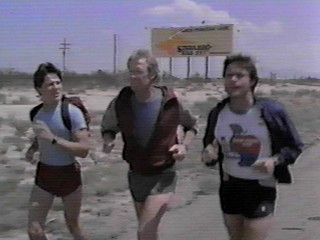
In 1982, actor Ronny Cox headed home to southern New Mexico to make a movie that would test his ambitions, his physical endurance, and perhaps his sanity. The project was Raw Courage, a low-budget survival thriller about three ultramarathon runners who stumble into a confrontation with an armed militia in the desert. What begins as a story about physical endurance quickly becomes a fight to stay alive.
The setting was more than a convenient backdrop. Cox was born in Cloudcroft and raised in Portales, and filming near Las Cruces brought the production into familiar territory. The landscape offered everything the story required: vast stretches of empty desert, unforgiving heat, isolated roads, and the unnerving feeling that civilization might be a very long way away.
It also offered temperatures that could make even a leisurely afternoon outdoors feel like an ill-advised expedition.
Cox wasn’t simply another actor collecting a paycheck. He co-wrote the screenplay with his wife, Mary, and helped produce the picture. By his own account in contemporary interviews, the project had become an obsession for the couple. They were determined to make a movie that would allow Cox to step outside the sensitive, dependable characters that had helped establish his career.
The result was a modestly budgeted thriller with a distinctly regional identity, a premise that tapped into the political anxieties of the early 1980s, and a production story almost as exhausting as the movie itself.
Released by New World Pictures in November 1984, Raw Courage never became a major theatrical success. For years, it remained an obscure entry in the decade’s enormous collection of action pictures, survival thrillers, and regional filmmaking experiments.
But there’s something admirable about a movie made because somebody simply had to get it out of his system.
Sometimes the story behind a film is every bit as compelling as the film itself.
Ronny Cox Wanted to Play Against Type
By the early 1980s, Ronny Cox had established himself as one of those dependable character actors who could make a supporting role feel like a fully inhabited human being.
His work in Deliverance (1972) introduced him to audiences in a film that understood the terror of ordinary people encountering a landscape and a way of life they don’t understand. He subsequently appeared in projects including the television series Apple’s Way and films such as Grey Lady Down (1978) and Taps (1981).
Cox possessed an understated screen presence. He could be thoughtful, decent, and reassuring without seeming dull. Hollywood, however, has a way of turning an actor’s strengths into a box.
Cox later described the danger of being pigeonholed as the wholesome, dependable type. His Raw Courage project offered an opportunity to take control of his own material rather than wait for somebody else to imagine him in a different kind of role.
The timing was interesting.
Cox was on the verge of becoming even more recognizable through Beverly Hills Cop (1984), in which he played Lieutenant Andrew Bogomil, the straight-arrow police superior who finds himself dealing with Eddie Murphy’s irreverent Detroit detective. He would go on to enjoy a long career in film and television, eventually appearing in major science-fiction productions including RoboCop (1987) and Total Recall (1990).
But Raw Courage represented a different kind of ambition.
This was Cox putting his own ideas on the screen, working with his wife on the screenplay, and helping shepherd a production that didn’t have the financial safety net of a major Hollywood studio.
The reported budget was approximately $1.5 million. That was enough to make a feature with professional crews and a substantial cast, but hardly enough to buy its way out of every production problem.
Cox had something to prove, and the desert was waiting.
Three Runners, One Very Bad Decision
The premise of Raw Courage is deliciously simple.
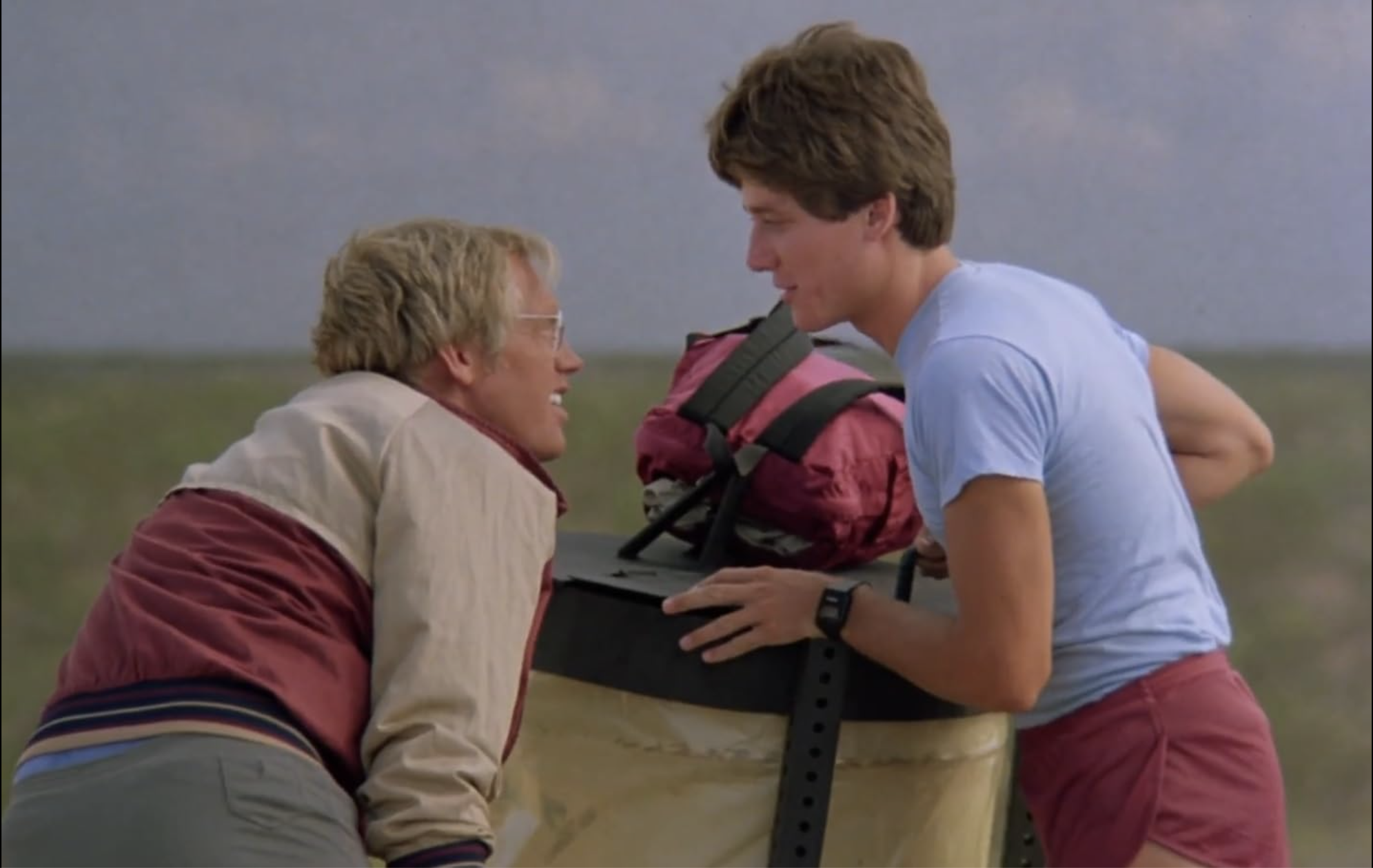
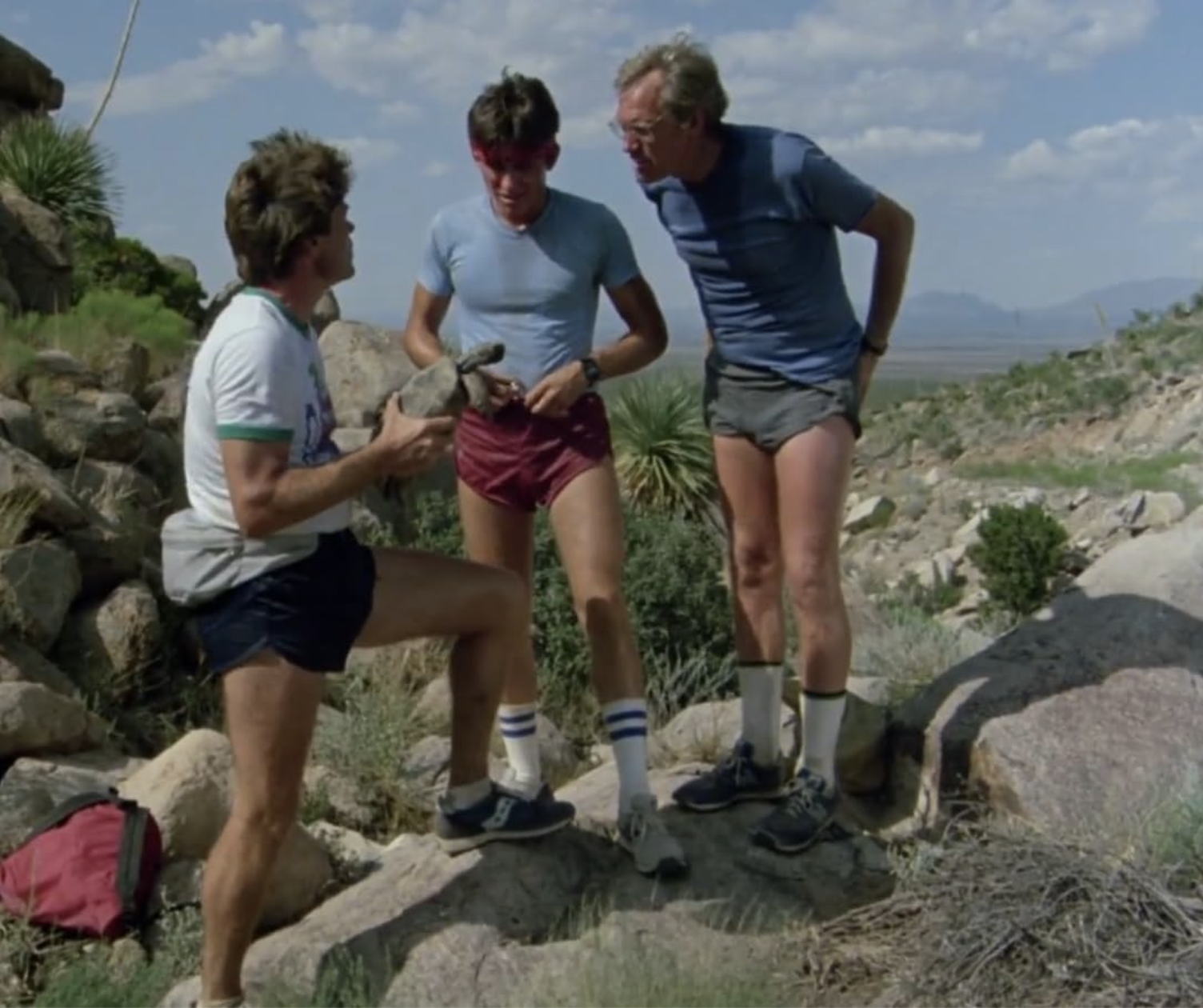
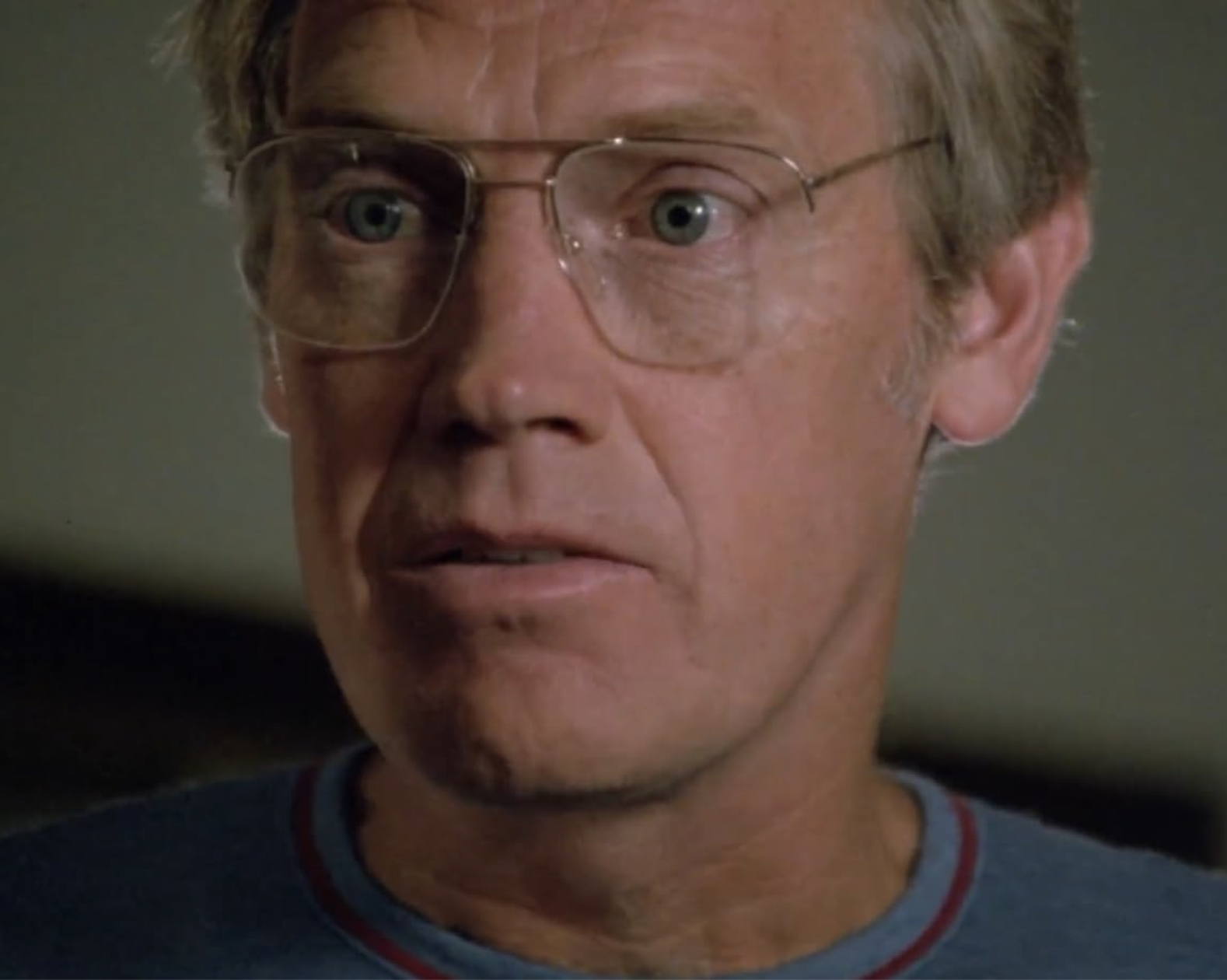
Pete Canfield, played by Cox, joins Roger Bower (Art Hindle) and younger runner Craig Jensen (Tim Maier) for a commemorative 72-mile ultramarathon associated with a local Pioneer Days celebration.
These aren’t hardened action heroes. They’re runners participating in an extraordinary physical challenge, testing their endurance against distance and the natural environment.
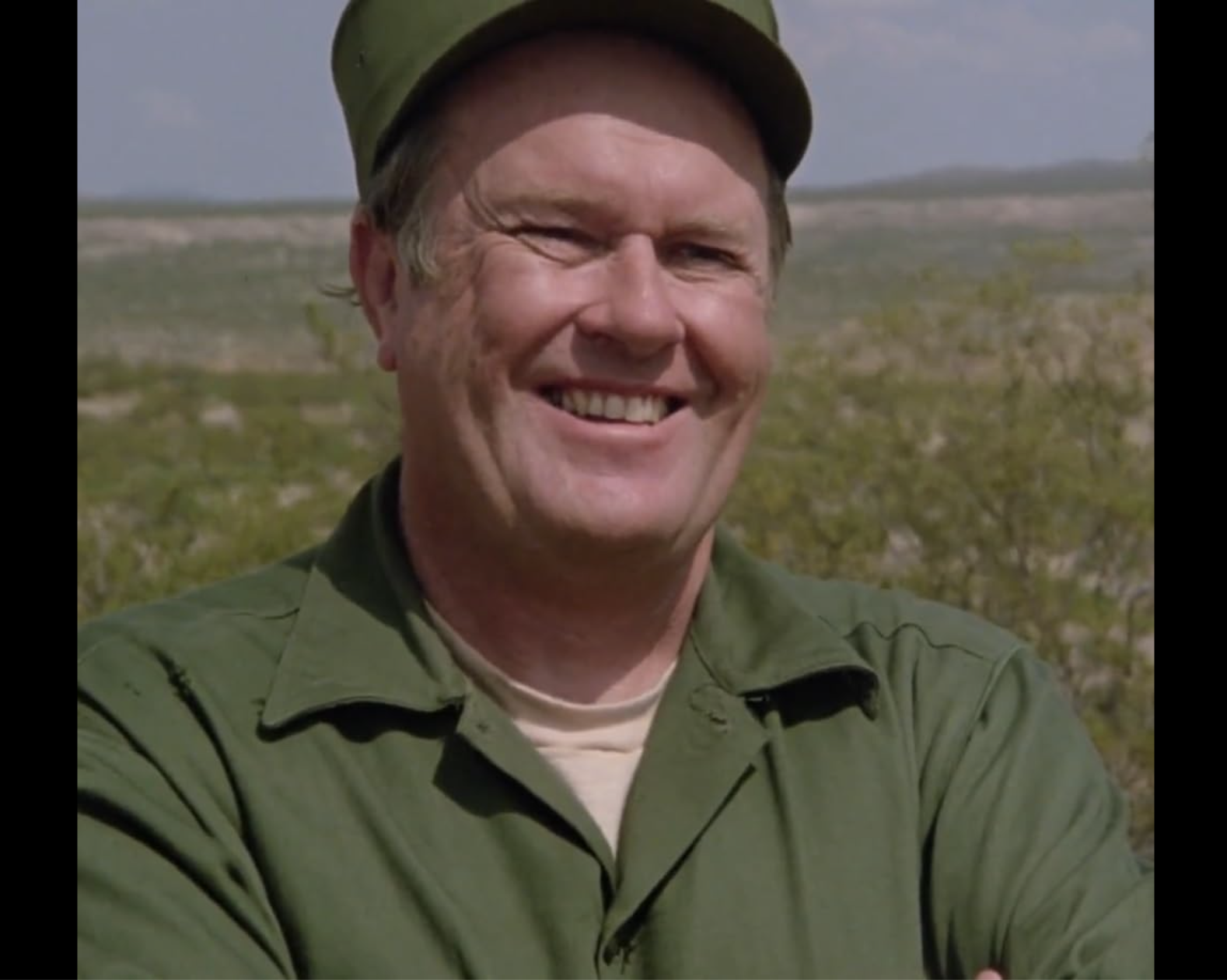
Then they encounter Colonel Crouse, played by the wonderfully dependable M. Emmet Walsh, and his Citizen’s Brigade.
Crouse’s men are an armed, quasi-religious militia preparing for what they call “the Crunch,” an anticipated societal collapse for which they intend to be ready. Their isolated desert training ground has become a place where their peculiar worldview can operate without much interference from the outside world.
The runners have wandered into somebody else’s idea of civilization.
At first, the confrontation is an awkward collision between people who have no particular reason to understand one another. But a fatal incident changes everything, and the runners find themselves pursued through the desert by men who possess weapons, local knowledge, and an increasingly dangerous conviction that they are preparing for the end of the world.
The race becomes a fight for survival.
The film’s title promises courage, but the story is more interested in what happens when courage becomes a practical necessity. There are no convenient shortcuts across the desert. No friendly police officer appears at precisely the right moment. The runners have to keep moving, make decisions, and live with the consequences.
Their greatest advantage is endurance. Their greatest disadvantage is that their opponents aren’t interested in playing fair.
There’s an obvious family resemblance to Deliverance, another film in which outsiders discover that their assumptions about the world offer little protection when they enter unfamiliar territory. Comparisons to Southern Comfort (1981) and First Blood (1982) also make sense. All three films understand that the American landscape can become frightening when the people who control it decide you’re the enemy.
But Raw Courage has its own peculiar early-’80s flavor.
Its protagonists are runners, representatives of a growing fitness culture that celebrated discipline, physical improvement, and the idea that a person could conquer almost anything through determination. Their opponents are survivalists preparing for social collapse.
Both groups believe in training. Both believe in endurance. Both think they’re preparing for a test of character.
Only one group has decided that everyone else might need to be eliminated first.
The Production Was an Endurance Test of Its Own
Filming a movie about people struggling through the desert is one thing. Actually filming it in the desert, in the middle of summer, is something else entirely.
Principal photography took place around Las Cruces during July and August 1982. Contemporary accounts described temperatures reaching approximately 114 degrees Fahrenheit.
That’s not atmospheric discomfort. That’s the sort of heat that makes you question every decision that brought you to that particular patch of ground.
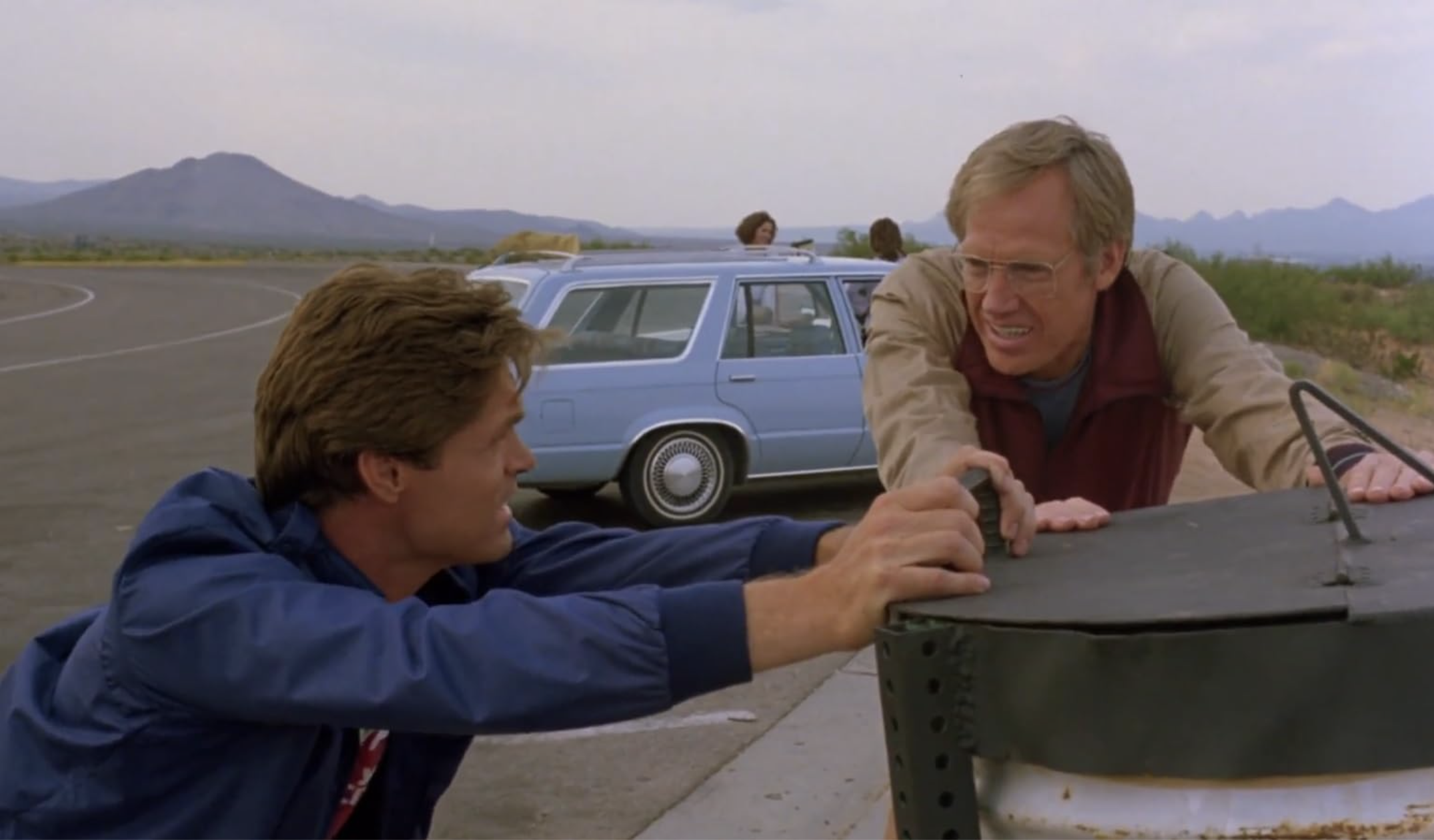
For the actors playing runners, the production demanded considerable physical exertion. The desert sequences required repeated takes, and filmmaking’s peculiar relationship with time meant that running a short stretch of road could become an all-day activity.
A movie might show a character completing one exhausting run. The actor may have to complete that run again and again while the camera crew adjusts equipment, the director changes a setup, and somebody determines that the shot needs to be repeated.
The audience sees one continuous experience. The production sees a series of separate tasks, each requiring its own combination of patience, coordination, and perspiration.
Cox later reflected on the physical toll of the endless running. The discomfort was real, and that reality contributes to the film’s appeal. The runners look as though they’re struggling because the people playing them were doing a considerable amount of actual struggling.
The production also employed local talent and made use of the region’s distinctive communities.
Anapra and Mesilla were combined in the finished film to create the fictional town of Glory, with major scenes shot in historic Mesilla. The locations give the movie a sense of place that would have been difficult to reproduce convincingly on a studio backlot.
Among the local performers were brothers Jeffrey and Brian Curry, then 14 and 10, who played Cox’s on-screen sons. Their recollections of the experience described a production that could be hard work, strange, and exciting all at once. Their parents also had to consider the implications of their children appearing in an R-rated movie.
It’s a small detail, but it captures something important about regional filmmaking. A production isn’t simply a collection of actors and technicians transported from Hollywood. It’s also an event that draws in local people, temporarily transforming familiar streets and landscapes into pieces of an imaginary world.
Still photographer George Andrejko also witnessed the peculiar rhythms of the production, where scenes weren’t necessarily filmed in the order audiences would eventually see them. Making a movie requires a level of teamwork that can be invisible in the finished product.
Everybody has to work toward the same result, even when the process seems anything but orderly.
And in this case, everybody had to do it in the heat.
The Price of a Passion Project
For all its local flavor, Raw Courage wasn’t an uncomplicated production.
First-time feature director Robert L. Rosen was responsible for bringing the story to the screen. It would prove to be his only feature film as director, an unfortunate footnote for a project that had already placed considerable responsibility on Cox and his wife.
Creative tensions also emerged during production, including an arbitration dispute involving co-producer Sandy Howard. Such conflicts are a reminder that independent filmmaking isn’t automatically a harmonious exercise in artistic freedom. A smaller budget may give filmmakers more flexibility in certain areas, but it can also leave them with fewer resources when disagreements arise.
Money dictates compromises.
One of the most frustrating for Cox concerned the music. He had hoped for a score by Jerry Goldsmith, whose work on films such as Alien (1979) and First Blood had demonstrated how effectively music could intensify tension and give a landscape an almost physical presence.
The finished film instead used a synthesizer-based score.
That isn’t necessarily a fatal flaw. Electronic scores were everywhere in the 1980s, and a spare synthesizer soundtrack could be perfectly appropriate for a film about isolation and impending danger. But Cox reportedly regretted the compromise, suggesting that the music wasn’t quite what he had envisioned for the picture.
He also later expressed regret that he hadn’t directed the film himself.
These are the kinds of frustrations that make Raw Courage interesting beyond its status as an obscure thriller. Cox had a clear personal investment in the project, but the finished movie inevitably reflected a series of decisions and compromises made by multiple people.
A film is a collaboration, even when one person feels particularly responsible for its existence.
The production also unfolded during a grim moment for Hollywood. In July 1982, the helicopter accident on the set of Twilight Zone: The Movie killed actor Vic Morrow and child performers Myca Dinh Le and Renee Shin-Yi Chen. Mary Cox was deeply affected by the tragedy.
The incident cast a shadow over a period already marked by the physical demands and practical risks of location filmmaking.
The desert thriller may have been a small production, but it existed within an industry where the line between cinematic danger and real danger could become painfully thin.
The Politics of Preparing for the End of the World
The militia at the center of Raw Courage isn’t merely a convenient collection of villains. Its members represent a recognizable strain of American paranoia.
The early 1980s were a period of intense political anxiety. Cold War fears remained part of everyday life, economic uncertainty shaped public attitudes, and survivalist thinking offered some people a way to imagine themselves prepared for a world they believed was heading toward catastrophe.
The film’s Citizen’s Brigade takes that anxiety to an extreme.
Colonel Crouse and his followers have constructed their own understanding of reality, complete with an anticipated collapse and a set of beliefs that justify their preparation for it. The runners, meanwhile, have wandered into this private universe without understanding its rules.
What makes the encounter disturbing is the militia’s conviction that its members are acting rationally.
They aren’t simply random criminals looking for trouble. They believe they’re training for a coming crisis, and that belief gives their behavior an ideological framework. Once the runners become a threat to that framework, ordinary human considerations begin to disappear.
This is where Raw Courage moves beyond the mechanics of a chase picture.
The film contrasts physical endurance with ideological rigidity. The runners are willing to push their bodies to the limit, but their survival ultimately depends on their ability to adapt to circumstances they never anticipated.
The militia, by contrast, has prepared for an imagined future so thoroughly that it has lost sight of the people standing in front of it.
It’s an ugly irony. People who claim to be preparing for the survival of civilization may be perfectly willing to destroy the lives of anyone who doesn’t fit their definition of it.
The movie doesn’t develop every aspect of this conflict as deeply as it might. Its antagonists can feel more like a collection of threatening attitudes than fully explored individuals, and the story occasionally settles into repetitive pursuit sequences.
Still, the underlying idea gives the film a sharper edge than its modest production might suggest.
The desert is dangerous. So are the people who believe their fear gives them permission to do anything.
A Small Release for a Film With Big Ambitions
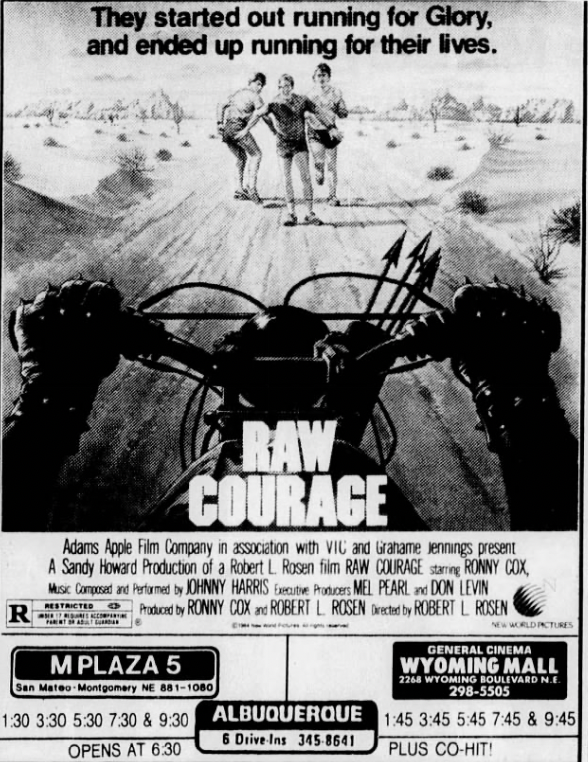
New World Pictures released Raw Courage on November 16, 1984, under a title that was also shortened to Courage in some contexts.
The theatrical rollout was limited, and the movie made little impact on the wider box office. Its regional roots were more prominent in contemporary coverage than any claim to national cinematic importance.
In Las Cruces, however, the picture represented something worth paying attention to: a familiar local landscape transformed into the setting for a professional feature film, with a New Mexico-born actor risking his own creative ambitions to bring the project to life.
That gave the movie a story beyond its plot.
Cox was already working steadily, and Beverly Hills Cop would soon make him recognizable to a much wider audience. But Raw Courage was a different kind of professional gamble. It wasn’t a conventional star vehicle designed to capitalize on an established formula. It was a project he had helped create, rooted in a place he knew, and shaped by his desire to play something other than the dependable good guy.
The film’s reception was mixed, and the criticisms are understandable.
The chase structure can become repetitive. Some of the antagonists could use greater depth. The synthesizer score may not satisfy viewers who imagine what a more substantial musical treatment might have accomplished.
Yet the film has qualities that are difficult to manufacture.
The New Mexico locations feel real because they are real. The running looks exhausting because the production required genuine physical effort. And the sense of isolation has an immediacy that can be lost when a movie relies too heavily on studio environments or artificial landscapes.
There is a difference between a film that looks inexpensive and one that makes productive use of its limitations.
Raw Courage doesn’t always overcome its budget, but its location work and physicality give it an identity beyond its rough edges.
For a movie released during a decade overflowing with action heroes, professional killers, and increasingly elaborate explosions, there’s something refreshing about a survival thriller that asks its characters to keep putting one foot in front of the other.
Sometimes that’s all they’ve got.
Rediscovering Raw Courage
For years, Raw Courage occupied the kind of cinematic limbo familiar to fans of overlooked 1980s movies.
It wasn’t a major hit. It didn’t inspire a franchise. It wasn’t regularly discussed alongside the decade’s canonical action and thriller releases. Like countless smaller films, it was easy to miss once its initial distribution cycle had passed.
But obscurity isn’t the same as worthlessness.
The film eventually found a new audience among viewers interested in regional cinema, low-budget survival thrillers, and the less celebrated corners of 1980s genre filmmaking.
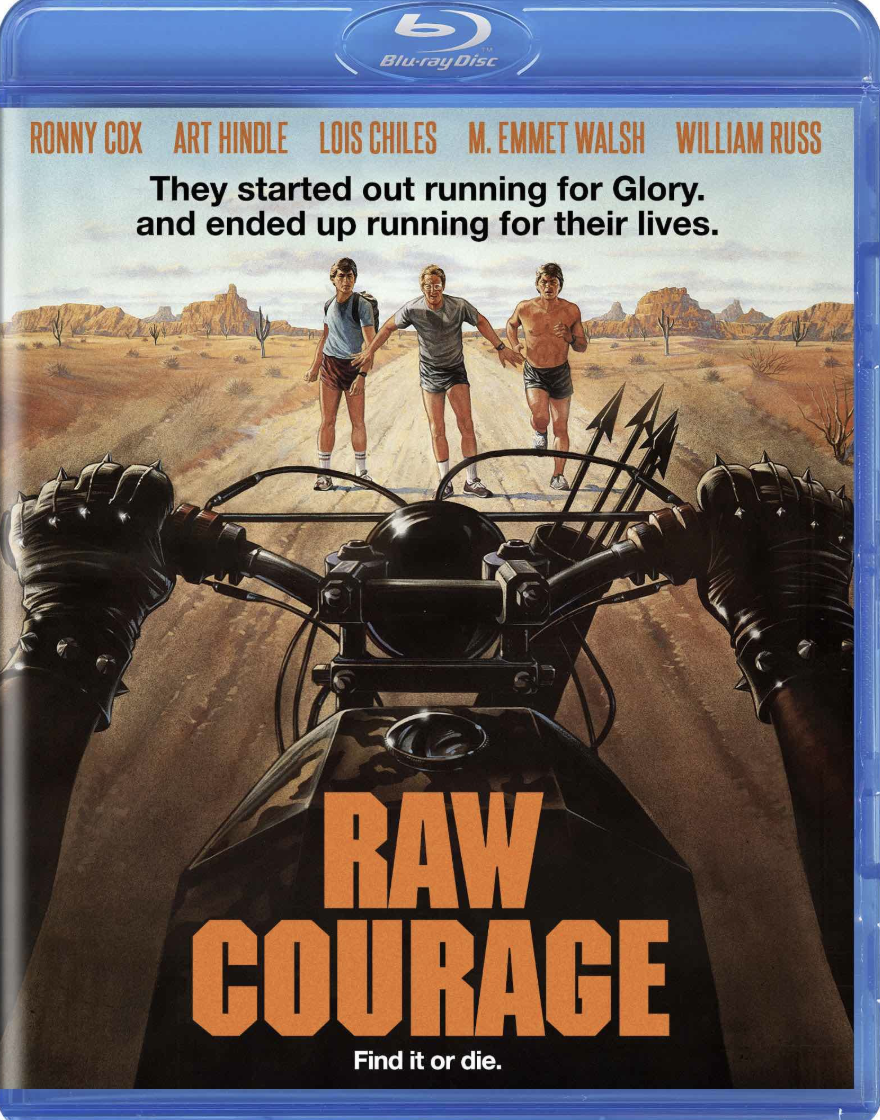
In 2020, Scorpion Releasing and Kino Lorber brought the movie back into circulation with a 2K-remastered Blu-ray release that included an interview with Cox. The restoration gave curious viewers a better opportunity to revisit a film that had spent decades outside the mainstream conversation.
The rediscovery makes sense.
The 1980s produced an extraordinary number of movies made by people who had something to prove and just enough money to attempt it. Some were polished studio productions. Others were rougher, stranger, and more personal. Many disappeared almost immediately, surviving through late-night television, video-store shelves, and the memories of people who happened to encounter them at the right moment.
Raw Courage belongs to that second group.
It also occupies an interesting place in Cox’s career. His subsequent work in films such as RoboCop and Total Recall helped establish him as a familiar face in some of the decade’s most memorable science-fiction productions. Yet Raw Courage offers a glimpse of a different ambition: an actor trying to shape his own material rather than simply finding his place within someone else’s vision.
Cox would eventually devote more attention to music, another creative pursuit that allowed him to work outside the expectations attached to his acting career.
The film remains an imperfect expression of that independent streak. But imperfections can be revealing. They show you where the money ran out, where the original idea collided with practical limitations, and where the people making the picture were forced to decide what mattered most.
In this case, the answer was getting the movie made.
The Courage to Make the Movie
Raw Courage isn’t a lost masterpiece. It doesn’t need to be.
It’s a modest, occasionally clumsy survival thriller with an evocative location, a strong central performance, and a premise that captures some of the cultural anxieties of its time. Its weaknesses are real, but so is its commitment to the physical business of survival.
More importantly, it’s a distinctly New Mexico story.
The landscape isn’t an anonymous stretch of desert standing in for somewhere else. The production drew on the region’s communities, employed local performers, and placed a personal project by a New Mexico-born actor within the environment that helped shape him.
That regional connection gives the film a value that extends beyond its effectiveness as a thriller.
Cox wanted to escape the limitations of his screen persona and take a chance on his own ideas. He did so with a relatively small budget, a demanding location, a screenplay co-written with his wife, and a production that brought its share of creative and financial compromises.
The result didn’t make him a major Hollywood power broker. It didn’t turn Raw Courage into a box-office sensation. And it certainly didn’t eliminate the rough edges that come with making a movie under difficult circumstances.
But the picture exists. It captures a particular place and moment, and it offers a reminder that American filmmaking has always depended on people willing to take chances outside the major studios.
If you’re a fan of Deliverance, Southern Comfort, or the scruffier end of 1980s survival cinema, Raw Courage is worth seeking out. Approach it with an appreciation for its limitations, and you’ll find a tense, sweaty little thriller with more going on beneath the surface than its obscurity might suggest.
Cox put a great deal of himself into this movie. You can feel the effort in the performances, the landscape, and the stubborn determination to make the project work.
The desert doesn’t care about your ambitions. Hollywood doesn’t always reward them, either.
Sometimes courage is simply the willingness to try.
And sometimes it means running 72 miles through the New Mexico desert while a bunch of armed survivalists decides you’ve become part of their end-of-the-world preparations.

Discover Raw Courage (1984), Ronny Cox’s overlooked desert thriller about ultramarathon runners hunted by a survivalist militia. Explore its New Mexico roots, grueling production, and cult legacy.
Tags
Raw Courage, Ronny Cox, Movies of the 80s, 1980s Movies, New Mexico Film History, Las Cruces, Survival Thrillers, Cult Movies, New World Pictures, M. Emmet Walsh, Forgotten Movies, 1980s Action Movies
Sources and research notes
Las Cruces Sun-News: Contemporary coverage of the production, Cox’s New Mexico connections, and the local significance of the film.
Contemporary Ronny Cox career profile or interview: Particularly valuable for his comments about the screenplay, the project becoming an obsession for him and Mary, his dissatisfaction with certain production compromises, and the physical demands of filming.
Ronny Cox: His career history and retrospective interviews provide context for his acting career and creative interests.
Kino Lorber: The 2020 Blu-ray release provides a useful reference point for the film’s later rediscovery.
New World Pictures: Useful background for the independent distribution landscape in which Raw Courage appeared.
Deliverance, Southern Comfort, and First Blood: Comparisons that help establish the film’s place within the broader survival-thriller cycle.
About the Creator
Movies of the 80s
We love the 1980s. Everything on this page is all about movies of the 1980s. Starting in 1980 and working our way the decade, we are preserving the stories and movies of the greatest decade, the 80s. https://www.youtube.com/@Moviesofthe80s
Enjoyed the story? Support the Creator.
Subscribe for free to receive all their stories in your feed.
Comments
There are no comments for this story
Be the first to respond and start the conversation.