
Ranking Every Cinematic Adventure of the Wall-Crawler
From Tobey Maguire to Tom Holland, I Evaluate Every Spider-Man Movie After Watching Brand New Day
The Web-Slinger on Film
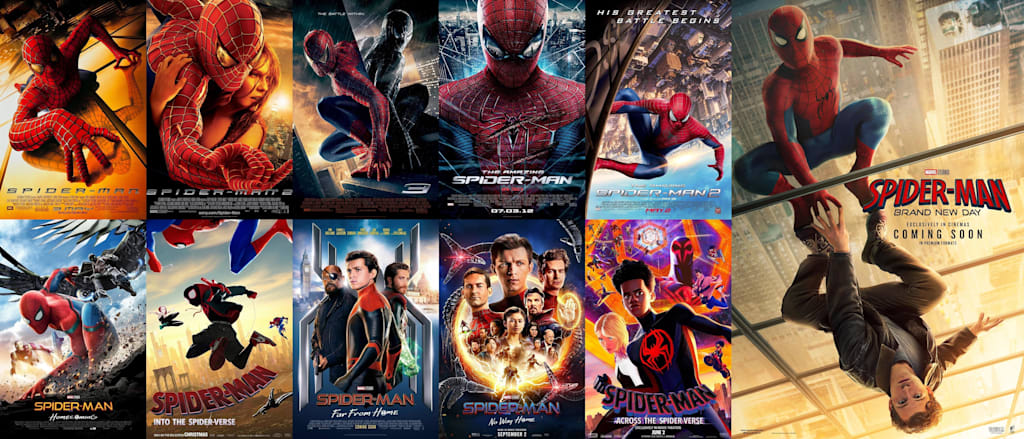
With Spider-Man: Brand New Day currently in cinemas, and having watched it with friends recently, I wanted to revisit the web-slinger’s cinematic history. Over the past two decades, Spider-Man has appeared in numerous live-action and animated films, with different actors, directors, villains and creative approaches shaping his journey. From Sam Raimi’s beloved trilogy and Marc Webb’s The Amazing Spider-Man duology to the Marvel Cinematic Universe and the groundbreaking Spider-Verse movies, each era has left its own mark. I’ll be ranking these films based on their storytelling, characters, action, emotional impact, performances and overall effectiveness as Spider-Man movies.
The Spider-Man Movies That Soar
Spider-Man 2 - Still A Masterpiece
Part of the reason why Spider-Man 2 remains not only the greatest Spider-Man movie but also one of the greatest superhero films ever made is its character-driven narrative. Peter’s struggle to balance his responsibilities as Spider-Man with his personal life gives the story genuine emotional weight.
The film also features iconic showdowns between Spidey and Doctor Octopus, particularly the unforgettable train sequence. Another memorable moment is the sequence set to “Raindrops Keep Fallin’ on My Head,” where Peter blissfully walks through New York after temporarily losing his powers. Tobey Maguire’s performance, Alfred Molina’s sympathetic portrayal of Doctor Octopus, and the film’s balance of humor, drama, and action make Spider-Man 2 a complete Spider-Man experience.
Spider-Man - The One That Started It All
Spider-Man remains the gold standard for what a superhero movie should be. It not only kickstarted the modern superhero movie craze, but it also defined Tobey Maguire as Peter Parker much like how Superman: The Movie defined Christopher Reeve as Clark Kent. Maguire perfectly captures Peter’s awkwardness, vulnerability, and determination, making his transition into Spider-Man feel believable and earned.
The brutal confrontation between Peter and Norman Osborn is another highlight, creating genuine tension as Peter is beaten, bloodied, and pushed to his physical limits. Combined with Willem Dafoe’s memorable performance as the Green Goblin, the film remains a landmark in superhero cinema.
Spider-Man: Brand New Day — A Fresh Start for Tom’s Peter Parker
Spider-Man: Brand New Day marks a fresh start for Tom Holland’s Peter Parker. Stripped of the Stark technology that once gave him an advantage, Peter is forced to navigate New York alone following a sacrifice he made to protect his loved ones. With its grittier tone and character-driven storytelling, this new chapter of Holland’s Spider-Man largely delivers, offering a more grounded take on Peter’s life as a street-level hero.
However, the film has its flaws, including a jarring shift toward a telepathic threat, an underwhelming Hulk versus Spidey fight, and unnecessary appearances from a certain character. Despite these shortcomings, Brand New Day successfully establishes a promising new direction for Holland’s Peter Parker.
Spider-Man: No Way Home - Nostalgia with Great Storytelling
Spider-Man: No Way Home raises the stakes for Tom Holland’s Peter Parker after his secret identity is exposed to the world. With Peter’s loved ones also facing the consequences, he turns to Doctor Strange for help, setting him on a deadly path that brings some familiar faces from Spider-Man’s cinematic history into his world.
One of the film’s biggest strengths is how it balances nostalgia with meaningful storytelling. Willem Dafoe’s Green Goblin, Alfred Molina’s Doctor Octopus, and Jamie Foxx’s Electro return in memorable roles, giving longtime fans plenty to celebrate while allowing these characters to interact with Holland’s Spider-Man in exciting ways.
The film also features appearances from previous cinematic versions of Spider-Man, creating some of the most exciting and emotional moments in the franchise. No Way Home uses its celebration of Spider-Man’s history to explore themes of responsibility, loss, and redemption. The result is a crowd-pleasing superhero movie that manages to honor the character’s cinematic roots while continuing Peter Parker’s own journey.
Spider-Man: Into the Spider-Verse - A Groundbreaking Era in Animated Films
I remember watching Spider-Man: Into the Spider-Verse during my junior year of high school, and I have to say, I was blown away. Part of what makes the film so groundbreaking is the way it combines animation with the visual style of a comic book, making every frame feel like it has been lifted straight from the pages. The colorful visuals, creative animation, and unique art style give the movie a distinct identity.
However, the animation isn’t the only reason the film works so well. At its heart is Miles Morales’ coming-of-age arc as he learns what it means to become Spider-Man.
Watching Miles struggle with uncertainty before gradually gaining confidence makes his journey relatable, while the film’s message that anyone can wear the mask gives it genuine emotional impact. Into The Spider-Verse is not simply revolutionary; it’s one of the most creative Spider-Man films ever made.
Spider-Man: Across The Spider-Verse - A Worthy Sequel
Following up on Miles’ story, Spider-Man: Across The Spider-Verse takes him on a new adventure where he encounters different Spider-People, including Miguel O’Hara. I really enjoyed seeing Miles and Gwen’s relationship develop throughout the movie because their shared experiences bring them closer together.
However, Miguel O’Hara is more of a misguided antagonist than a full-blown villain. His beliefs about how canon events should be handled directly clash with Miles’ desire to forge his own path. The movie also continues the incredible animation and comic-book style that made Into The Spider-Verse so memorable, while expanding the universe.
The Spider-Man Movies That Fell Short
The Amazing Spider-Man 2 - A Bloated Mess
The Amazing Spider-Man 2 had the potential to be a solid entry, but unfortunately, it’s infested with issues. One of the biggest problems with the film is that there are too many subplots going on, such as Peter finding out about his parents, Gwen preparing to study abroad in England, Electro’s origin, and Harry Osborn’s illness. There’s nothing wrong with having many subplots, but they have to be done in a way that contributes to the overall story.
Additionally, Electro’s origin felt absurd — really, falling into electric eels and becoming a villain partly because Spider-Man doesn’t notice him?! I also disliked Electro’s design. I get that the filmmakers wanted to give him a different look, but it just didn’t work for me. Combined with his ridiculous origin, the whole character ended up feeling more goofy than scary.
Harry and Peter’s relationship from friends to enemies also felt rushed. Harry suddenly goes after Peter because he wants his blood, and their friendship doesn’t get enough time to develop before everything falls apart.
I’ve seen The Amazing Spider-Man 2 numerous times before, yet I’ve lost track of when the last time I watched it was. That probably says something about how little the movie has stayed with me. Andrew Garfield and Emma Stone are still great, but the movie itself is a mess.
The Amazing Spider-Man - Good Movie, But It Could’ve Been Better
The Amazing Spider-Man rebooted the franchise after Spider-Man 3 received a divisive reception and Sam Raimi’s planned fourth movie fell apart. While I enjoyed the film for its visuals and Andrew Garfield’s performance, it had some flaws.
First, the Lizard’s plan to turn the people of New York into human-Lizard hybrids was pretty bizarre. I also disliked making Peter a high school student again and revisiting his origin story. Even though this version has Peter bitten by a radioactive spider at Oscorp, I think it would’ve been better if they had skipped the origin or told it in a montage-like sequence in the opening credits, since the 2002 movie had already covered it perfectly.
Not only that, the subplot involving Peter’s parents felt unnecessary. I also wasn’t a fan of the dark visual style, which felt out of character for Peter Parker. Spider-Man is usually associated with a colorful and energetic world. The Amazing Spider-Man is by no means a bad movie, but with a more focused story and different creative choices, it could’ve been on the level of Batman Begins.
Spider-Man 3 - The Weak Point Of The Trilogy
Spider-Man 3 marked where everything went wrong for the Raimi trilogy. First, the film is overstuffed with villains and characters, including New Goblin, Sandman, Gwen Stacy, and Venom, which can detract from the overall story and leave several characters underdeveloped. The infamous emo dance sequence featuring Peter Parker under the influence of the Venom Symbiote is another questionable choice that can make the film difficult to take seriously.
However, it is understandable why Venom’s inclusion feels somewhat forced, particularly given the well-documented creative tension surrounding the character. Sam Raimi had expressed little interest in using Venom, but Sony wanted the popular character included in the film.
Topher Grace was a terrible choice to play Eddie Brock. In the comics, Brock is typically portrayed as a physically imposing, muscular man who can intimidate others through his sheer presence. Grace, while a talented actor, does not naturally evoke that image because he lacks the imposing screen presence the role demands.
The film also makes a controversial retcon involving Uncle Ben’s death that unnecessarily complicates Peter’s backstory. Without spoiling the specific twist, the revelation weakens one of the most important elements of Peter’s motivation from the first movie. Instead of building upon that emotional foundation, Spider-Man 3 alters it in a way that feels forced.
That said, the movie is not without its strengths. It has great action sequences such as Symbiote Spider-Man vs. Sandman and Peter and Harry, now reconciled, fighting off Sandman and Venom. Nevertheless, Spider-Man 3 remains a cautionary tale of what happens when a studio doesn’t give its director creative control.
Spider-Man: Homecoming - Disney Channel Spider-Man & Too Reliant on Stark Tech
After the mixed reception to The Amazing Spider-Man 2, Sony turned to Marvel Studios for help. The two companies reached a deal that enabled Spider-Man to be integrated into the MCU beginning with Captain America: Civil War, with Tom Holland taking over from Andrew Garfield. Then, Holland made his solo debut in Spider-Man: Homecoming, which was released in July 2017.
Although Homecoming was fun to watch, it doesn’t really feel like a Spider-Man movie. First, Peter’s hardships aren’t shown enough, and he feels too reliant on Stark technology. Some people might counter that Peter demonstrates his independence from Stark when he turns down the offer to join the Avengers. Tony also tells him, “If you’re nothing without the suit, then you shouldn’t have it,” forcing Peter to prove himself without the suit, which he eventually does when he defeats the Vulture. I understand that argument, but it still doesn’t change my opinion. Stark’s influence is so prominent that Peter sometimes feels more like “Iron Boy Jr.” than Spider-Man.
I also wish Steve Rogers had been Peter’s mentor instead of Tony Stark. Tony essentially recruited Peter into the Civil War conflict without giving him the full context, and Peter was still a young kid who had barely begun his career as Spider-Man. Steve would have shown Peter the importance of responsibility, discipline, and doing the right thing. I think that relationship could’ve helped Peter become a more independent hero.
Not only that, I wasn’t a fan of some of the casting decisions, particularly Tony Revolori as Flash Thompson. I understood they were trying to move away from the outdated jock bully archetype, but I think this removes an opportunity for Flash to develop into a more interesting character. In the comics, Flash Thompson eventually becomes Agent Venom after being inspired by Spider-Man. Revolori also didn’t come across as intimidating to me. If Marvel wanted to move away from the traditional Flash, I think he would’ve been better used as an original character.
Then, there’s Michelle Jones. When Zendaya was cast as MJ, I remember there was backlash from fans who assumed she would be playing Mary Jane Watson. It turned out that she was playing Michelle Jones, an original character created for the film. Personally, I found her character pretty bland. She mostly feels like a background character who has little to no impact on the story.
Finally, the childish tone sometimes makes Homecoming feel more like a Disney Channel movie than a Spider-Man film. Peter is supposed to be a teenager, but I think the movie takes the youthful aspect too far. For me, Homecoming is entertaining, but it doesn’t capture the Spider-Man I wanted to see.
Spider-Man: Far From Home - Slight Improvement, But Still Infested With Problems
Spider-Man: Far From Home is a slight improvement because Tony Stark is no longer around to constantly guide Peter, but the movie still has plenty of problems. First, Peter and Michelle’s relationship developed way too quickly to feel believable as a couple, and the same goes for Ned Leeds and Betty Brant.
Second, Peter still relies heavily on Stark technology, which continues the same problem I had with Homecoming. Not only that, Peter makes a really stupid decision to hand EDITH over to Quentin Beck, a guy he barely knows. I understand Peter is grieving Tony and wants to trust someone who appears to understand what he’s going through, but giving Beck access to such powerful technology without establishing trust was incredibly reckless.
Then there’s the Mysterio and Tony Stark connection, which feels unnecessary because it makes Peter’s conflict even more tied to Tony instead of allowing him to grow independently. Far From Home has some great action and an entertaining villain, but it still leaves a lot to be desired.
Looking Back: Spider-Man’s Cinematic Legacy
Looking back on Spider-Man’s cinematic journey, it’s clear to me that the character remains timeless. No matter how many times Peter Parker is reinvented, there is something about his struggles, humor, responsibility, and determination that continues to connect with audiences. Some films have captured those qualities better than others, while several had the potential to be much stronger. There’s no single template for how the web-slinger should be portrayed because every adaptation evolves with the times. As long as Peter Parker remains relatable, Spider-Man will continue swinging into the future.
About the Creator
TheScreenAnalyst
I am a passionate movie and TV enthusiast, devoted to analyzing storytelling, characters, visuals, and performances. I provide thoughtful critiques and insights, exploring both mainstream and independent works to engage audiences.
Enjoyed the story? Support the Creator.
Subscribe for free to receive all their stories in your feed.
Comments
There are no comments for this story
Be the first to respond and start the conversation.