
Ramayana Trailer Fact Check: What Comes From Valmiki Ramayana and What Is Fiction?
From Rama’s blindfold training and Lakshman Rekha to Pushpaka Vimana, Surpanakha and Airavata—here is what the original epic actually says.

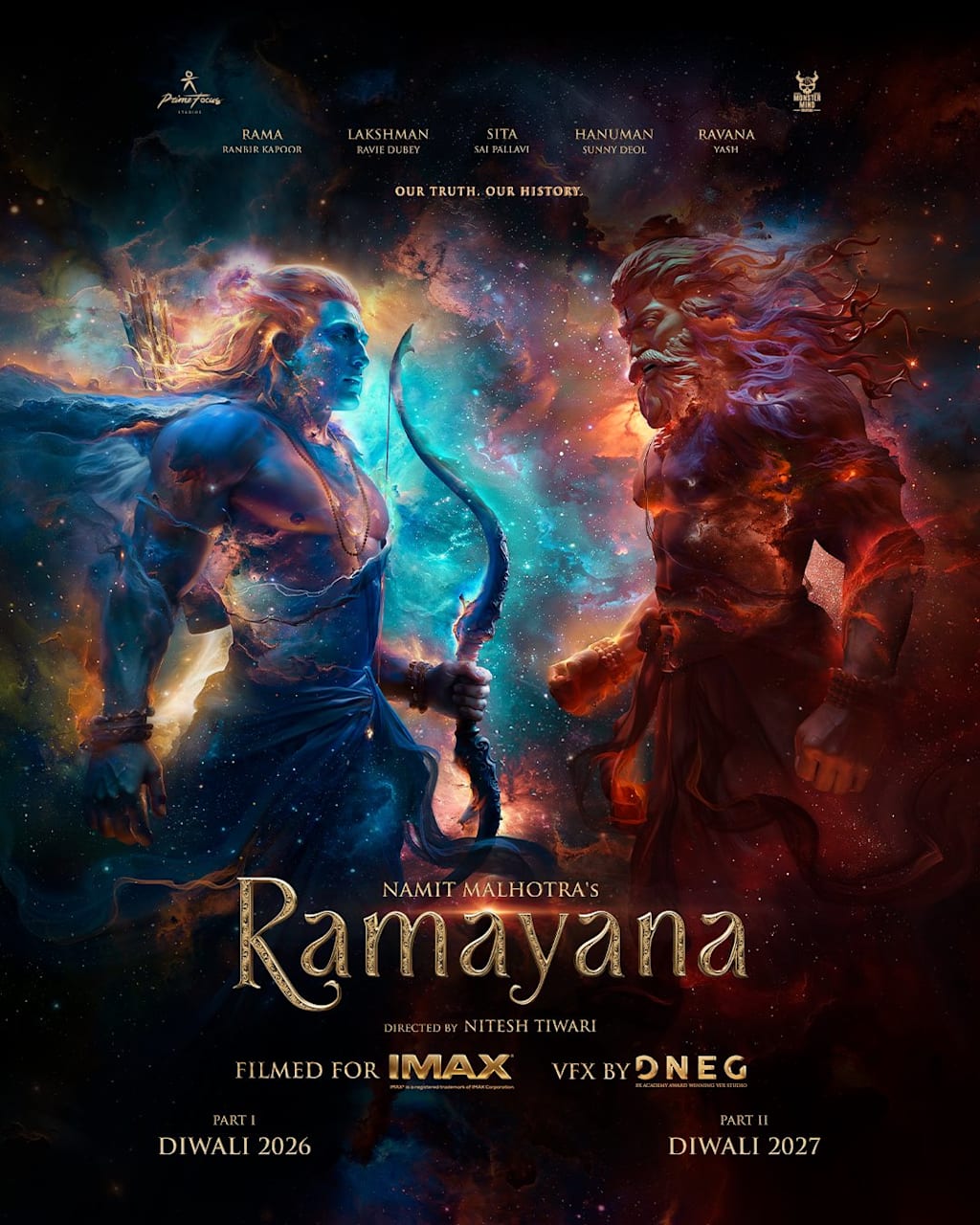
Nitesh Tiwari’s Ramayana trailer has not simply created excitement—it has divided viewers into two very different groups.
One side believes the filmmakers may have created a masterpiece and possibly one of the most textually faithful cinematic adaptations of the epic. The other side is questioning several scenes: Did Lord Rama ever practise archery while blindfolded? Was Lakshman Rekha actually mentioned in Valmiki Ramayana? Was Pushpaka Vimana shaped like a flower? And why is a giant white elephant flying through the sky?
The official trailer introduces Ranbir Kapoor as Rama, Sai Pallavi as Sita and Yash as Ravana, with the film scheduled for a worldwide theatrical release around Diwali 2026.
However, before labelling the trailer completely accurate or completely fictional, it is important to understand one thing: Valmiki Ramayana provides events, characters and poetic descriptions, but it does not offer modern concept art or detailed visual blueprints. Therefore, filmmakers must interpret many descriptions for the screen.
Here is a closer look at the trailer’s biggest scenes.
1. The Giant Muscular Rakshasa
One of the most discussed trailer shots shows Rama facing a huge, muscular and terrifying rakshasa. Viewers have jokingly described the creature as an “Indian Hulk.”
The rakshasa’s appearance also seems different from the creature shown in an earlier promotional glimpse. The newer design appears more culturally rooted, with Indian-style ornaments and a mark on the forehead.
Valmiki Ramayana includes several extremely powerful rakshasas whom Rama encounters during different stages of his journey. These include Tataka, Maricha, Subahu, Viradha, Khara and others. Tataka, for example, is described as possessing the strength of a thousand elephants.
However, the trailer does not provide enough information to confidently identify the muscular creature. Its tilak, body structure and monster-like face are visual design choices rather than details that can be matched exactly with a particular verse.
Verdict: The presence of a powerful rakshasa is faithful to the epic, but its exact appearance is cinematic interpretation.
2. Did Lord Rama Train While Blindfolded?
The trailer apparently shows Rama practising archery while his eyes are covered. This has led many viewers to ask whether such a training sequence appears in Valmiki Ramayana.
There is no clearly described incident in the standard Valmiki narrative in which Rama trains with a blindfold.
What the text does confirm is that Rama and Lakshmana received extraordinary knowledge from Sage Vishvamitra. In Bala Kanda, Vishvamitra teaches them the sacred Bala and Atibala disciplines. These teachings protect their strength and vitality and help them resist hunger, thirst, exhaustion and illness.
Vishvamitra also later gives Rama knowledge of powerful celestial weapons. Therefore, the filmmakers may be using blindfolded archery to visually represent Rama’s control over his senses, concentration and ability to strike through awareness rather than ordinary sight.
Verdict: The training under Vishvamitra is authentic, but blindfolded archery appears to be creative liberty.
3. The Truth About Lakshman Rekha
Lakshman Rekha is one of the most famous elements associated with the Ramayana. Surprisingly, the scene of Lakshmana drawing a magical protective line around the cottage does not appear in Valmiki Ramayana.
In Aranya Kanda, Maricha imitates Rama’s voice and cries for help. Sita becomes frightened and asks Lakshmana to find Rama. Lakshmana initially refuses because he knows Rama cannot easily be defeated. After an emotional and painful argument, he finally leaves the cottage.
The text then moves to Ravana approaching Sita while disguised as a wandering ascetic. No protective line is drawn in these chapters.
There is another important correction: the complete Lakshman Rekha incident is not directly narrated in the Aranya Kanda of Tulsidas’s Ramcharitmanas either. A later passage contains Mandodari’s allusion to a small line drawn by Lakshmana, while the full protective-boundary episode became prominent through later regional versions, literary traditions and popular adaptations.
Verdict: Lakshman Rekha is not part of the original Valmiki abduction sequence. Its use in the film would come from later Ramayana traditions.
4. Is the Trailer’s Pushpaka Vimana Accurate?
The trailer’s depiction of Pushpaka Vimana is among its most visually fascinating elements. Instead of looking like a conventional aircraft or chariot, it appears to open like a giant mechanical flower.
This interpretation is not completely baseless.
Valmiki Ramayana describes Pushpaka as an extraordinary aerial vehicle built by Vishvakarma. It is decorated with refined gold, diamonds and precious gems. It has numerous structures and peaks, can move according to concentrated thought and possesses a beauty compared with masses of spring flowers.
The text also states that Ravana obtained Pushpaka after defeating his half-brother Kubera and overpowering the Yakshas.
Later, after Ravana’s defeat, Rama, Sita, Lakshmana, the Vanaras, bears and other companions are all able to travel comfortably inside it, suggesting that it could accommodate a remarkably large number of passengers.
Therefore, a flower-inspired, expandable and highly advanced design fits the poetic qualities associated with Pushpaka. However, Valmiki does not provide a precise mechanical diagram showing that it literally opened like a flower.
Another popular claim is that Pushpaka could travel thousands of kilometres within the time taken to blink. The text describes supernatural movement and thought-based navigation, but it does not provide a modern numerical speed measurement.
Verdict: The concept is strongly rooted in Valmiki Ramayana, while the flower-shaped mechanism is the filmmakers’ visual interpretation.
5. Was Sita Abducted in Pushpaka Vimana?
This is one of the most commonly repeated misconceptions.
In Valmiki Ramayana, Ravana does not clearly abduct Sita in Pushpaka Vimana. The abduction chapters describe him forcing Sita into his own aerial chariot. Jatayu then confronts Ravana and attacks that chariot in the sky.
Pushpaka appears elsewhere in the story and is later used to transport Sita during the war and to carry Rama’s party back towards Ayodhya.
Many television adaptations and popular retellings have merged Ravana’s aerial chariot with Pushpaka, causing audiences to treat them as the same vehicle.
Verdict: According to Valmiki’s abduction narrative, Ravana uses an aerial chariot, but it is not specifically identified there as Pushpaka Vimana.
6. Why Does Surpanakha Look So Beautiful?
The trailer appears to introduce Surpanakha in a grand manner, possibly riding a lion and looking far more glamorous than the simple or frightening versions seen in older adaptations.
Valmiki Ramayana initially contrasts Surpanakha’s appearance with Rama’s beauty. She is described as having distorted features, reddish hair, an unpleasant voice and an older appearance.
However, rakshasas in the Ramayana are repeatedly described as beings capable of changing their form. Some traditional interpretations also suggest that Surpanakha could approach Rama in an attractive assumed form.
Therefore, showing her as beautiful does not automatically contradict the larger mythological framework. It may represent the form she chooses while trying to attract Rama.
The basic sequence is clear: Surpanakha proposes marriage to Rama, who redirects her towards Lakshmana. Lakshmana also refuses her. When she attempts to attack Sita, Lakshmana cuts off her nose and ears. She then runs first to her brother Khara—not directly to Ravana.
Khara subsequently leads a massive rakshasa army against Rama.
A fast-cut trailer might make it appear that Surpanakha immediately approaches Ravana, but the full film may preserve the longer chain of events.
Verdict: Her grand entrance and beautiful form are creative choices, but her shape-shifting nature can justify the interpretation. Her going to Khara before Ravana is the textually important detail.
7. Is Airavata, the Flying White Elephant, Fictional?
The giant white elephant shown in the trailer has confused some viewers, but Airavata itself is not an invention of the filmmakers.
Airavata is the divine elephant associated with Indra, king of the Devas. Valmiki Ramayana even describes Ravana as carrying scars on his chest from wounds inflicted by Airavata’s tusks. This indicates a violent confrontation between Ravana and the celestial elephant.
The trailer also appears to explore Ravana’s campaigns beyond the human world. Ravana’s victories over celestial, subterranean and supernatural kingdoms are referenced throughout the epic. His ambition to dominate different realms is therefore consistent with his established character.
However, the exact visual presentation of Airavata flying through clouds, its size and the arrangement of its tusks are cinematic interpretations combining descriptions from the broader Hindu literary tradition.
Verdict: Airavata and its confrontation with Ravana are textually grounded. The precise flying-elephant design is visual creative liberty.
Final Verdict: How Accurate Is the Ramayana Trailer?
The trailer appears to be deeply inspired by Valmiki Ramayana, but saying that it is exactly “90 percent accurate” would be difficult before watching the complete film.
Several major elements are authentic:
Rama’s training under Vishvamitra, Bala and Atibala knowledge, Ravana’s conquest of Kubera, Pushpaka Vimana, Surpanakha’s role in escalating the conflict and Ravana’s encounter with Airavata all have foundations in the ancient narrative.
At the same time, blindfolded archery, the exact monster designs, the flower-like mechanical transformation of Pushpaka and some compressed character interactions appear to be creative cinematic choices.
That does not necessarily mean the filmmakers are changing the Ramayana. A film must transform poetry into images, and Valmiki’s descriptions often leave enough space for artistic imagination.
The real test will be whether these visual liberties preserve the characters’ values, motivations and emotional journey.
For now, the trailer looks less like a completely altered Ramayana and more like a grand cinematic interpretation built on a largely recognisable textual foundation.
About the Creator
parwinder singh
🎬 Movie & Entertainment Writer sharing reviews, ending explanations, story breakdowns, plot twists and hidden details from Bollywood, Hollywood, South Indian cinema, Korean dramas and OTT releases.
Enjoyed the story? Support the Creator.
Subscribe for free to receive all their stories in your feed.
Comments
There are no comments for this story
Be the first to respond and start the conversation.