
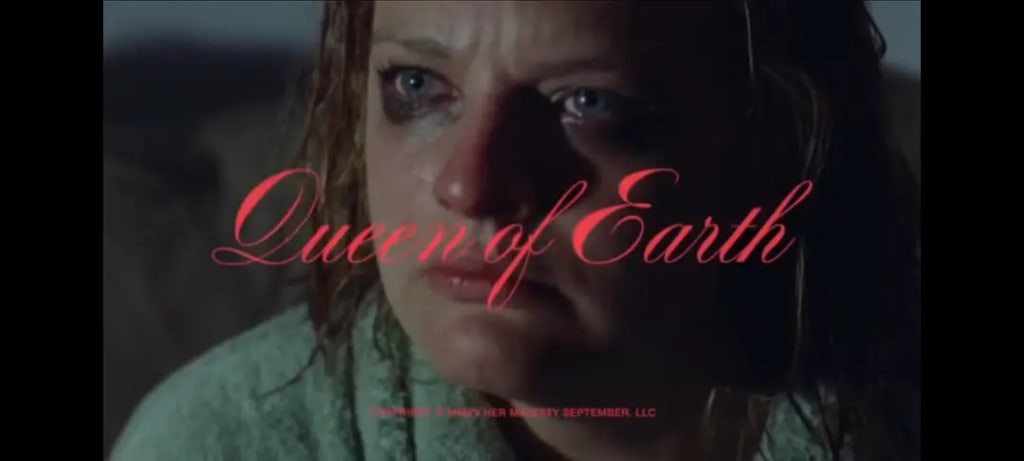
After I watched Queen of Earth two years ago, the film haunted me like a nightmare, unreasonably appearing when my subconscious was tired of some things and longing for others, declaring its legitimacy with an indefinable presence. Now I want to try to confront her and her director Ross Perry.
When it becomes clear that part of the film's creator holds the abstract idea in isolation from the concrete work, the clear natural sounds already divide the world of perception: the abrupt but faint sound of birdsong in the treetops leads us, and Moss's rebuke and close-ups are left to a slightly slower vision. The male voice does not prove to be a dialogue with the appearance of the man's face, but rather becomes more and more of an off-screen voice as the emotional tone of the two parties widens, a treatment proven in the section of "The Wheel" where the woman walks alone on the street: the sound and the image gradually merge, and then the external physical space shifts, revealing a deliberate stagnation on the visual level. And our emotions are thus open to the images that are about to appear. The exception is "Her Scent," where the music is both a realistic pulling force and a rhythm to match the dialogue, so that in the overpowering context, the film tires to construct a plausible scene rather than naturally laying out the scenario through a perception that has fallout.
Seeing a moment reminds me of everything
A few empty shots begin with different rates of movement, close-ups and entry into the room, tiny scenes zoomed in, surprised that the interior space of the house is not invaded, but rather the women's occupancy seems to complete the place, the sound stays truly unified with the visual at this moment. Along with the separation of the two, Waterston took over the task of leading us, her sorrow for Moss unknown still did not enter the interference of the physical space, followed by the lake next to the two obviously talking in one piece but always close-up switch, so that the audience is faced with a bizarre situation: after adapting to the falling rate of sound and picture, the warning with a warning of danger looked but warm. Thus when Waterston took the jokes of others seriously, I could not help but feel my heart tighten, and sure enough the accompanying overreaction to any flirtation she had afterwards allowed a vortex to quickly form, and we were caught between people who seemed depressed and those who really showed the knot of depression. It's as if this virus makes us kindred spirits by spreading through the air, recalling together a painful past and anxiety about the future. And when we try to find its source in the physical space, we have to face this miraculous viral outburst from the fictional world of emotions, and then admit that through this scene alone, two worlds are quietly born.
People spreading to become part of the environment
In Perry's previous works, the characters repeatedly leave quickly with their hearts in their mouths before editing to the bland faces of the others, with emotions being forced on the audience, and similar techniques include
1. two people meet only to shoot the back of the fictional surroundings, so that people obviously want to affect the next physical environment, the action seems to fall short of transforming into emotional impact "her smell
2. The man goes home to hide from the woman, the camera gradually shot sinking space, overlooking the other woman stealing into the small room, the same stolen joy "Golden Exit
3. Separate, leaving in a car, the face of the person in the car window, she was sad to cry out, but the camera cut to the person entering the house to open the door "color wheel
All are a class of scenarios generated by the interaction of the characters in the previous paragraph is suppressed to the next scene, resulting in the analysis of the current shot does not depict their true feelings. And this delay of a few moments to meet the anticipation in the "Queen of Earth" touches on a more insidious situation. Moss is disturbed by the sight of men entering Waterston's room, she walks out the door to pick up a man and says she wants to kill him, and the next day Waterston cuts his hand over the cup she recklessly breaks. Everything just as the heart wants? Her sensitivity and vulnerability suddenly became the power to make everything around her realistic, and all the things that arose absolutely affected the things that followed.
What are you watching?
The paradox of not being surprised by every shot on rewatch, of not being unfamiliar, of not being able to locate the axes, of being able to precisely show the guiding space, all these contradictions exist at the same time, just like in "The Life of Philip" where Preiss' voice seamlessly connects with the narrator's ramblings to Schwartzman, the almost absurd narration instead distances the sense of distance, the choices he makes again and again become unbearable for the audience in a cold voice, without caring himself . It's a lot like the game Stanley's Parable, but it's a contemptuous attitude that delineates the audience's interaction with the image, learning to deny the plausibility of the narrative in sophisticated scenes.
When I was troubled by the film's appeal, there was a myriad of energy in my body that wanted to portray her, but when I put pen to paper and analyzed only two or three scenes, I felt that the more I dismantled it, the further away from what she really was. I'm not trying to get anything out of this analysis, because this film has remained present for the past two years while watching other films, and she reminds me with perfect poise that the analysis that blocks access to the feelings of other films is essentially discussing something else: power, destruction, struggle, falsehood, and we need to breathe.
Ross Perry is one of the directors of this era who chooses to internalize the idea of filmmaking, and when that which engulfs your perception comes, it may smell of fear, but it is in an irresistible wholeness that we can truly determine how language should analyze images.
Queen, what I owe you has been repaid
About the Creator
Enjoyed the story? Support the Creator.
Subscribe for free to receive all their stories in your feed.
Comments