
Poor Things (2023) Movie Review
Comedy / Romance / Drama / Sci-FI

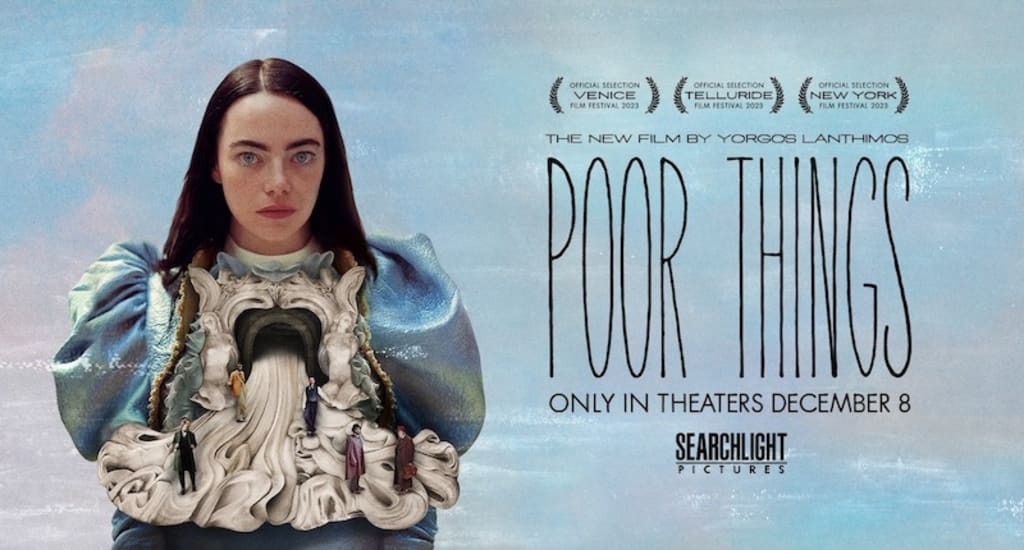
Yorgos Lanthimos revels in portraying extreme human behavior against the backdrop of pristine environments. Whether it's the serene suburbia in "Dogtooth," the sterile laboratory setting in "The Lobster," or the lavish opulence depicted in "The Favourite," Lanthimos consistently explores the jarring dichotomy between societal expectations and the messy reality of human nature, a theme that endlessly captivates him.
Nowhere is this conflict more pronounced and captivating than in his latest and arguably greatest work, "Poor Things." The film embraces a wonderfully bizarre atmosphere, from its eccentric performances and unconventional dialogue to its striking production and costume designs. Yet, amidst this peculiar tapestry, "Poor Things" remains deeply rooted in the human experience, particularly in its exploration of the challenges of forming genuine connections.
At its heart, "Poor Things" follows the journey of Bella Baxter, portrayed by the talented Emma Stone, who strives for self-discovery and authentic relationships in Victorian London. Living with her guardian and surrogate father, the enigmatic Dr. Godwin Baxter, played with a gentle demeanor by Willem Dafoe, Bella initially exhibits childlike behavior, grappling with her identity and place in the world.
Throughout Bella's development, she encounters various influences, including Max McCandles, portrayed with warmth and rationality by Ramy Youssef, and the charismatic yet manipulative Duncan Wedderburn, played by the incomparable Mark Ruffalo. As Bella navigates these relationships, Stone delivers a tour de force performance, seamlessly transitioning from innocence to empowerment with precision and nuance.
Ruffalo's portrayal of Wedderburn adds a layer of comedic brilliance, blending charm with absurdity in a role that showcases his versatility as an actor. Supported by a talented ensemble including Jerrod Carmichael, Hanna Schygulla, and Kathryn Hunter, "Poor Things" thrives on its richly developed characters and their interwoven narratives.
Tony McNamara's screenplay, adapted from Alasdair Gray's novel, infuses the film with a poetic cadence that evolves alongside Bella's intellectual growth. As Bella's character matures, so does the dialogue, reflecting her journey towards self-realization with eloquence and wit.
Robbie Ryan's cinematography masterfully captures the film's evolution, transitioning from a grainy black-and-white aesthetic to vibrant colors that mirror Bella's blossoming independence. Similarly, Holly Waddington's costume design and the production work by Shona Heath and James Price contribute to the film's immersive world-building, each detail reflecting Bella's journey and the diverse settings she encounters.
In essence, "Poor Things" is more than just a film; it's a testament to the human spirit and the enduring quest for self-discovery. With its captivating performances, intricate storytelling, and visually stunning craftsmanship, "Poor Things" stands as a cinematic triumph, solidifying Yorgos Lanthimos' status as a visionary filmmaker. In a year filled with noteworthy releases, "Poor Things" shines as a true gem, a poignant exploration of identity and empowerment that resonates long after the credits roll.
In conclusion, "Poor Things" represents the pinnacle of Yorgos Lanthimos' cinematic prowess, blending eccentricity with profound humanity in a visually striking and thematically rich masterpiece. Through the lens of Victorian London, the film delves into the complexities of forging genuine connections and asserting one's identity in a world governed by societal norms.
Emma Stone's portrayal of Bella Baxter is nothing short of remarkable, navigating her character's evolution from innocence to empowerment with grace and authenticity. Supported by a talented ensemble cast, including standout performances from Willem Dafoe, Ramy Youssef, and Mark Ruffalo, "Poor Things" thrives on its well-developed characters and their intertwining narratives.
Tony McNamara's screenplay, Robbie Ryan's cinematography, and the meticulous costume and production design further elevate the film, immersing the audience in Bella's journey of self-discovery. As the narrative unfolds, viewers are treated to a poetic exploration of resilience, optimism, and the enduring quest for personal agency.
Ultimately, "Poor Things" transcends the confines of its Victorian setting to deliver a timeless message of empowerment and authenticity. In a cinematic landscape filled with spectacle and grandeur, Lanthimos' latest offering stands out as a testament to the power of storytelling and the human spirit. With its blend of humor, pathos, and visual splendor, "Poor Things" cements its place as a cinematic triumph and a must-see for audiences seeking both entertainment and enlightenment.
About the Creator
Enjoyed the story? Support the Creator.
Subscribe for free to receive all their stories in your feed.
Comments
There are no comments for this story
Be the first to respond and start the conversation.