
Piracy Is Wrong. Platform Greed Doesn’t Make It Right.
Why “memberships cost too much” explains the anger but never excuses the theft.
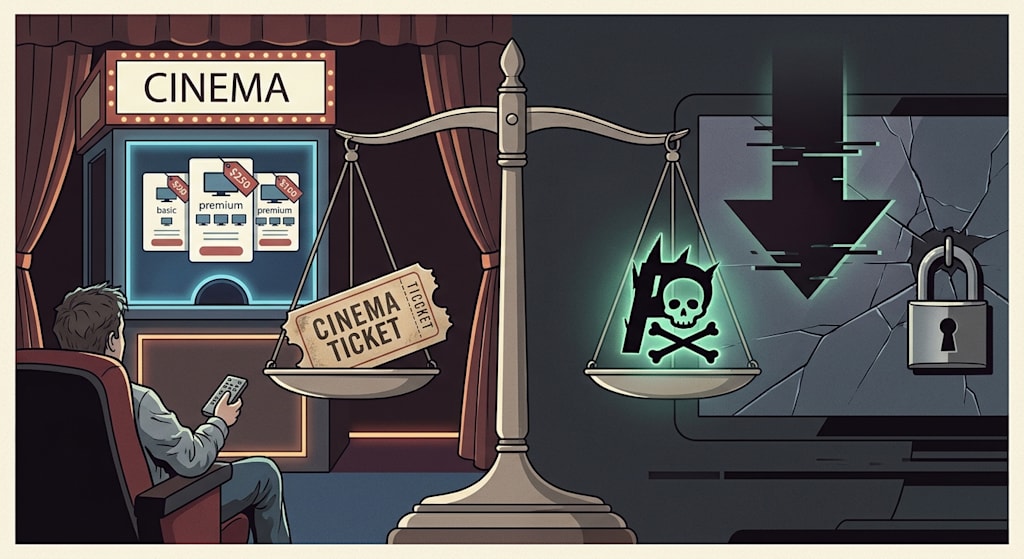
Two lazy arguments show up whenever premium viewing and piracy come up.
One says platforms are too greedy. They sell premium episodes, finale packages, and bonus packs on top of membership, slicing one story into several payments. So users who pirate are “understandable.” The other says tiered pricing is normal. Other industries do it. If you do not want to pay more, wait. If you think it costs too much, go pirate. You want everything without paying, and that is wanting both.
Each argument is half right.
Piracy cannot be justified. Users’ anger at platform tricks is also real, and “business-model exploration” does not answer it. Anti-piracy is a baseline, not a blank check for every pricing plan. Users may be angry. They still do not have the right to watch unauthorized copies.
Start with the baseline. Youku, iQIYI, and Tencent Video canceled premium on-demand on October 4, 2021. The model first appeared with The Untamed in August 2019. Producers said it earned RMB 156 million. In December 2019, Joy of Life charged RMB 50 to unlock six episodes and set off the backlash. In the first half of 2021, 67 new dramas used premium on-demand, 33% of new shows. Courts found platforms in breach in individual cases. They also said paid premium on-demand was a business-model experiment, and the model itself did not violate the law. The China Consumers Association then said, “less trickery, more sincerity,” and the three platforms backed off.
Premium on-demand is gone in name. Tiered memberships, finale packages, and bonus packs remain. Tencent Video charges RMB 25 for standard membership and RMB 35 for premium. iQIYI charges RMB 25 for Gold and RMB 35 for Platinum. The extra money buys TV-screen access, 4K, and one early episode on each update day. In the same week, non-members watch episodes 13 to 18. Members get early access to episodes 17 to 22. Members who pay for acceleration reach episodes 21 to 26. Extra money buys time. The story stays the same.
Criticize the tricks. Criticize the annoying rules. Criticize rights sliced into fragments. Do not jump from that to “so I will pirate.” Disliking a restaurant’s prices does not let you walk into its kitchen and take food. If you do not want to pay for early access, wait for updates. Wait for limited free sections. Watch ads to unlock episodes. Wait until the series finishes. Do not buy a membership. The legal roads are open. They are slower. Slower is not a piracy license.
The criticism of premium on-demand is not about the word “tiering.” Defenders say SaaS has tiers, Netflix has tiers, Disney charged $29.99 for Mulan, Amazon and Apple rent titles for $3.99. Why is it unacceptable when film and TV platforms do it?
The point is half right.
SaaS tiers sell credits, concurrency, and response speed. The boundary is clear: pay more, get faster machines and larger quotas. Film and TV platforms anger users with changing rights, extra charges for TV screens, ads for paying members, finale packages that cut a story into pieces, auto-renewal that is easy to start and hard to cancel, and social-discussion timing held back on purpose. Users are not angry at tiering itself. They are angry at unclear rules, repeated charges after they already paid, and anxiety-driven payments for finishing a story.
The court said the model was legal. The China Consumers Association said less trickery. Both statements can stand. A model can be explored, and a case can be a breach. Tiering can exist, and tricks still deserve criticism. Legal is not the same as reasonable. Common is not the same as exempt. Other industries tier their prices, but that does not prove every extra charge from a film and TV platform is fair.
Users’ anger has limits. Piracy is outside those limits. The useful criticism is not “I want the latest full series for free.” It is: make prices clear. Do not change rights at will. Make cancellation easy. Make ads and member rights match. Do not split a complete story into anxiety payments. Do not keep telling paying users they must pay more to avoid spoilers.
Those demands are fair. Platforms cannot say they offer entry points for different willingness to pay while designing those entry points as a maze. They cannot say users may wait while spoilers, trending topics, and short-video clips push the cost of waiting into users’ faces. Time scarcity can be sold. Manufacturing anxiety and selling the antidote invites anger.
Anger at tricks is not a license to pirate. “The platform has tricks” explains the anger. It does not make infringement legal. You can call the platform’s behavior ugly. You can call the tiered design insincere. You can say some terms need regulation. Unauthorized distribution and viewing are still separate. The two can be criticized at once. They do not cancel each other out.
Piracy data needs care. An iResearch report from April 2026 says the online film and TV market reached RMB 134.3 billion in 2025. Piracy losses were RMB 24.47 billion, or 18.2%. Long-form video had 730 million users. Pirated-content users were 54.94%. From 2018, the industry grew 39.5%, while piracy losses grew 79.4%. Browsers and search engines were 64.5% of entry points. Protection satisfaction hit a record 82.81 points. More than half of users still sit in the piracy chain. High approval, low practice.
Those figures show scale. They need care. RMB 24.47 billion in “losses” does not mean legitimate revenue would rise by the same amount. The 54.94% “pirated-content users” may be a broad category. Piracy is harmful. Loss estimates alone do not prove users simply refuse to follow rules.
Another figure says more. 27.7% of people mainly use cloud drives as repositories for pirated resources. Many pay for cloud-drive memberships for faster downloads and more storage. They pay for services inside the piracy chain. This is not simply a money problem. The money goes somewhere else. Price matters. So do the legal experience, access, habit, and path dependence. Anti-piracy cannot rely only on moral appeals. Legal access must be smoother, clearer, and less full of tricks.
The traffic-light analogy is too easy. Article 89 of the Road Traffic Safety Law sets a warning or a RMB 5 to 50 fine for pedestrians who break the rules. Many places charge RMB 20. Shenzhen charges RMB 20 to 100. The old line “once enough people gather, you can go, it has nothing to do with the light” spread online. Someone counted 13 people running the light in 15 minutes at Guomao Bridge in Beijing. No one was stopped with “I ran it because the light waited too long.” A long wait and permission to cross are separate.
The analogy warns. Inconvenience is not a reason to break rules. It still explains piracy poorly. Running a red light is an immediate public-safety risk. Enforcement is clear. The cost is low. Copyright infringement is a complex chain. Platforms have their own history of breaches and tricks. Users face standard terms, regional limits, release windows, bundles, and changing rights. This does not make piracy legal. It means “personal rule-breaking” does not explain the whole chain.
The excuses changed. Fansub users said resources were hard to find. Cloud-drive users said official versions were cut. Clip viewers say memberships cost too much. Rule-breaking sits inside the excuses. The other side matters too. People who follow the rules can wait, watch a few ads, check free sections, and still watch legally. People who do not want to follow rules will complain about price today, queues tomorrow, and speed limits the day after. Platforms should not treat every user as a thief. Users should not treat piracy as rights advocacy.
Other countries tier too. Netflix raised its three U.S. tiers to $8.99, $19.99, and $26.99 on March 26, 2026, about 11%. Most titles sit on the ad tier, with a few locked. Adding one person to the same household costs $7.99 or $9.99. Disney charged $29.99 for Mulan in 2020. Amazon and Apple rent titles for $3.99. Mulan entered the library on December 4 and stopped charging extra. People who waited three months paid nothing more.
Tiering, paying for speed, and single-title rental are not Chinese inventions. “Other countries do it” proves the model is common. It does not prove every design is fair. Netflix price hikes draw complaints. Disney single-title charges draw complaints. Most foreign users complain, then return to legal paths or wait. Chinese platforms should learn to explain tiers, smooth the legal path, and protect paying users. “Look, others tier too” teaches nothing.
Two bottom lines can stand together.
Piracy cannot be justified. If you do not want to pay RMB 20 or RMB 40, wait. Watch ads. Check free sections. Do not buy a membership. There is no right to watch the latest full series legally for free. “It costs too much” is not a piracy defense.
Platforms cannot use “tiering is common” as a shield. Make prices clear. Do not change rights at will. Do not make cancellation a maze. Do not split a complete story into anxiety payments. Users have a right to transparency and fairness. Anti-piracy is a baseline, not a blank check.
People who follow the rules should not be treated as marks. People who do not follow the rules should not use platform tricks as a fig leaf. Platforms should stop charging again after users already paid. Users should stop saying “if it costs too much, I will pirate.” Both sentences can be true at once.
About the Creator
Jin
Writer of reamstories
https://reamstories.com/jin
Enjoyed the story? Support the Creator.
Subscribe for free to receive all their stories in your feed. You could also become a paid subscriber, letting them know you appreciate their work.
Comments
There are no comments for this story
Be the first to respond and start the conversation.