
Picking up the Pieces
Chapter 6-What Remains After the Poison

The world looked strangely sharp once the burning stopped.
Light slanted through the rice shop’s rear window, catching dust in the air and the fine tremor in Maomao’s fingers as sensation returned. Her arm still ached where the dart had entered, a deep, angry throb under the bandage that **Law** had wrapped with more care than he’d admit.
The merchant—no, the architect of this mess—hung against the support beam where Law had chained him, wrists bound above his head. Sweat glued his hair to his temples. The confidence that had gleamed in his eyes earlier had gone brittle, cracked by the simple fact that his special toxin had failed to kill its target.
Maomao flexed her fingers experimentally.
“Motor function returning,” she said quietly. “Residual pain localized. No dizziness.”
Law’s shoulders eased a fraction.
“Good,” he said. “Stay that way.”
“Bossy,” she murmured.
“Alive,” he countered.
She couldn’t argue with that.
Penguin, Shachi, and Bepo hovered a cautious distance away, as if she might suddenly fall over again or Law might explode. Neither seemed entirely impossible.
“So,” Penguin said at last, glancing between the captor and the captured. “What do we do with this one?”
“First?” Maomao said, pushing herself up a little straighter in the chair. “We ask questions.”
Law’s eyes were cold when they landed on the merchant.
“You designed the system,” he said. “Rice, tonic, incense, darts. I want everything. Ingredients, methods, sources. And I want it now.”
The man licked his lips.
“If I tell you,” he rasped, “you’ll kill me.”
“If you don’t,” Law said, “you’ll die slow. And I’m running low on patience.”
Maomao tilted her head.
“Also,” she said, “you’re overestimating how much we need you. We’ve already unraveled most of it without your help. At this point, your value is in saving us time.”
The merchant looked at her.
“You should understand,” he said. “You’re like me.”
Maomao’s brows rose.
“In what way?” she asked.
“You see the beauty in it,” he said. “The structure. The way each piece does its part. You called it elegant.”
“I called it admirable work on a pile of bodies,” she said.
“Minor variables,” he said. “Necessary losses.”
Law stepped forward, and for a heartbeat Maomao thought he might simply tear the man apart.
She reached out, laying her not-quite-steady hand lightly on his sleeve.
“Data,” she said under her breath. “We’re still collecting.”
The reminder threaded through his anger like a stabilizing stitch.
He took a breath. Then another.
“Talk,” he said to the merchant. “Start with where you learned to do this.”
The man’s eyes darted to the side, as if he could see something beyond the wooden wall.
“There’s an old shrine,” he said at last. “Outside the village. On the cliffs. People stopped going there—said the gods had abandoned it. The air there…feels strange. Like you’re breathing something that isn’t yours.”
Maomao’s attention sharpened.
“Strange how?” she asked.
“The wind comes and goes when there’s no storm,” he said. “Sound twists. Sometimes you hear waves where there’s only rock. Sometimes you smell…smoke. Metal. Salt.”
The words tightened something low in her chest.
Law’s gaze flicked briefly toward Maomao, then back to the merchant.
“You found something there,” Law said.
“My first time, I went on a dare,” the man said, a dull light in his eyes as he remembered. “There were fallen stones, broken offerings. In the center, a basin. Cracked. Dry. But the scent…” He swallowed. “It was like nothing I’d known. It clung to the air. To my clothes.”
Maomao remembered the first time she’d opened the jar in her own world. The hum in her bones. The wrongness in the air.
“You tried to recreate it,” she said.
He laughed, ragged.
“Of course,” he said. “At first, small things. Herbs. Minerals. I mixed and burned and observed. People came to me with little ailments. I fixed some. I made others worse. I learned.”
“At whose expense,” Law said flatly.
The man shrugged as much as the chains would allow.
“They were going to die anyway,” he said. “Of age, of hunger, of bad luck. I offered them something more meaningful. To be part of progress.”
Maomao’s fingers curled in her lap.
“No,” she said. “You offered yourself the luxury of calling their suffering ‘data’ so you could sleep at night.”
“You do the same,” he said, eyes glittering. “You cut people open. You test things. You experiment.”
“We ask,” she said. “We warn. We choose targets that have already chosen the game. You didn’t.”
Law’s voice dropped to a low, dangerous register.
“You found notes there, too,” he said. “Didn’t you.”
The man hesitated.
“Yes,” he said slowly. “Scraps. Half-rotted. In a script not quite ours. Whoever wrote them understood the body differently. More…completely. It was like a new language. I filled in the gaps.”
Maomao’s skin prickled.
“Not quite yours,” she repeated. “But familiar enough to work with.”
“Let me see them,” Law said.
“They’re not here,” the man said. “I kept them at the shrine. Safer that way. Fewer questions from buyers.”
“Of course,” Maomao said faintly. “Of course you did.”
The room felt smaller suddenly.
Law caught the shift in her expression.
“What,” he said quietly.
“The jar that brought me here,” she said. “The one with the wrong smell. The wrong movement. It didn’t belong in my storeroom. I assumed it was misfiled. But if it came from…a place like that…”
Law’s eyes narrowed.
“You think this shrine is a door,” he said.
“Or a crack,” she said. “A place where something leaks between worlds.”
Penguin made a choked sound.
“Between what now?” he said.
Maomao ignored him.
“Did you ever…see anything there?” she asked the merchant. “Anything vanish? Hear voices that weren’t echoes? Find containers that seemed newer than the stones around them?”
He frowned.
“Once,” he said slowly. “I left a bowl of one mixture overnight. When I went back, the bowl was shattered and the mixture gone. Burned, I thought. But there was no ash. Just a smell that clung.”
She and Law exchanged a look.
“My jar shattered,” she said. “When I blacked out.”
“And you woke up here,” he said.
“Coincidence is an unhelpful concept,” she said.
Bepo raised a tentative paw.
“So…does that mean there might be a way to send you back?” he asked.
The question hung there, heavy.
Maomao looked down at her bandaged arm. At her borrowed kimono. At the herbs in her sleeves and the unfamiliar flooring under her feet.
“I don’t know,” she said.
Law’s jaw tightened.
“We’ll find out,” he said.
The merchant laughed again, bitter.
“You think you can just walk up to it and step through?” he said. “I spent months there. Years. I never vanished.”
“You weren’t looking in the right direction,” Maomao murmured.
He sneered.
“Or maybe your little guest is stuck here,” he said. “Maybe the door only opens once.”
Law turned away from him as if he’d lost all interest.
“Penguin, Shachi,” he said. “Get him secured on the Tang. Separate room. No sharp objects. No herbs. No chances.”
“What about—” Penguin began.
“He’s more valuable alive,” Maomao said, cutting in, her voice cool. “For now. His notes, his exact recipes, his memory of what the shrine looked like before he started meddling. Once we have everything, his value decreases.”
“And then?” Shachi asked.
“Then we let the local authorities decide whether they prefer curses or trials,” she said.
Law’s mouth twitched.
“Practical,” he said.
“It keeps our hands cleaner,” she said. “Or at least no dirtier.”
The crew moved to obey, unchaining the merchant with little care for his comfort and hauling him out between them. He shouted something about ignorance and wasted potential. No one bothered to answer.
When the door finally closed, the small room exhaled.
Maomao sagged a little in her chair.
“Don’t stand,” Law said immediately. “You’ve already pushed it.”
“I’m only moving from sitting up to sitting down,” she said. “Very different.”
He gave her a look that said he could, in great detail, explain all the ways it was not.
“I need to see that shrine,” she said.
“I know,” he said.
“After we stabilize the village,” she added.
“I know that too,” he said.
She studied his face.
“You’re handling this very calmly,” she said.
“What do you expect me to do,” he said dryly. “Throw you back through a hypothetical hole in reality without checking for sharp edges?”
“That would be irresponsible,” she said.
“Exactly,” he said.
His hand hovered, briefly, as if he wanted to touch her shoulder and wasn’t sure how. Eventually, he let it rest lightly on the back of her chair.
“How bad is the arm, really?” he asked.
She rotated it, wincing a little.
“I’ll live,” she said. “With your help. Annoyingly.”
“Good,” he said.
She blinked.
“Only good?” she asked.
He glanced away.
“If I say more, you’ll accuse me of sentimentality,” he said.
“I will,” she agreed.
“Then I’ll save it,” he said.
She let it go.
For now.
***
The next days blurred.
They moved through the village like a two-person storm: measured, controlled, and quietly relentless.
Shrine incense was pulled from homes and burned in controlled pits outside town, where Maomao could watch the smoke and note how it behaved in the open air. The rice merchant’s additive was confiscated; barrels of water were boiled and discarded, then refilled from safer sources on Law’s orders.
Maomao stood in cramped kitchens and low, smoky rooms, instructing housewives and old men alike on how to measure decoctions, how to watch for the shift in a patient’s breathing that meant the balance had tipped from dangerous to recoverable. She corrected hands, adjusted doses, and occasionally smacked someone lightly with a spoon when they tried to double the medicine out of panic.
“More is not better,” she snapped at one frantic uncle. “Do you want to flush the poison or their entire liver?”
The man stammered an apology. She shoved the corrected cup into his hands.
“Do as I say and they might live,” she said. “Ignore me and you’ll be digging a grave by morning.”
Law, for his part, handled the worst cases personally.
He moved from house to house, the villagers’ fear of the demon doctor slowly giving way to something more complicated as patients who should have died began, stubbornly, to live. His coat was often off by midday, sleeves rolled, tattoos flashing as he summoned his power again and again to ease organs that had labored too long under invisible strain.
At night, they compared notes on the Tang.
“Third-stage patients respond better if we lower the first dose,” Maomao said, circling a line on one of her pages. “Their bodies can’t handle too abrupt a flush.”
“Agreed,” Law said. “And I can’t keep their hearts stable if we hit them too hard up front.”
His handwriting had grown tighter, more cramped, the more exhausted he became. Maomao’s was as small and neat as ever.
“You are overusing your ability,” she said once, watching his hand tremble slightly when he reached for a pen.
“You’re overusing your body,” he shot back.
“Yes,” she said. “But I don’t feel responsible for an entire organ system in every house.”
“You took a dart meant for me,” he said. “That’s a few systems right there.”
She gave him a look.
“You’re going to hold that over my head forever?” she asked.
“Yes,” he said.
She couldn’t quite suppress the tiny pull at the corner of her mouth.
“Fine,” she said. “You can have that one.”
***
It took time.
Some patients didn’t make it—those who had been too far gone before Law and Maomao reached them, or those whose bodies simply had nothing left to give. Those deaths went into both their ledgers, quietly, with no excuses.
But many more lived.
The old woman on the futon near the hearth regained enough breath to scold Maomao for being thin. A young father who had collapsed in his doorway made it through the night and, three days later, managed to sit up and demand to know who had insisted on watering down his sake.
The village’s fear of curses shifted slowly into different stories: of a sharp-tongued medicine girl and a demon doctor who could see inside bodies and rearrange fate, if not the gods.
Maomao ignored the whispers. Law glowered at them.
At last, when the tally of worsening cases dwindled and no new “cursed” bruises appeared in the market, Maomao allowed herself to say, if only in her head:
For now.
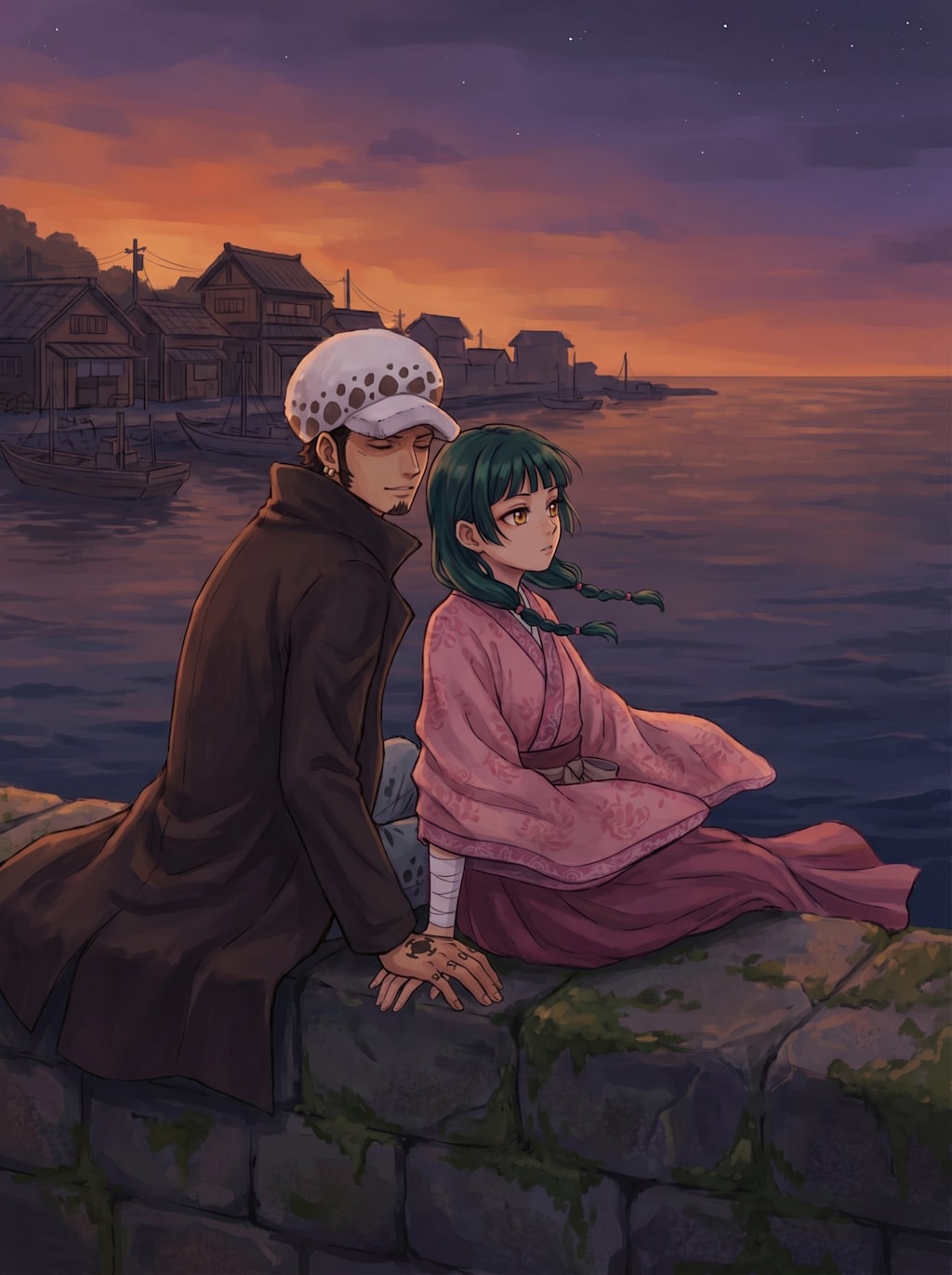
They sat on a low stone wall at the edge of the village one evening, watching the sky bleed from orange to purple over the sea. The air tasted clean. The bells from the shrine on the hill were silent.
“Not bad,” Law said.
“For a demon and an apothecary,” Maomao said. “It will have to do.”
They were both bone-tired. The kind of exhaustion that went past the body and sank into the joints of the spirit. But under the fatigue, there was a taut, humming satisfaction.
“We should go to the shrine,” she said, finally speaking the thought that had been circling since the interrogation.
“Yes,” he said.
“When?” she asked.
“When I’m sure the village won’t collapse without us,” he said. “A day or two. The crew can handle most cases now. You trained them well.”
“I trained the villagers,” she corrected. “Your crew just carry heavy things.”
He snorted softly.
“Still useful,” he said.
“A little,” she allowed.
A gull cried overhead. The wind tugged at her hair, at his coat.
“You’re thinking about going back,” he said, not as an accusation.
“Yes,” she said. “And about staying.”
He was quiet for a moment.
“Do you regret coming here?” he asked.
She thought of the first humming tilt of the storeroom, of waking in the grass, of bruises blooming under strangers’ skin. Of the Polar Tang’s hum. Of inked hands and the taste of medicine on his breath when he leaned too close.
“No,” she said. “That would be an inaccurate description.”
“Do you regret almost dying here?” he asked.
She lifted her bandaged arm.
“Not yet,” she said. “Ask me again if I lose the hand.”
He huffed.
“If you go back,” he said slowly, “you’ll probably never see this place again.”
“Probably,” she said.
“And if you stay,” he said, “you might never see your world again.”
“Also probably,” she said.
“You’re very calm about that,” he said.
“I’m not calm,” she said. “I’m just…thinking in longer lines.”
He turned his head to look at her.
“And what do those lines say?” he asked.
“That nothing stays still,” she said. “Worlds. People. Even doors. If this one opened once, it might open again. If it doesn’t, then I still have work to do wherever I am.”
He watched her for a long moment, something unreadable in his eyes.
“You’re infuriatingly reasonable,” he said.
“Thank you,” she said.
“It wasn’t a compliment,” he added.
“It still applies,” she replied.
He looked away, toward the dark line of cliffs in the distance where the old shrine waited.
“When you’re ready,” he said, “we’ll go see your door.”
She followed his gaze.
“I am never ready,” she said. “I just go.”
He almost smiled.
“That tracks,” he said.
They sat in silence until the stars began to appear, one by one, over a sea that belonged to his world and, for the moment, to hers too.
Maomao slid her hand along the stone, just close enough that the back of her fingers brushed his.
He didn’t move away.
For now, that was enough.
About the Creator
Sun Pirate Essasys
I write about what One Piece teaches us about politics, trauma, community, and the real world we live in — and I write cross‑anime fanfiction about tired adults, found family, and slow‑burn healing (Sanji × Tohru, Law × Maomao, and more).
Enjoyed the story? Support the Creator.
Subscribe for free to receive all their stories in your feed.
Comments
There are no comments for this story
Be the first to respond and start the conversation.