
Past Lives
Media Literacy Movie Review


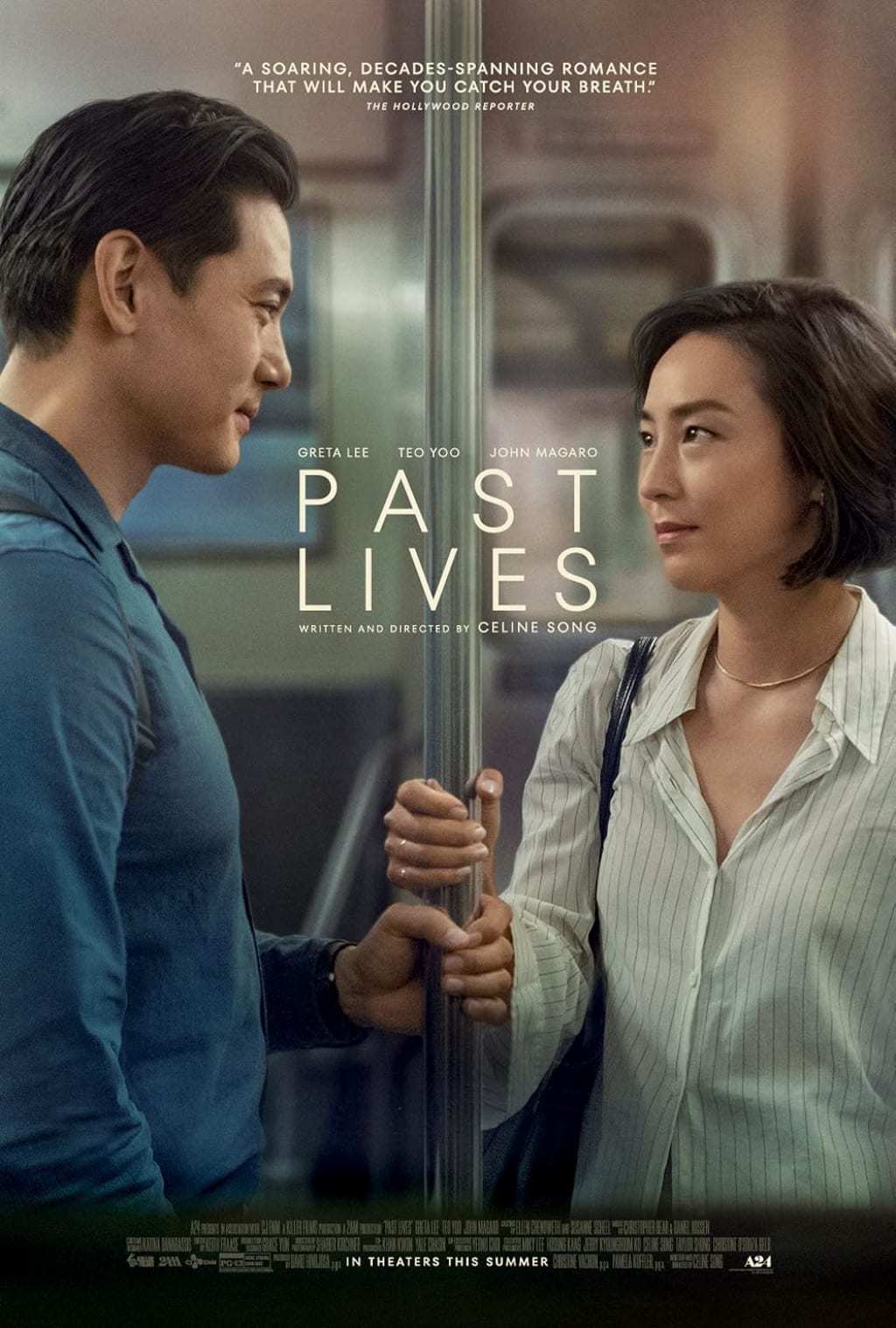
I watched this movie on the plane from Rome to New York almost a year ago. I started writing this story by getting the image, putting in the title and the first sentence. However, I never got around to actually writing it up until this week when in my Intercultural Communication course I used the movie clip as an illustration of non-verbal communication in different cultures. The memories and feelings of the movie flooded and urged me to return to this review. So I will try to point out some of the ways the movie affected me at the four distinct levels from the media literacy perspective:
Cognitive dimension (What have I learned from the movie that I didn’t know before?)
The plot of the movie is semi-autobiographical and inspired by the real life story of the movie's director and screenwriter Celine Song. It is a romantic drama that starts in South Korea and follows two 12-year-old classmates - a girl named Na Young and a boy Hae Sung - who were set up on a "date" by their mothers and quickly developed a strong connection. Unfortunately for both of them, shortly after Na Young is being taken away by her family to immigrate to Canada. There is a heart-breaking scene where Na Young breaks the news of her departure to Hae Sung where not much is said but a lot is felt through eye-gazing and teenage awkwardness.
They both live separate lives from then on. However, 12 years later Hae Sung, who is now out of the military service and dating a young woman he is going to marry, tries to find Na Young without knowing that she changed her name to Nora. Nora accidentally finds out about his attempts to re-connect and they start communicating on Facebook. Their video calls suggest that the feelings are still there and they discuss meeting in person but Nora abruptly tells that she is going to a writing retreat where unbeknownst to her she would meet her American husband named Arthur and eventually move to New York.
Twelve more years later, Hae Sung, who is no longer with his girlfriend, tracks Nora down again and goes to New York to meet with her. Nora's husband, an empathetic, sensitive and somewhat insecure Jewish American (I'm not sure why that was emphasized in the movie but it was, perhaps to add another cultural level of complexity) wonders if he is going to be a roadblock to Nora's true love and if she had married him only for a green card. To reassure him, Nora takes Arthur to the bar where she was to meet with Hae Sung. In that bar scene we realize that both men love Nora and are deeply committed to her. At the same time they develop respect and empathy for each other.
If you want to watch the movie and don't like spoilers, stop here. It is impossible to not give out the plot completely without mentioning it has another heart breaking good-bye scene where Hae Song, after a long, teary and tense eye gazing asks Nora, "What if it is also one of our past lives and we are already something different for each other in the next one?" Nora says "I don't know," and he responds, "I'll see you later" (which was not even subtitled in the movie and I had to ask my Korean students what he said), and gets into the taxi to leave. Nora goes back to anxiously waiting Arthur who was still afraid that she might leave him for her Korean love. Nora breaks down and weeps in his embrace.
So, you can probably tell I was fascinated by this deeply personal human story that is both simple (boy meets girl, girl leaves, boy finds her twice, girl does not follow him when asked) and complicated in its span of different cultures and geographies. It is a true indie gem.
Affective dimension (How did the movie make me feel, which emotions did it evoke?)
I was empathetic to all three main characters - Na Young/Nora, Hae Sung and Arthur and could see how they were all affected by this life-long bond, each in a different way. The parting scenes had me in tears both times (on a plane, nonetheless, next to my son who was sleeping most of the flight and woke up to check on me: "Why are you crying, mama? Watching Past Lives? Makes sense, it's a really good movie!").
I was also fascinated by the behavior of people from different cultures: low-context (American) vs high-context (Korean) and the way the cultures regulate haptics (touch behavior and PDA). I know this sounds too academic, but it is basically about how people communicate and express their feelings in open and straightforward ways, using appropriate touch (American culture) and non-verbal communication, specifically long eye-gazing, implications and subtlety of touch-less behavior (Korean culture).
Finally, I was feeling for Nora, who as a bi-cultural person had to navigate both cultures and explain the differences to her husband along the lines of "He is really Korean," suggesting that Hae Sung is different. When Arthur points out that Nora is Korean as well, she says, "It's different. I have a lot of Korean friends here, and they are not like him. He is REALLY Korean, and I almost forgot how it is." Somehow, that consoles Arthur.
Aesthetic dimension (How did the movie give me the aesthetic pleasure?)
It is a beautifully shot movie with masterfully directed close-ups and restraint on character's behavior in public: "No touching!" the director had to repeatedly remind the lead actors. There's a scene where they ride the New York subway and their hands accidentally slightly touch in movement while they are holding on to a steel bar. The electric charge there is almost palpable, just as when they give each other the awkward welcome and lingering good-bye hugs bracketing their New York encounter. The movie is set in both Seoul and NYC, so the urban aesthetic is prominent as a background to the story. It's a feast for your eyes on many levels.
Moral dimension (What moral and ethical lessons does the movie teach us?)
Ultimately, the movie is about love, commitment, and loyalty. Nora was facing an impossible choice and she made it, at an incredibly high cost to her soul. But I can't stop wondering what would have happened if she'd made a different choice.
In general, I highly recommend this as a beautiful, contemporary and exceptionally well-executed movie that is a good illustration of intercultural communication. Here's the scene I showed to my students in class:
About the Creator
Lana V Lynx
Avid reader and occasional writer of satire and short fiction. For my own sanity and security, I write under a pen name. My books: Moscow Calling - 2017 and President & Psychiatrist
@lanalynx.bsky.social
Enjoyed the story? Support the Creator.
Subscribe for free to receive all their stories in your feed. You could also become a paid subscriber, letting them know you appreciate their work.
Comments
There are no comments for this story
Be the first to respond and start the conversation.