
Notorious at 80: Love, Suspicion, and Poison in Hitchcock’s World
A stylistic and political reading of Notorious

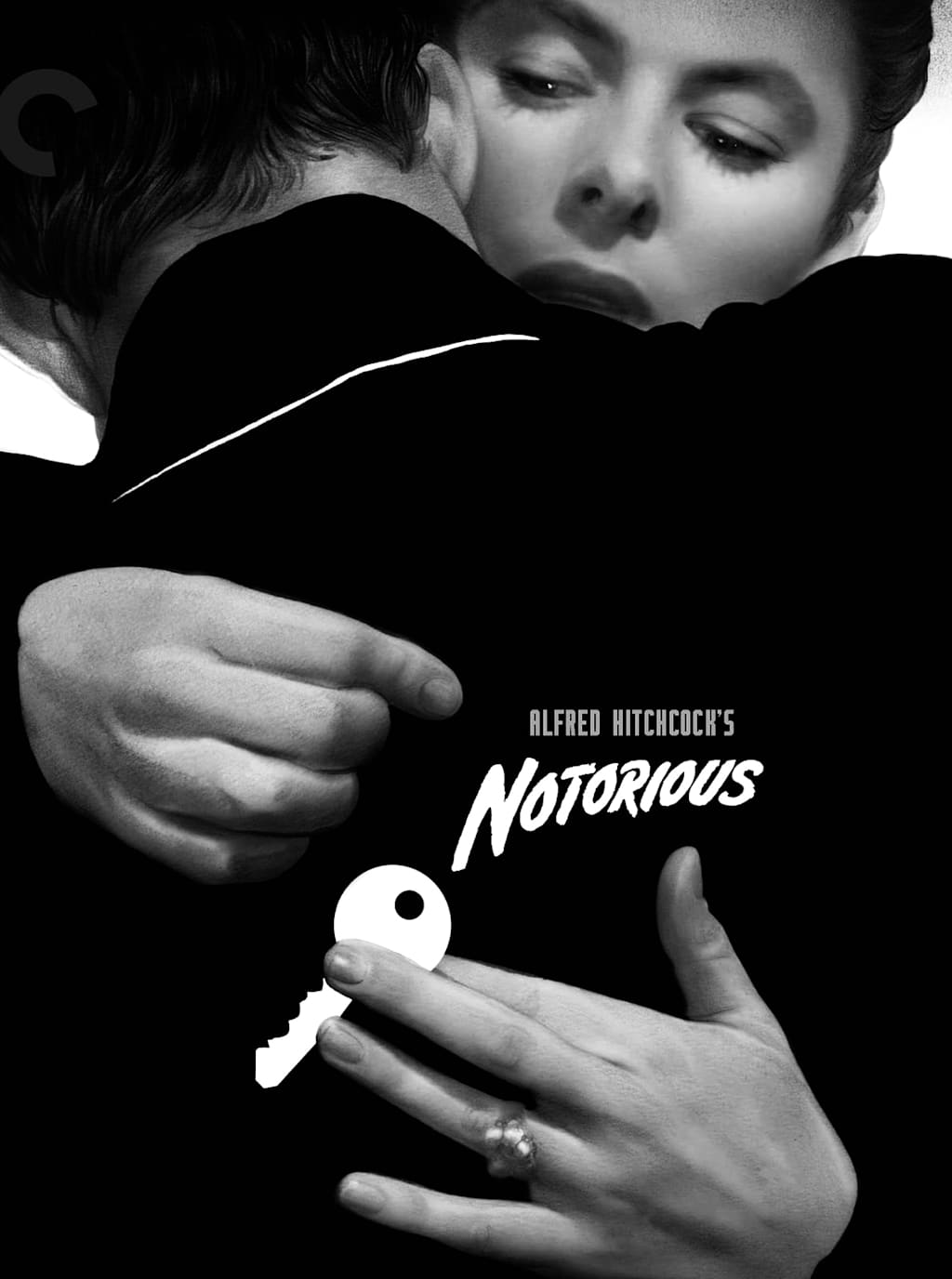
A Matter Of Trust
A U.S. intelligence agent named T.R. Devlin recruits Alicia Huberman, the daughter of a convicted German war criminal, to assist in a clandestine mission targeting a network of Nazi collaborators in postwar South America. Reluctantly drawn into the operation, Alicia is tasked with investigating Alexander Sebastian, a former Nazi sympathizer with ties to that group. As Devlin guides her from the shadows, their professional alliance becomes entangled with suspicion, loyalty, and desire. Caught between duty and manipulation, Alicia is forced to navigate an environment where trust is fragile and every relationship conceals the possibility of betrayal.
A Cast Defined By Tension
Cary Grant delivers one of the most restrained performances of his career as T.R. Devlin, portraying the operative with a stoic professionalism that conceals deep emotional conflict beneath his composed personality. His performance gives the film much of its emotional edge, balancing humanity with quiet detachment.
Ingrid Bergman gives Alicia Huberman both elegance and emotional depth, balancing sophistication, vulnerability, and resilience throughout the film. Her charm allows Alicia to move naturally through the Nazi social circles, while subtly conveying her isolation and exploitation within the assignment. Furthermore, Claude Rains delivers a remarkably fragile interpretation of Alexander Sebastian, transforming him from a conventional antagonist into a tragically sympathetic figure.
Louis Calhern portrays Paul Prescott, Devlin’s superior, with a stern yet composed authority that reinforces the film’s atmosphere of secrecy and political calculation. The supporting cast, including Leopoldine Konstantin as Madame Anna Sebastian, Reinhold Schünzel as Dr. Anderson, and Ivan Triesault as Eric Mathis, further strengthens the film’s sense of paranoia and mistrust.
Moments Beneath The Suspicion
The film opens with Alicia Huberman’s father, John, being convicted of treason against the United States for aiding Nazi activities during the war. Hitchcock immediately establishes an atmosphere of public shame and political tension, putting Alicia in the shadow of her father’s crimes while setting the emotional foundation for the story that follows.
One of the film’s most revealing moments occurs when T.R. Devlin recruits Alicia for the mission in Brazil. Although Alicia initially resists becoming involved in the operation, Devlin pressures her into cooperating by reminding her of her troubled relationship with her father and her desire to forge her own path.
The emotional tension deepens further when Alicia realizes the mission may require her to marry Alex Sebastian in order to maintain her cover. As the American intelligence operatives discuss the plan with detached pragmatism, Hitchcock exposes the emotional cost of espionage and the quiet cruelty beneath Devlin’s emotional restraint.
Another standout moment takes place during the wine cellar sequence at Sebastian’s mansion. While guests gather downstairs during an elegant social event, Alicia and Devlin secretly investigate the cellar in search of evidence connected to the Nazi conspiracy. Hitchcock evokes suspense through silence, timing, and confinement, transforming a simple search into one of the film’s most memorable scenes.
The climax reaches its emotional peak when Devlin rescues Alicia from Sebastian’s mansion after discovering she has been slowly poisoned. Carrying her past the suspicious conspirators, Devlin finally abandons inhibition, bringing the film’s cynical tone to a haunting close.
Secrets Behind The Shadows
Notorious remains one of Alfred Hitchcock’s most fascinating productions, filled with behind-the-scenes stories that continue to intrigue longtime admirers of the film. According to the trivia section of the movie’s IMDb page, Claude Rains stood on a box during several scenes opposite Ingrid Bergman in order to create the illusion that he appeared taller on screen. The detail created the strange effect of both Rains and Grant appearing taller than Bergman, despite Grant actually being taller than Rains in reality. The decision subtly reinforced Alexander Sebastian’s authority and intimidating presence within Hitchcock’s climate of suspicion and control.
Another widely discussed story surrounding the production involves the film’s use of uranium as part of the Nazi conspiracy. According to Hitchcock, the FBI kept a close watch on the project because information surrounding uranium and atomic research remained highly sensitive during the mid-1940s. The public would not fully understand the significance of atomic development until after the bombings of Hiroshima and Nagasaki and the eventual revelation of the Manhattan Project.
The film’s famous kissing sequence between Cary Grant and Ingrid Bergman also presented unexpected challenges during filming. Grant and Bergman reportedly found the scene difficult to shoot because of the intricate blocking Hitchcock required across multiple extended takes. The sequence would later become one of the film’s most iconic moments, further highlighting the chemistry between the two performers and Hitchcock’s meticulous attention to visual detail.
After production ended, Cary Grant kept the iconic UNICA key prop before later giving it to Ingrid Bergman as a good luck charm. Years afterward, Bergman presented the key to Hitchcock during a tribute honoring the famed director.
Beneath the Surface of Suspicion
Trust remains one of the central themes explored throughout Notorious. Alicia infiltrates the social circle of Alexander Sebastian, eventually marrying him in order to gather information about a hidden network of Nazi collaborators operating in postwar South America. Hitchcock presents espionage as an environment built upon deception, secrecy, and emotional vulnerability. The fragile nature of trust becomes even more apparent once Sebastian discovers the broken wine bottle hidden within his cellar and realizes Alicia has been working undercover for the American government. After revealing the truth to his mother, the two quickly begin planning Alicia’s death through slow poisoning, transforming the marriage into a prison built on paranoia and betrayal.
Another major theme explored in the film is the conflict between love and duty. T.R. Devlin remains committed to his responsibilities as an American intelligence agent, yet he struggles to suppress his growing feelings throughout the mission. His inner turbulence becomes most apparent when Alicia agrees to marry Alexander Sebastian in order to maintain her cover, a decision Devlin silently accepts despite the emotional distress it causes to both of them. Rather than openly expressing his feelings, Devlin distances himself, creating much of the film’s romantic tension.
Patriotism also plays an important role within the story’s postwar backdrop. Although the mission is framed as an act of national duty against former Nazi conspirators, Hitchcock portrays the American intelligence operatives as morally ambiguous characters willing to manipulate Alicia for strategic purposes. Alicia herself openly rejects blind patriotism early in the film, telling Devlin “I don’t go for patriotism or patriots.”
A Kiss, a Key, and a Legacy
Nearly eighty years after its release, Notorious continues to leave a lasting influence on modern cinema through its combination of romance, espionage, and psychological tension. Elements of the film can be found in other thrillers such as Mission:Impossible 2, particularly the storyline involving Nyah Hall being assigned to spy on her former lover, Sean Ambrose, which mirrors Alicia Huberman’s infiltration of Alexander Sebastian’s world. Filmmakers such as Martin Scorsese have also cited Alfred Hitchcock’s work as a major influence on their visual storytelling. Scorsese especially admired the intimacy and fluid camera movement found in the famous kissing sequence between Bergman and Grant, techniques that would later influence scenes in films such as Goodfellas.
Through its atmosphere of suspicion, emotional restraint, and moral ambiguity, Notorious remains one of Hitchcock’s most enduring cinematic achievements. Its influence on suspense filmmaking and character-driven thrillers continues to resonate decades later, securing the film’s reputation as one of the defining classics of American cinema.
About the Creator
TheScreenAnalyst
I am a passionate movie and TV enthusiast, devoted to analyzing storytelling, characters, visuals, and performances. I provide thoughtful critiques and insights, exploring both mainstream and independent works to engage audiences.
Enjoyed the story? Support the Creator.
Subscribe for free to receive all their stories in your feed.
Comments
There are no comments for this story
Be the first to respond and start the conversation.