
'No Wire Hangers… Ever': 45 Years of Hollywood’s Most Unhinged Fashion Rule
How one furious closet raid turned Mommie Dearest into a camp classic—and briefly made coat hangers a matter of national importance.

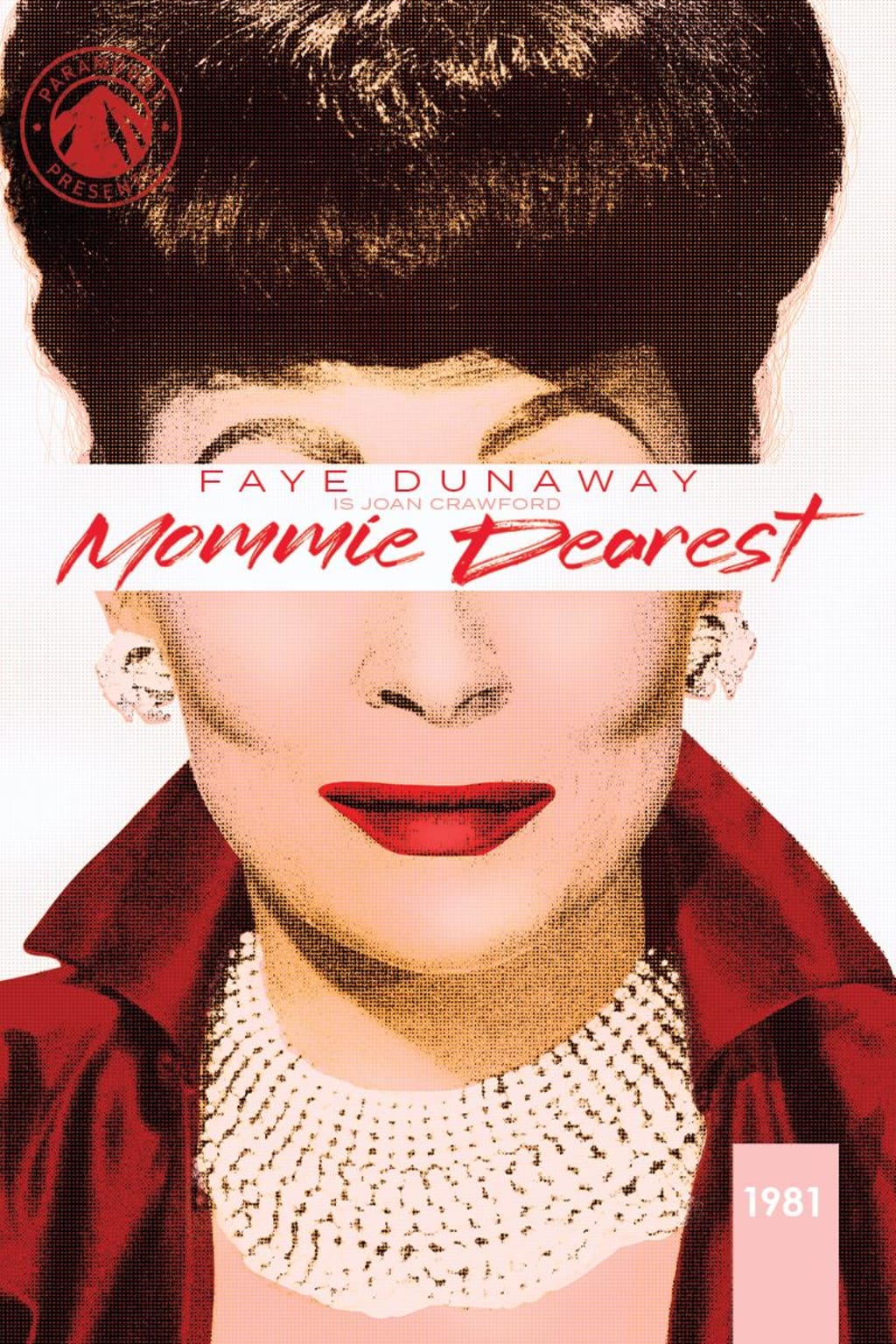
45 years after Mommie Dearest, the infamous “No wire hangers… ever!” scene remains a camp classic. Explore the movie’s marketing, real-world hanger debate, and cultural legacy.
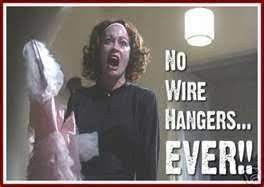
There are movie lines that become famous because they are beautiful.
There are movie lines that become famous because they are profound.
And then there is:
“No wire hangers… ever!”
Forty-five years after Mommie Dearest arrived in theaters, Joan Crawford’s greatest contribution to American culture may not be her movies, her Oscar, or even her eyebrows.
It may be the fact that an entire generation learned to regard a perfectly innocent coat hanger as a potential instrument of domestic terror.
Somewhere, a dry cleaner is still explaining to a customer that the wire hanger is perfectly safe.
Somewhere else, a mother is opening a closet and wondering why the pink-and-white party dress is still hanging there.
And somewhere in Hollywood, a marketing executive is still regretting the day he discovered that audiences were laughing at a movie that was supposed to make them cry.
Happy 45th anniversary, Mommie Dearest.
Please put the good dresses on padded hangers.
The Scene That Ate the Movie
For anyone who has somehow avoided the cultural event that is Mommie Dearest, the scene is simple.
Joan Crawford, played by Faye Dunaway, discovers that her young adopted daughter has left a dress on a wire hanger.
This is not a minor wardrobe violation.
This is a declaration of war.
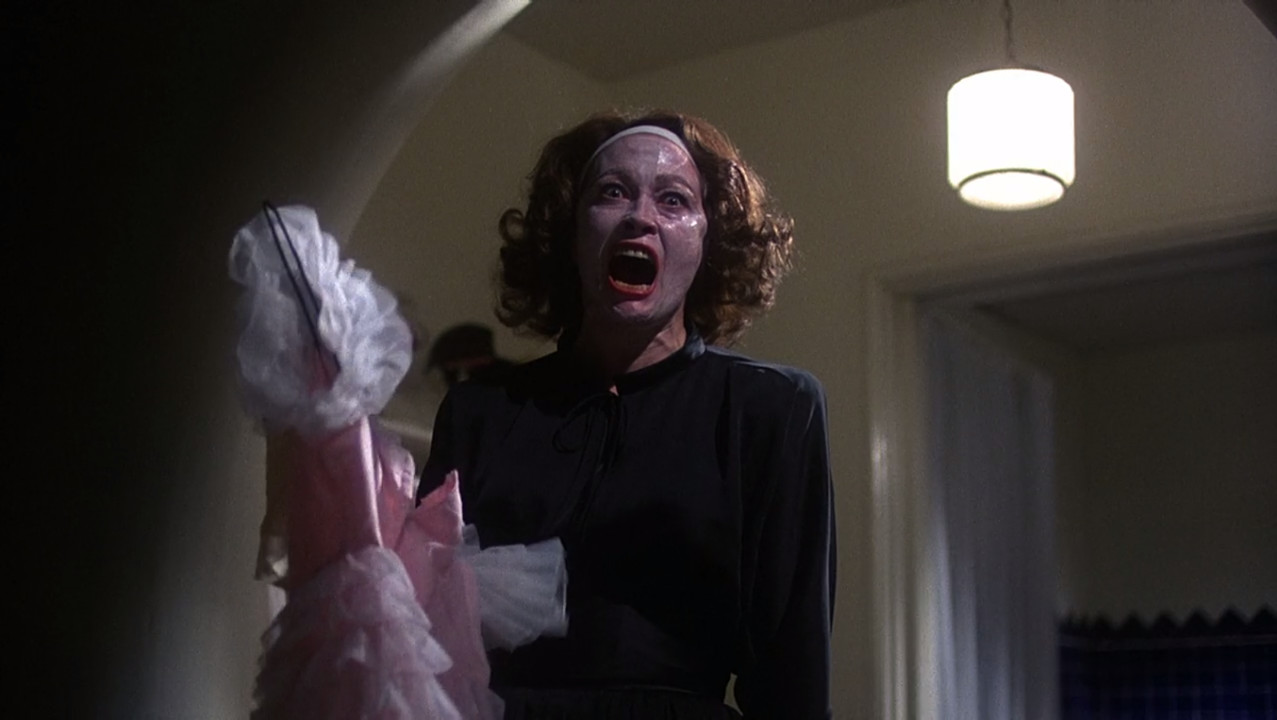
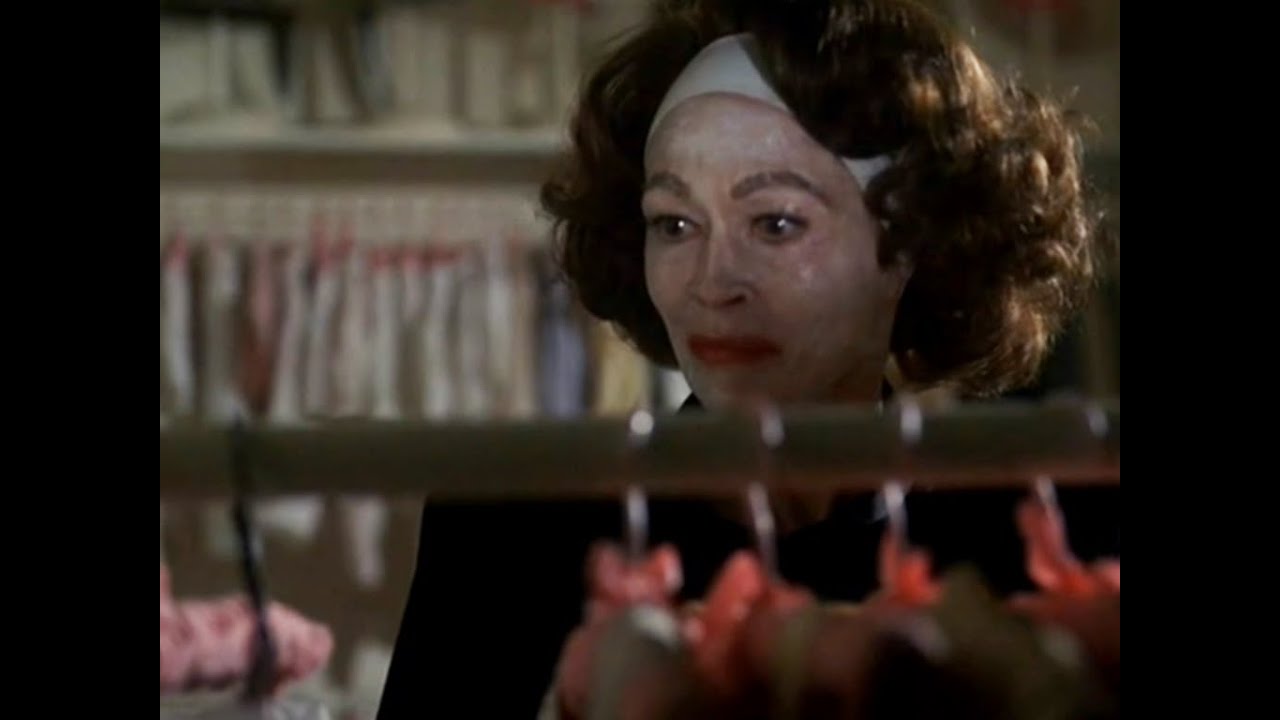
Crawford enters the closet, already looking like she has been awake for three days and has personally declared war on sleep. Her face is smeared with cold cream. Her mouth is horribly smeared with lipstick.
She finds the dress.
She finds the hanger.
And then she finds God.
Or at least, she finds something to scream at.
“You treat them like they were some kind of dishrag!”
The dress is waved. The child is confronted. The hanger becomes a symbol of everything wrong with the world.
And then comes the line.
“No wire hangers… ever!”
The scene ends with Crawford beating the child on the back and shoulders with the hanger.
It is, in its own way, a remarkable piece of filmmaking.
It is also one of the funniest scenes in American cinema.
That is not necessarily what director Frank Perry or producer Frank Yablans had in mind.
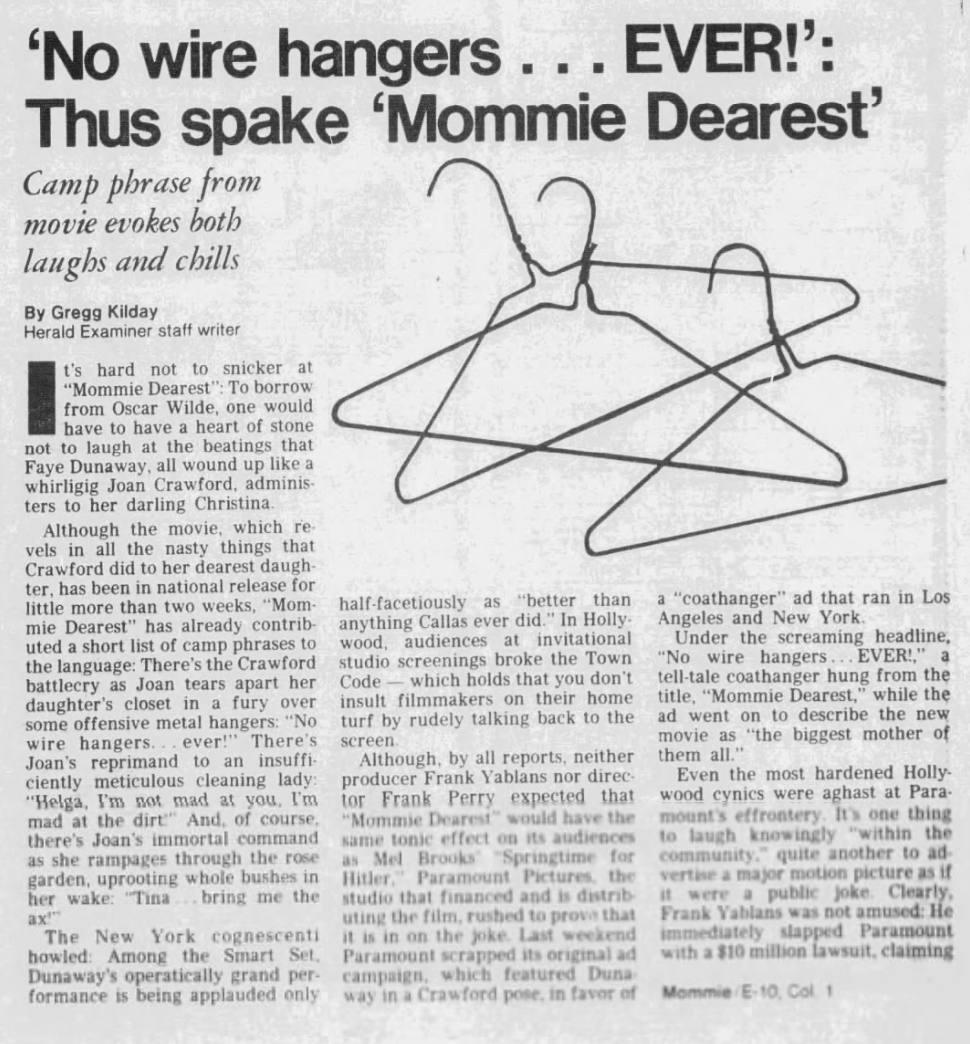
Two weeks after the film opened, Herald Examiner writer Gregg Kilday noted that Mommie Dearest had already “contributed a short list of camp phrases to the language.”
At the top of the list?
The wire hangers.
And audiences were not merely chuckling at the scene. They were turning it into a cultural event.
As Kilday observed, it was “hard not to snicker” at the movie’s increasingly outrageous behavior. Borrowing from Oscar Wilde, he suggested that one would need “a heart of stone not to laugh at the beatings.”
That is a sentence that tells you everything you need to know about the film’s immediate reception.
The other instant classics included:
“Helga, I’m not mad at you, I’m mad at the dirt.”
And, of course:
“Tina… bring me the ax!”
There are movies that inspire serious discussion about the human condition.
Mommie Dearest inspired people to yell about hangers.
Hollywood Realizes It Has Made a Comedy
The story behind the film’s marketing is almost as entertaining as the film itself.
Mommie Dearest was not supposed to be a camp classic.
It was supposed to be a serious drama about the troubled relationship between Hollywood legend Joan Crawford and her adopted daughter, Christina Crawford.
The source material was Christina Crawford’s bestselling 1978 memoir, Mommie Dearest, which detailed allegations of abuse and the difficult relationship between mother and daughter.
The film arrived with the kind of prestige machinery that Hollywood loved in the late 1970s and early 1980s.
A famous actress.
A bestselling book.
A major studio.
A story about the darker side of fame.
And Faye Dunaway, who had already established herself as a serious dramatic performer, taking on one of Hollywood’s most recognizable figures.
What could go wrong?
Well, the audience could laugh.
And laugh they did.
Kilday reported that Paramount quickly realized the movie was being received as something other than the serious drama it had intended to release.
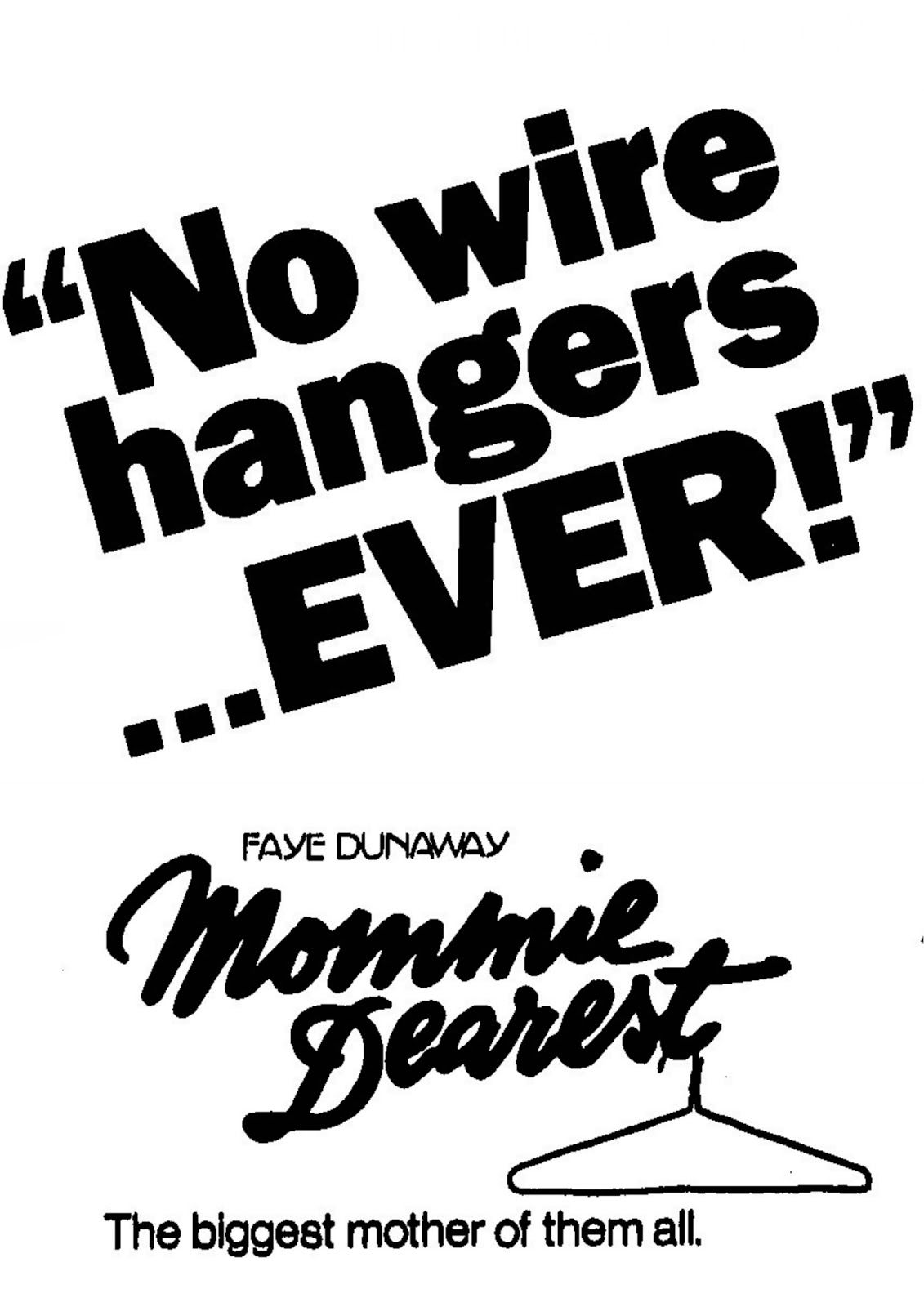
The studio scrapped its original campaign and ran a new “coathanger” advertisement under the screaming headline:
“NO WIRE HANGERS… EVER!”
The ad described the movie as “the biggest mother of them all.”
It is difficult to imagine a more perfect example of Hollywood trying to catch up with its own audience.
The studio had made a movie about a troubled mother.
The audience had discovered a woman who could turn a closet into a crime scene.
Producer Frank Yablans was reportedly “not amused.”
According to Kilday, he “immediately slapped Paramount with a $10 million lawsuit.”
The film’s screenings had already become a problem. Audiences were reportedly breaking the “Town Code” by laughing out loud at the drama unfolding on screen.
This is the sort of thing that makes Hollywood nervous.
Not because people are laughing.
Hollywood loves laughter.
Hollywood becomes nervous when people are laughing at the wrong thing.
The studio had intended to sell a serious story about abuse and celebrity. Instead, it had created a movie where the most memorable image was an adult woman losing her mind over a coat hanger.
And once that image escaped into the culture, there was no getting it back.
Were Wire Hangers Really That Bad?
Here is where the story gets even better.
Because in 1981, while Mommie Dearest was becoming a camp phenomenon, the real-world wire-hanger industry was apparently having a conversation about whether Joan Crawford had a point.
This is not a joke.
This actually happened.
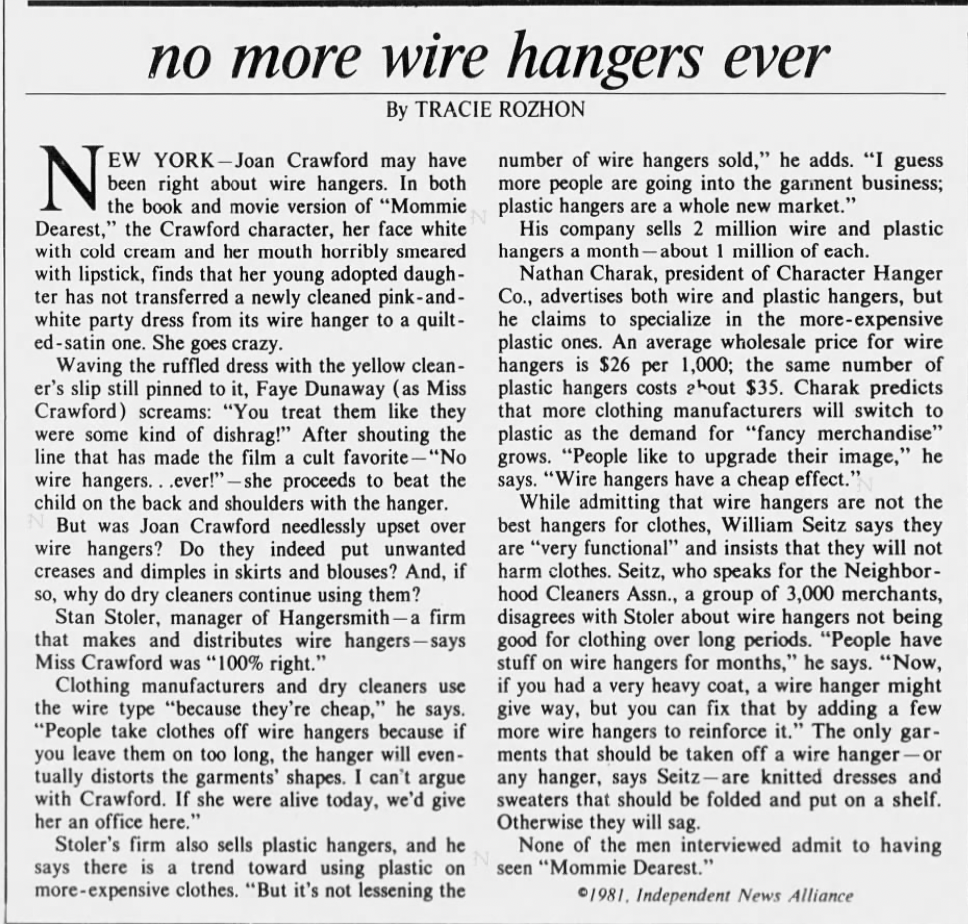
In a 1981 article by Tracie Rozhon, published by the Independent News Alliance, the question was posed directly:
“Joan Crawford may have been right about wire hangers.”
I love this sentence.
It begins as a joke and then immediately becomes consumer journalism.
The article explored whether wire hangers really did damage clothing, and the people interviewed had opinions.
Strong opinions.
Stan Stoler, manager of Hangersmith, a company that made and distributed wire hangers, declared that Miss Crawford was “100% right.”
“Clothing manufacturers and dry cleaners use the wire type ‘because they’re cheap,’” he explained.
“People take clothes off wire hangers because if you leave them on too long, the hanger will eventually distort the garments’ shapes. I can’t argue with Crawford. If she were alive today, we’d give her an office here.”
There is something wonderfully absurd about a hanger manufacturer using Mommie Dearest as a reference point for sound clothing-storage policy.
But Stoler was not alone.
Nathan Charak, president of Character Hanger Co., explained that his company sold both wire and plastic hangers, but specialized in the more expensive plastic variety.
The reason?
“Fancy merchandise.”
Charak predicted that more clothing manufacturers would switch to plastic as demand for “fancy merchandise” grew.
“People like to upgrade their image,” he said.
“Wire hangers have a cheap effect.”
Which is perhaps the most Joan Crawford sentence ever spoken by a man who sells coat hangers.
The message was clear.
Plastic hangers were not merely practical.
They were aspirational.
They said, “I care about my clothes.”
They said, “I have a closet.”
They said, “I am not going to be beaten with a hanger.”
The Hanger Industry Fights Back
But not everyone agreed that wire hangers were the devil.
William Seitz of the Neighborhood Cleaners Association, a group representing 3,000 merchants, pushed back against the idea that wire hangers were bad for clothing.
Seitz called them “very functional” and insisted they would not harm clothes.
“People have stuff on wire hangers for months,” he said.
And honestly?
He had a point.
Most of us have clothes on wire hangers for years.
Some of us have clothes on wire hangers that we have not worn since the Reagan administration.
Some of us have clothes on wire hangers that no longer fit, no longer resemble our personal style, and may actually be older than the people currently wearing them.
The wire hanger is not necessarily the enemy.
It is simply the hanger that has been there.
Seitz did concede that heavy coats could cause problems.
“Now, if you had a very heavy coat, a wire hanger might give way, but you can fix that by adding a few more wires to reinforce it.”
This is where the article becomes a beautiful collision between Hollywood melodrama and practical engineering.
Joan Crawford: “No wire hangers… ever!”
William Seitz: “You can reinforce it.”
The only garments that should be removed from a hanger, Seitz said, were knitted dresses and sweaters that should be folded and placed on a shelf.
Otherwise, they would sag.
Which is a perfectly reasonable argument.
And yet, after watching Dunaway scream at a child over a hanger, I suspect most viewers were not in the mood for a nuanced discussion of garment maintenance.
Rozhon’s article ends with the perfect deadpan observation:
“None of the men interviewed admit to having seen ‘Mommie Dearest.’”
Of course they hadn’t.
They were men in the hanger business.
They had reputations to protect.
Did Mommie Dearest Hurt the Wire-Hanger Industry?
This is the question I wish someone had followed up on.
Did the movie actually hurt sales of wire hangers?
Did plastic hangers suddenly become more popular?
Did people walk into dry cleaners and demand that their clothes be transferred to plastic?
Did anyone ever say:
“I don’t care if it costs more. I’m not putting my dress on one of those things.”
According to Stoler, the trend toward plastic was not lessening the number of wire hangers sold.
“I guess more people are going into the garment business,” he said.
This is a spectacularly dry response to a question that seems to have been inspired by a movie.
And it raises another possibility.
Maybe Mommie Dearest was the best free advertising the hanger industry ever received.
Think about it.
Before the film, a hanger was a hanger.
After the film, a hanger had a personality.
A wire hanger was cheap.
A plastic hanger was fancy.
A padded hanger was apparently the only thing standing between you and a nervous breakdown.
And suddenly, everybody had an opinion.
This is the kind of publicity most companies would pay for.
Of course, there is a difference between a product becoming famous and a product becoming desirable.
Nobody was buying wire hangers because they wanted to be Joan Crawford.
They were buying them because they were cheap.
And because, as Seitz pointed out, they were functional.
But the movie gave them a cultural identity.
And that is not nothing.
The Modern Closet Confessional
Forty-five years later, the line still works.
That is the remarkable thing about Mommie Dearest.
You can forget the plot.
You can forget the names of the characters.
You can forget what year it was released.
But you will remember the hanger.
You will remember the face.
You will remember the cold cream.
And you will remember the way Dunaway delivers the line as if the future of civilization depends on the proper storage of a party dress.
The line has become shorthand for a very specific kind of rage.
Not ordinary anger.
Not even ordinary parental anger.
This is anger that has become an event.
The sort of anger that requires a camera crew, a costume department, and a $10 million lawsuit.
It is the rage of someone who has been pushed too far by the world, and the world happens to be a coat hanger.
And yes, I understand the absurdity of it.
There is real pain behind Mommie Dearest. Christina Crawford’s allegations were not a joke, and the film’s portrayal of abuse was not intended to be funny.
But the film’s cultural afterlife is a different story.
Audiences took the movie’s excesses and turned them into camp.
They found the theatricality, the screaming, the melodrama, and the sheer commitment to every emotional beat almost impossible to take seriously.
And once that happened, the hanger was no longer just a hanger.
It was a symbol.
A symbol of Hollywood excess.
A symbol of parental rage.
A symbol of the moment when a serious movie accidentally became something else.
And perhaps, most importantly, a symbol of the fact that sometimes the audience gets to decide what a movie is going to be.
A Toast to the Hanger
There are movies that age gracefully.
There are movies that become classics.
There are movies that disappear.
And then there are movies like Mommie Dearest, which somehow become more famous with every passing year.
The film is now 45 years old, and the wire hanger remains one of the most recognizable objects in movie history.
That is a remarkable achievement for a piece of bent metal.
It is also a reminder that Hollywood cannot always control the life of a movie once it has been released.
Sometimes the audience finds the joke.
Sometimes the audience finds the camp.
Sometimes the audience finds the thing that the studio never intended to sell.
And sometimes that thing is a coat hanger.
So raise a glass to Mommie Dearest.
Raise a glass to Faye Dunaway’s cold cream.
Raise a glass to Joan Crawford’s closet.
Raise a glass to the men who sold wire hangers and insisted that they were “very functional.”
And raise a glass to the fact that, 45 years later, we are still talking about this.
Just make sure the glass is not hanging from a wire hanger.
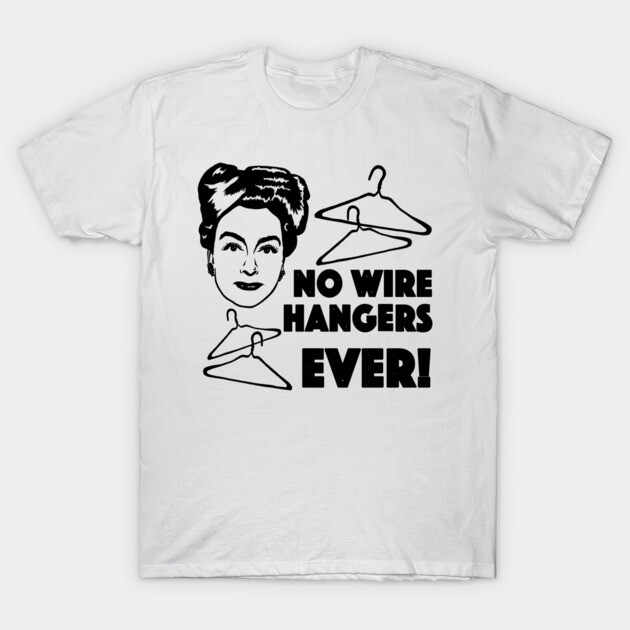
No wire hangers… ever.
Or at least, not for the good dresses.

About the Creator
Movies of the 80s
We love the 1980s. Everything on this page is all about movies of the 1980s. Starting in 1980 and working our way the decade, we are preserving the stories and movies of the greatest decade, the 80s. https://www.youtube.com/@Moviesofthe80s
Enjoyed the story? Support the Creator.
Subscribe for free to receive all their stories in your feed.
Comments
There are no comments for this story
Be the first to respond and start the conversation.