
No Retreat No Surrender: A Forgotten 80s Martial Arts Film Worth Discovering
An in-depth retrospective on an obscure 80s martial arts film four decades later.

Enter The Dragon’s Shadow
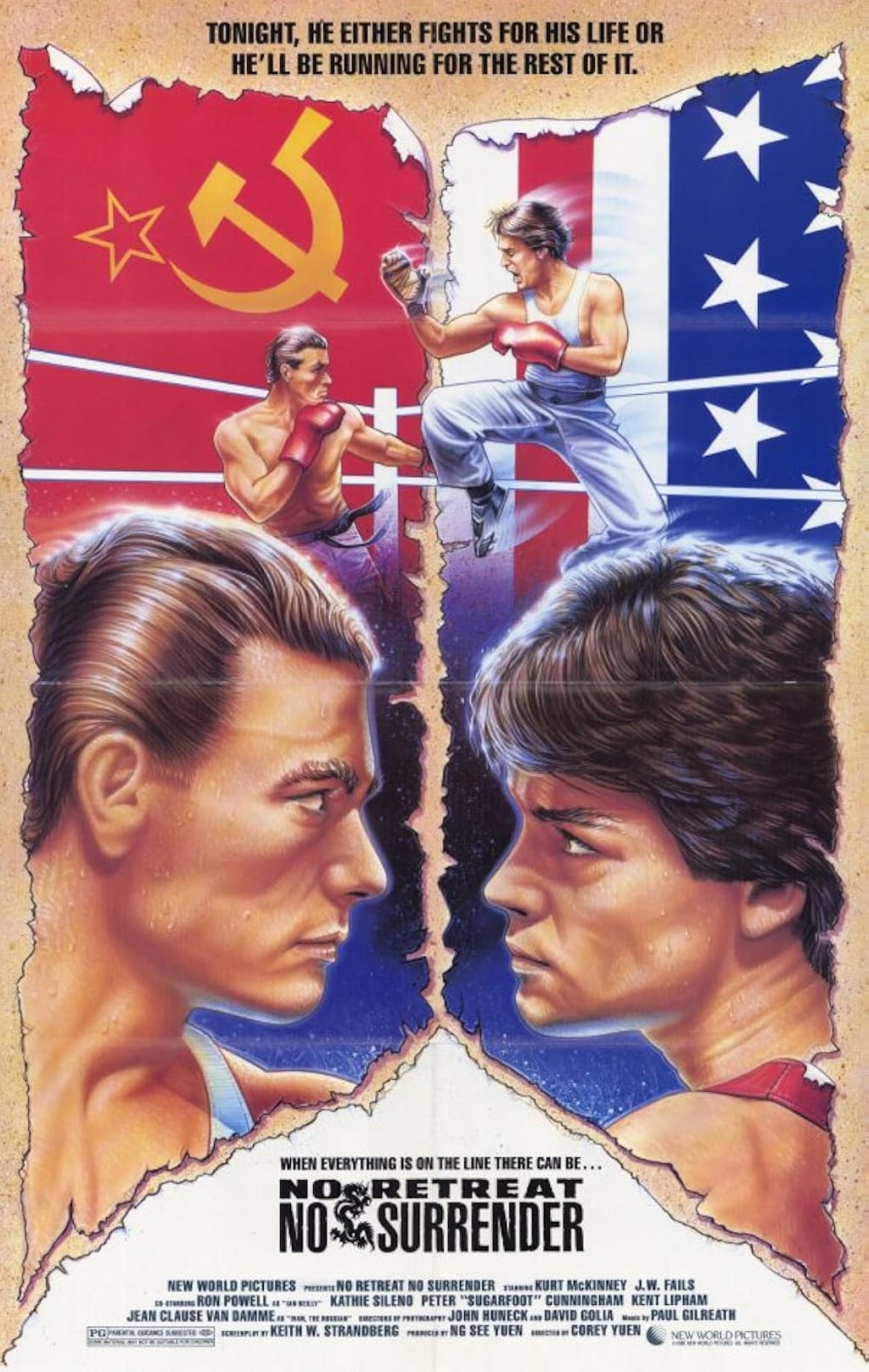
Jason Stillwell, a teenage Bruce Lee fan and martial artist, is forced to relocate to Seattle after his father’s dojo is attacked by a criminal syndicate led by Ivan Kraschinsky. Isolated and bullied in his new home, Jason’s life changes when he visits Bruce Lee’s grave and later meets Bruce Lee’s spirit, who becomes his mentor. Through intense training in discipline, focus, and inner strength, Jason transforms into a determined fighter, preparing himself to face escalating challenges that test his skill, courage, and resilience.
The Warriors Behind The Screen
Kurt McKinney delivers a memorable portrayal of Jason Stillwell as a teenager driven by admiration and perseverance. He brings a believable sense of wonder and resolve to the role, especially in scenes where Jason seeks guidance from Bruce Lee’s legacy. McKinney’s portrayal captures the vulnerability and ambition of a young martial artist striving to prove himself.
Jean-Claude Van Damme presents Ivan Kraschensky with a quiet yet unmistakable menace. Van Damme utilizes presence and physicality to create tension. His calm demeanor and focused movements make him feel deadly before a single strike is thrown.
J.W. Fails portrays R.J. with wit and humor, serving as Jason’s loyal friend and anchor throughout the movie. His comedic presence helps balance the movie’s more intense moments, giving audiences relief while reinforcing the importance of companionship.
Kathie Sileno portrays Kelly with warmth and charm, adding a sense of sincerity to Jason’s romantic subplot. Her performance contributes to the emotional grounding of the film, giving Jason purpose beyond competition and fighting.
The supporting cast also plays a key role in shaping the narrative. Timothy D. Baker delivers a convincing performance as Tom Stillwell, Jason’s father, highlighting the protective instincts shaped by past experiences. Kent Lipham, meanwhile, portrays Scott, the bully who serves as an early obstacle Jason must overcome.
The Hardest Hits and Greatest Fights
The film begins with Tom dismissing his karate class before being approached by members of a criminal organization who attempt to recruit him. When he refuses on moral grounds, a brutal confrontation follows, leaving him with a broken leg at Ivan’s hands— an event that soldifies his aversion to violence.
Later, Jason sees his friend R.J. being harassed by Scott and his cronies. Jason steps in to defend him, marking an early turning point that shows his instinct to stand up for others despite not yet being fully confident in his skillset. It also sows the seeds for the growing conflict between him and his father over when is the appropriate time to resort to fighting.
As the story progresses, Jason undergoes rigorous training guided by the spiritual presence of Bruce Lee. These sequences emphasize discipline, balance, and mental focus rather than reckless aggression, refining the skills he already possesses rather than introducing them from scratch.
The film culminates in a full-contact karate tournament where Ivan Kraschinsky dominates every fighter through aggression and intimidation. Jason intervenes and faces Ivan in a final fight, putting his training, discipline, and personal growth to the ultimate test.
The Film in Different Forms
No Retreat No Surrender exists in at least two widely distributed cuts, each offering slight but noticeable differences in tone, pacing, and character emphasis. In the original international cut, a key early scene features Tom reprimanding Jason after he nearly gets into a confrontation with Scott and his gang outside a fast food restaurant. In this version, Tom dismisses Jason’s side of the story and expresses his anger over his son’s actions, reinforcing his negative stance against unnecessary fighting.
In the shortened U.S. cut, it immediately transitions into a full-contact Karate tournament featuring Ian Reilly. The differences extend into the film’s training sequences as well. In the original version, Jason’s training montage is accompanied by “Hold On to the Vision” while the U.S. cut replaces it with “Stand on Your Own.” The latter gives the montage a more direct, motivational tone that matches Jason’s progression.
There are additional alterations in smaller character moments. The U.S. version includes an extra scene where Jason spends time with his girlfriend Kelly on a date around Seattle, highlighting her personality and interests. The international version also includes a scene where Scott aggressively chases R.J., heightening tension between Jason’s friends and the antagonists.
Conversely, certain transitional or character-building sequences, including moments involving R.J. and Bruce Lee imagery, are absent depending on the version of the movie.
Overall, the U.S. version presents a more serious and focused narrative. The use of “Stand on Your Own” in particular gives the film a stronger motivational identity, reinforcing Jason’s independent growth and making the streamlined cut feel more cohesive in tone.
Cracks in The Fighting Spirit
Although the film succeeds as an 80s martial arts entry, it is not without flaws. One of its main weaknesses lies in the writing, particularly how Tom Stillwell is handled. While his opposition to engaging in combat is understandable given earlier events in the film, he is often unwilling to listen to Jason’s perspective. He quickly jumps to conclusions, making the dispute between father and son feel one-sided.
It’s only after Jason saves him during an attempted mugging does Tom begin to reconsider his stance, which feels like an abrupt shift rather than a gradual change. A more balanced approach could have kept him resistant to needless brawling but still acknowledge self-defense more clearly, given his background as a former karate instructor.
Another issue with the film is that Jason’s school life is never shown or developed. We are not given a sense of his daily environment, classmates, or academic setting, which makes his character feel less grounded and limits the realism of his teenage world. It is also never established what school he attends in Seattle, further limiting the sense of a complete, lived-in environment.
Characterization is another weak point. Scott’s hostility toward R.J. is shown clearly, but the film never fully explains the reason behind it, leaving their antagonistic relationship underdeveloped. Similarly, Kelly’s prior connection to Jason is mentioned without much context, making their romance lacking depth. A stronger script could’ve established Jason and Kelly as childhood friends in Seattle, grounding their bond more naturally.
The same issue can also be seen in Jason’s rivalry with Dean. Their conflict feels largely one-dimensional because it is triggered and escalated through misinformation rather than a fully explored personal history. Scott’s interference — specifically the lies he tells — becomes the catalyst for Dean’s hostility toward Jason at the dojo. While this effectively creates immediate tension, it limits the emotional depth of their conflict. As a result, their fights feel more situational than personal, lacking the narrative buildup of a genuine feud.
The film also relies on unnecessary repetition. A flashback of Jason being kicked by Dean shortly after he drives away from Kelly’s birthday party feels redundant, since the scene has already occurred. Additionally, some narrative payoffs feel missing, such as Jason never truly confronting Dean, Scott, and his cronies after gaining confidence through training with the spirit of Bruce Lee.
Finally, the climax feels somewhat underwhelming. While films like Rocky IV and The Karate Kid build their final confrontations through sustained personal rivalry, Jason’s showdown with Ivan Kraschinsky lacks substance, as the criminal organization fades into the background for much of the middle act, undermining their role in Jason’s journey. A more consistent presence throughout the story would have made the final fight feel earned.
The Lost Karate Tiger Saga
According to an episode of the Art of Action podcast, hosted by Scott Adkins, Kurt McKinney explained that he did not return for No Retreat No Surrender 2: Raging Thunder (1987) due to safety concerns related to filming in Cambodian jungles. While understandable, this decision invites speculation about how Jason Stillwell’s journey might have evolved had he remained the central figure. Placing Jason in foreign settings could have transformed the series into a more adventurous and globally scaled martial arts saga.
The series itself had the potential to rival franchises like Rocky and The Karate Kid if the sequels had continued Jason’s story. In an alternate timeline, the first movie focuses entirely on Jason’s rivalry with Dean Ramsay, with pride and ego as its central themes, expanded into a longer, more developed narrative. Jason is reimagined as an established martial artist trained in Jeet Kune Do and Tang Soo Do, having been trained at his father’s dojo since he was 4 years old, as the Stillwells are reimagined as a martial arts family.
The Stillwells would already be living in Seattle from the start. Their backstory of moving from Los Angeles would be established as an escape from gang violence, with Jason having been five years old at the time.
Jason and Dean would ultimately face each other in a state-sanctioned Tang Soo Do exhibition match at the Seattle Kingdome. In this version, he would be a high school junior at Franklin High School in Seattle, which better aligns with his experience in martial arts and physical maturity.
Jason’s victory over Dean would become a catalyst that exposes him to a more dangerous martial arts world, where reputation and ego define every challenge. This could draw the attention of a secretive traditional dojo led by a shadowy yet deadly master named Katuso Tokugawa, played by Sonny Chiba, who tests Jason’s discipline and control rather than his ability to learn from scratch.
From there, the criminal organization introduced in the background evolves across various entries into a structured global network of fighters. Jason would eventually face a rising elite enforcer in the organization named Vladimir Smirnov (renamed from Ivan Kraschinsky), played by Jean-Claude Van Damme, in a brutal street fight that escalates the stakes of his journey.
In the final reimagined installment, the franchise shifts into a darker, more grounded tone focusing on Jason and his girlfriend Kelly now living together after years of dating, as they face financial difficulties that force him to compete in the Ultimate Combat League, a deadly underground multi-discipline combat tournament, to make ends meet.
This creates tension between the couple, as she sees his participation in a MMA-style competition as dangerous, but ultimately remains supportive. Jason — now trained in styles such as kickboxing, jujutsu, boxing, and catch wrestling in addition to his existing Jeet Kune Do and Tang Soo Do skills — faces top-tier opponents, including a seasoned fighter named Michael Donahue, portrayed by Loren Avedon. The franchise would ultimately evolve into a multi-film universe defined by elite-level competition and escalating mastery of skill.
A Forgotten Warrior Worth Discovering
When people think of 1980s cinema, films like Top Gun, Lethal Weapon, Die Hard, and The Karate Kid often come to mind as defining entries of the decade, yet No Retreat No Surrender is rarely mentioned and has largely faded into obscurity.
Although I am against unnecessary reboots, remakes, and sequels, I would welcome a reinvention that launches a new story for a new generation while honoring the spirit of the original and emphasizing themes such as deep rivalries, evolving fighting styles, and perseverance—an approach the original never fully explored and one that could grow into a broader franchise.
About the Creator
TheScreenAnalyst
I am a passionate movie and TV enthusiast, devoted to analyzing storytelling, characters, visuals, and performances. I provide thoughtful critiques and insights, exploring both mainstream and independent works to engage audiences.
Enjoyed the story? Support the Creator.
Subscribe for free to receive all their stories in your feed.
Comments
There are no comments for this story
Be the first to respond and start the conversation.