
Movies of the 80s: 'Sword of the Valiant' (1984) — Cannon’s Strange Little Arthurian Adventure
Sean Connery, Miles O’Keeffe, a green knight, and Cannon Films take a very strange trip into the world of King Arthur.


A Knight’s Tale, Cannon Style
There are certain movies that could only have been made in the 1980s.
Sword of the Valiant: The Legend of Sir Gawain and the Green Knight is one of them.
Released in 1984, Stephen Weeks’ eccentric fantasy adventure arrived at precisely the right moment to take advantage of Hollywood’s renewed fascination with swords, sorcery, ancient legends, and heroic quests. Movies like Excalibur had demonstrated that audiences were willing to take Arthurian mythology seriously, while the success of Conan the Barbarian and its imitators had turned sword-and-sorcery into a full-blown cinematic playground.
And then there was Cannon Films.
Because if there was one thing Menahem Golan and Yoram Globus understood, it was that there was always room for one more movie.
Even if that movie was a wildly uneven, occasionally charming, frequently bizarre adaptation of a medieval poem starring Miles O’Keeffe as Sir Gawain and Sean Connery as a gigantic emerald-green knight.
That combination alone makes Sword of the Valiant worth remembering.
Going Back to Gawain
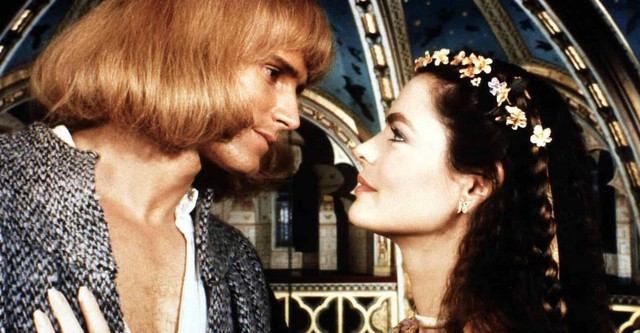
Weeks had already taken a crack at the material more than a decade earlier with his 1973 film Gawain and the Green Knight. For Sword of the Valiant, he essentially returned to the same story with considerably more ambition—and, thanks to Cannon, considerably more resources.
The foundation remained the 14th-century Middle English poem Sir Gawain and the Green Knight, but Weeks wasn’t interested in simply translating the medieval story onto the screen.
Instead, the screenplay—credited to Philip M. Breen, Howard C. Pen and Weeks—expanded and rearranged the material, creating a more conventional adventure narrative around Gawain’s increasingly dangerous encounters.
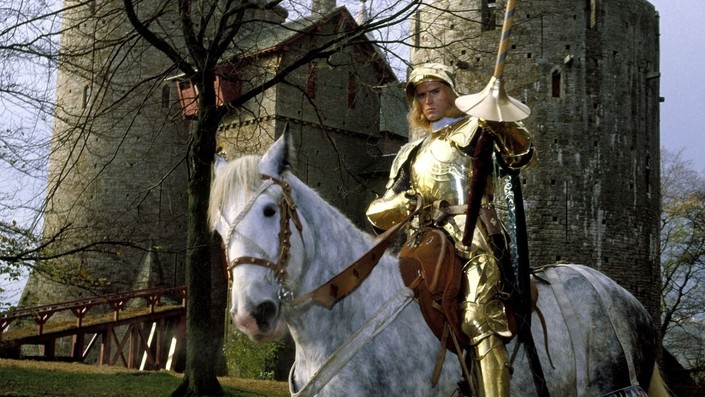
Weeks reportedly wanted Mark Hamill for the title role, which is an interesting bit of alternate 1980s casting to contemplate. Cannon ultimately went with Miles O’Keeffe, whose presence in Tarzan, the Ape Man had given him a certain genre visibility.
And then Cannon landed its trump card.
Sean Connery.
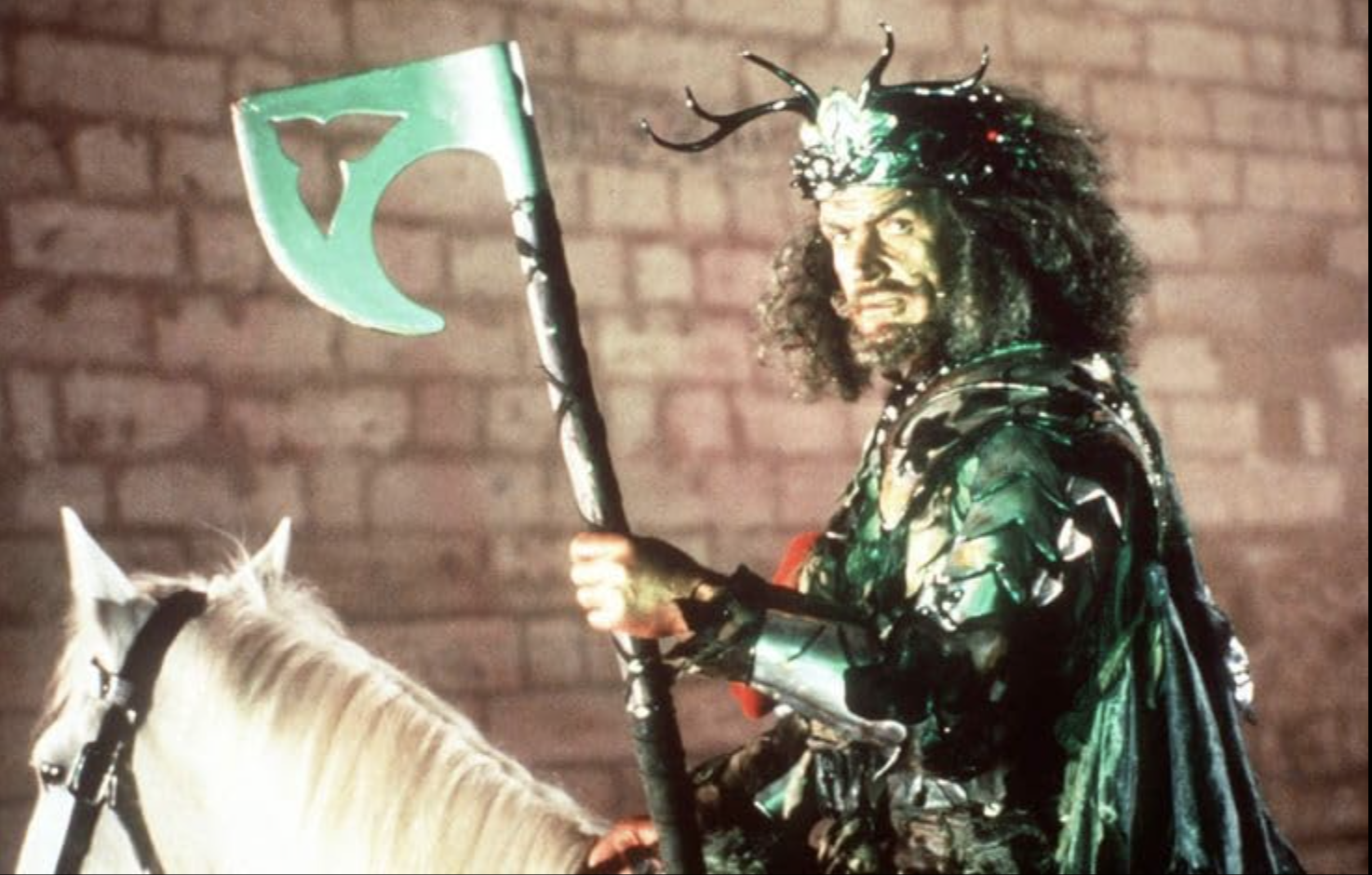
Connery wasn’t exactly an obvious choice for the Green Knight, but that’s precisely what makes the casting so memorable. The former James Bond wasn’t simply another supporting actor brought in to lend credibility to a low-budget fantasy. He was Sean Connery wearing green.
That’s hard to ignore.
Welcome to Camelot
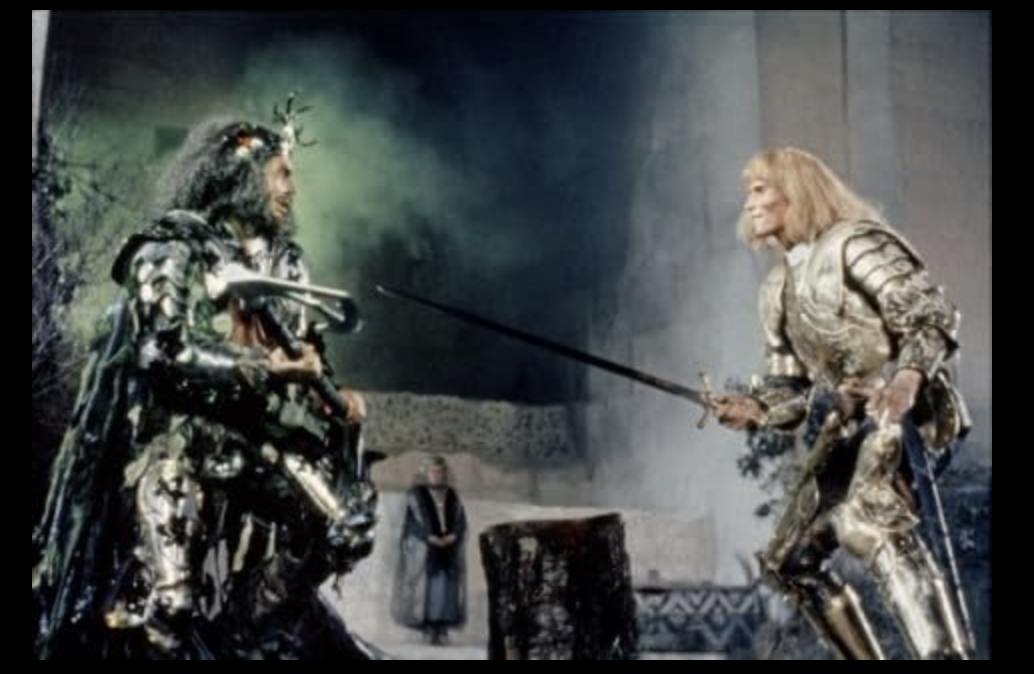
The movie surrounds O’Keeffe and Connery with an impressive collection of British acting veterans, including Trevor Howard, Peter Cushing and Wilfrid Brambell.
That casting gives Sword of the Valiant an oddly respectable pedigree.
You have seasoned British performers delivering dialogue rooted in Arthurian legend while the production around them occasionally looks like it has escaped from a completely different kind of movie.
And that’s part of the charm.
This isn’t Excalibur. There is no attempt to create a grand, mythic vision of Arthurian Britain at every moment. Instead, Sword of the Valiant feels like a fantasy adventure assembled from whatever pieces were available.
There are knights.
There are castles.
There are riddles.
There are supernatural encounters.
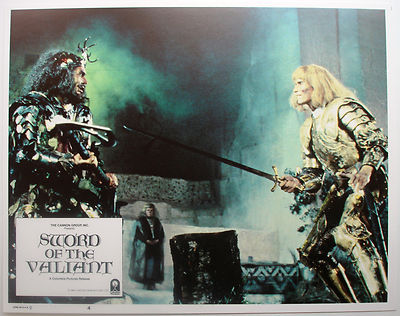
There is a gigantic green man who wants Sir Gawain to cut off his head.
And somehow, Sean Connery makes the whole thing seem almost reasonable.
Cannon Goes Medieval
Principal photography began in late 1983, with filming taking advantage of locations in Wales and Ireland, along with historic European locations including France’s Palais des Papes.
The scenery does much of the heavy lifting.
There is something inherently cinematic about these landscapes, particularly when populated by knights on horseback and characters dressed as though they have wandered out of an illustrated medieval manuscript.
Cinematographer Peter Hurst worked alongside legendary cinematographer Freddie Young, while Ron Geesin provided the score.
And that score is very much a product of its time.
Rather than attempting to create a traditionally orchestral medieval sound, the film incorporates synthesizers, giving the supposedly ancient world a distinctly early-’80s electronic texture.
It’s an unusual choice, but then Sword of the Valiant is an unusual movie.
The production also carries the fingerprints of Cannon’s particular approach to filmmaking. Golan and Globus were willing to throw money at projects, but they weren’t exactly in the business of creating endless cinematic luxury.
The result is a movie that wants to look epic while occasionally reminding you that you’re watching an independent production working with finite resources.
And honestly?
That’s part of the fun.
The Green Knight Steals the Movie
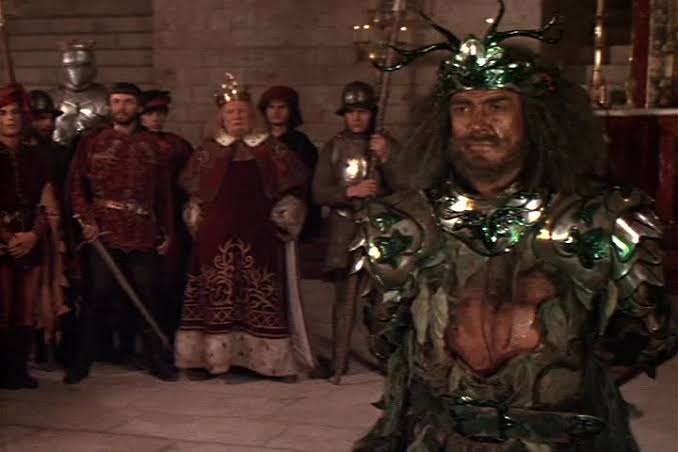
Miles O’Keeffe may be the star, but Connery owns the screen.
The Green Knight is a wonderfully strange creation, and Connery plays him with the kind of deadpan authority that only makes the character stranger.
He doesn’t seem particularly interested in convincing us that he’s inhabiting another world.
He simply walks into it.
That’s the magic of casting a performer like Connery in a movie this eccentric. He brings an inherent gravitas that the production itself doesn’t always possess.
Peter Cushing and Trevor Howard similarly give the movie a sense of weight, even when the material threatens to collapse under its own peculiarities.
Unfortunately, O’Keeffe isn’t able to generate the same kind of presence.
Sir Gawain is supposed to be the emotional and heroic center of the story, but the performance can feel stiff, leaving the supporting cast to provide much of the personality.
That imbalance becomes increasingly noticeable as the movie progresses.
A Fantasy Film Out of Time
When Sword of the Valiant arrived in American theaters in August 1984, it was stepping into a crowded marketplace.
The fantasy boom was still alive, but audiences had plenty of alternatives. Cannon had bigger ambitions than its resources could always support, and Sword of the Valiant struggled to distinguish itself among the more polished genre offerings of the period.
It disappeared commercially without making much of a dent.
That isn’t entirely surprising.
The film is simply too strange to fit comfortably into any one category. It’s not quite a serious Arthurian epic. It’s not quite a comedy. It’s not quite sword-and-sorcery. And it’s certainly not the kind of lavish medieval fantasy that Hollywood was beginning to produce.
Instead, it occupies that wonderfully weird space where a filmmaker’s ambitions collide with a producer’s budget.
And that’s where a lot of the best forgotten movies live.
Critics Weren’t Kind
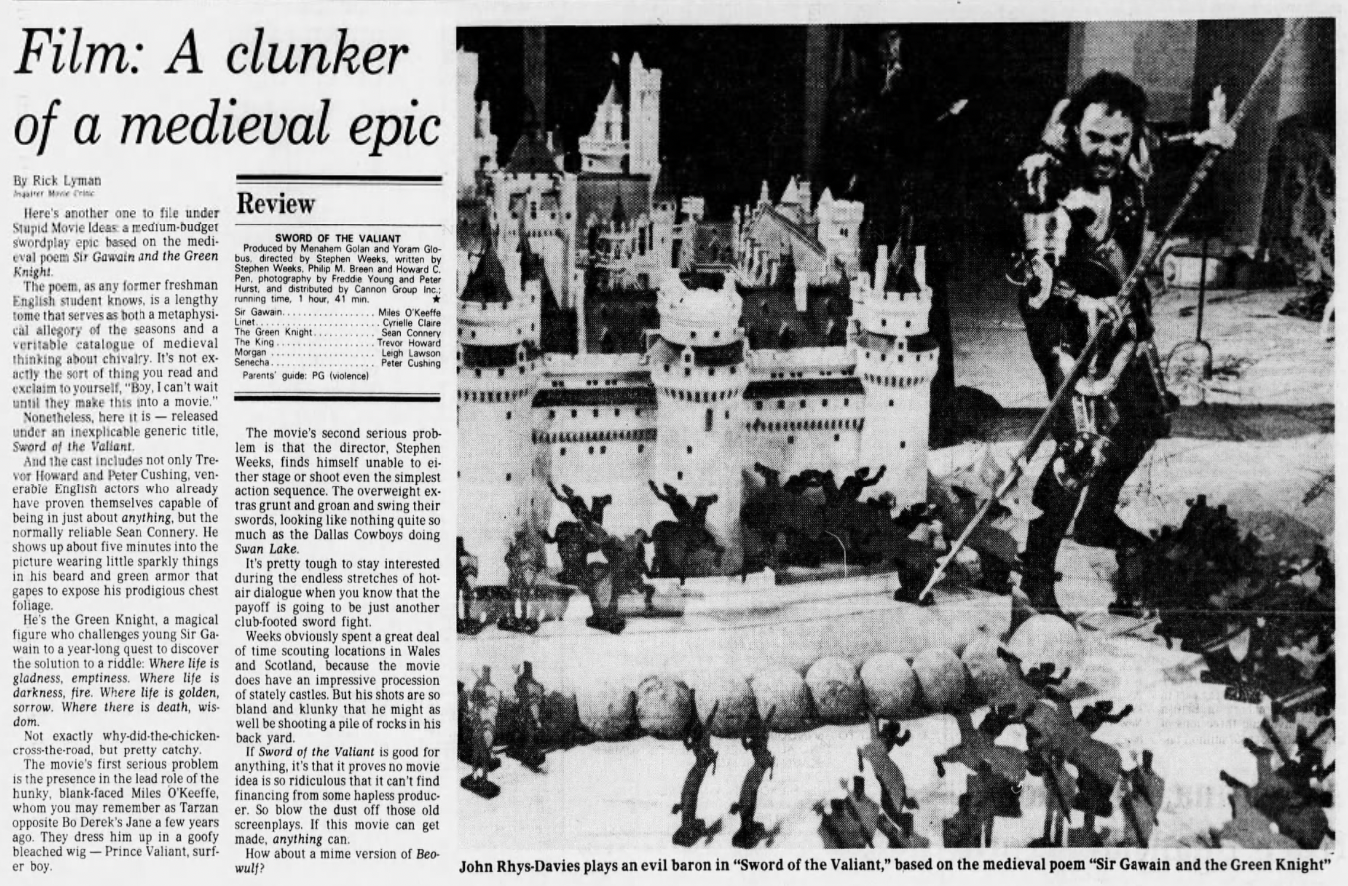
The critical response was predictably rough.
Reviewers found the movie disjointed, uneven and underpowered, with particular criticism directed toward its screenplay, action sequences and production values. The film’s mixture of medieval mythology and contemporary sensibilities didn’t always land, while the synthesizer-heavy score could feel strangely disconnected from the period setting.
The biggest problem was that the movie never quite figured out what it wanted to be.
It wanted the seriousness of Arthurian legend.
It wanted the accessibility of an adventure movie.
It wanted the humor of a fairy tale.
And it wanted the commercial appeal of the sword-and-sorcery cycle.
Those ingredients don’t necessarily belong together.
Yet every once in a while, Sword of the Valiant gets close to something genuinely enjoyable.
Usually, that something involves Sean Connery.
A Cannon Curiosity Worth Remembering
There is no great cinematic masterpiece hiding inside Sword of the Valiant.
I’m not going to pretend otherwise.
But forgotten movies don’t have to be masterpieces to be worth rediscovering.
Sometimes they’re fascinating because they represent a moment when filmmakers were willing to take chances on strange material. Sometimes they’re worth remembering because of the people involved. And sometimes they’re simply so wonderfully weird that they become impossible to completely forget.
Sword of the Valiant checks all three boxes.
It’s Stephen Weeks returning to a story he had already filmed more than a decade earlier. It’s Cannon Films trying to turn medieval mythology into another piece of 1980s genre entertainment. It’s Miles O’Keeffe attempting to carry an Arthurian adventure while surrounded by British acting royalty.
And, most memorably, it’s Sean Connery as the Green Knight.
That alone earns it a place in the strange little museum of 1980s cinema.
Because the decade was filled with movies that wanted to be the next Star Wars, the next Conan, or the next Excalibur.
Very few of them thought that maybe the answer was to simply put Sean Connery in green and see what happened.
Cannon did.
And somehow, forty years later, we’re still talking about it.

About the Creator
Movies of the 80s
We love the 1980s. Everything on this page is all about movies of the 1980s. Starting in 1980 and working our way the decade, we are preserving the stories and movies of the greatest decade, the 80s. https://www.youtube.com/@Moviesofthe80s
Enjoyed the story? Support the Creator.
Subscribe for free to receive all their stories in your feed.
Comments
There are no comments for this story
Be the first to respond and start the conversation.