
Missing in Action (1984): The Cannon Films Gamble That Accidentally Made the Sequel First
Chuck Norris became an action icon, Cannon Films struck box office gold, and one of the studio’s most unforgettable production decisions turned two movies into a hit franchise.

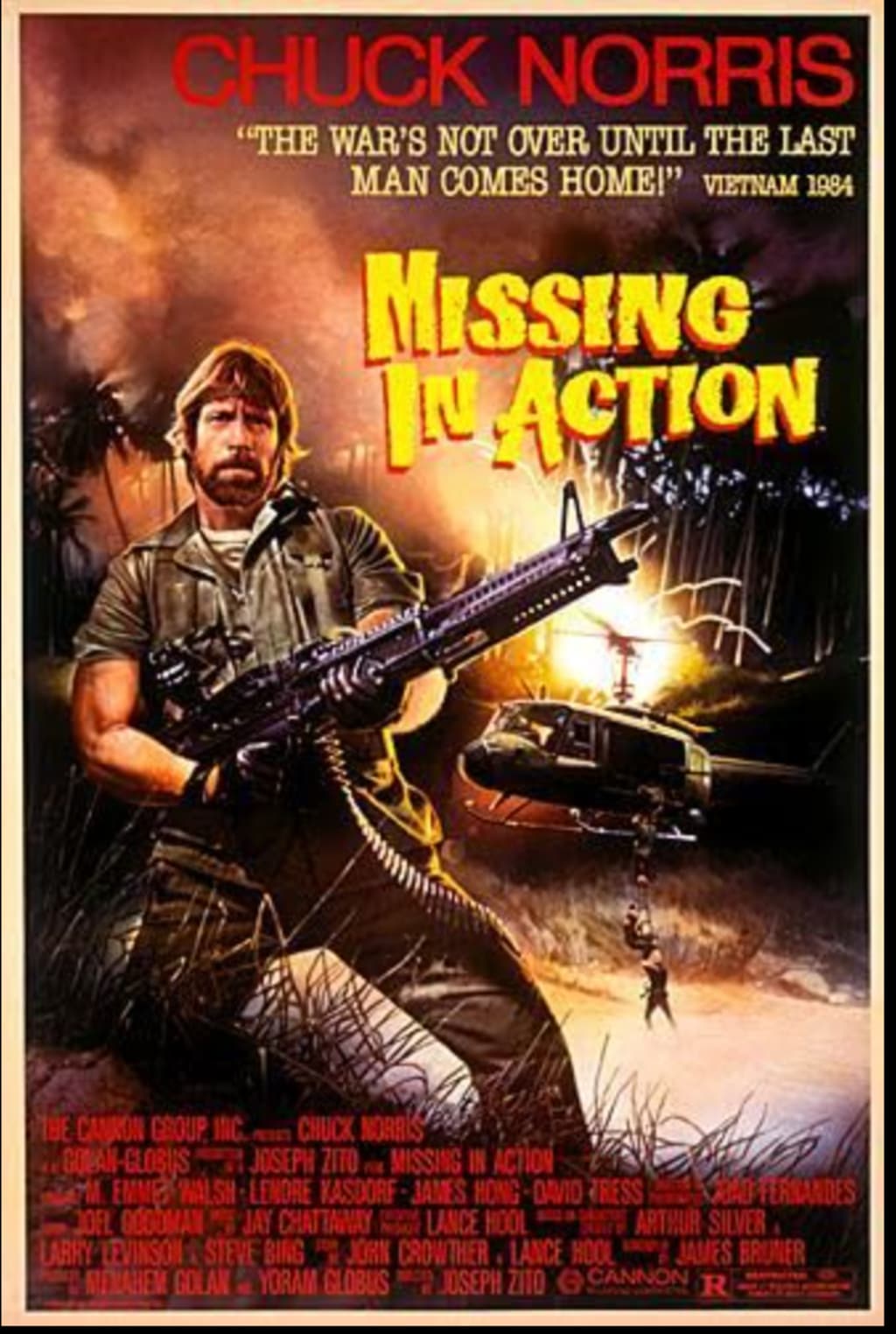
There are plenty of stories about troubled movie productions, but only Cannon Films could shoot two installments of a franchise at the same time…then decide they had released them in the wrong order.
That is exactly what happened with Missing in Action.
Released in November 1984, the Chuck Norris vehicle became one of Cannon’s biggest hits, cemented Norris as one of the defining action heroes of the decade, and arrived months before Rambo: First Blood Part II turned Vietnam rescue missions into one of Hollywood’s hottest trends. But what makes Missing in Action fascinating isn’t simply that it beat Stallone to theaters.
It’s that Cannon accidentally made the sequel before the prequel—and then embraced the chaos.

A Perfect Cannon Films Concept
By the early 1980s, the wounds of Vietnam were still fresh. Stories surrounding American POWs and MIAs continued to circulate, and many Americans believed soldiers had been left behind after the war. Whether those claims were true mattered less than the emotional power they carried.
Hollywood recognized the opportunity.
Producer Lance Hool brought Chuck Norris a screenplay centered on American prisoners still being held in Vietnam. Norris had already been thinking along similar lines, and when the project landed at Cannon Films, Menahem Golan and Yoram Globus saw exactly what they loved most—a commercially appealing action picture that could be made quickly and inexpensively.
Screenwriter James Bruner also drew inspiration from Mission MIA, a book written by a former Delta Force soldier, helping shape the story that would eventually become Colonel James Braddock’s first adventure.
For Norris, the project was personal. He dedicated the film—and eventually the entire series—to his younger brother Wieland, who was killed in Vietnam in 1970 while serving with the U.S. Army.

Making Two Movies at Once
Most studios would make one film, wait to see if audiences responded, then produce a sequel.
Not Cannon.
Confident they had a franchise on their hands, Cannon greenlit two films simultaneously.
One screenplay followed Braddock’s brutal years as a prisoner of war. The other featured his return to Vietnam to rescue Americans still being held captive. The POW story was intended to be released first, establishing the character before audiences watched his rescue mission.
Production began in 1984 under two different directors.
Lance Hool handled the POW film, while Joseph Zito—fresh off the success of The Prowler and Friday the 13th: The Final Chapter—was assigned the rescue picture.
The productions quickly developed very different personalities.
Hool’s film was shot largely in St. Kitts with additional work in Mexico. Zito argued that a Vietnam rescue movie needed to actually look like Southeast Asia and convinced Cannon to move production to the Philippines. Working with crews that had experience on Apocalypse Now, Zito found locations that gave the film a much larger scope than its modest budget suggested.
It wasn’t always smooth sailing.
Rainy season weather complicated filming, and Zito substantially rewrote portions of the script during pre-production. Norris reportedly preferred elements from the earlier version, creating occasional creative disagreements between star and director.
The production also borrowed real weapons from the Philippine Army, requiring private security to ensure they didn’t disappear into the hands of local insurgents. Even by Cannon standards, it was an unusually ambitious production.
Sharp-eyed viewers can also spot a very young Jean-Claude Van Damme working as a stunt performer and extra, credited simply as “J. Claude Van Damme.” Aaron Norris, Chuck’s brother and future director, also contributed to the stunt work.
With budgets estimated between roughly $2 million and $4 million, Cannon was stretching every dollar.

Cannon Changes Its Mind
Then came one of the most wonderfully Cannon moments in studio history.
As both movies entered post-production, executives watched early cuts and reached an unexpected conclusion.
Joseph Zito’s rescue movie was simply better.
Instead of sticking to the original release plan, Cannon did what only Cannon would do. They promoted Zito’s film to become the first installment and quietly transformed the original “Part One” into a prequel.
Overnight, the second movie became the first movie.
The first movie became Missing in Action 2: The Beginning.
Continuity be damned.
It was exactly the kind of seat-of-the-pants decision that defined Cannon Films throughout the 1980s. The studio wasn’t interested in protecting a grand cinematic mythology. It wanted the strongest commercial picture opening first.
In this case, it worked.

A Box Office Victory
Missing in Action opened on November 16, 1984, in more than 1,100 theaters and immediately exceeded expectations.
The film debuted at number one with more than $6 million during its opening weekend before finishing with approximately $23 million domestically against a very modest budget.
For Cannon, it was a major victory.
It also reached theaters months before Stallone’s Rambo: First Blood Part II, allowing Chuck Norris to become the face of the Vietnam rescue fantasy before Hollywood’s biggest action star entered the conversation.

Critics Didn’t Buy It—Audiences Didn’t Care
Critics were generally dismissive.
Many labeled it a formulaic action picture filled with simplistic patriotism, wooden performances, and an exploitative approach to Vietnam. Others viewed it as little more than a low-budget imitation of Rambo, despite the irony that Norris actually arrived first.
Audiences had a completely different reaction.
Norris later recalled moviegoers standing and applauding during screenings. For many viewers, Braddock represented something Hollywood rarely offered—a fictional chance to rewrite one of America’s most painful military defeats into a triumphant rescue mission.
Historical accuracy wasn’t the point.
Wish fulfillment was.

The Cannon Formula
Looking back, Missing in Action represents Cannon Films operating at peak efficiency.
Take a timely subject. Cast a charismatic action star. Keep the budget lean. Deliver plenty of explosions, machine guns, helicopters, and patriotic speeches. If it works, make another one immediately—even if you’ve already filmed it.
The film launched a trilogy, leading to Missing in Action 2: The Beginning in 1985 and Braddock: Missing in Action III in 1988. More importantly, it established the partnership between Chuck Norris and Cannon that would produce favorites like Invasion U.S.A. and The Delta Force.
Today, Missing in Action is very much a product of its era. Its politics, portrayal of Vietnam, and revisionist view of history are viewed much differently than they were in 1984.
But as a slice of pure Cannon entertainment, it’s difficult to top.
The explosions are loud. The hero is unstoppable. The storytelling is unapologetically direct.
And somehow, thanks to one last-minute executive decision, audiences got the better movie first. That’s about as Cannon Films as it gets.

About the Creator
Movies of the 80s
We love the 1980s. Everything on this page is all about movies of the 1980s. Starting in 1980 and working our way the decade, we are preserving the stories and movies of the greatest decade, the 80s. https://www.youtube.com/@Moviesofthe80s
Enjoyed the story? Support the Creator.
Subscribe for free to receive all their stories in your feed.
Comments
There are no comments for this story
Be the first to respond and start the conversation.