
Michael (2026) Review: A Sanitized Michael Jackson Biopic That Plays the Hits but Avoids the Truth
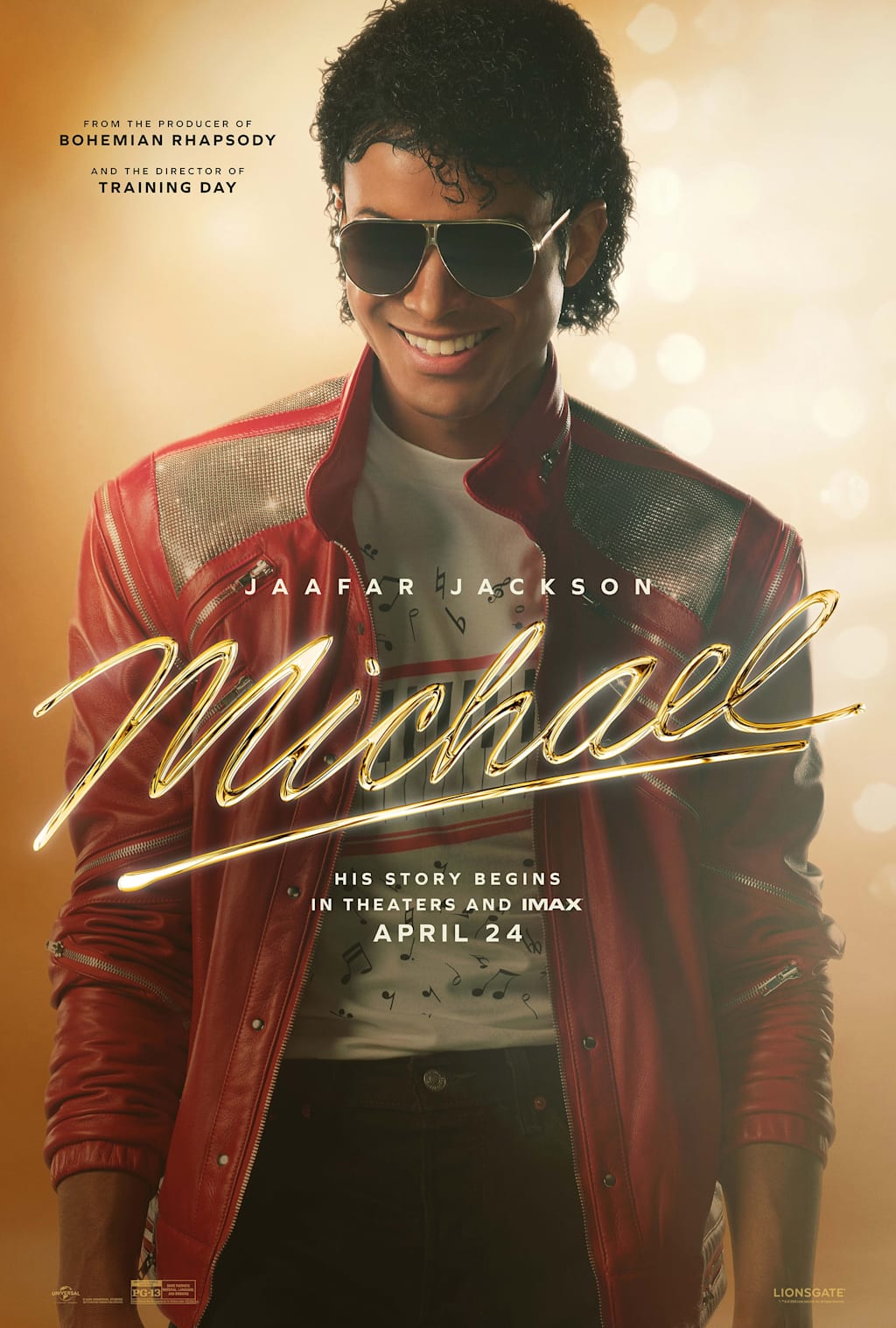
A review of Michael (2026), directed by Antoine Fuqua and starring Jafar Jackson. This Michael Jackson biopic delivers nostalgia but avoids the deeper truth behind the icon.


⭐ Rating: 2.5 / 5
Michael
Directed by: Antoine Fuqua
Written by: John Logan
Starring: Jafar Jackson, Colman Domingo, Miles Teller
Release Date: April 24, 2026

A Biopic Built on Resemblance, Not Revelation
Michael stars Jafar Jackson—Michael Jackson’s real-life nephew—as the King of Pop, and from time to time, the resemblance is uncanny. Unfortunately, when that resemblance slips, it creates a jarring effect—a reminder of the artificial simulacrum that makes up much of the movie.
We begin in Gary, Indiana in the mid-1960s. Joe Jackson (Colman Domingo) works a dreary manual labor job and looks to his five sons to lift the family out of poverty by any means necessary. It’s clear that if the Jackson boys had shown a knack for basketball or some other sport, Joe would have built a pro sports factory in his home.
Instead, he latches onto their musical talent, pushing them relentlessly toward stardom—and it works.

The Rise of The Jackson 5
Though their success comes at the expense of their mental health and their relationship with their father, The Jackson 5 rise quickly. Nightclub gigs lead to bigger audiences, and eventually, a meeting with Motown.
By 1968, they are a smash success. The family leaves Gary for Los Angeles. All the while, Joe rules with money in one hand and a belt in the other.
The older brothers appear hardened, largely unaffected. But sensitive young Michael absorbs the worst of Joe’s abuse.

Fantasy as Escape: Building the Myth of Michael Jackson
Michael retreats into fantasy—animal friends, pirates, and dreams of Neverland, inspired by Peter Pan. He rereads The Wizard of Oz, each story acting as a blunt but effective visual shorthand for who he will become.
It’s obvious. But it’s also functional filmmaking.
Director Antoine Fuqua has no interest in subtlety, which mirrors the film’s portrayal of Michael himself—too naive for subtlety. As Michael grows into global superstardom, he begins assembling the pieces of his dream world as though it’s perfectly natural for a man in his late teens and 20s to take his Llama for a walk or spend his private time chatting with a chimp.

The “Beat It” Sequence and the Illusion of Impact
Michael’s childlike worldview carries into his creative process. In one scene, he watches a news report on gang violence and becomes inspired to unite the Crips and Bloods through dance while creating Beat It.
This reportedly did happen—gang members were called together and gathered peacefully to watch Michael work. For one day, Crips and Bloods united in a shared reverence for a beloved musical icon. That's wildly weird and fascinating as a concept.
But the film presents it without irony, as though Michael solved gang violence through choreography.
This is where the movie falters most. The moment begs for absurdity—for a touch of dark humor acknowledging how surreal the situation is. Instead, it plays straight, then moves on, uninterested in the contradiction or its implications. Gang violence continued unabated and Michael Jackson never spoke of it again.

A Genius Without Complexity
The Michael Jackson of Michael exists in extremes:
* In the studio, he’s Mozart crossed with Gandhi
* In private, he’s a childlike figure playing a sad, lonely, game of Twister with his chimp, Bubbles
The film never reconciles this disconnect.
A stronger movie would build tension from this duality—exploring how such a fractured identity could exist. Instead, Michael settles for a simplified explanation: abuse led to retreat, and retreat occasionally produced genius.

The Elephant in the Room
To its credit—or perhaps its limitation—this review attempts to focus on the film itself.
But Michael makes that difficult by aggressively ignoring the most controversial aspects of Michael Jackson’s life. The allegations, the public scrutiny, the deeply complicated legacy—all are absent.
This is not an oversight. It’s the point.
Michael is the movie Michael Jackson’s family and fans want: a tribute that treats him not as a person, but as a sacred piece of pop culture.

A Familiar, Sanitized Formula
Taken on its own terms, Michael is a standard, workmanlike biopic. It presents a series of recognizable anecdotes that loosely add up to a life audiences can nostalgically revisit.
Much like Bohemian Rhapsody, one of the most sanitized and dramatically hollow music biopics in recent memory, Michael plays the hits. It leans heavily on performance recreations and the dopamine rush of memory.
If that’s enough, the film will satisfy.

Final Verdict
For me, Michael is a competently made movie that functions on a basic level but fails to transcend it. It never interrogates its subject, never embraces contradiction, and never risks discomfort.
It’s a movie that understands the icon—but avoids the man.

Tags
Michael (2026) review, Michael Jackson biopic, Antoine Fuqua, Jafar Jackson, music biopics, The Jackson 5, movie reviews 2026, film criticism, biopic analysis, Bohemian Rhapsody comparison
About the Creator
Sean Patrick
Hello, my name is Sean Patrick He/Him, and I am a film critic and podcast host for the I Hate Critics Movie Review Podcast I am a voting member of the Critics Choice Association, the group behind the annual Critics Choice Awards.
Enjoyed the story? Support the Creator.
Subscribe for free to receive all their stories in your feed. You could also become a paid subscriber, letting them know you appreciate their work.
Comments
There are no comments for this story
Be the first to respond and start the conversation.