
Liu Huan Died at 63. The Song That Asked China’s Hardest Question Still Has No Easy Answer.
Thirty-three years after “A Million Times of Asking,” the answer isn’t East or West. It’s whether you can see clearly.
On September 26, 2026, Liu Huan died. He was 63.
Jiemian News published a memorial. It said the theme song of Beijingers in New York, “A Million Times of Asking,” contained the line “Time and time again you ask me...” and that the line expressed the collective bewilderment of that era over where China should go.
In 1993, Beijingers in New York aired. Zheng Xiaolong and Feng Xiaogang directed it. Cao Guilin wrote the novel. Wang Qiming and Guo Yan went to New York. The opening song alternated Chinese and English. Liu Huan composed and sang it. The lyrics asked whether he loved you, hated you, could leave you. They ended with “ask myself what exactly is good about you, what exactly is good about you?!” The arrangement added Broadway-style brass. The sound was American urban. The undertone was Eastern wandering.
Later the song became a political metaphor. Especially after Trump’s first election win and the intensifying China-US rivalry. But bewilderment was not the base note of Liu Huan’s music.
In 1988, River Elegy aired. Six episodes. The narration circulated widely. More than a dozen newspapers reprinted it. Three or four publishers issued standalone editions. The creators Xia Jun, Wang Luxiang, and Xie Xuanjun held a discussion at Renmin University. Students treated them as idols. The core logic: the Yellow River, yellow earth, and yellow skin were symbols of backwardness. Modernization had to abandon yellow culture and adopt azure ocean culture. The last episode closed with: “The Yellow River must eliminate its fear of the sea. The Yellow River must preserve the unyielding will and impulse from the highlands. The water of life comes from the sea and returns to the sea. After a thousand years of loneliness, the Yellow River finally saw the azure sea.”
This logic lifted specific factors to a universal, abstract height. It gave them special, sacred status. Then it worshipped them. Yang Zhenning said at the time: “What I cannot accept most is that these three traditions, ‘dragon, Great Wall, and Yellow River,’ are criticized as utterly worthless, and that if these three traditions are not abandoned, China will have no hope. But I think this is greatly wrong.” Li Daozheng said: “A nation that relies only on the past has no development, but a nation that abandons its ancestors will also have no future.” Yin Yunpeng, publisher of Taiwan’s CommonWealth Magazine, said: “Today’s mainland is ‘turning to any doctor in a critical illness.’ China wants modernization, but does modernization equal complete Westernization?”
Liu Huan began teaching at the University of International Business and Economics in 1991. He taught Western music history. His undergraduate degree was in French literature. He was self-taught in music. He mastered Western classical forms and harmony. He could compose, arrange, and score on his own. His Western Music History was a classic course in aesthetic education. Enrollment was 300, but more than 700 signed up. The classroom was packed. Students recalled that throughout class he never mentioned his identity as a singer. He wrote several blackboards of notes by hand. He quoted widely and spoke fluently. His English and French cursive was especially beautiful.
Liu Huan’s knowledge of Western music did not make him a spokesman for “connecting with the world.” He never worshipped the soil that produced that beautiful music. In his last class at UIBE, he said:
“Music has no effect. This world of ours is like this. We have seen the process by which Western music came. We have seen so much beautiful music, so many excellent musicians constantly working hard. But so what? Music has not eliminated poverty, has not stopped war. Those peoples who created such beautiful music still went and slaughtered. They still had notorious records. Music has no effect. But for us, music may have an effect. The effect is at the bottom of our hearts. Because we love it, we can keep a hope of beauty that we can look forward to at any time, a mere hope. In fact, music and all art occupy the same position in human civilization: an endless inquiry into and exploration of beauty.”
This passage challenged the logical foundation of Western cultural superiority. If music cannot stop the peoples who created it from slaughtering and doing evil, then elevating Western culture to a position of fundamental superiority cannot hold logically.
In the decades after reform and opening up, many intellectuals raised their own fields to a height where they could determine the fundamental virtue and character of society and the nation. As if as long as they were allowed to develop freely and say whatever they wanted, the world would become better. This thinking traces back to the influence of a cultural hierarchy centered on Western culture, built for late-developing regions.
Liu Huan’s difference was his ability to see clearly. He could see clearly and criticize the soil that produced the things he studied. This ability was not only about level of learning. The more one emphasized narrow learning itself, the easier it was to go further down the road of blind belief and fanaticism.
Liu Huan’s musical practice ran through this cultural subjectivity. He never stopped learning and absorbing Western music and new technologies. People said that when drunk he liked to speak foreign languages. But this absorption was built on “taking myself as the master and using it for myself.”
In “A Million Times of Asking,” the arrangement added Broadway-style brass. The sound was American urban. The undertone was Eastern wandering and loneliness. Chinese and Western elements interwove, fitting the situation of Chinese immigrants. This set of film and television music, seven songs and dozens of background pieces, was all completed by Liu Huan alone. International arrangements merged with Chinese homesickness and national sorrow.
When he took on the original soundtrack for Empresses in the Palace, Liu Huan read the script thoroughly and grasped the characters’ emotions. He blended traditional pentatonic scales with modern orchestral arrangements. He polished works with a strong classical texture, such as “Phoenix Flying.” The Beijing Olympics theme song “You and Me” stood on the world stage with a restrained Eastern expression. Liu Huan said: “Being sung by the masses is not the purpose of music; creation is very personal. In my view, music creation is personal to begin with, writing one’s inner world, writing one’s relationships with surroundings, and so on. When an individual resonates with many other individuals, it elicits a response. That is the process of music. So-called ‘niche’ and ‘mass’ are commercial concepts.”
Regarding “Chinese style,” he said: “First, I don’t think this direction is wrong, because after all this is our own native land, the way we Chinese do our own things is what we are most familiar with. But development cannot always remain at the past level, infinite copying. That would be meaningless.” He also said: “The sentence I hate hearing most is, after listening to a song, ‘This isn’t commercial.’ What makes you think it isn’t commercial? What does its being commercial or not have to do with you? What you need to do is the music you like.”
Not blindly following the market, not worshipping the West, not stubbornly clinging to tradition, but creating based on native culture. This is cultural subjectivity in practice.
Thirty-three years later, the answer is cultural self-awareness rather than a simple reversal. The logic of River Elegy, that China can only move toward the world by fully transplanting modern Western civilization, including market economy, democratic system, and ideology, has been falsified by reality. China did not follow the “azure” script. It walked out its own path of modernization. Flipping the binary from “the West is superior to the East” to “the East is superior to the West” would still be the same either-or frame.
Fei Xiaotong proposed “cultural self-awareness.” People living in a certain culture should have “self-knowledge” about their culture. They should understand its origin, formation process, characteristics, and development trends. It does not mean “cultural return.” It is not about restoring the old. Nor does it advocate “complete Westernization” or “sticking to tradition.” The practical goal of “cultural self-awareness” is to strengthen the capacity for autonomy in cultural transformation, and to achieve the autonomous position of deciding cultural choices when adapting to new environments and new times.
Liu Huan’s artistic career is the practice of “cultural self-awareness” in music. He took his study of Western music history as foundation, and Chinese traditional music aesthetics as root. He created musical works that neither clung to tradition nor blindly followed the West. He was not a River Elegy-style complete Westernization theorist, nor a narrow cultural conservative. After understanding the West, he maintained clear judgment. He saw the achievements and limitations of Western culture. On that basis he carried out creative fusion.
Since the new century, the re-recognition and reactivation of “tradition” has become a major voice in intellectual circles. The intellectual orientation of reconstructing Chinese cultural subjectivity has become an important issue.
But the establishment of cultural subjectivity is by no means achieved overnight. Even today, many intellectuals still lack this ability to see clearly and then criticize. They either remain immersed in the inertia of River Elegy-style thinking, measuring everything by Western standards; or they go to the other extreme, replacing cultural confidence with empty cultural conservatism. These two seemingly opposed positions share the same premise: reducing cultural issues to an essentialized, unquestionable choice of stance.
Liu Huan transcended this either-or. He understood the essence of Western music, while maintaining a strong identification with Chinese culture. He absorbed all outstanding foreign cultural achievements without losing his own cultural subjectivity. This stance of “taking myself as the master and using it for myself” was built on a full understanding of both Chinese and Western cultures.
The line in “A Million Times of Asking,” “I am no longer me, but you are still you,” expressed the heartfelt voice of the era of the wave of going abroad. Full of longing, one crosses mountains and seas chasing a dream. Upon arrival, one finds the dream has changed, and one is no longer one’s former self. Looking back thirty-three years later, perhaps a less pessimistic interpretation can be given: precisely because in the process of chasing one “became no longer me,” one finally saw clearly who “you” are, and also saw clearly who one is. This seeing clearly is the first step in the awakening of cultural subjectivity.
Liu Huan used his life to give his own answer. He answered with a lifelong practice: not losing oneself in openness, staying clear-headed in absorption, taking one’s own cultural roots as the origin, and examining, absorbing, and creating. He said that music and all art occupy the same position in human civilization: an endless inquiry into and exploration of beauty.
This long inquiry, perhaps its answer is to return to an independent and sound cultural personality itself. Neither confused by the myth of the West, nor swept along by narrow national sentiment. On the basis of understanding the world, find one’s own voice.
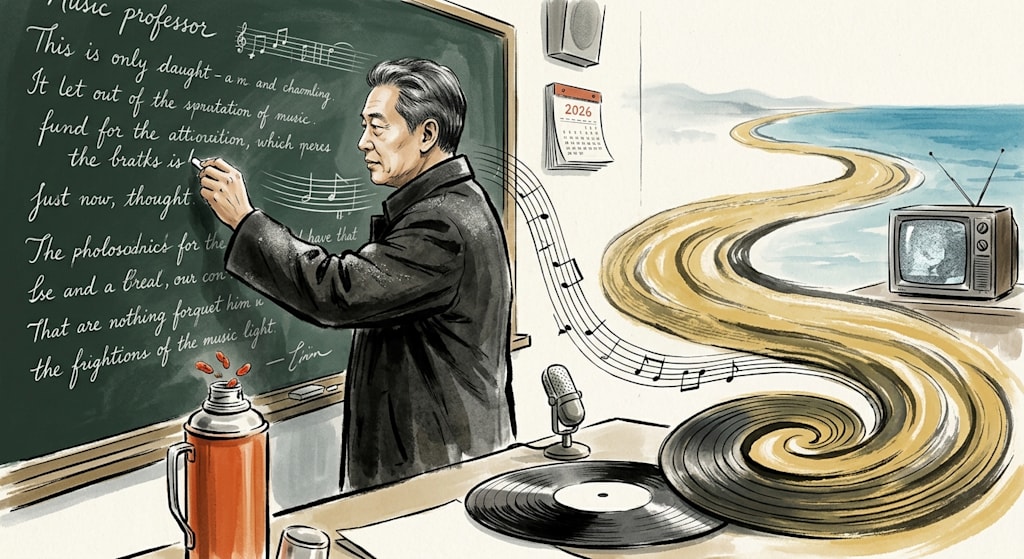
On September 26, 2026, in a classroom at UIBE, the cursive writing on the blackboard had not yet been erased. When Liu Huan turned to write on the board in his last class, chalk dust fell on the cuff of his dark coat. He was writing the title of a chapter of Western Music History. After class, a student asked him whether he would continue teaching. He said: “I’ve retired, but the music is still here.” Then he smiled, picked up his thermos, which contained warm water with goji berries.
About the Creator
Jin
Writer of reamstories
https://reamstories.com/jin
Enjoyed the story? Support the Creator.
Subscribe for free to receive all their stories in your feed. You could also become a paid subscriber, letting them know you appreciate their work.
Comments
There are no comments for this story
Be the first to respond and start the conversation.