
'Ladyhawke' (1985): The Cursed Romance That Became an 80s Fantasy Classic
Richard Donner brought together Michelle Pfeiffer, Rutger Hauer, and Matthew Broderick for an ambitious medieval adventure filled with Italian landscapes, forbidden romance, and one very distinctive musical score.

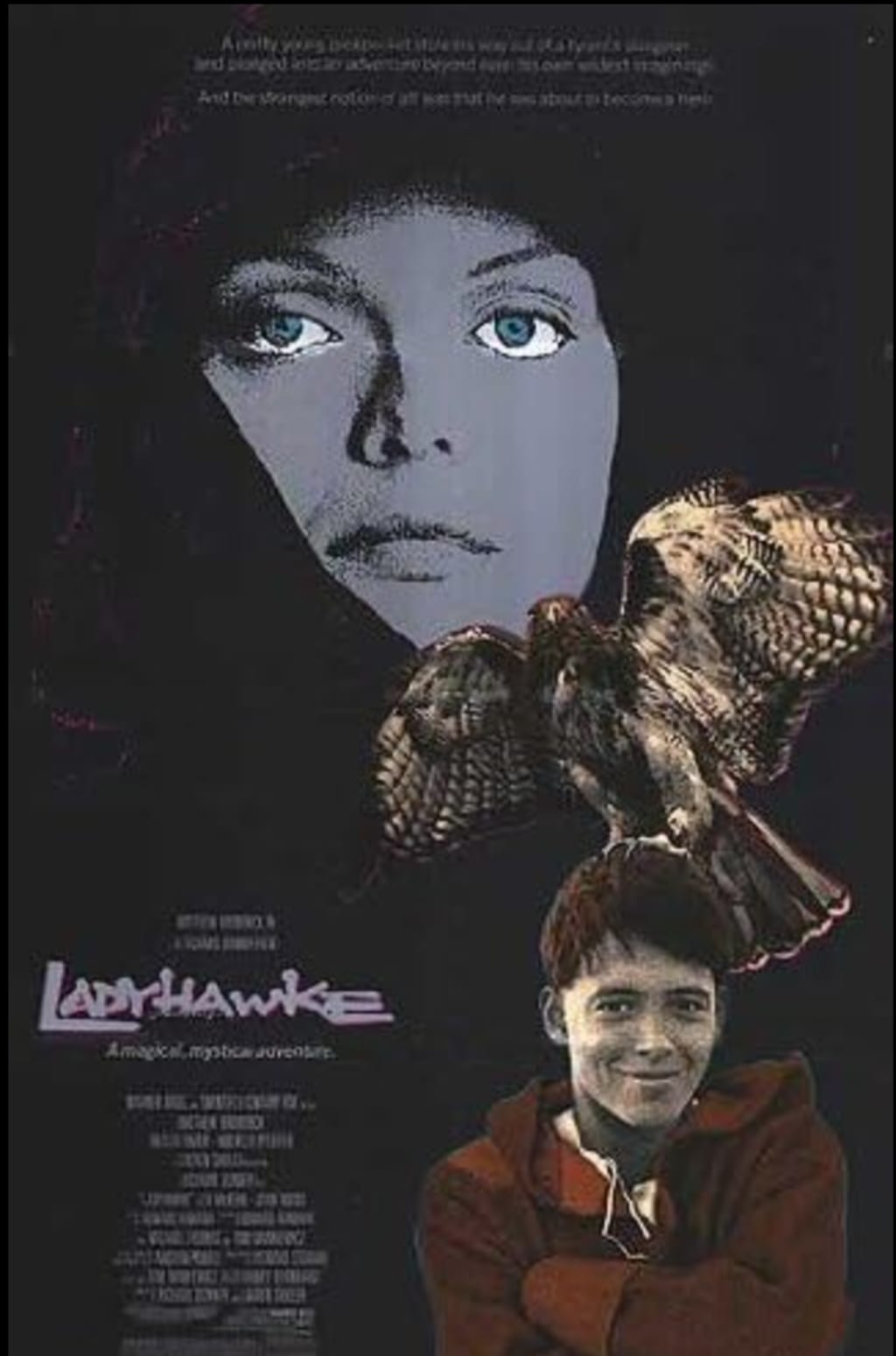
There are few romantic predicaments quite as inconvenient as being cursed by an evil bishop.
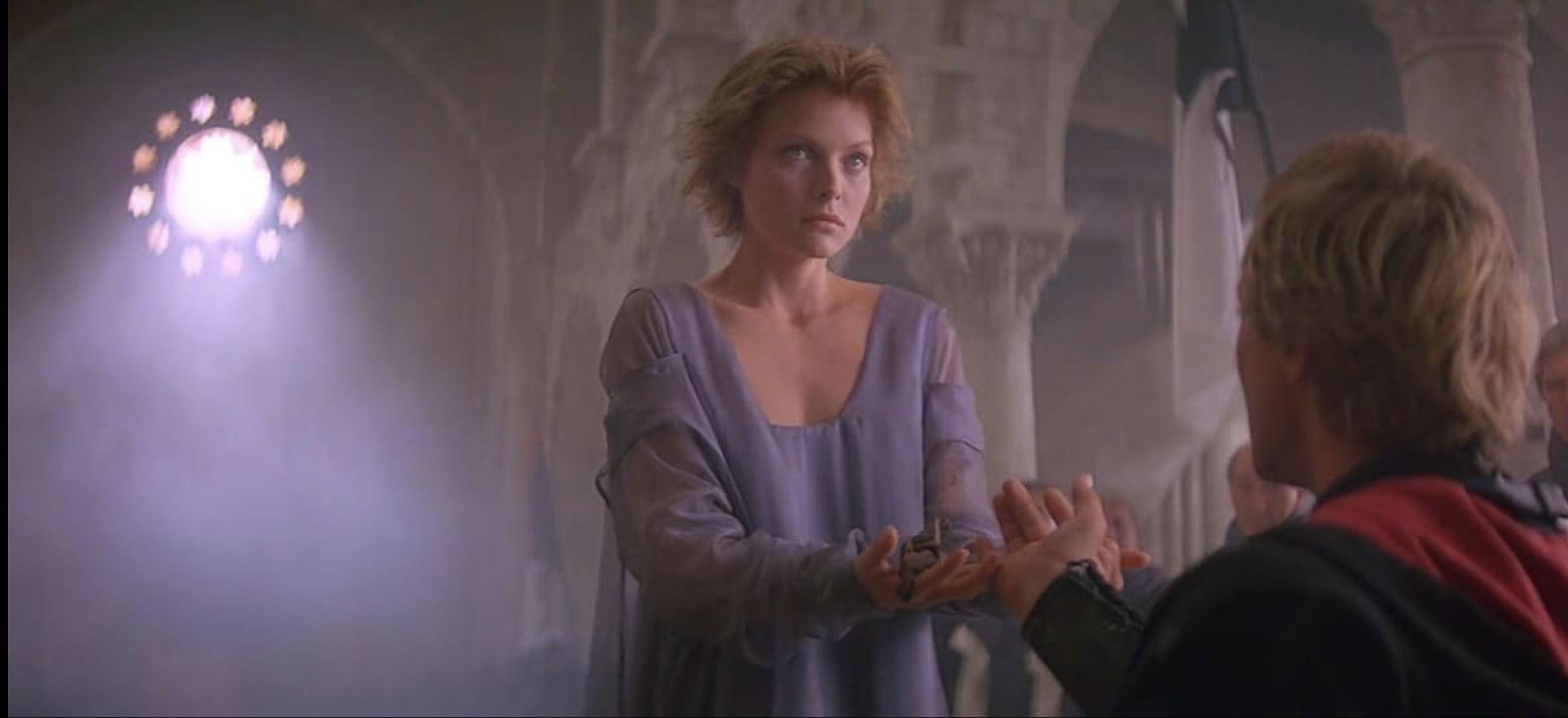
Imagine falling in love with someone you can never actually be with. Not because of distance, family disapproval, or some unfortunate misunderstanding involving a third party. No, your problem is considerably more complicated. During the day, you’re a beautiful young woman who has been transformed into a hawk. At night, your lover becomes a wolf. You can see each other, but never as human beings. Only at the fleeting moments between day and night do you have a chance to be together.
It’s a pretty good setup for a fantasy movie.
In 1985, Richard Donner, the director who had already given us Superman and The Goonies, brought this unusual romantic adventure to the screen with Ladyhawke. Starring Rutger Hauer, Michelle Pfeiffer, and Matthew Broderick, the film combined medieval adventure, supernatural romance, and some spectacular Italian scenery.
It also featured a musical score that sounded as though someone had accidentally wandered into a different movie.
That last detail has become something of a talking point among fans. But there’s more to Ladyhawke than its unusual soundtrack. Behind the film was a lengthy development process, an ambitious European production, and a cast that seemed to understand that the story was about something considerably more painful than your average sword-and-sorcery adventure.
Forty years later, Ladyhawke remains one of the more distinctive fantasy films to emerge from the decade.
A Fantasy Years in the Making
The origins of Ladyhawke go back to screenwriter Edward Khmara, who developed the story after an idea came to him while jogging. The project also drew inspiration from the French poet François Villon, whose work and historical mythology helped inform the film’s medieval atmosphere.
Getting the movie made proved considerably more difficult than coming up with the idea.
Several writers became involved during the development process, including Michael Thomas, Tom Mankiewicz, and David Webb Peoples, who received an uncredited contribution. The screenplay went through multiple revisions as the project moved between producers and studios.
Richard Donner became particularly interested in bringing the story to the screen. There were earlier attempts to get the production underway in Europe, including plans involving England and Czechoslovakia. At one point, Czechoslovakia was being considered as the primary filming location, and Donner traveled to Prague to scout possibilities.
The project continued to stall.
Eventually, Warner Bros. and 20th Century Fox became involved, with Alan Ladd Jr. among the important figures in getting the production moving. By 1983, the pieces were finally coming together.
The casting process had its own interesting detours.
Kurt Russell was originally attached to play Navarre opposite Michelle Pfeiffer. The role of Phillipe Gaston, the young thief who becomes entangled in the lovers’ predicament, was reportedly offered to Sean Penn and Dustin Hoffman before landing with Matthew Broderick.
It’s an interesting collection of possibilities. Russell would have brought a different kind of ruggedness to Navarre, while Hoffman would have been an entirely different sort of Mouse.
Ultimately, the combination Donner assembled gave the film a personality that was difficult to duplicate.
Italy Becomes a Fairytale
Filming began in August 1983, with production taking advantage of some extraordinary locations throughout Italy.
The Italian countryside wasn’t simply a convenient backdrop. It was practically another character in the movie.
Among the locations were Campo Imperatore, with its enormous open meadows and mountainous landscape, the dramatic ruins of Rocca Calascio, and several historic castles and medieval villages. Torrechiara Castle, Castell’Arquato, and Soncino were among the locations that helped give the film its convincing old-world atmosphere.
Cinematographer Vittorio Storaro, whose credits included Apocalypse Now and Reds, brought an extraordinary visual sensibility to the production.
The landscapes are frequently breathtaking. The enormous skies, rolling hills, stone fortifications, and winding roads give Ladyhawke a sense of scale that would have been difficult to reproduce on a conventional soundstage.
The production was also dealing with something a little more complicated than costumes and scenery. The central characters required actual animal performers.
Real trained hawks and black wolves were used throughout the production, with the filmmakers having to work around the practical difficulties of incorporating animals into an already complicated shooting schedule.
In a contemporary production feature titled “Ladyhawke: It’s Fantasy, But Painful,” the cast discussed the physical and emotional demands of the story.
Broderick offered a particularly memorable description of the experience:
"In 80% of the film, I'm wet. Listen, I never realized what it when I read the script... Of course, I have to be soaking wet but those scenes took five days! Before every scene there's an old Italian woman with a bucket of water she keeps throwing over me! It makes my temper very short, I have to admit. In fact, let's be honest, I want to kill her."
Broderick did his best to be a good sport about it... "Ok, I know it's not her fault, but just seeing her standing there with a smile on her face... She doesn't speak English either, and she got it wrong more than once. I'll say please wait, just one second, I'm not ready, and whoosh, right in the face."
The humor was understandable. Fantasy filmmaking might look glamorous when you’re watching the finished product, but spending months outdoors in unfamiliar surroundings, working with animals, horses, armor, and complicated costumes is another matter entirely, especially when you're always wet.
The production was reportedly an enormous undertaking, with one account describing the outdoor construction as the “biggest outdoor set ever built.”
For Donner, however, the physical scale was only part of the equation. The story needed to retain its emotional center.
“The lovers never see each other as humans—only as animals. That’s the pain of it.”
That’s really the heart of Ladyhawke. Beneath the sword fights and supernatural elements is a fairly heartbreaking story about two people who have been denied the most basic expression of their love.
A Cast of Unlikely Romantic Heroes
The casting of Ladyhawke is one of its greatest strengths.
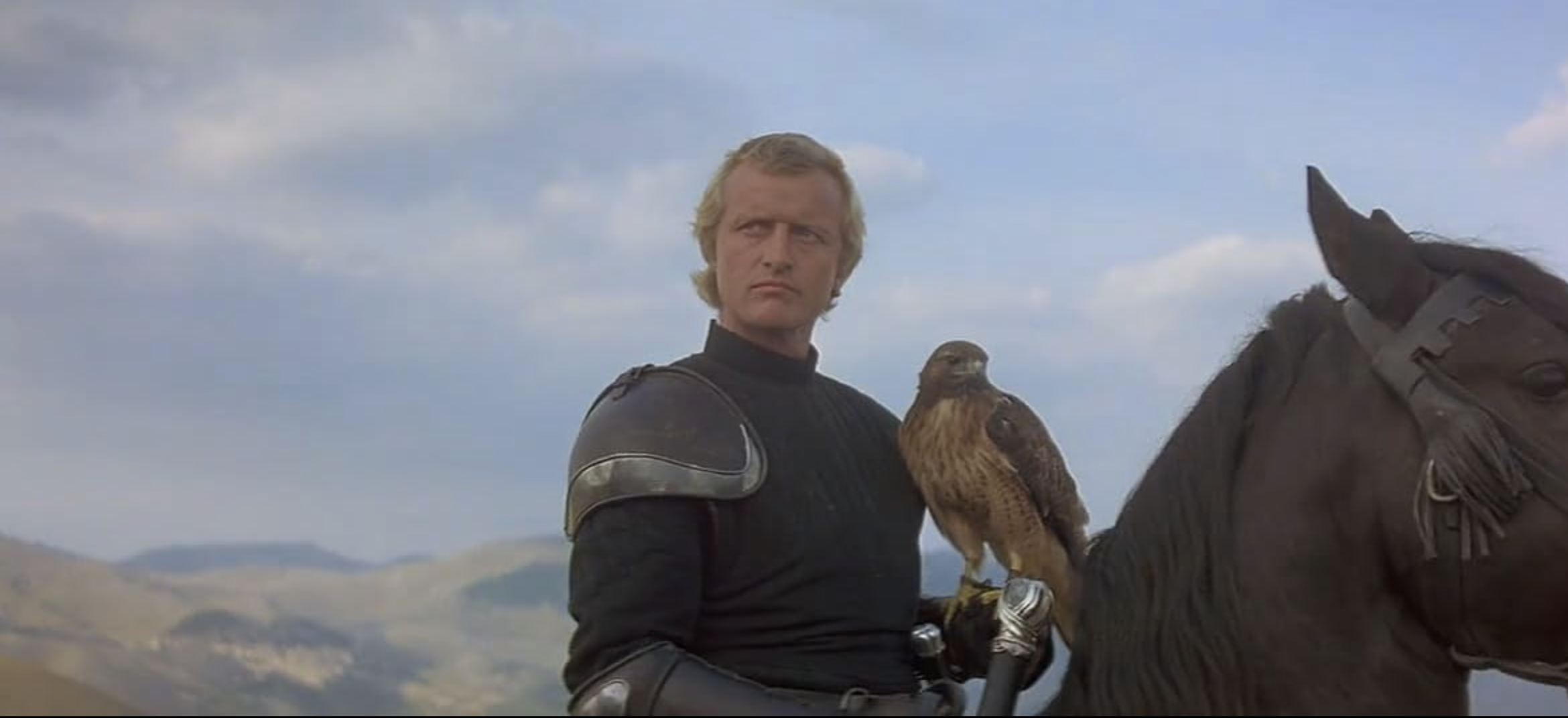
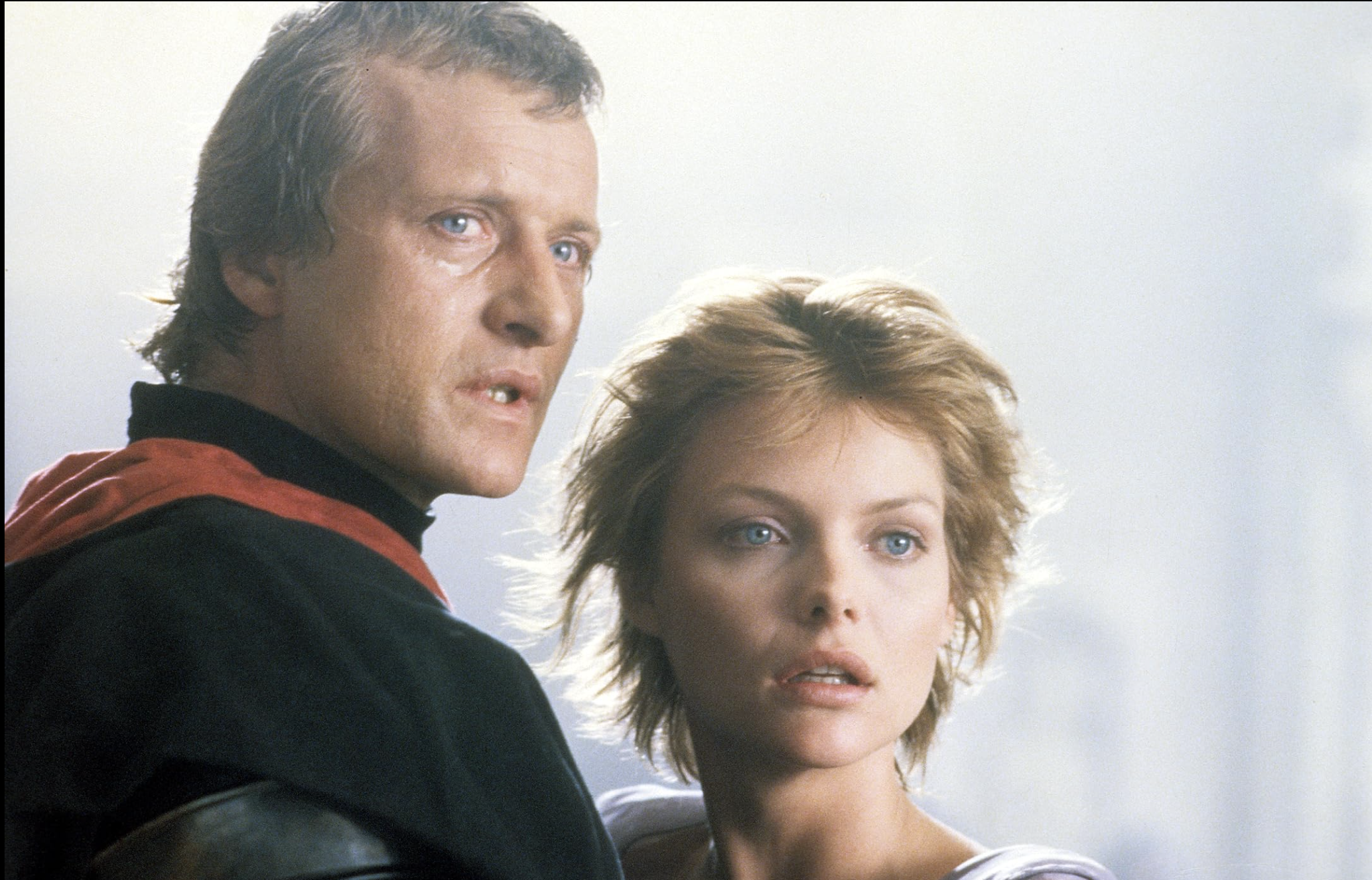
Rutger Hauer plays Captain Etienne of Navarre, a warrior consumed by his desire to destroy the Bishop of Aquila, the man responsible for cursing him and Isabeau.
Hauer was particularly well suited to the role. There was always something slightly dangerous about his screen presence, even when he was playing a character with noble intentions. Navarre is a man who has lost nearly everything, and Hauer gives him the necessary combination of physical toughness and emotional restraint.
Michelle Pfeiffer plays Isabeau of Anjou, the woman whose beauty and relationship with Navarre inspired the Bishop’s jealousy.
Pfeiffer was still establishing herself as a leading actress in Hollywood. She had already experienced the unpleasant side of the movie business, particularly following the commercial failure of Grease 2.
In a Los Angeles Times interview with Roderick Mann, Pfeiffer was candid about the experience.
“I’m used to hearing that word (Failure). It’s not a new experience for me. I was in ‘Grease 2,’ remember?”
There was a certain resilience in her attitude. She understood that Hollywood could be unforgiving, particularly toward actresses whose careers hadn’t immediately followed the trajectory the industry expected.
Reflecting on her father’s original reservations about her career choice, she recalled:
“My father had never liked the idea of my becoming an actress and you know what he said to me? ‘You become an actress and you will have to wear a mattress on your back.’”
It was an unusually revealing and rather shocking comment, particularly coming from someone who was beginning to emerge as one of Hollywood’s most promising young actresses.
Pfeiffer also understood the importance of getting a substantial starring role.
“I know it’s not any film to be in,” she said, “but since it’s a starring film, I think it had to be one of the better ones.”
Ladyhawke gave her an opportunity to play something considerably different from the roles that had previously defined her career. Isabeau is beautiful, certainly, but she’s not simply a decorative presence waiting to be rescued.
Matthew Broderick provides the film with a very different kind of energy.
As Phillipe Gaston, nicknamed “The Mouse,” Broderick is the audience’s introduction to this strange medieval world. He’s a thief, a survivor, and a rather reluctant participant in Navarre’s quest for revenge.
His contemporary sensibilities and wisecracking personality occasionally feel as though they’ve wandered in from another movie. But that’s also part of the film’s charm. Phillipe provides some much-needed humor in a story that could otherwise become relentlessly grim.
The supporting cast includes Leo McKern as Imperius, the eccentric monk who understands the curse, and John Wood as the Bishop, whose obsession with Isabeau sets the entire tragedy in motion.
It’s a strong ensemble, with each performer contributing something different to the film’s unusual mixture of romance, adventure, and comedy.
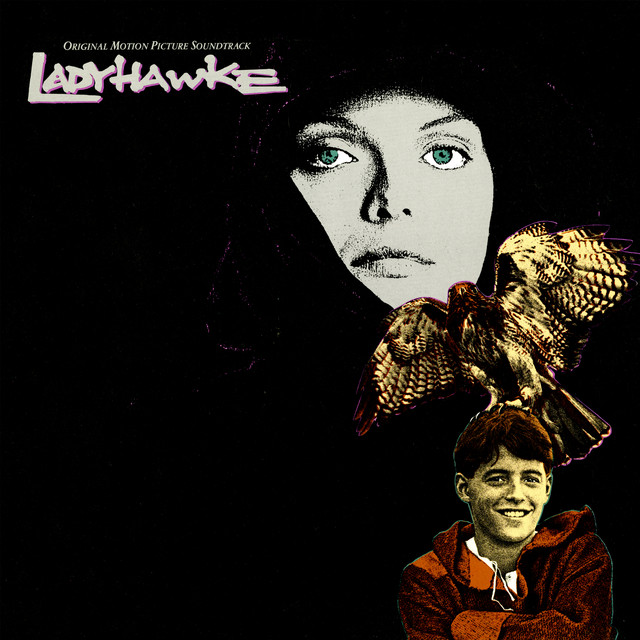
The Sound of Medieval Synth-Rock
And then there’s the music.
If there’s one aspect of Ladyhawke that continues to divide audiences, it’s the score by Andrew Powell, produced by Alan Parsons.
The story behind the musical choice is almost as unusual as the movie itself.
Donner reportedly became interested in the music of The Alan Parsons Project while scouting locations in Europe. He liked the sound and believed it could provide the film with a distinctive musical identity.
He wasn’t interested in simply giving audiences another conventional medieval orchestral score.
The result was something rather different.
Powell’s music is full of synthesizers, electric guitars, and the sort of sweeping progressive-rock arrangements that were very much at home in the middle of the 1980s.
Whether it works is another question.
There are moments when the music seems perfectly suited to the film’s romantic sweep. Then there are others when Navarre appears to be riding through medieval France accompanied by the soundtrack to a particularly ambitious arena-rock concert.
It’s an odd combination, and one that has become inseparable from the film’s identity.
Some viewers find it wonderfully atmospheric. Others would prefer something a little more traditional.
I’m inclined to think the score is part of what makes Ladyhawke such an unmistakable product of its time. It doesn’t always work, but at least it has a personality. There are plenty of fantasy movies with forgettable music. Nobody has ever accused Ladyhawke of being forgettable.
A Disappointing Box Office and a Longer Life on Home Video
Ladyhawke finally arrived in American theaters on April 12, 1985, distributed by Warner Bros.
Rated PG-13 and running 121 minutes, it opened in more than 1,000 theaters, earning approximately $3.45 million during its first weekend.
Those weren’t terrible opening numbers, but the film struggled to build on them.
With production costs generally reported in the neighborhood of $20 million, its eventual domestic gross of approximately $18.4 million represented a disappointing theatrical result. It wasn’t the sort of performance that would have encouraged Hollywood to immediately start planning a sequel.
The critical response was mixed but generally appreciative of the film’s visual qualities and romantic ambition.
Variety described it as a “very likeable, very well-made fairytale,” while other reviewers were less enthusiastic about its pacing and the sometimes awkward combination of comedy and fantasy.
Gene Siskel and Roger Ebert were both positive about the picture, although not everyone shared their enthusiasm.
The film received two Academy Award nominations in sound categories, while its genre recognition continued at the Saturn Awards, where it won Best Fantasy Film and Best Costumes.
The theatrical disappointment didn’t tell the whole story, however.
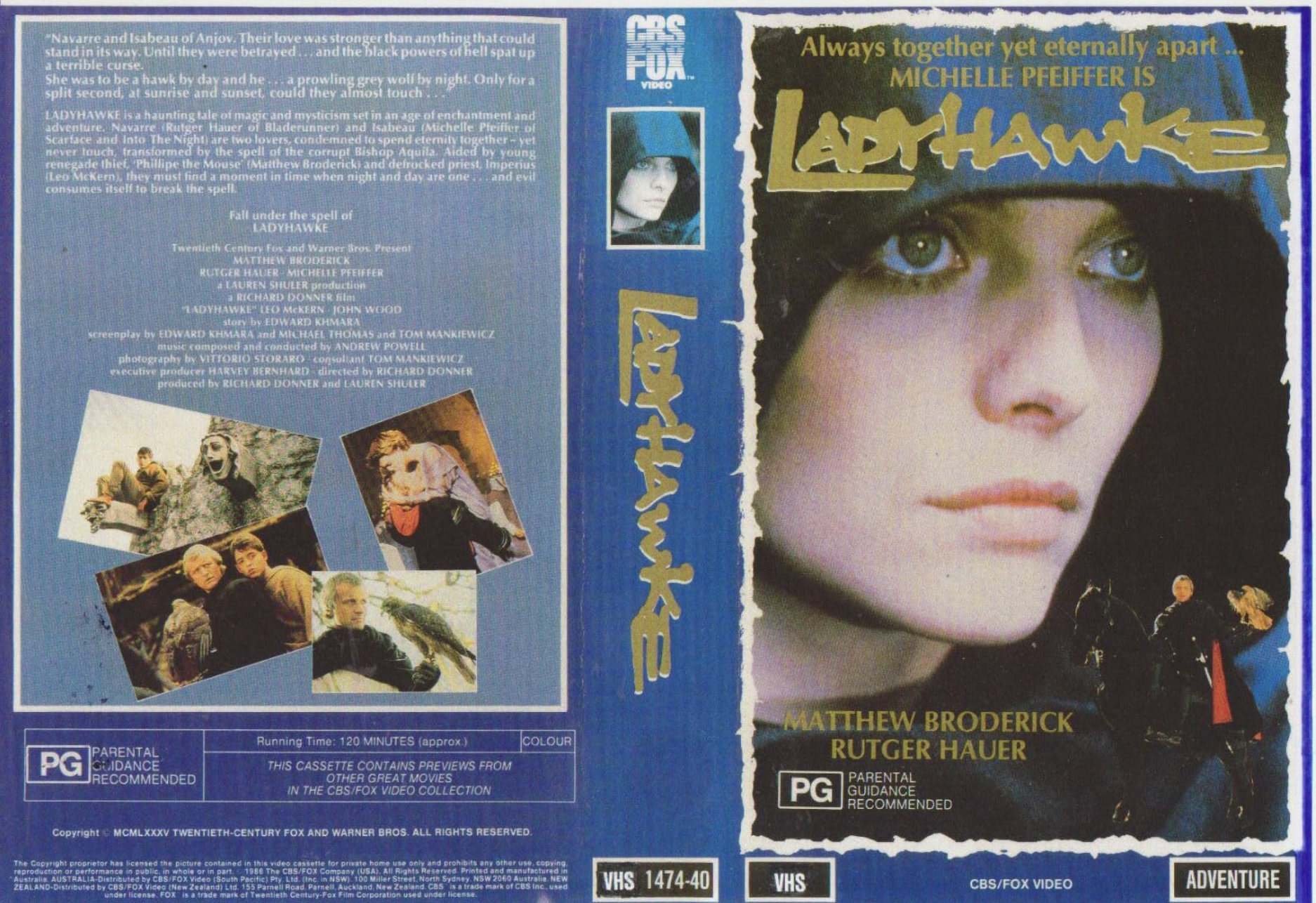
Like so many movies from the 1980s, Ladyhawke found a considerably longer life after leaving theaters. VHS rentals, cable television, and subsequent home-video releases introduced it to audiences who might never have discovered it during its original theatrical run.
For a generation of viewers, it became one of those movies that seemed to be waiting for you whenever you turned on the television.
And sometimes that’s all a movie needs.
The Enduring Magic of Ladyhawke
There are certainly things about Ladyhawke that haven’t aged particularly well.
The pacing can be leisurely, the tonal shifts occasionally awkward, and the score remains a matter of considerable debate. It’s not a perfect fantasy film, and it doesn’t pretend to be.
But perfection isn’t necessarily the point.
What Donner accomplished was something rather unusual for a major Hollywood production of the period. He made a fantasy adventure that was genuinely interested in the emotional consequences of its central premise.
The curse isn’t simply a convenient plot device. It’s the source of the film’s entire emotional identity. Navarre and Isabeau are separated by something they cannot control, and the movie never entirely loses sight of the sadness beneath their predicament.
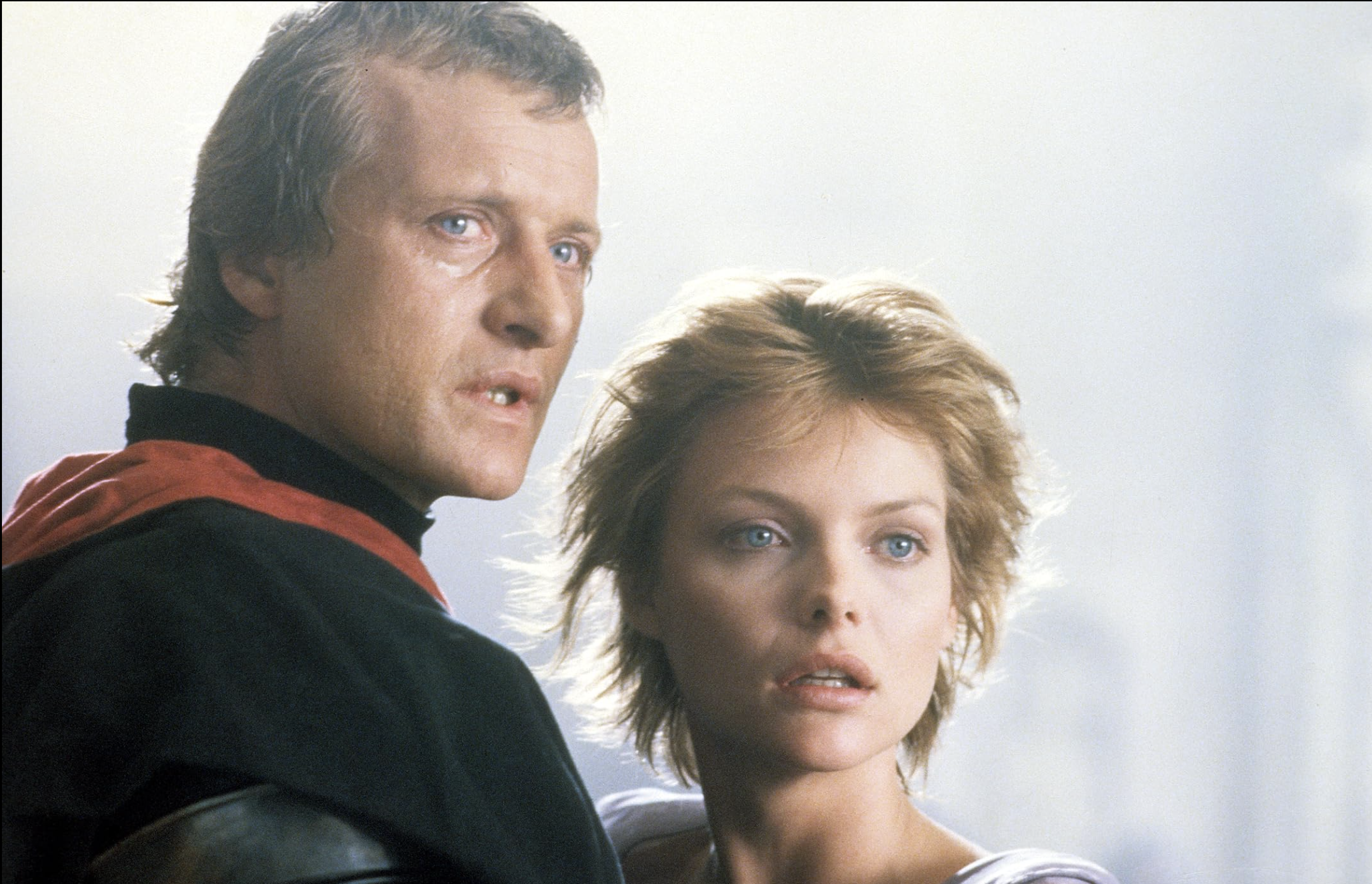
The Italian locations give the story an extraordinary visual richness, Storaro’s cinematography elevates the material, and Hauer and Pfeiffer make a convincing romantic couple despite spending much of the film separated by their animal transformations.
Its influence even extended beyond the movies. New Zealand musician Ladyhawke, born Phillipa Brown, took her professional name from the film.
Four decades later, Ladyhawke has become something of a cult favorite, enjoying an appreciation that wasn’t necessarily there when it first arrived in theaters.
Perhaps that’s appropriate.
It’s a movie about two people waiting for the right moment to be together. It took a little longer for audiences to find their moment with it.
And while the synth-rock may still sound a little peculiar against the backdrop of medieval castles and wandering knights, there’s something genuinely lovely about a movie that takes its romantic fairy tale so seriously.
Sometimes you just need a little magic. And perhaps a very good hawk.

Explore the making of Ladyhawke (1985), Richard Donner’s medieval fantasy starring Michelle Pfeiffer, Rutger Hauer, and Matthew Broderick. Discover its troubled development, Italian locations, production stories, and unlikely journey to cult-classic status.
Ladyhawke, 1985 Movies, Michelle Pfeiffer, Rutger Hauer, Matthew Broderick, Richard Donner, 1980s Fantasy Movies, Movie History, Cult Classic Movies, Hollywood History, Forgotten Movies of the 80s, Movies of the 80s
About the Creator
Movies of the 80s
We love the 1980s. Everything on this page is all about movies of the 1980s. Starting in 1980 and working our way the decade, we are preserving the stories and movies of the greatest decade, the 80s. https://www.youtube.com/@Moviesofthe80s
Enjoyed the story? Support the Creator.
Subscribe for free to receive all their stories in your feed.
Comments
There are no comments for this story
Be the first to respond and start the conversation.