
Kadaisi Vivasayi Ending Explained: Full Story, Meaning and Maayandi’s Emotional Journey
Kadaisi Vivasayi (The Last Farmer) is more than a Tamil village drama. Here is the complete story, ending explained, and the deeper meaning behind Maayandi, Ramaiah and the mysterious peacock scene.

Spoiler Warning: This article contains major spoilers for Kadaisi Vivasayi.
What Is Kadaisi Vivasayi About?
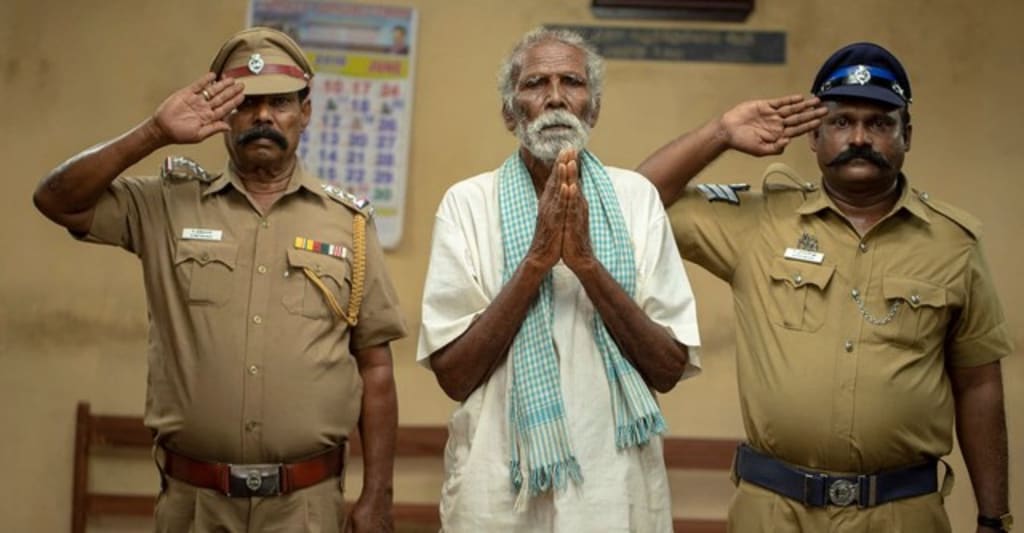
Kadaisi Vivasayi, meaning The Last Farmer, is a Tamil drama directed by M. Manikandan. Nallandi plays Maayandi, while Vijay Sethupathi appears as Ramaiah and Yogi Babu has a supporting role. The film received its theatrical release in February 2022.
On the surface, Kadaisi Vivasayi is the story of an elderly farmer who is wrongly accused of killing peacocks. But underneath that simple premise is a deeply emotional film about farming, disappearing traditions, nature, faith, loneliness and humanity.
Maayandi is around 80 years old and lives alone in a quiet Tamil Nadu village. Almost everyone around him has abandoned farming. Some villagers have taken jobs elsewhere, while others have sold their agricultural land.
Maayandi refuses to follow them.
For him, farming is not simply a profession. The land represents his ancestors, identity and responsibility.
When a property dealer tries to convince him to sell, Maayandi makes his philosophy clear: he does not truly consider himself the owner of the land. He is merely its temporary caretaker, responsible for protecting it before passing it to another generation.
That idea becomes the heart of the entire movie.
Why Does Maayandi Start Growing Paddy?
After lightning strikes an old tree in the village, the villagers interpret the event as a bad omen.
They decide to perform an important traditional ritual for their deity. Paddy is required for the ceremony, but there is one major problem: hardly anyone in the village farms anymore.
Maayandi is effectively their last traditional farmer.
The villagers request that he grow enough paddy to make the offering, and despite his age, Maayandi accepts without hesitation.
He prepares the field with his bulls and works tirelessly under the sun. His commitment highlights the contrast between traditional agricultural life and a village that is slowly moving away from the land.
Who Is Ramaiah in Kadaisi Vivasayi?
Another important character is Ramaiah, played by Vijay Sethupathi.
Ramaiah once loved a woman deeply. After their relationship was opposed, she died, and Ramaiah never married.
Emotionally, however, he never accepts that she has truly left him.
Wherever he travels, Ramaiah carries two bags: one for himself and another for his dead lover. If he buys food, he buys for two. If he sits down to eat, he places two plates.
Most villagers consider him strange.
Maayandi does not.
Whenever Ramaiah visits, Maayandi treats the unseen woman with the same dignity that Ramaiah does. He even places a second plate of food for her.
Their relationship reveals something important about Maayandi: he does not need to understand another person's belief before respecting it.
Why Is Maayandi Arrested?
One morning, Maayandi discovers dead peacocks near his field.
Because the birds have religious significance for him, he is heartbroken. He respectfully buries them instead of leaving their bodies exposed.
Unfortunately, another man sees Maayandi burying the birds.
The police later receive a complaint accusing Maayandi of killing them.
Maayandi is taken into custody.
The tragedy of this situation is that he does not even fully understand why his act of compassion has turned him into a criminal suspect.
When produced before the magistrate, Maayandi explains that he only found the birds dead and buried them respectfully.
Even the witness admits that he never actually saw Maayandi killing them.
Still, because the investigation remains incomplete, Maayandi cannot immediately return home.
His biggest concern is not prison.
It is his crop.
The Courtroom Scenes Reveal the Film’s Real Conflict
Maayandi repeatedly asks one heartbreaking question:
Can I go back to my field?
The legal system sees a case file, procedures and investigation deadlines.
Maayandi sees living crops that require water.
The magistrate eventually orders the policeman involved in the case to look after Maayandi's field while the elderly farmer remains detained.
Ironically, working in the field begins changing the policeman himself. What initially feels like punishment slowly teaches him the peaceful rhythm and importance of farming.
Inside prison, Maayandi produces a similar transformation in a young inmate.
The prisoner begins asking him questions about seeds, soil and cultivation. Eventually, the young man decides that after leaving prison, he wants to return to his own agricultural land and become a farmer.
Maayandi's influence spreads without speeches or preaching.
He simply lives according to his principles.
What Happens to Ramaiah?
Ramaiah's storyline takes an increasingly spiritual direction.
During one of his journeys, he encounters a mysterious holy man.
The holy man somehow recognizes the presence of Ramaiah's dead lover—something nobody else has ever been able to do.
This moment validates Ramaiah's faith in a way that deeply affects him.
Later, after travelling to a hilltop, Ramaiah mysteriously disappears. Only the two bags he always carried remain behind.
When Maayandi learns what happened, he does not react with shock.
Instead, he quietly understands that Ramaiah has finally gone where he was meant to go.
The implication is spiritual rather than literal: Ramaiah's long journey of grief has finally ended, and he has perhaps been reunited with the woman he could never let go.
Why Is Maayandi’s Crop Destroyed?
While Maayandi is trapped in the legal process, insects attack his crop.
He recommends a traditional natural remedy using particular leaves mixed with cow urine. But when those leaves cannot be found, a chemical product is used instead.
Eventually, Maayandi manages to visit the field.
What he sees destroys him emotionally.
The crop he had worked so hard to cultivate for the village ceremony has been ruined.
This is one of the most painful moments in Kadaisi Vivasayi because Maayandi never wanted money, status or sympathy.
He only wanted to farm.
The system may eventually recognize his innocence, but by then something far more valuable than his freedom has already been damaged.
How Does the Village Save Maayandi’s Dream?
Eventually, the investigation clears Maayandi and he is allowed to go home.
But the most beautiful transformation occurs when he returns to his village.
He discovers that the villagers have come together to work on his land.
People who had moved away from farming are once again touching the soil. The police also join them. Even Yogi Babu's character participates with his elephant.
The man who seemed to be the last farmer has unknowingly inspired an entire community to farm again.
The village ritual can finally take place.
When the day arrives, Maayandi does not enter like a conventional movie hero.
There is no action sequence, dramatic weapon or triumphant dialogue.
He simply carries the paddy he has cultivated.
That grain is his victory.
Kadaisi Vivasayi Ending Explained
The final scene of Kadaisi Vivasayi is simple but highly symbolic.
The morning after the village ceremony, Maayandi returns to his field with his bulls.
As he sits peacefully looking across the land, a peahen appears before him and begins spreading its feathers.
Maayandi smiles.
Then lightning flashes across the sky.
For a moment, the screen is overwhelmed by light.
When the light disappears, the bird is gone.
So what does the ending mean?
The film deliberately avoids giving one definitive explanation, but several interpretations are possible.
The peahen can represent nature forgiving and blessing Maayandi. Earlier, dead peacocks became the reason an innocent man was imprisoned. At the end, a living bird appears peacefully before him, almost restoring the balance.
It can also represent Ramaiah and the spiritual world.
Ramaiah's mysterious disappearance has already blurred the boundary between life, death, memory and faith. When the bird appears and disappears after the lightning, Maayandi seems to understand something that the audience cannot completely see.
Most importantly, the ending symbolizes continuity.
People may disappear.
Traditions may weaken.
Villages may change.
But nature continues.
And as long as someone remains willing to care for the land, the relationship between human beings and the soil is not completely lost.
Why Kadaisi Vivasayi Is So Powerful
Kadaisi Vivasayi does not need a conventional villain.
Its real conflict is between two ways of living.
One values land mainly according to its selling price.
The other sees land as something inherited, protected and eventually passed on.
Maayandi represents the second philosophy.
He saves seeds instead of depending completely on new ones. He respects animals even after death. He refuses to sell ancestral farmland for easy money. Most importantly, he never considers farming inferior simply because society has found more profitable occupations.
That is why calling him The Last Farmer ultimately feels both tragic and hopeful.
He may begin the story as the village's last farmer, but by the end, his example has brought other people back into the field.
Final Thoughts
Kadaisi Vivasayi is not simply a movie about an elderly farmer.
It is about what happens when progress causes people to forget the value of the things that sustained generations before them.
Maayandi rarely delivers dramatic speeches. He does not try to change the world. He simply remains loyal to the soil, his animals and his principles.
Yet that quiet commitment eventually changes almost everyone around him.
And perhaps that is the film's most beautiful message:
You do not always need to fight the world to change it. Sometimes, you only need to protect what truly matters.
About the Creator
parwinder singh
🎬 Movie & Entertainment Writer sharing reviews, ending explanations, story breakdowns, plot twists and hidden details from Bollywood, Hollywood, South Indian cinema, Korean dramas and OTT releases.
Enjoyed the story? Support the Creator.
Subscribe for free to receive all their stories in your feed.
Comments
There are no comments for this story
Be the first to respond and start the conversation.