
Jimmy Kimmel Controversy Explained: Comedy, Politics, and the WHCD Shooting Fallout
Jimmy Kimmel, Political Satire, and the White House Dinner Shooting Controversy That Sparked a National Debate on Free Speech and Media Responsibility

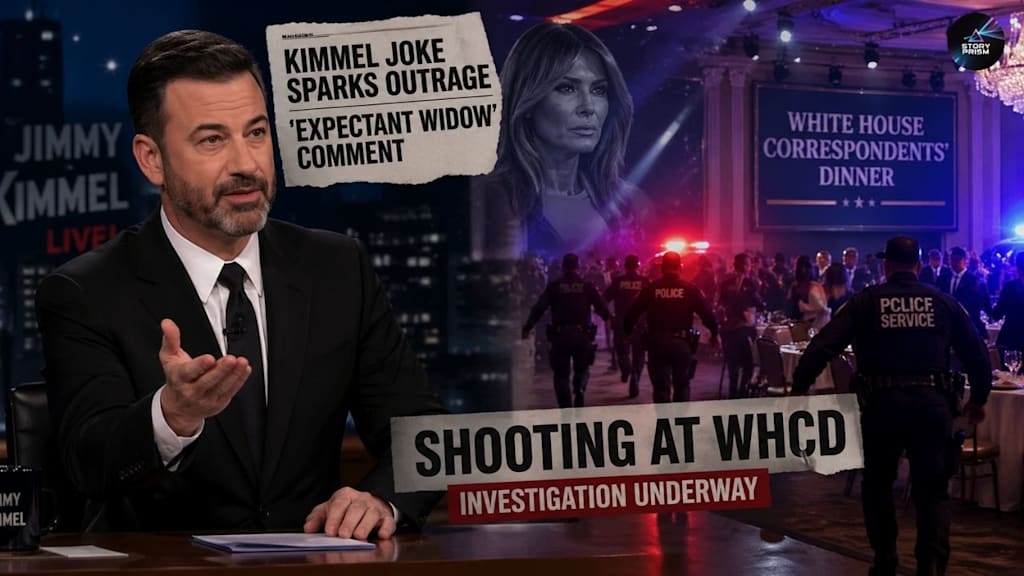
Jimmy Kimmel has become the center of a heated public debate following controversy surrounding remarks made during a White House Correspondents’ Dinner parody segment and the political fallout that followed a security incident at the event. The situation has drawn attention from major media outlets, political figures, and audiences across the United States, raising questions about the boundaries of political comedy, media responsibility, and the impact of rhetoric in an increasingly polarized environment.
According to multiple reports, Kimmel delivered a satirical monologue in which he made a joke referring to Melania Trump as having “an expectant widow” appearance, a comment that immediately sparked backlash from political supporters and commentators. While late-night comedy has long been known for its provocative political humor, critics argued that the timing and tone of the joke crossed a line, especially given the tense political climate surrounding the event.
Days after the remarks, a shooting incident occurred at the White House Correspondents’ Dinner in Washington, D.C., where an armed suspect breached security and opened fire before being subdued by law enforcement. The incident led to the evacuation of high-profile attendees, including President Donald Trump and First Lady Melania Trump, and resulted in injuries to a Secret Service agent. Authorities later confirmed the suspect was apprehended, and investigations into the motive are ongoing.
In the aftermath of the shooting, Melania Trump issued a strongly worded public statement criticizing Jimmy Kimmel’s comments. She described the joke as “hateful and violent rhetoric” and suggested that such language contributes to a broader culture of hostility in political discourse. She also urged ABC, the network associated with Kimmel’s program, to take a firm stance regarding the comedian’s conduct, calling for accountability from media organizations that broadcast politically charged content.
The controversy quickly escalated into a national debate about the role of satire in politics. Supporters of Kimmel argue that his comments fall within the tradition of comedic expression protected by free speech, emphasizing that political satire has historically played an important role in holding public figures accountable. They caution against conflating comedy with real-world violence, warning that restricting satire could set a precedent for censorship.
On the other hand, critics argue that public figures with large platforms bear responsibility for how their words may be interpreted, especially in volatile political environments. They contend that even comedic statements can have unintended consequences when tensions are already high, and that media personalities should exercise greater caution when addressing sensitive subjects.
The incident has also reignited broader discussions about security at major political events. The breach at the Correspondents’ Dinner raised concerns about how such an attack could occur despite heightened security measures. Officials have stated that a review of protocols is underway to prevent similar incidents in the future, with a focus on identifying potential vulnerabilities in access control and screening procedures.
Media analysts note that the intersection of comedy, politics, and real-world violence is not new, but the immediacy of social media and 24-hour news cycles has intensified public reactions. Statements that might once have remained confined to entertainment circles now rapidly become part of larger political narratives, amplifying their impact.
As the situation continues to unfold, Jimmy Kimmel has not issued a detailed public response addressing the latest criticism directly. However, the debate surrounding his remarks highlights the increasingly complex role of entertainers in shaping political discourse. Whether viewed as harmless satire or irresponsible commentary, the controversy underscores the delicate balance between free expression and social responsibility in modern media.
Search interest around the Jimmy Kimmel controversy has surged, making keywords such as 'Jimmy Kimmel joke Melania Trump', 'WHCD shooting controversy', and 'late-night comedy free speech debate' trending across news platforms and social media. SEO analysts note that the incident has significantly increased engagement on political entertainment content, especially as audiences seek context on what was said and how it connects to the White House Correspondents’ Dinner shooting. The discussion has also intensified scrutiny on ABC’s handling of political satire programming and whether networks should enforce stricter editorial oversight in sensitive moments.
At the center of the debate is a broader question about the role of comedians in political discourse. Jimmy Kimmel, known for his sharp political monologues, now finds himself in a situation where satire, timing, and real-world events intersect in a controversial way. As investigations into the shooting continue, public attention remains divided between condemning violence and analyzing media influence. The ongoing story continues to evolve, shaping conversations about entertainment responsibility, political polarization, and the limits of humor in modern broadcast media. Ultimately, the controversy highlights ongoing tensions between free speech, media ethics, and political accountability today.
About the Creator
Enjoyed the story? Support the Creator.
Subscribe for free to receive all their stories in your feed.
Comments
There are no comments for this story
Be the first to respond and start the conversation.