
Is Erin Hannon Hot?
How a lifetime of foster care turned Erin Hannon into a blind spot for the male gaze.
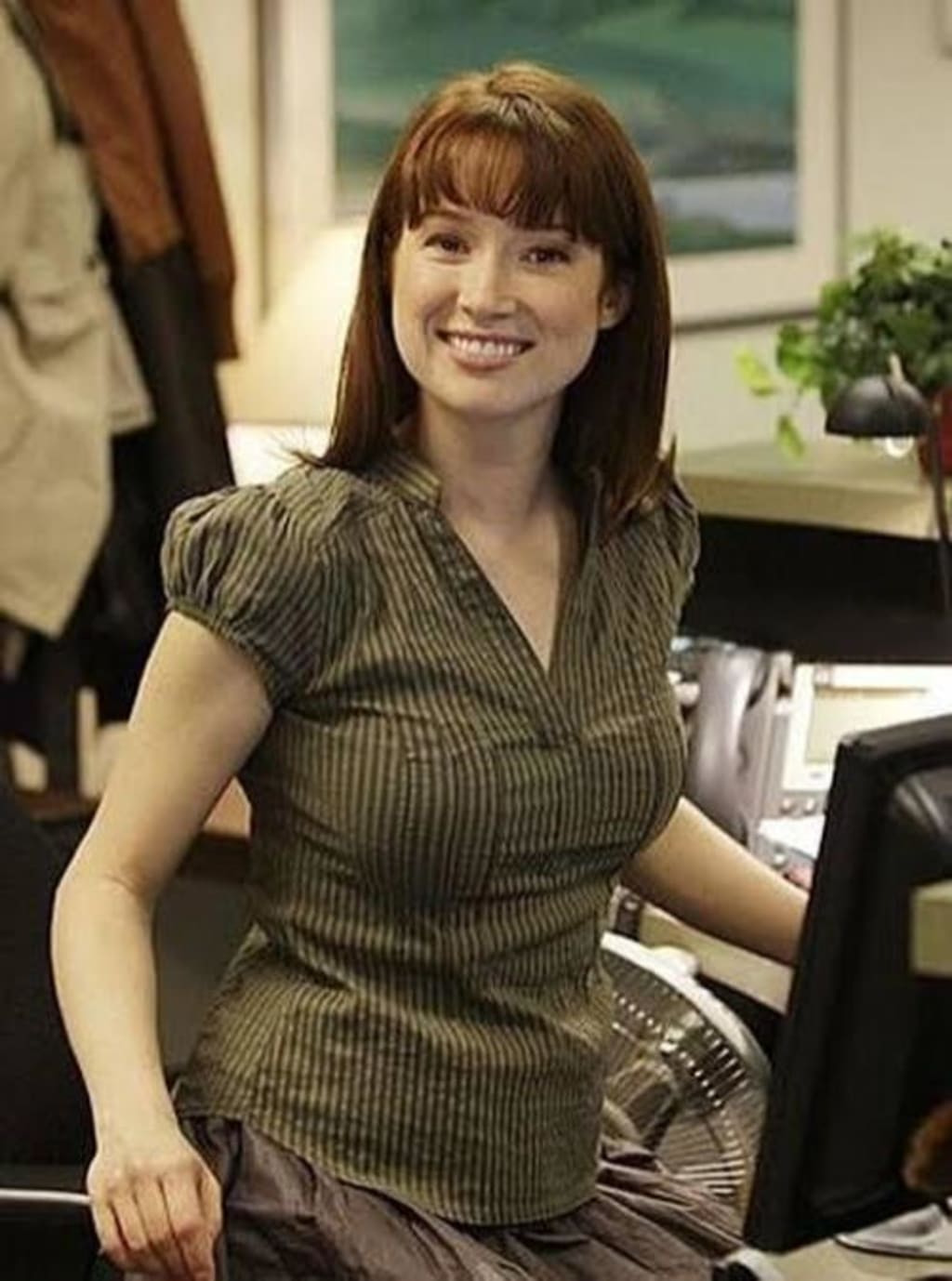
I. The Crack Between Seeing Her and Gazing at Her
When Erin Hannon first walked into the Dunder Mifflin office, she was someone everyone could see, but few were willing to truly look at.
She is good-looking. Blonde hair, blue eyes, full cheekbones, a face that lights up entirely when she smiles. In that Scranton office space filled with beige partitions and dim fluorescent light, she was like someone had placed a flower that didn't belong there next to the copier—jarring, bright, making you do a double take. But only a double take. When you try to let your gaze linger any longer, a subtle unease arrives before any stronger emotion can take hold. You're not sure where this unease comes from; you only know it makes your look lighter, quicker, eventually reducing it to a hurried glance, a brief sweep and away.
This state of "being unable to gaze" is the key to understanding Erin Hannon.
The word "sexy" keeps getting suspended around her—not because discussants lack judgment or have differing tastes, but because this character was, from the very beginning, designed as a blind spot for the gaze. She's pretty enough to make you notice her; but she lives in a way that's "off" enough to prevent you from translating that "pretty" into any stronger verb of desire without feeling uncomfortable.
This is a self-aware narrative strategy. The writers gave her a beautiful exterior while simultaneously installing an insulating layer—not to uglify her, not to deliberately hide her body, but to make her unaware that she looks the way she does.
II. She Doesn't Know What She Looks Like
This is the most fundamental difference between Erin and every other female character in the office.
Pam Beesly knows her own appeal. Her shyness and insecurity conceal a suppressed self-awareness—she told the camera once, "I think I'm pretty sometimes"; every look back at Jim carries deliberate restraint; she knows what she's doing. Angela uses her dogma and conservatism to build a wall, but that wall itself is a repeated confirmation: she knows how others see her. Kelly Kapoor deploys her body alternately as weapon and shield; every outfit is a declaration.
Erin doesn't know.
When she stands before the camera in that obviously ill-fitting cheap professional wear, when she excitedly describes some childish weekend plan, when she calls out "Michael!" in that over-tight, overly positive tone that makes people slightly uncomfortable—she has no awareness that she's being seen. This "lack of awareness" isn't affectation, isn't some higher form of self-possession. She genuinely does not know.
It's a strange thing. A young woman in her twenties, in a social space like an office so saturated with exchanges of looks—how could she possibly be completely oblivious to what her appearance means? But Erin pulls it off. Or rather, the writers made her pull it off—by having her spend all her attention elsewhere.
Where did her attention go? To a more urgent, more primal place: the fear of being abandoned.
III. Someone Forever Bracing to Be Kicked Out
Erin grew up in foster care. This backstory is mentioned lightly, a few times throughout the show. But if you take this sentence as the single key to understanding everything she does, you'll find it all clicks into place.
A child shuffled through the foster system learns, from an early age, a brutal survival skill: how to reshape yourself into what the other person wants, before they ever get tired of you. She had no permanent parents to tell her, "You don't have to do anything, we're right here." She had only a succession of temporary guardians, any one of whom could at any moment say, "We can't afford you anymore" or "It's time for you to leave."
Children raised in this environment develop a people-pleasing instinct. It's not grace, not politeness, not even genuine kindness—it's a strategy born of preemptive fear. You're forever scanning the other person's expression, forever exhausting yourself to prove you're "not a burden," forever flattening yourself, folding yourself smaller, stuffing yourself into the shape least likely to be thrown out, before anyone even says a word.
Every single "odd" thing about Erin traces back to this root:
Her cringe-inducing, borderline uncomfortable loyalty to Michael isn't admiration—it's a girl who never had a father latching onto the first man willing to show her any "fatherly" attention.
Her hot-and-cold oscillation with Andy isn't a game—it's a girl who's never seen a healthy intimate relationship, panic-testing over and over: "He's pulling away, I need to pull him back"; "He's getting too close, I need to run."
The way she speaks, that positivity bordering on a tic—it's writing "I'm not a burden" into every single inflection.
Her childish collections, her pajama parties, her obsession with Glee—these are signs that her psychological age stopped at some point, frozen at the age when she was last abandoned.
Everything about her that makes people "afraid to look" is the debris of trauma. You can't feel desire for someone who's just crawled out of a wreck—at least, not if you're mentally healthy. So your gaze automatically switches channels, shifting from "appraisal" to "checking that she's still breathing."
IV. Relationships as Mirrors: Every Approach Is a Rehearsal for Escape
Erin's three significant relationships in the show are essentially three rehearsals of the same script:
With Michael: She tries to turn him into a father. He enjoys her worship. Neither wants the other "as a man/woman"—they both want the person who was absent from their childhood. There isn't a trace of sexual tension here, because the "father-daughter" frame fundamentally empties out all possible erotic space. We watch her being good to Michael, and our thought is, "Finally, someone is willing to be good to her," not "Does she have feelings for him?"
With Andy: Two adults whose emotional ages haven't caught up try to pretend they're in a relationship. Their love is filled with adolescent absurdity—sulking, cold wars, loud proclamations, dramatic reconciliations staged in front of everyone. The scene where Erin makes Andy wait hours in the car looks like punishment on the surface, but its underlying logic is a test: "How long will you wait for me? Will you, like everyone else, walk away halfway?" This isn't a woman's desire to conquer; it's a child's panic-test. She's not playing games with feelings—she's repeatedly checking, "This time I won't be left behind again, right?"—and then using every confirmation to prove the opposite: "No, they all leave."
With Plop: She ultimately chooses stable, boring, drama-free Plop. This is her most honest choice: she chose safety over passion. She chose the person who "will be there every day" over the one who "makes my heart race." This choice itself is a refusal of "sexy"—Erin Hannon doesn't pursue sexiness, and has never sought to be seen as a sexual object by anyone, because she simply cannot afford the cost of "losing control." A person who could lose everything at any moment fears nothing more than losing again.
V. But "Not Sexy" Is Precisely Her Strength
If "sexy" is defined as a magnetic field designed to arouse desire in others, with a clear directional pull, then Erin is an insulator against that field.
But that doesn't mean she lacks value.
In seasons eight and nine, when Sabre descends into chaos and the office is filled with unease, Erin fills the room with her completely illogical optimism. She can't read spreadsheets, can't untangle factional infighting, but she possesses an almost physiological ability to keep going—she'll smile even if the sky falls, she's still there after everyone's left, she understands nothing but she doesn't run.
This sounds like cheap positivity, but in Erin's case, it carries another meaning: a person who has been abandoned countless times, choosing to show up again every single morning—that act alone is already a kind of miracle. She's not peddling platitudes; she's demonstrating, with her own body, one thing: you can leave, I can leave too, but I choose to stay and finish today.
This resilience has nothing to do with her appearance. It has to do with her trauma, and with the decision she makes every morning after waking up: "Fine. I'll get up anyway." It doesn't belong to the category of "sexy," but its power is no less than any form of attraction.
VI. What This Character Teaches Us
Whether Erin Hannon is actually "pretty" is, in truth, a false question. We ask it not because the answer matters, but because we're using the question as cover—what we really want to say is something else:
This world owes her unconditional acceptance.
A person who was told repeatedly, from childhood, "It's time for you to leave," grows up exhausting every ounce of energy to become "not a burden," "easy to get along with," "useful." She has lived herself into a person who is always smiling, never refusing, never complaining. She has lived herself into the most easily overlooked presence in the office—because someone who's always positive, everyone assumes, is fine.
But if you place her opposite the word "sexy," you'll find she answers a deeper question: Can a young woman's worth be measured by how much she makes others desire her?
The answer is no. But what makes Erin special is that she never asked this question, and she doesn't care about the answer. She comes to work every day, wears those ill-fitting clothes, speaks in that excessive tone, is kind to everyone, and takes the bus home. She isn't "rebelling" against anything—she doesn't even know she's in a position to rebel. Her very existence is evidence of one thing: the opposite of sexy isn't ugly; it's "I'm not even thinking about it."
VII. Back to That Word
So—is Erin Hannon sexy?
No.
She isn't. She shouldn't be categorized as "sexy," nor should she be asked to be. The word "sexy" placed on her is like draping a coat that's too heavy over someone who's still shivering—it weighs her down, covers her, makes her less like herself.
But is she pretty? Yes. Is she interesting? Yes. Does she deserve to be taken seriously? Yes. Does she deserve a childhood that wasn't taken from her? Yes. Does she deserve a life where she doesn't have to prove she's "not a burden" every single day? Yes.
But she's not sexy. And it's precisely this "not sexy" that makes her one of the characters in this fictional office who comes closest to real trauma and real survival. She shows us, wrapped in comedy, a heavy demonstration of how to keep living in a world where nobody wants you.
And if, after reading all of this, you still think, "She's fine, but I can't quite say what's good about her"—then congratulations. You've just experienced, in the most honest way, that core thing about this character that can't be captured by language. It's not the temperature of desire. It's something else. It has no name. It's just there, every morning at nine, walking into that gray office, smiling at everyone and saying, "Good morning."
About the Creator
Jin
Writer of reamstories
https://reamstories.com/jin
Enjoyed the story? Support the Creator.
Subscribe for free to receive all their stories in your feed. You could also become a paid subscriber, letting them know you appreciate their work.
Comments
There are no comments for this story
Be the first to respond and start the conversation.