
I Watched Jiang Wen’s Later Films So You Don’t Have To: Here’s Why They Fail Where Let the Bullets Fly Succeeded
The train left Goose City, and the audience never followed. A breakdown of the one film where Jiang Wen shook hands with viewers—and the two that turned his back.
After the train leaves Goose City: why Gone with the Bullets and Hidden Man could never reach Let the Bullets Fly
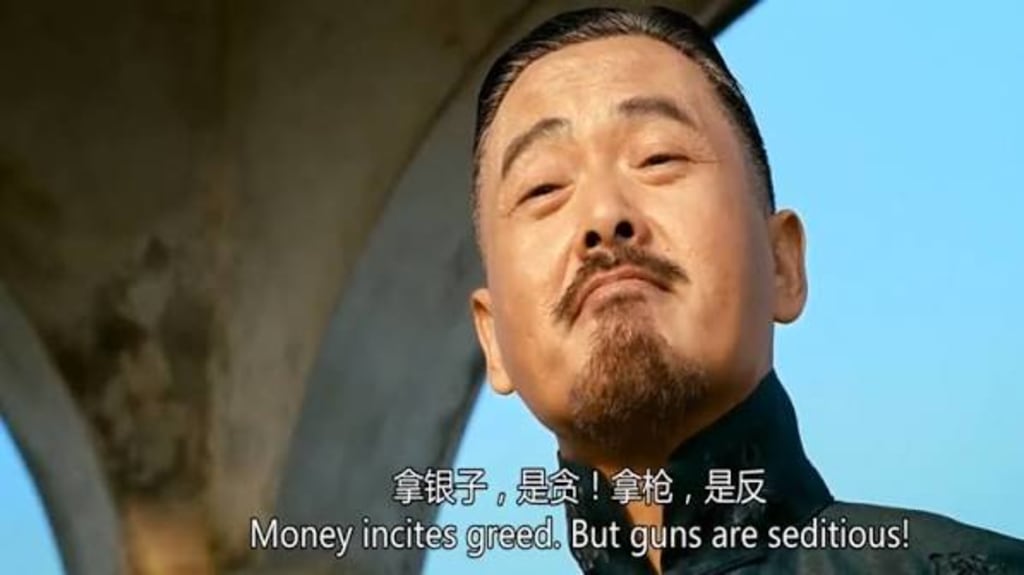
A horse-drawn train. Hot pot. Guns. Zhang Mazi pulls Tang Shifu out of the water, and the story of Goose City begins. In 2010, the audience sat in cinemas and first saw a train pulled by horses, then saw Jiang Wen, Ge You, and Chow Yun-fat scheming around a table. That year, Jiang Wen stood inside the screen and in front of the audience.
Later, he turned away.
I. Let the Bullets Fly: give the story first, the riddle second
The opening does not explain. Train, horses, hot pot, guns. A few strokes are enough. Zhang Mazi hijacks the train. Ma Bangde bought an official post. Huang Silang waits in Goose City. Three men, three calculations. Zhang Mazi wants money and fairness. Tang Shifu wants money and his life. Huang Silang wants money and control. Calculation meets calculation, and drama emerges.
The audience does not need to understand the metaphor first. Silver is handed out by day and collected by night. The people of Goose City dare not take it. Zhang Mazi asks why. Tang Shifu says they are afraid. Huang Silang does not even appear, and the silver goes back. That is fear. The double is killed. Huang Silang says he is Huang Silang, and everyone believes it. That is the sign. The horse-drawn train is absurd, and it is power. But these metaphors grow out of action. You can see the silver. You can see the guns. You can see the hat fly off.
The dialogue also grows out of character. Zhang Mazi says, "Let the bullets fly for a while," because he has a gun and patience. Tang Shifu says, "If you take too big a step, you'll tear your balls," because he is slippery and afraid. Huang Silang says, "Arrogance exposed," because he thinks he is secure. Every line has a source, an object, a purpose. They belong to the people in that scene.
The structure is steady. Hijack the train, enter the city, hand out money, suppress the bandits, kill the double, attack the tower. Every section has a goal, an obstacle, a turn. Zhang Mazi fights Huang Silang. Tang Shifu stirs in the middle. Zhang Mazi wins a round. Huang Silang cuts back. Huang Silang presses, Zhang Mazi turns it around. The audience follows. No need to guess. Guessing is the second layer. The first is watching.
The actors are all at their peak. Jiang Wen's roughness, Ge You's slickness, Chow Yun-fat's menace. Three pillars. Chen Kun, Jiang Wu, Liao Fan, Zhang Mo, Zhou Yun. Each occupies a position. No one waits for anyone. No one yields. The camera sweeps, and everyone is moving.
After The Sun Also Rises, Jiang Wen had lost money. With Let the Bullets Fly, he knew he had to shake hands with the audience. He was still proud, still an author, but he hid his pride behind the story. The audience saw Goose City first, then the allegory. They saw Zhang Mazi first, then Jiang Wen. Later, the order reversed.
II. Gone with the Bullets: the stage lights come on, the entrance disappears
Gone with the Bullets opens in Shanghai. Stage, song and dance, the Flower President. Wan Yan is under the lights. Ma Zouri is beside her. The images are gorgeous, the scenes lively. And then? Ma Zouri becomes a murderer. Xiang Feitian investigates. Wu Qi stirs trouble. The story turns, but the audience finds no handle.
Ma Zouri is a question the film never answers. It never explains his love for Wan Yan, his reason for saving Xiang Feitian, or why he runs. Or rather, it answers with lines, with voice-over, with symbols. Ma Zouri becomes Jiang Wen's loudspeaker. His words have tone and force, but they do not feel like things Ma Zouri must say. Wan Yan stands for desire. Wu Qi caricatures privilege. Xiang Feitian stands in for opportunism. Once characters become concepts, the audience cannot worry for them.
The dialogue grows vaguer. "I am still a child" can be a meme, but it does not move the plot. It only lets the audience know that Ma Zouri has a past, grievances, some refusal to grow up. But the audience cannot see that past. They only see Wen Zhang saying it. Saying is voice-over. Doing is cinema.
The rhythm scatters. One musical number after another, one cinephile reference after another. Each piece has talent on its own. Together they feel like a party. Jiang Wen is having a wonderful time inside. The audience stands at the door without an invitation. They expected the table in Goose City. They got the stage in Shanghai. A table has winners and losers. A stage only has performance.
Gone with the Bullets has force. Absurdity, flight, ideas about public opinion, power, performance. But the ideas hang in the air. The audience has to climb up to see any view. Most people buy a ticket to a cinema, not to climb scaffolding.
III. Hidden Man: the man on the roof, the people on the ground
Hidden Man adapts Zhang Beihai's novel. The original has the daily life of Beiping. Hutongs, food, human feeling, warmth, banter. Revenge grows out of life. The film also has Beiping, but more as symbol. Rooftops, bell tower, Union Medical College, white coats, dumplings, vinegar. Li Tianran returns for revenge. Zhu Qiansheng has become a policeman. Nemoto runs an opium den. Lan Qingfeng is scheming.
Li Tianran should be a revenge seeker of flesh and blood. He carries the blood debt of his master's family. He comes back from America. He can parkour, ride a bike, read maps. But his revenge line is chopped up. Lan Qingfeng says a passage. Zhu Qiansheng says a passage. Nemoto says a passage. Li Tianran runs on rooftops, shouts in the bell tower, shows his abs in front of Xu Qing. The audience sees action and gunfire. It does not see hesitation or motive.
Lan Qingfeng becomes the director's spokesman. He schemes, he makes phone calls, he speaks riddles. He asks, "Do you know what you have to do?" The audience wants to ask too. But the film does not answer. The film lets Lan Qingfeng keep talking. Once a character speaks for the director, he stops living.
The dialogue becomes meme-ified. "Who writes diaries? Serious people don't write diaries" spreads across the internet. That is a success in virality, and a failure in cinema. A line that still stands after leaving the character and the scene proves it did not depend enough on character and scene. A meme can fly. A character must stand. If the character does not stand, the higher the meme flies, the emptier the film becomes.
The Republican-era background is also symbolized. Beiping functions as a cinephile stage. Revenge becomes a set of actions. History becomes a pile of references. Zhang Beihai's delicate warmth is drained. The audience sees Jiang Wen arranging everything on the roof. They do not see how Li Tianran lives on the ground.
IV. Author Jiang Wen overwhelms genre Jiang Wen
In Let the Bullets Fly, Jiang Wen is Zhang Mazi and also the director. But he lets Ge You steal scenes. He lets Chow Yun-fat hold the field. He knows that no matter how powerful Zhang Mazi is, someone must fight him. A fight makes drama. Later, Jiang Wen makes everyone yield to him.
In Gone with the Bullets, Ma Zouri is Jiang Wen. In Hidden Man, Lan Qingfeng is Jiang Wen. Characters become the director's microphone. Dialogue no longer grows from character; it drops from theme. Rhythm turns from contest to collage. The audience must decode, guess, catch every symbol Jiang Wen throws. If they cannot catch it, that is their problem.
The scripture-commentators say, "You didn't understand." Criticism is blocked. Any confusion can be explained as depth. Any self-indulgence can be beautified as authorship. So the director grew more confident. The fans grew more fervent. The films drifted from ordinary viewers. This is not elitism. Elitism believes the audience can understand. Pseudo-elitism demands worship. It puts symbols ahead of character, references ahead of story, riddles ahead of dialogue. The director gets himself drunk and drags the audience to drink with him.
V. Expectation mismatch, and the backlash is harsh
In 2010, the Chinese film market was rising. Audiences were still fresh to auteur commercial blockbusters. A film that was both authorial and commercial, both metaphorical and watchable, was scarce. Later, "Let Studies" rose, online interpretation became a carnival, and Let the Bullets Fly was pushed onto an altar. The audience loved Jiang Wen, but the Jiang Wen they loved was the one in Goose City.
By Gone with the Bullets and Hidden Man, the audience wanted "another Let the Bullets Fly." Jiang Wen gave a more private, more cinephilic, more uncompromising auteur film. The stronger the expectation, the harsher the backlash. The market did not buy it. Word of mouth split. They had ideas that did not connect with the audience. Style overwhelmed narrative. And there was too much Jiang Wen.
The audience did not change. Jiang Wen turned away first. The train leaves Goose City. The stage lights of Shanghai are on. The rooftops of Beiping remain. The audience stands on the ground, looks up once, then looks down at their phones. The next film is about to begin.
VI. A film must first be a film
Let the Bullets Fly worked because of timing and skill. Jiang Wen found balance after failure. The actors were at their peak. The market needed such a film. Jiang Wen could also direct rhythm, direct character, and weld commerce and authorial expression together.
The later two failed in order. By then, Jiang Wen's films were no longer films first. They were Jiang Wen statements first. The audience was not invited to watch; it was asked to decode. Characters stopped acting and became symbols.
A good film lets the audience enjoy first, then discover they have walked into a riddle. Let the Bullets Fly did that. Gone with the Bullets and Hidden Man did not. The train has left Goose City. The Shanghai stage lights are still on. On the rooftops of Beiping, Li Tianran is still running. The audience looks down at their phones. The next film is about to begin.
About the Creator
Jin
Writer of reamstories
https://reamstories.com/jin
Enjoyed the story? Support the Creator.
Subscribe for free to receive all their stories in your feed. You could also become a paid subscriber, letting them know you appreciate their work.
Comments
There are no comments for this story
Be the first to respond and start the conversation.