
I Watched Hongguo Short Dramas Until 3 A.M. Here's Why 168 Million People Can't Stop
They look like cheap, fast stories. They work like adult fairy tales, built on free access, algorithmic feeding, and emotional payback.
In July 2026, one number kept coming up: 168 million. That was the daily active user count for Hongguo Short Dramas. It passed the combined daily active users of Tencent Video, iQiyi, Youku, and Mango TV. Getting there took less than three years.
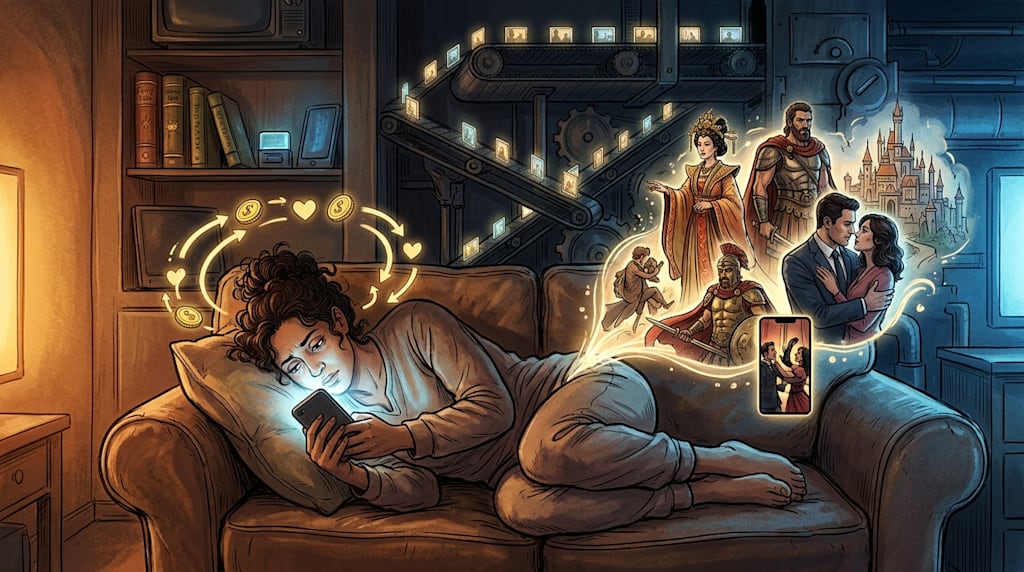
On subways, in restaurants, and beside beds late at night, people stare at phone screens. One episode lasts a minute or two. One follows another. Their faces move with the images: a frown, a grin, a long exhale. They may not call themselves addicted, but the average daily usage time of more than two hours says something.
Why does Hongguo hold so many people? The short answer: it sells adult fairy tales and runs them through a machine built for emotional payback.
1. The summer-vacation TV, now in your hand
When we were children, summer and winter vacations meant watching TV from morning to night. At that age, everything looked good. You did not need logic, strong acting, or high production values. As long as pictures moved and a story kept going, time felt full and the day felt settled.
Hongguo gives adults that feeling back. One user said, "Watching Hongguo short dramas feels like going back to the summer and winter vacations of childhood." What makes it work is simple: it does not ask you to think. Traditional film and TV care about setup, development, turn, and resolution. They care about character arcs and realistic logic. Hongguo does not. It cares about a conflict every three seconds, a reversal every five, and a payoff every ten. An episode lasts one or two minutes, so every second has to hook you.
Logic gets compressed. Reality gets simplified. Plausibility gets dropped. What remains is emotional stimulation: anger, satisfaction, sweetness, relief. It is fast food for feelings. It does not need nutrition. It needs to hit now. When people are tired, they often do not want nutrition. They want the hit.
2. Same shelf as Grimm
Putting Hongguo next to Grimm's Fairy Tales, Andersen's Fairy Tales, Zheng Yuanjie's stories, Harry Potter, and One Thousand and One Nights is not flattery. It shows what the platform is. They share a job: build a world that ignores real-world logic but feels coherent inside. In that world, no one asks why a pumpkin becomes a carriage or why a glass slipper finds the right woman. Readers accept the rules because the world offers justice, miracles, and wholeness.
Hongguo offers the same. Time travel, revenge, CEO romance, war gods, live-in sons-in-law, rebirth, palace intrigue. Almost every story pays back a real regret. The office worker who swallows every insult can become a patient war god returning in triumph. The person betrayed in love can watch the villain get crushed. The person stuck in a dull marriage can become a time-traveling empress who goes to work. It does not teach. It does not make you think. It does not force you to face complexity. It pulls you into a simple world where good and evil are clear, cause leads to effect, effort gets rewarded, and villains get punished. That simplicity is its own kind of healing.
Adults stop believing in fairy tales. They never stop needing them.
3. Free, algorithm, coins: the machine
Content alone cannot explain 168 million. Hongguo also built a system.
First, it is free. Traditional short dramas let you watch a few episodes, then ask for money. Hongguo removed that. It uses free viewing plus ad revenue sharing. You do not pay for an episode. That removes the biggest mental barrier. You do not decide whether something is worth money. You only decide whether to keep watching. With an algorithm feeding you, that decision barely feels like a decision.
Second, the algorithm. Hongguo sits inside ByteDance. It puts dramas into a feed the way short videos go into a feed. They autoplay. They get recommended. You do not search. The algorithm sends the next thrill that matches your taste. You stop looking for a show and start being fed one. Leaving costs more effort than staying. As long as you do not exit, it keeps playing.
Third, coins. The platform lets you earn money while watching. Coins give instant feedback. Watching becomes a game. Watch longer, get more coins. Get more coins, stay longer. The trick is old. It works.
Free entry, no choice cost, higher exit cost. Stack them and you get a strong habit loop. Users seem to spend no money. They spend attention and time. The business trades that time for ad revenue, then shares the revenue with producers.
4. A market for feelings
The scale is no longer small. As of July 2026, daily active users reached 168 million. Hongguo releases more than 1,000 new short dramas a month. It has more than 15,000 episodes online. Its content source is tied to ByteDance's Tomato Novel, which holds more than 1.5 million IPs. That gives the platform a steady supply of hit blueprints already tested by data. Average daily use is 125 minutes, more than two hours. This is not casual watching. It is immersion.
Hongguo is a market for feelings. It does not trade stories. It trades anger released, grievance paid back, longing satisfied. In real life, those feelings often cost a lot. On Hongguo, they cost a swipe.
5. When the fairy tale wears thin
Even fairy tales wear out. When users see too many time-traveling empresses, returning war gods, and live-in sons-in-law, fatigue sets in. Pure brainless payoff stops being enough. Users get pickier. The platform starts backing shows with cinematic polish and real-world resonance. Midsummer Fendela got 4.4 billion plays through delicate emotional construction. Adult fairy tales are trying to grow a soul and an aftertaste.
Does that mean Hongguo will become traditional prestige TV? Not likely. Its edge is still short, fast, and gratifying. Its base is still ordinary people looking for emotional payback in fragmented time. Premium shows are icing, not the cake.
The deeper worry: when someone fills every emotional gap with short dramas, can they still tolerate moments that need patience, thought, and uncertainty? When gratification is instant, does real life feel worse?
6. We escape. Then what?
Hongguo works because it builds immediate emotional satisfaction. Free entry. Algorithmic choice. Dense payoffs. Viewing becomes a cheap daily habit. It lets us return to childhood summers, to watching TV from morning to night and thinking everything was good. In that world, there is no KPI, no mortgage, no complicated relationships. There is simple good and evil, and direct pleasure.
But a fairy tale is still a fairy tale. We can hide there for a while. We still have to come back. The value of Hongguo may not be in the stories it tells. It may be in the reminder that adults in a tired era need a parallel world they can enter at any time, where they owe nothing and only need to feel good.
When we leave that world and face reality, the question is whether we can carry a little more strength back with us and solve the problems that actually need solving.
About the Creator
Jin
Writer of reamstories
https://reamstories.com/jin
Enjoyed the story? Support the Creator.
Subscribe for free to receive all their stories in your feed. You could also become a paid subscriber, letting them know you appreciate their work.
Comments
There are no comments for this story
Be the first to respond and start the conversation.