
House of the Dragon Season 3 Ending Explained: Full Season Recap, Helaena’s Death and Rhaenyra’s Dark Turn (Spoilers)
From the Battle of the Gullet and Jace’s shocking death to Rhaenyra taking King’s Landing, the Battle of Tumbleton and Helaena’s haunting final vision, Season 3 changes the Dance of the Dragons forever.

Spoiler Warning
This article contains major spoilers for House of the Dragon Season 3, including the Battle of the Gullet, the fall of King’s Landing, the Battle of Tumbleton and the Season 3 finale.
House of the Dragon Season 3 Explained
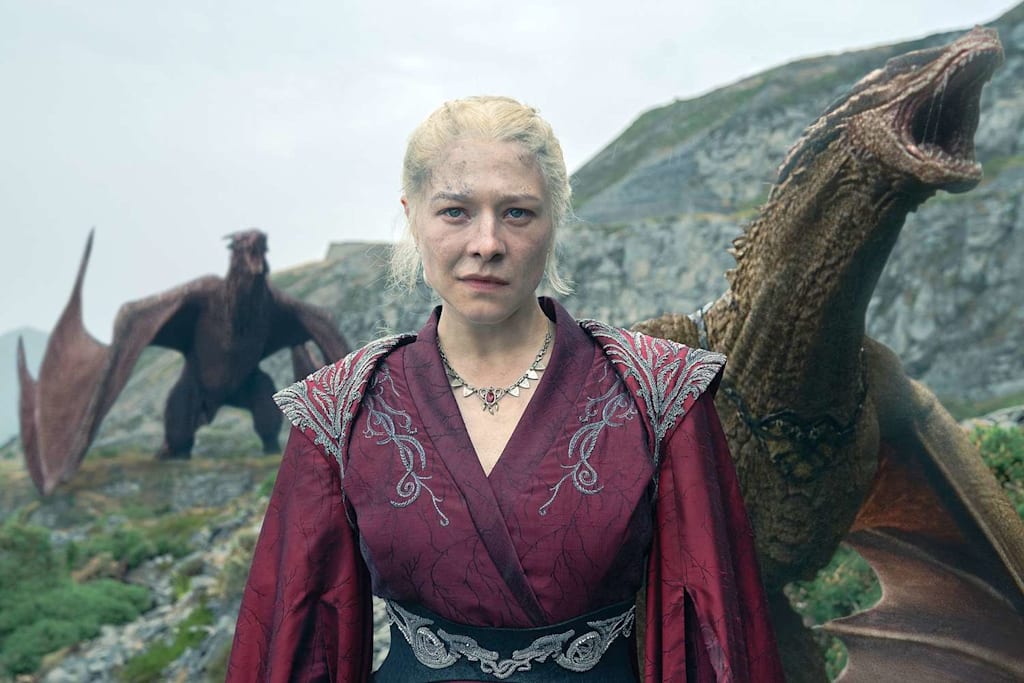
House of the Dragon Season 3 is the point where the Dance of the Dragons stops feeling like a political argument and becomes a war capable of destroying almost everyone involved.
The season opens with spectacular dragon warfare, but its real focus is the psychological cost of power. Rhaenyra Targaryen begins the season determined to prove that the Iron Throne belongs to her. By the ending, she has gained enormous power, but the woman sitting closest to victory is very different from the Rhaenyra we once knew.
Meanwhile, Aegon remains alive, Aemond becomes increasingly unstable, Daemon embraces the brutality of war, Alicent desperately tries to save what remains of her family, and Helaena continues seeing pieces of a future that nobody understands until it is too late.
Everything begins with the devastating Battle of the Gullet.
The Battle of the Gullet Changes Everything
One of Season 3’s biggest moments arrives almost immediately when the Triarchy attacks the Velaryon fleet.
Jacaerys Velaryon and Baela enter the battle with Vermax and Moondancer. Rhaena also becomes involved after bonding with the wild dragon Sheepstealer, but controlling such a creature proves extremely difficult.
The battle quickly becomes chaotic.
Ships burn, dragons are attacked from the sea and the difference between allies and enemies begins to disappear in the smoke.
Jace eventually finds himself in terrible danger when Vermax is badly wounded and dragged toward the water. Jace separates himself from his dragon and manages to reach the surface, but enemy soldiers fire arrows at him.
The prince is killed.
For Rhaenyra, this is far more than another military casualty.
Jace was her son, her heir and an important part of the future she imagined for House Targaryen. After already suffering terrible personal losses, Rhaenyra is forced to confront another dead child.
From this moment, grief begins changing the way she rules.
Rhaenyra Takes King’s Landing
While the Blacks suffer at the Gullet, Alicent begins secretly working toward a different solution.
She understands that continuing the war could destroy King’s Landing completely. With Aegon gone and Aemond temporarily away from the capital, she creates an opportunity for Rhaenyra to enter the city.
Rhaenyra and Daemon arrive with overwhelming dragon power.
Instead of fighting a suicidal battle against them, many guards lower their weapons. The Gold Cloaks also help shift control of the city toward Rhaenyra.
Rhaenyra finally reaches the Iron Throne.
But victory immediately demands blood.
Aegon has escaped with Larys Strong, meaning Rhaenyra cannot eliminate her biggest rival. Otto Hightower, however, is still available as a symbol of the Green cause.
Rhaenyra ultimately executes Otto.
The scene matters because it demonstrates how much she has changed. She is no longer simply asking the realm to recognise Viserys’ chosen heir. She is now prepared to personally destroy those who stand between her and unquestioned power.
Rhaenyra finally becomes the ruler she always wanted to be.
Unfortunately, possessing the throne turns out to be much easier than ruling from it.
Why Rhaenyra’s Reign Starts Falling Apart
King’s Landing has serious problems.
The treasury is depleted, food is becoming difficult to manage and ordinary people are exhausted by war.
Rhaenyra also faces a religious problem when she wants her legitimacy publicly recognised. Her dragons may make her militarily powerful, but dragons cannot automatically force people to believe she is their rightful queen.
That becomes one of Season 3’s most important themes.
What makes a ruler legitimate?
Is it inheritance?
A crown?
Religion?
An army?
Dragons?
Or the acceptance of the people being ruled?
Rhaenyra increasingly chooses power.
When criticism spreads among the smallfolk, her response becomes harsher. The more insecure her position becomes, the more aggressively she tries to protect it.
This is exactly the transformation the ending will eventually underline.
Aegon Is Still Alive
Rhaenyra’s biggest political problem is simple: Aegon is not dead.
Badly injured and physically broken, Aegon travels with Larys while trying to stay beyond Rhaenyra’s reach.
His condition makes him appear weak, but his survival is politically dangerous.
As long as Aegon Targaryen lives, supporters of the Greens still have a king around whom they can unite.
This means Rhaenyra can sit on the Iron Throne without completely winning the war.
The crown is hers.
The realm is not.
Aemond, Harrenhal and the Fear Behind the Warrior
Aemond spends much of Season 3 appearing dangerous, unpredictable and increasingly isolated.
Vhagar makes him one of the most powerful individuals in Westeros, but Harrenhal begins revealing another side of him.
The mysterious environment surrounding Alys Rivers forces Aemond to confront fear in a way physical enemies rarely can.
Aemond can burn armies.
He can kill soldiers.
But he cannot easily defeat dreams, visions and psychological terror.
His growing paranoia makes him even more dangerous because he begins trusting fewer people around him.
Alicent eventually realises how destructive her son has become and takes desperate action against him, further breaking apart what remains of the Green family.
Daemon Becomes Rhaenyra’s Most Dangerous Weapon
Daemon remains one of Rhaenyra’s greatest military advantages.
He is fearless, experienced and willing to use violence without hesitation.
But that also makes him dangerous.
Rhaenyra and Daemon increasingly begin to view Targaryen power as something almost divine. Their dragons give them an advantage that ordinary rulers could never possess, and the temptation to use that power becomes stronger as the war continues.
The problem is that dragons do not create peace.
They simply make destruction easier.
That lesson becomes impossible to ignore at Tumbleton.
Why the Battle of Tumbleton Matters
The Battle of Tumbleton becomes the enormous final military confrontation of Season 3.
By this point, alliances are unstable, dragonriders have their own ambitions and civilians are trapped between competing armies.
What begins as strategy becomes slaughter.
Soldiers charge into battle knowing many of them will never return. Dragons turn defensive positions into burning ruins. Old loyalties collapse while individual fighters begin making decisions based on survival, revenge or personal ambition.
The battle shows the central tragedy of the Dance of the Dragons.
Nobody truly controls the war anymore.
Not Rhaenyra.
Not Daemon.
Not the Hightowers.
And certainly not the people trapped beneath the dragons.
Even a victory produces mountains of dead soldiers and civilians.
Tumbleton is not proof that one side deserves to rule.
It is proof that the conflict itself has become monstrous.
What Happens to Helaena?
While armies destroy each other outside King’s Landing, one of the season’s most heartbreaking stories reaches its conclusion inside the Red Keep.
Helaena has always been different from the other members of her family.
She understands pieces of events before they happen, but her visions rarely arrive in a form that allows her to change the future.
Throughout the war, she loses control of almost everything around her.
Her family uses crowns, marriages and bloodlines as political weapons while Helaena becomes trapped inside a conflict she never wanted.
In the finale, that burden finally becomes unbearable.
Helaena jumps from the Red Keep and dies.
Her death is tragic not simply because another Targaryen has been lost, but because Helaena was one of the few major characters who never truly wanted power.
Yet power destroys her anyway.
Helaena’s Final Tapestry Explained
The most important part of Helaena’s ending may actually come after her death.
Rhaenyra looks at Helaena’s work and discovers disturbing imagery.
Among the images is Rhaenyra herself connected to the Iron Throne, surrounded by blood and destruction.
This is one of the finale’s strongest pieces of symbolism.
Rhaenyra has spent years believing that reaching the Iron Throne will prove that everything she endured was justified.
But Helaena’s imagery suggests something much darker.
Rhaenyra may get the throne.
She may even successfully force the realm to recognise her.
But the crown will be surrounded by death.
The image can therefore be read as both a prophecy and a warning.
The Iron Throne is not necessarily Rhaenyra’s reward.
It may be the place where her destruction is completed.
Why Rhaenyra Is So Different at the End
Season 3 gradually removes almost every emotional protection Rhaenyra once had.
She loses children.
She loses allies.
She becomes suspicious of her council.
The people of King’s Landing begin resenting her.
Religious authorities challenge her legitimacy.
Aegon remains alive.
Aemond remains a threat.
And every military victory creates another political problem.
Instead of making Rhaenyra more cautious, these experiences make her more convinced that strength is the only answer.
That is why the final image involving the Iron Throne matters so much.
Rhaenyra once wanted the crown because her father chose her.
Now she increasingly believes she deserves it because she possesses the power to take it.
That difference may define the rest of her story.
What Does the Season 3 Ending Mean for Season 4?
Season 3 does not end the Dance of the Dragons.
It makes the final stage even more dangerous.
Aegon’s survival means the Greens still have a claimant.
Aemond and Vhagar remain central to the larger war.
Alicent has become separated from the political machine she once helped create.
Daemon remains Rhaenyra’s most powerful ally but also encourages her most destructive instincts.
The smallfolk are increasingly angry.
And Rhaenyra has finally obtained the throne without achieving peace.
That creates the perfect setup for the next chapter.
The question is no longer whether Rhaenyra can become queen.
She already has.
The real question is what she will become while trying to remain queen.
House of the Dragon Season 3 Ending Explained
Ultimately, House of the Dragon Season 3 ends as a story about the difference between winning power and surviving it.
Rhaenyra captures King’s Landing and reaches the Iron Throne, but her family continues collapsing around her.
Jacaerys is dead.
Helaena is dead.
Thousands have died in battles such as the Gullet and Tumbleton.
Aegon survives.
Aemond remains part of the unfinished conflict.
And the kingdom Rhaenyra fought so desperately to rule is becoming poorer, angrier and more divided.
Helaena’s final imagery brings all of those ideas together.
Rhaenyra is on the Iron Throne.
But she is surrounded by blood.
That may be the clearest warning House of the Dragon has given us yet: in the Dance of the Dragons, nobody truly wins the throne without losing something far greater.
About the Creator
parwinder singh
🎬 Movie & Entertainment Writer sharing reviews, ending explanations, story breakdowns, plot twists and hidden details from Bollywood, Hollywood, South Indian cinema, Korean dramas and OTT releases.
Enjoyed the story? Support the Creator.
Subscribe for free to receive all their stories in your feed.
Comments
There are no comments for this story
Be the first to respond and start the conversation.