
Honey, Don’t and Eddington
A Neo-noir vs. A Neo-Western


I am such a pretentious cinema-goer that I went to see two films this week partly because they were defined as a neo-noir and a neo-western. I wanted to work out what these terms really mean for the cinema experience.
Of course, the prefix neo- just means ‘new’. But that literal translation robs some nuance. Neo is about building on the old, taking older ideas, themes and aesthetics and making them relevant to current contexts. Done properly the ‘neo’ is more than just cinematic nostalgia.

Let’s start with the neo-noir, Ethan Coen’s “Don’t Honey”.
It’s important to note that for the original filmmakers of the 1940s, they didn’t know they were making classic film noir. They were just writing and directing film that fitted with contemporary themes, could get past censors and were limited by the technology of the time. Filmmakers of that period would have called them crime drama, until some French critic decided they were a different kind of film. (Nino Fran coined the term Film Noir in 1946, to describe a particular kind of American film. The term was not adopted by the Americans until much later, as a retrospective grouping of black and white crime drama). Film noir was characterised by cynical attitudes and motivations coupled with a cinematography which made use of the heightened shadows of black and white. Often it involved expressionistic European directors using tilted camera angles and long shots to unbalance the viewer. It developed a range of cinematic tropes like the lonely private detective, the femme fatale and the uncanny, unstable world of urban crime.
So, one of the key distinctions between classic and neo-noir would be that filmmakers are now aware of the genre. Neo-noir is a knowing nod to a previous generation of film. It is a deliberate style choice, a co-option of an earlier cinematic vocabulary.
Don’t, Honey certainly has fun with the tropes of noir. It is a dark comedy following Honey O’Donahoe’s (Margaret Qualley) private investigation into a fatal road traffic accident. So far, so noir. The neo aspect of the noir is that we have a lesbian protagonist.
The film opens with a tilted shot of a woman making her way down a rocky slope in heels to steal the ring from the finger of a dead woman. The shot is concerned with the ankles of the woman and the cynicism of the approach to the body.
Honey is also often shot from behind, with an emphasis on her legs and the click-clacking hip sway of her walk, like a pastiche of the femme fatale. Except Honey isn’t the temptress. It might be more accurate to say that that role goes to MG Falcone the police officer (played by Aubry Plaza) with whom Honey goes onto have an affair. However, Marty (Charlie Day) the local police chief doesn’t see it that way, with his constant attempts to woo Honey. He sees her as the hard to get broad who just needs to be worn down.
Honey: “I like girls.”
Marty: “You always say that.”
The plot centres on Honey’s investigation into the Church of the Four Way Temple headed by Reverend Drew Devlin (Chris Evans) who seduces his vulnerable church members and deals in drugs as a side grift.
The feel of the film is sleazy Americana. It looks like the cover of a pulp fiction novella. It has the themes of distrust, suspicion, double-crossing corruption that run through classic film noir. But what it doesn’t have is a 1940s censor breathing down the neck of the studio executives. Instead it has graphic sex and violence – definitely not for the faint-hearted or prudish (which I sometimes fear I might be).
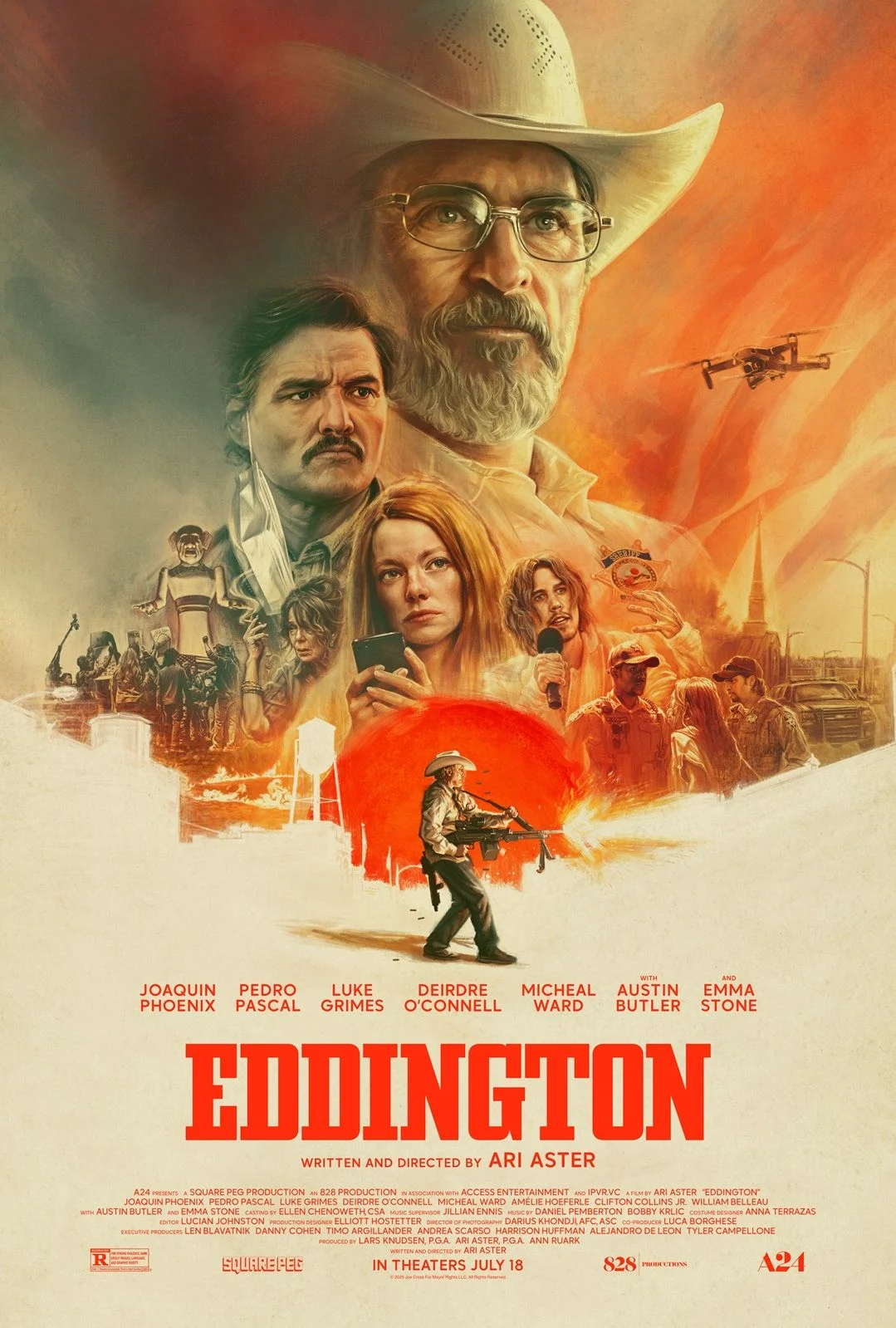
Then we come to Eddington, the neo-Western.
Look I don’t know much about westerns – neo or otherwise. I’ve never really watched them. They are dusty movies that played on the TV some Sunday afternoons that never grabbed my attention. The only Westerns I have really watched and enjoyed are Calamity Jane and Johnny Guitar – which even I know are not typical of the genre.
What I know is the basics. They take place in an isolated, often lawless place. They are concerned with land, territory, and good vs evil. They have horses and guns. Action takes place in saloon bars or on wide open plains. Women rarely feature, except to wear corsets and to be fought over. They tend to be epic in scale, using the full width of the screen and with sweeping narratives. Oh, and did I mention guns. Guns are everywhere. Gunfights are the denouement. And in case you missed it, westerns are films about men riding horses and shooting guns.
Eddington has all the basics, apart from the horses. It is an epic tale about territorial rights between two male protagonists, Police Chief Joe Cross (Joaquim Phoenix) and Mayor Ted Garcia (Pedro Pascal). They see themselves as the big players, while ignoring the issues of native land symbolised by Officer Butterfly Jimenez (William Belleau) of the Pueblo tribe. But it is so much more than a duel between good and evil. In fact, it is perhaps too much more. I mean everything is in there. The film throws any number of subplots that embrace all of the current themes: covid, mask mandates, vaccines, conspiracy theories, Black Lives Matters, critical race theory, incel culture, charismatic religious leaders, child abuse, false memory syndrome, name-calling political discourse, homelessness, police violence, rioting, terrorism. And beyond all this colour and drama the film is really about the tech billionaire coming to open a data-processing centre promising jobs and providing environmental degradation.
Also, lots of guns.
Did I mention guns? Lots of them.
Whilst it has had generally good reviews, I found it too much and too long. It is full of quirky characters, that could more easily have been made into a mini-series with each getting more time to be developed into a set of cliff-hanging episodes. Instead, there were two or three times that I thought that the movie was ending only for more drama (usually more gun violence) to be crammed in. We are living through a golden age of quality streaming drama serials and I feel that this is where the material would have been suited. It just needed more space.
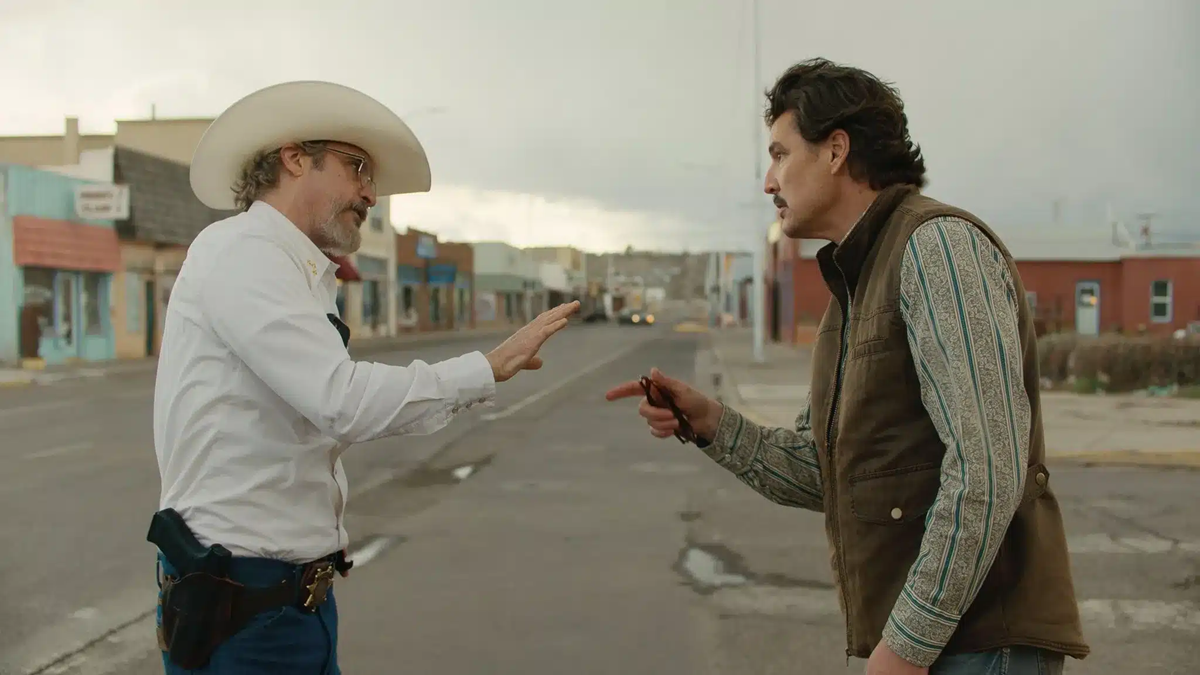
Both films offer plenty for the student of film to write about. They are both literate in the vocabulary of Classic Hollywood. This makes them interesting, but not necessarily entertaining. Of the two, my preferred film was Honey, Don’t, but I suspect I will think about Eddington longer.
If you've enjoyed what you have read, consider subscribing to my writing on Vocal. If you'd like to support my writing, you can do so by leaving a one-time tip or a regular pledge. Thank you.
About the Creator
Rachel Robbins
Writer-Performer based in the North of England. A joyous, flawed mess.
Please read my stories and enjoy. And if you can, please leave a tip. Money raised will be used towards funding a one-woman story-telling, comedy show.
Enjoyed the story? Support the Creator.
Subscribe for free to receive all their stories in your feed. You could also become a paid subscriber, letting them know you appreciate their work.
Comments
There are no comments for this story
Be the first to respond and start the conversation.