
Hokum Ending Explained: Ohm’s Guilt, the Cailleach Witch and the Truth About Fiona (Spoilers)
Damian McCarthy’s Hokum mixes Irish folklore, buried guilt and supernatural horror as Ohm Bauman uncovers Fiona’s fate, confronts the witch beneath Bilberry Woods Hotel and finally accepts the truth about his mother.

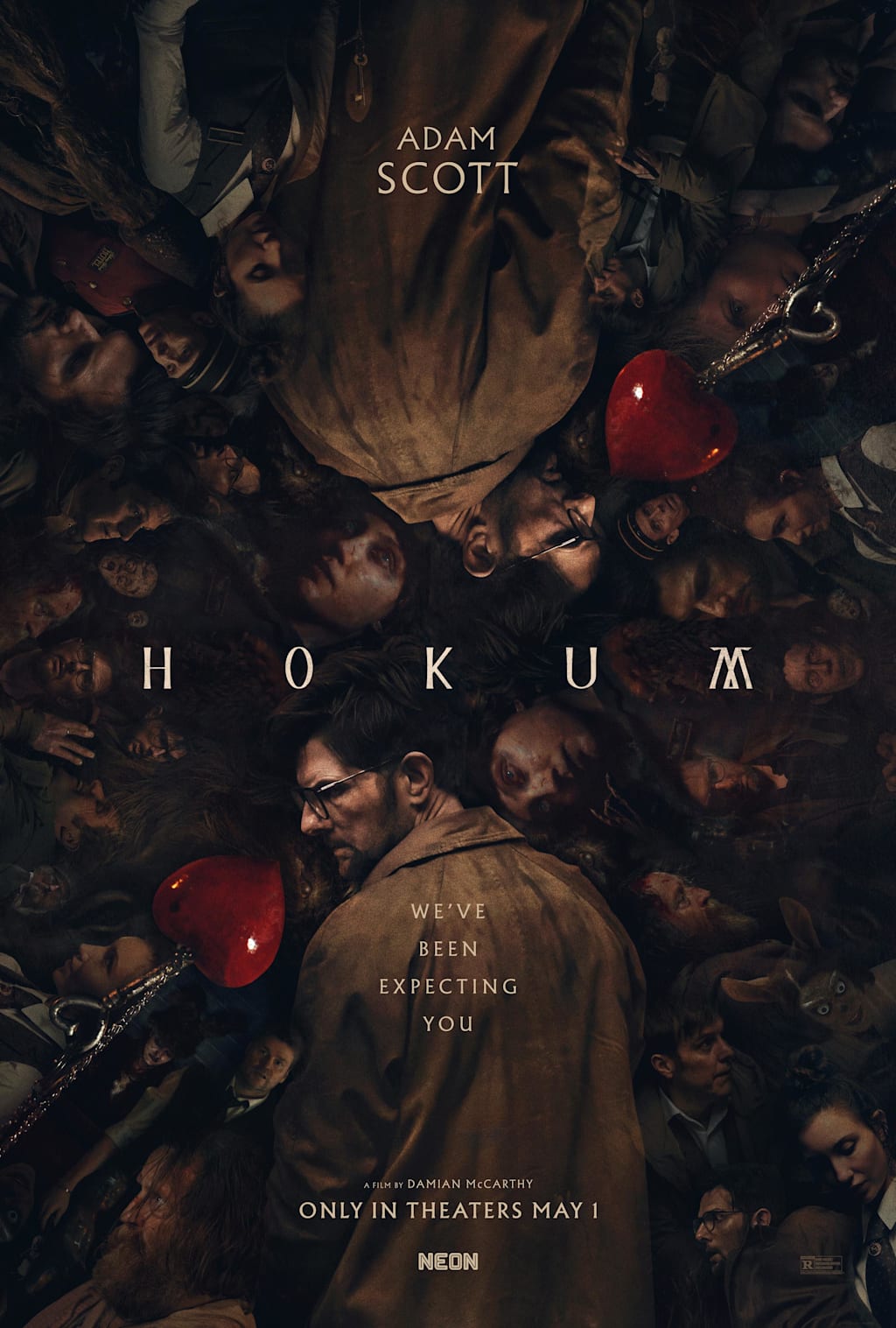
Spoiler Warning: This article contains major spoilers for Hokum, including its ending, Fiona’s disappearance, Ohm Bauman’s past and the mystery surrounding the witch.
Damian McCarthy’s Hokum looks like a haunted-hotel horror movie on the surface, but its real story is about guilt, denial and the frightening things people bury instead of confronting.
The 2026 supernatural horror film is written and directed by Damian McCarthy and stars Adam Scott as novelist Ohm Bauman.
Ohm travels to Ireland intending to scatter the ashes of his parents near Bilberry Woods Hotel, where they once stayed together. What begins as a personal journey soon pulls him into stories about a witch, a sealed honeymoon suite, a missing bartender and an underground space that may literally connect to another world.
By the ending, however, Ohm discovers that the most terrifying secret in the hotel is connected not only to the supernatural but also to a truth he has spent most of his life refusing to face.
Why Does Ohm Go to Bilberry Woods Hotel?
Ohm Bauman is a successful but deeply unhappy writer.
At the beginning of Hokum, he is working on the final part of his Conquistador trilogy. His fictional ending is incredibly bleak: a Conquistador and an enslaved boy are stranded in a desert with a map trapped inside a bottle.
Because the bottle cannot easily be opened, the Conquistador considers smashing it against the boy’s head, even though doing so could kill him.
That cruel ending reflects Ohm himself.
He is emotionally isolated, drinks heavily and treats almost everyone around him badly.
After going through possessions belonging to his deceased parents, Ohm finds photographs showing his mother at Bilberry Woods Hotel in Ireland. He decides to travel there and scatter his parents’ ashes near the same tree shown in the photograph.
His treatment of the ashes immediately tells us something important.
Ohm lovingly scatters his mother’s ashes.
His father’s ashes receive almost no affection.
At first, we assume his father must simply have been abusive or emotionally distant. Later, the movie reveals the much darker reason behind their broken relationship.
The Witch of Bilberry Woods Hotel
When Ohm arrives at the hotel, owner Cob is telling children a frightening local story.
According to the legend, an old witch lives within the woods and targets vulnerable people. She places them in chains and drags them toward the underworld, where evil spirits can tear away parts of their bodies—or something even more valuable.
The honeymoon suite is supposedly connected to this supernatural presence.
Cob claims that the witch has been locked inside the area for years, which explains why access to the honeymoon suite is heavily restricted.
Ohm considers the entire story nonsense.
In other words, hokum.
But Fiona, a bartender working at the hotel, is much more curious.
She shows Ohm a book about Irish folklore and explains that a chalk circle can supposedly prevent a witch from crossing into the protected area.
That apparently small piece of information later saves Ohm’s life.
What Happens to Fiona?
Fiona becomes one of the few people who shows genuine kindness toward Ohm.
When Ohm becomes dangerously unstable after drinking one night, Fiona and Alby discover him in his room and save his life.
Ohm is taken to hospital.
When he eventually returns to Bilberry Woods Hotel several weeks later to collect his belongings, he learns something disturbing.
Fiona has disappeared.
Mal, the hotel desk clerk, suggests that Jerry may be responsible. Jerry lives around the woods and already has a suspicious history connected to the death of his wife.
However, Jerry insists he did not hurt Fiona.
He explains that his wife had been suffering badly and that he ended her life because he believed he was ending her pain.
Jerry also claims that while searching the hotel for medication, he saw Fiona’s spirit pointing toward the bell connected to the honeymoon suite.
That gives Ohm and Jerry a new theory.
Fiona may still be somewhere inside—or underneath—the honeymoon suite.
Fiona’s Body and Mal’s Secret
Ohm eventually manages to enter the forbidden honeymoon suite.
Inside, he notices an old dumbwaiter that travels between the suite and the basement.
When the dumbwaiter is brought up, the mystery finally begins to unravel.
Fiona’s body is inside.
Ohm then discovers his voice recorder with recordings made by Fiona before her death.
The truth is horrifying.
Fiona and Mal had been having an affair.
Fiona became pregnant with Mal’s child.
Mal was already married and had three children, and he was terrified that the affair would destroy his family and his relationship with Cob, his father-in-law.
Fiona was willing to raise the child herself without publicly revealing Mal as the father.
Mal still refused to take the risk.
On Halloween night, he drugged Fiona and placed her inside the dumbwaiter, sending her down into the basement.
There was no way for Fiona to operate the dumbwaiter from below.
She became trapped.
Whether the basement itself killed Fiona or the supernatural entity living there ultimately finished the job, Mal is responsible for putting her there.
And the recordings reveal something even worse.
Fiona was not alone in that basement.
Something else was with her.
Is the Cailleach Witch Real?
The movie initially gives viewers several reasons to doubt the supernatural events.
Jerry regularly consumes milk mixed with psychedelic mushrooms.
Then, near the ending, Alby admits something extremely important: after Ohm cruelly burned him earlier in the film, Alby secretly put Jerry’s mushrooms into Ohm’s whisky flask.
That means Ohm was hallucinating during at least part of his experience.
So was the witch simply a drug-induced nightmare?
Not necessarily.
Ohm later notices physical marks around his wrists exactly where the witch’s chains had restrained him.
The movie therefore appears to deliberately combine hallucination and genuine supernatural activity rather than choosing only one explanation.
McCarthy himself has said that the movie contains clues for distinguishing between the two. One important detail is Ohm’s glasses: viewers can examine whether something he sees is also reflected in them.
The implication is fascinating.
The mushrooms may not have invented the supernatural world.
They may simply have allowed Ohm to perceive something that was already there.
Jerry essentially says the same thing earlier: people with closed minds cannot see certain entities, while the mushrooms “open” his perception.
The Cailleach and Irish Folklore
The witch in Hokum is strongly associated with the Cailleach, an ancient figure from Irish and Scottish folklore.
Within the movie’s mythology, she operates almost like a collector who takes vulnerable people, binds them in chains and leads them into an underworld filled with hungry spirits.
That explains the strange objects Ohm discovers hanging in the basement.
They appear to be possessions taken from previous people who encountered the entity.
Even Alby’s missing lighter is there.
The basement is therefore not simply a forgotten section of the hotel.
It is the witch’s territory.
The chalk outlines resembling doors may represent supernatural thresholds rather than physical exits. To humans they look like drawings on solid walls, but to the Cailleach they could function as gateways into the underworld.
Ironically, Ohm finds chalk in the same place and later uses it against her by drawing a protective circle around the bed.
The witch approaches him but cannot cross the boundary.
Why Is Fiona’s Pregnancy Important?
One of the darker theories surrounding Hokum concerns Fiona’s unborn child.
Throughout Bilberry Woods Hotel, there is strange imagery involving children: statues, miniature figures, cherubs and other decorations.
The honeymoon suite contains especially noticeable child imagery.
Earlier, Cob’s story says the witch sometimes takes something from her victims even more valuable than an eye or an ear.
The movie never gives us a straightforward explanation of what this “most valuable thing” is.
One possible interpretation is that it represents a victim’s future—or, more literally, the possibility of having children.
That makes Fiona particularly important.
She enters the witch’s territory while pregnant.
During Halloween night she is also associated with a miniature child figure, creating possible foreshadowing of her fate.
The theory cannot be treated as confirmed fact, but the symbolism strongly connects Fiona’s pregnancy, the hotel’s child imagery and the witch’s appetite for something more valuable than ordinary body parts.
Ohm’s Biggest Secret: He Killed His Mother
The supernatural mystery is only half of Hokum.
The emotional mystery concerns Ohm’s mother.
Throughout most of the movie, Ohm claims that his mother was shot by an unidentified underage boy.
He remains furious about the crime decades later.
But when Ohm sleeps inside the honeymoon suite, his memory finally reveals what actually happened.
There was no mysterious child.
Ohm was the child.
When he was young, he found his father’s gun and began playing with it.
The weapon accidentally fired.
The bullet killed his mother.
Ohm spent his entire life psychologically rewriting the memory so that another child was responsible.
It explains almost everything about him.
His drinking.
His bitterness.
His inability to form healthy relationships.
His hatred toward his father.
His obsession with cruel endings.
And his tendency to hurt people before they can get close to him.
His father did not simply become an alcoholic for no reason after his wife died. He was grieving, and his relationship with his son became poisoned by the knowledge of what had happened.
Ohm could not emotionally survive the truth, so he created a different version.
His entire adult identity was constructed around denial.
Why Does Ohm’s Mother Always Appear Behind Him?
One of the movie’s smartest visual details involves the ghost of Ohm’s mother.
For much of Hokum, whenever her spirit appears, she is behind Ohm.
He does not truly face her.
This mirrors his psychological state.
Ohm has spent decades turning his back on the truth about his mother’s death.
Only near the climax, when the witch puts him in chains, does his mother finally appear directly in front of him.
For the first time, Ohm admits what happened.
He tells her that it was his fault.
He apologizes.
And instead of condemning him, his mother appears to forgive him.
She guides his hand toward his chest, making him realize that Fiona’s blade is still inside his jacket.
Ohm uses the blade to cut through the chains.
The symbolism is extremely clear.
Ohm can only escape the literal chains after breaking the psychological chains of guilt.
What Happens to Mal?
While Ohm is confronting his past, Mal attempts to destroy the evidence.
After killing Jerry, Mal starts a fire in the hotel.
But his escape does not go as planned.
Both Ohm and Mal eventually enter the basement.
The witch captures Mal and places him in chains.
Unlike Ohm, Mal never truly accepts responsibility.
He murdered Fiona because he wanted to protect his own comfortable life and then continued covering up what he had done.
The Cailleach drags Mal away toward the underworld.
The evil spirits waiting there appear ready to consume him.
Later, after the hotel burns, remains belonging to Fiona and Jerry are discovered.
Mal’s remains are not found.
His car, however, remains outside.
The obvious implication is that Mal did not die in the hotel fire.
The witch took him somewhere else.
Why Does Fiona Appear at Peace?
After Ohm escapes the witch, he encounters Fiona’s body again.
There is a subtle change.
Her eyes, previously open, are now closed.
It suggests that Fiona has finally found peace.
The truth about what Mal did has been uncovered.
Ohm knows she did not simply disappear.
And Mal has been punished.
Fiona’s spirit no longer needs to desperately call attention to the honeymoon suite.
Her story has been heard.
Why Does Fergal Save Ohm?
Ohm manages to escape the basement and reach the burning hotel, but smoke overwhelms him.
Fergal enters and rescues him.
According to the explanation given afterward, Fergal came because he heard Fiona calling him.
That detail provides another clue that the supernatural events cannot be dismissed purely as Ohm’s mushroom hallucinations.
Other characters appear to interact with the consequences of the supernatural world too.
Ohm survives and wakes up in hospital.
Alby visits him and finally admits that he put psychedelic mushrooms into Ohm’s drink.
Yet physical evidence remains on Ohm’s body.
The movie deliberately leaves viewers with both explanations.
He was drugged.
But something supernatural also happened.
Why Does Ohm Stop Drinking?
Alby brings Ohm a bottle of alcohol as a gift from Fergal.
Ohm gives it back.
It is a small but important character moment.
Alcohol was one of the main ways Ohm avoided confronting his trauma.
Once he finally admits the truth about his mother and receives the emotional forgiveness he desperately needed, he no longer seems interested in escaping through drinking.
Another change occurs when Alby asks Ohm to read his writing.
Earlier, Ohm humiliated him.
This time Ohm agrees.
The cold, cruel man we met at the beginning is starting to reconnect with other people.
The Conquistador Ending Explained
The clearest evidence of Ohm’s transformation comes through his novel.
At the beginning, his proposed ending reflects his worldview.
Survival requires cruelty.
The Conquistador is prepared to sacrifice the boy to open the bottle containing the map.
Everyone loses.
After surviving Bilberry Woods Hotel, Ohm rewrites the ending.
The Conquistador no longer tries to kill the child.
Instead, he offers himself as the person against whom the bottle can be broken so that the boy might survive.
The child refuses to sacrifice him too.
Instead, the two embrace.
Then hope appears almost accidentally.
The bottle lands near a goat skull sticking out of the sand.
The skull provides the hard surface they need to break the bottle, recover the map and continue toward their destination.
They can both survive.
McCarthy has explained that the rewritten ending was designed to demonstrate how something inside Ohm had changed and that he could finally create something more hopeful.
The parallel is obvious.
Old Ohm believed suffering automatically demanded more suffering.
New Ohm understands that people do not always need to destroy somebody else—or themselves—to move forward.
What Does the Title Hokum Mean?
“Hokum” essentially refers to nonsense, something fake or something that should not be taken seriously.
That makes the title deliberately ironic.
Throughout the movie, Ohm dismisses supernatural stories as nonsense.
The witch?
Hokum.
Irish folklore?
Hokum.
Ghosts?
Hokum.
Yet the supposedly ridiculous supernatural story increasingly appears to contain truth.
Meanwhile, the story Ohm believes completely—that some unknown child killed his mother—is the actual fiction.
The movie reverses the meaning.
What Ohm calls fake may be real.
What Ohm calls reality is the lie he created to protect himself.
Hokum Ending Explained: Was Everything Real?
The strongest interpretation is that Hokum contains both hallucination and genuine supernatural events.
Yes, Ohm consumed psychedelic mushrooms without knowing it.
That likely distorted at least some of the imagery he experienced, including strange visions connected to his childhood memories.
But the physical chain marks, Fiona’s supernatural warnings, the objects inside the basement and Mal’s unexplained disappearance all push the story beyond a simple “it was all a hallucination” explanation.
The mushrooms do not necessarily create the ghosts.
They may open Ohm’s mind enough to see them.
And that idea perfectly fits the movie’s larger theme.
Ohm’s real problem has always been refusing to see what is already in front of him.
The supernatural horror forces him to finally look.
Final Thoughts
The real ending of Hokum is not about defeating a witch.
It is about Ohm Bauman finally defeating the lie that has controlled his life.
The Cailleach puts him in physical chains, but Ohm has already spent decades imprisoned by guilt.
His mother’s forgiveness gives him the courage to accept that what happened was a tragic childhood accident rather than something he must punish himself for forever.
Mal represents the opposite path.
Ohm accepts responsibility and changes.
Mal hides responsibility and destroys others to protect himself.
One escapes the chains.
The other is dragged into the underworld.
That is why Ohm rewriting his Conquistador story matters so much. He is not simply changing a fictional ending.
He is changing the way he understands life itself.
The original ending says somebody must be sacrificed.
The new ending says both people can survive.
And after everything Ohm experiences at Bilberry Woods Hotel, that small piece of hope may be the biggest victory in the entire movie.
About the Creator
parwinder singh
🎬 Movie & Entertainment Writer sharing reviews, ending explanations, story breakdowns, plot twists and hidden details from Bollywood, Hollywood, South Indian cinema, Korean dramas and OTT releases.
Enjoyed the story? Support the Creator.
Subscribe for free to receive all their stories in your feed.
Comments
There are no comments for this story
Be the first to respond and start the conversation.