
'Hero at Large' (1980) - John Ritter Discovers That Being a Hero Is Harder Than Wearing the Costume
Before superheroes became billion-dollar franchises, John Ritter put on a ridiculous suit and tried to save New York

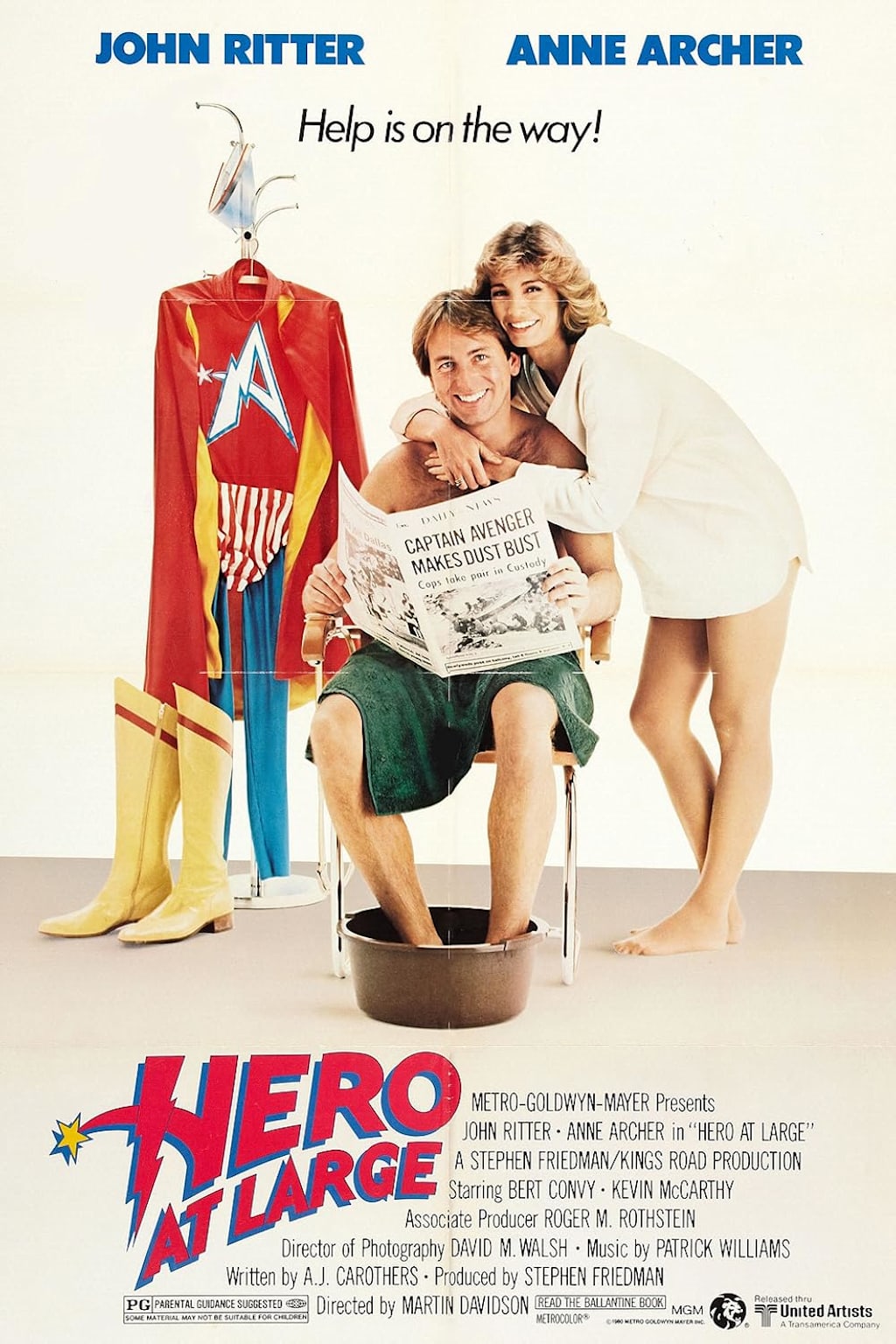
There was a time when putting on a superhero costume didn’t automatically mean you were about to become the star of a $200 million franchise.
In 1980, Martin Davidson’s Hero at Large took a much smaller, stranger approach to the superhero phenomenon. Instead of giving us a billionaire with a secret lair, an alien from another planet, or a radioactive teenager, the movie gave us Steve Nichols, a struggling New York actor who gets a job wearing the costume of a fictional comic-book hero.
Then, almost by accident, he becomes one.
Starring John Ritter, Hero at Large is an amiable little comedy that sits somewhere between a superhero satire, a romantic comedy, an urban farce and a Frank Capra-style story about ordinary people doing the right thing. It isn’t particularly sophisticated, and it doesn’t always know what kind of movie it wants to be.
But there is something undeniably appealing about it.
Maybe that’s because John Ritter was so good at playing fundamentally decent men who were constantly overwhelmed by the ridiculous situations they found themselves in.
Captain Avenger Goes to Work
Steve Nichols isn’t a superhero. He’s an actor trying to find work.
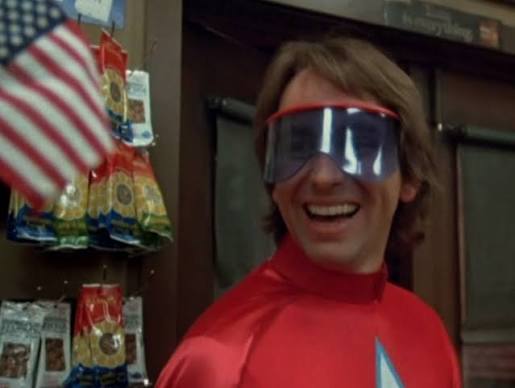
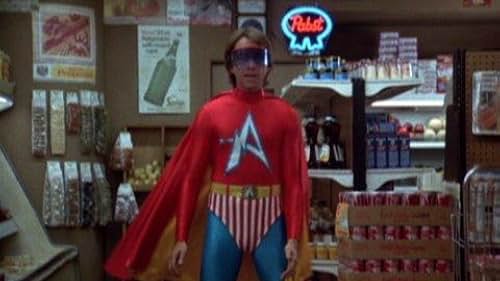
His big break comes in the least glamorous way imaginable: he’s hired to promote a superhero movie by walking around in a Captain Avenger costume.
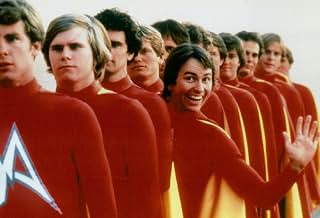
Captain Avenger is the kind of character Hollywood could manufacture because Hollywood could manufacture anything. The costume is a marketing tool. The hero is a product. Steve is simply the guy inside the suit.
But while wearing it, he encounters a robbery.
Instead of walking away, Steve intervenes.
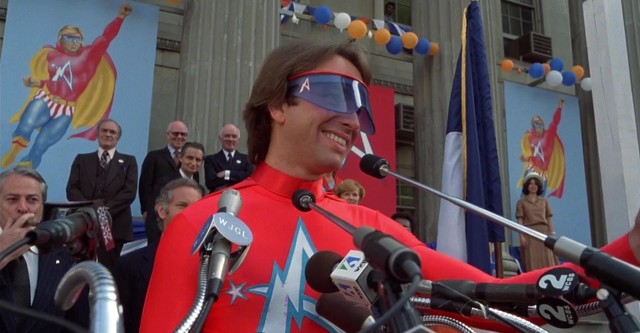
And something unexpected happens. People don’t see an unemployed actor in a cheap costume. They see Captain Avenger.
Suddenly, Steve has become a local celebrity.
That premise gives Hero at Large its best idea: what happens when people start treating you like a hero before you’ve decided to become one?
The movie understands that heroism can be performative. There is the costume, the publicity, the cameras and the carefully manufactured image. But Steve discovers that once people believe you’re a hero, there’s a responsibility that comes with the role.
The joke is that he may actually be better at being a hero than he is at being an actor.
John Ritter Was Born for This Movie
John Ritter was already a television star when Hero at Large arrived, thanks to Three’s Company. But his movie career was still taking shape.
This was one of those roles that played directly into Ritter’s greatest strength.
He could be frantic without being obnoxious. He could play a fool without making the character stupid. And beneath all the physical comedy, he had an enormous amount of warmth.
That warmth is essential here.
Steve could easily have been played as a complete buffoon. Instead, Ritter makes him likable. He isn’t trying to become famous. He isn’t looking for power. He simply finds himself in situations where doing the right thing seems like the only reasonable option.
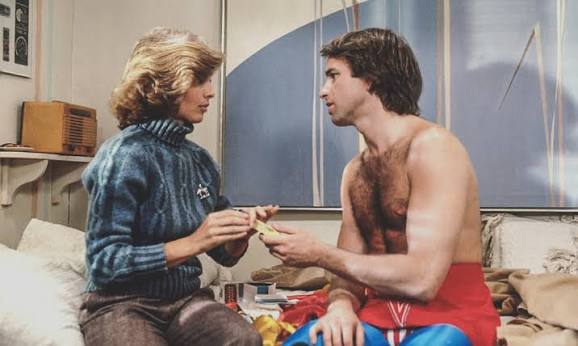
Anne Archer provides the romantic counterbalance, and their relationship gives the movie some grounding amid all the silliness.
Ritter’s Steve isn’t a traditional movie hero. He’s awkward, insecure and frequently in over his head.
Which, in retrospect, makes him feel surprisingly relatable.
New York Gets the Superhero Treatment
One of the more interesting things about Hero at Large is its setting.
This isn’t a glossy comic-book metropolis. It’s New York City at the end of the 1970s and beginning of the 1980s, when the city still had plenty of rough edges.
The movie puts its superhero fantasy against real streets, ordinary apartments and people dealing with ordinary problems.
That contrast gives the film some of its charm.
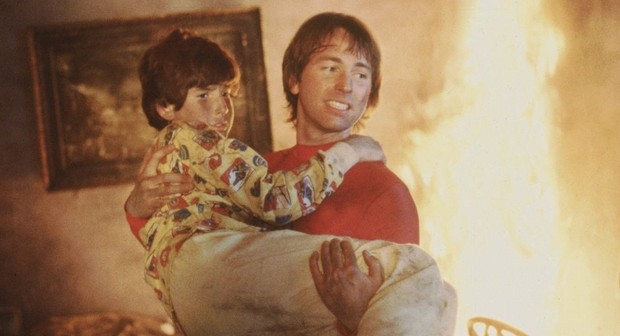
There is also an impressive fire sequence involving a burning tenement, giving the production an opportunity to briefly shift from comedy into genuine action. Professional firefighters were involved in staging the sequence, and for a movie built around a guy wearing a superhero costume for a publicity stunt, the filmmakers occasionally allow the stakes to become surprisingly serious.
It’s a reminder that Hero at Large isn’t entirely a spoof.
It actually believes in its hero.
A Superhero Movie Before Superhero Movies
Released in February 1980, Hero at Large arrived in an interesting moment.
Superman had already demonstrated that audiences could embrace a big-screen superhero. Comic-book characters were increasingly becoming mainstream entertainment rather than something relegated to Saturday-morning television and children’s lunchboxes.
But Hollywood hadn’t yet figured out exactly what to do with the superhero movie.
Hero at Large represents one of the more unusual answers.
It takes the superhero fantasy and shrinks it down to human size.
There are no superpowers. There is no enormous mythology. There isn’t even a particularly convincing costume.
There is just a guy who decides that if people need help, maybe somebody should help them.
That’s actually a pretty good idea for a movie.
Critics Saw a Sitcom in a Movie Theater
Not everyone was convinced.
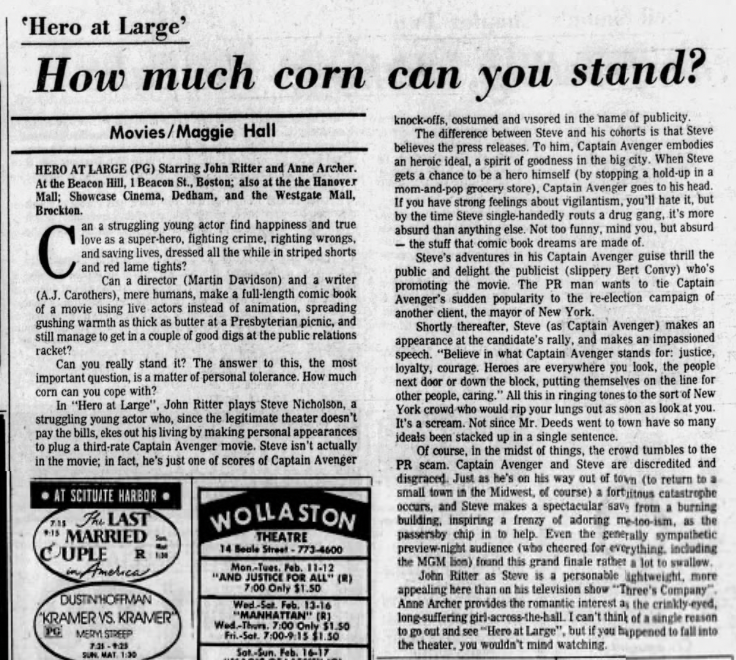
The movie’s tone proved to be one of its biggest problems. Some critics appreciated its good-natured humor and family-friendly appeal, while others thought the material felt more like an extended television sitcom than a theatrical comedy.
Roger Ebert was among those who found the movie uneven, while Gene Siskel was considerably more receptive to its charms.
And it’s easy to understand both reactions.
Hero at Large can be broad and sentimental. It has moments when it seems to be making fun of superhero movies, followed by moments when it suddenly becomes completely sincere about the responsibilities of heroism.
The tonal shifts can be jarring.
One minute you’re watching John Ritter stumble through a comedy routine. The next, you’re watching him contemplate what it means to be responsible for the image he’s created.
The movie never quite decides whether it wants to be satire or a wholesome morality tale.
In the end, it is both.
The Little Movie That Got Lost
Hero at Large wasn’t a blockbuster.
It earned roughly $15.9 million in North America, respectable business but hardly the kind of performance that would turn a modest comedy into a cultural phenomenon. Eventually, like so many movies of its era, it found another life on television and home video.
And that may be where Hero at Large made the most sense.
This is a movie that feels built for stumbling across on cable on a Saturday afternoon.
You might not remember seeking it out. You might not even remember its title.
But you remember John Ritter in that ridiculous Captain Avenger costume.
And you remember the basic idea.
Sometimes You Become the Hero by Accident
The most interesting thing about Hero at Large isn’t really its superhero satire.
It’s the idea underneath it.
Steve Nichols puts on a costume because it’s a job. People then begin treating him differently because of what the costume represents. Eventually, he has to decide whether being a hero is about the costume, the publicity or what you actually do when nobody is paying you to do it.
That’s a very simple message.
Maybe too simple.
But there’s something refreshing about it.
Today’s superhero movies often come with complicated universes, elaborate mythology and stakes involving the fate of the planet. Hero at Large asks a much smaller question:
What if you could help somebody right in front of you?
John Ritter’s answer is essentially, Why wouldn’t you?
That sincerity is what keeps the movie alive.
Hero at Large isn’t a forgotten masterpiece. It isn’t even particularly great.
It’s a small, occasionally clumsy movie that arrived just as Hollywood was beginning to discover how profitable superheroes could become. It never had the budget, spectacle or cultural impact of the movies that followed.
But it had John Ritter.
And it had a genuinely sweet idea at its center.
Before superheroes became gods, billionaires, aliens and cinematic universes, there was just a guy in a costume trying to do the right thing.
Sometimes, that’s enough.

About the Creator
Movies of the 80s
We love the 1980s. Everything on this page is all about movies of the 1980s. Starting in 1980 and working our way the decade, we are preserving the stories and movies of the greatest decade, the 80s. https://www.youtube.com/@Moviesofthe80s
Enjoyed the story? Support the Creator.
Subscribe for free to receive all their stories in your feed.
Comments
There are no comments for this story
Be the first to respond and start the conversation.