
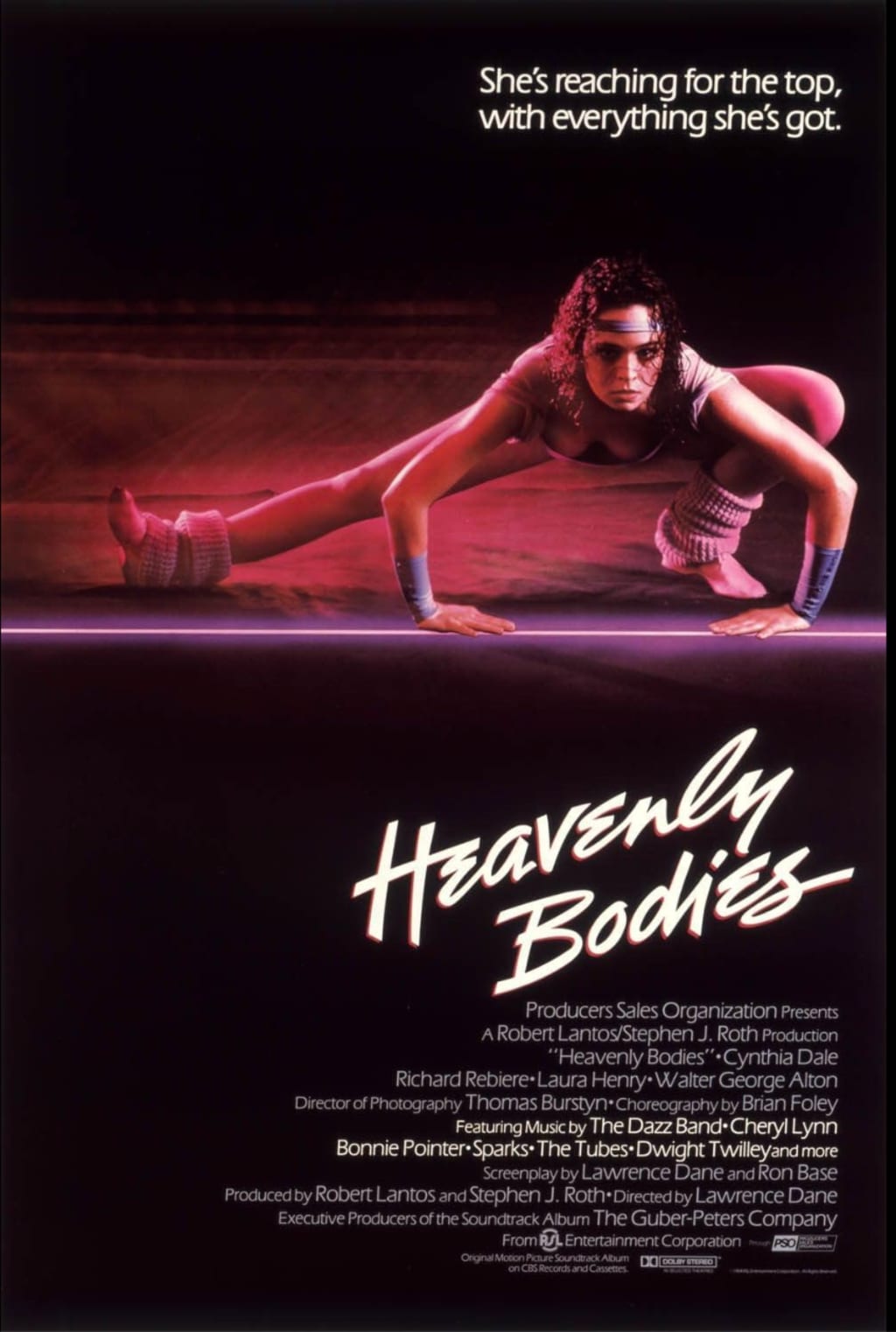
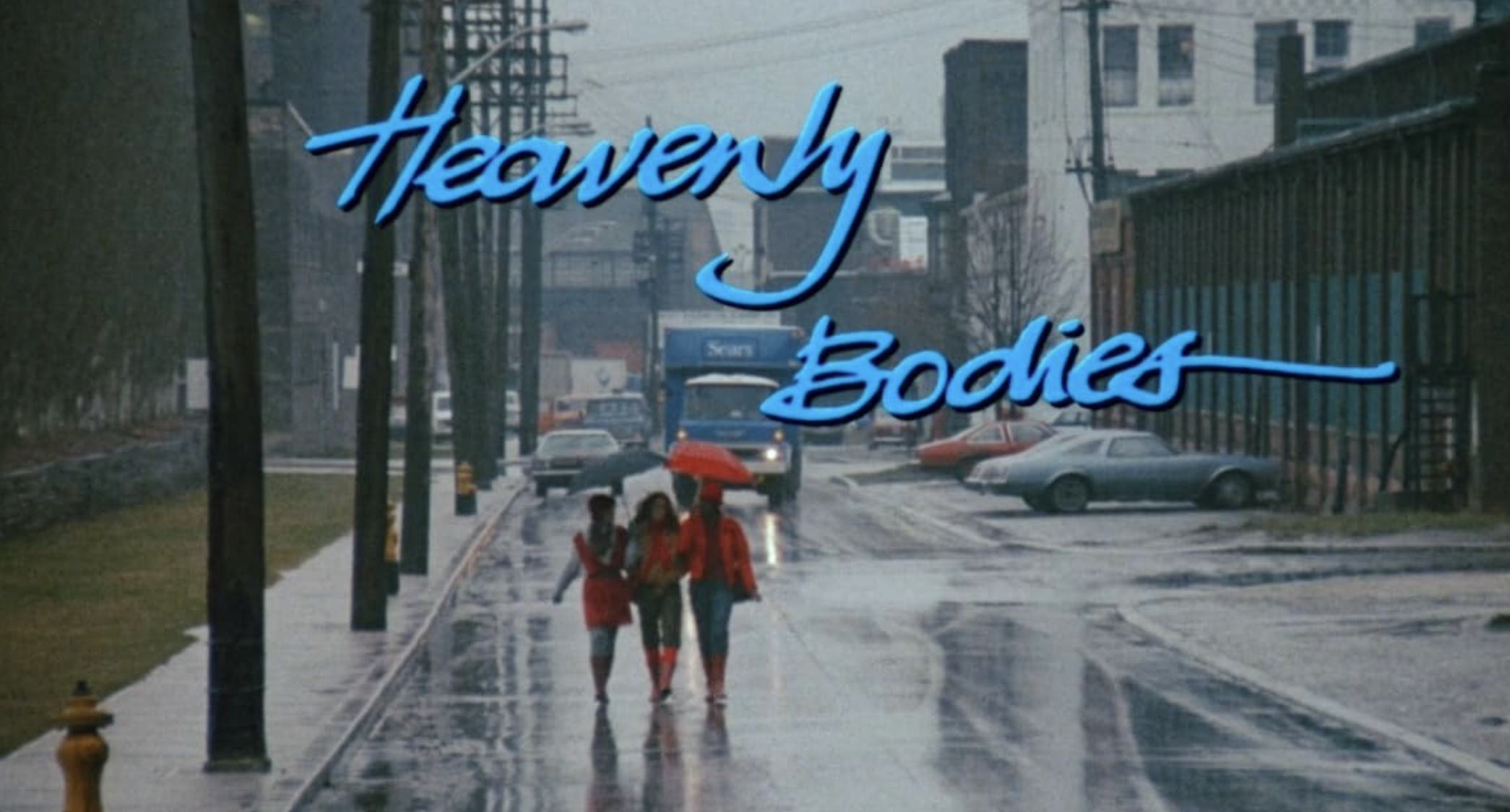
'Heavenly Bodies' (1985) - Spandex, Sweat, and the Great Canadian Aerobics Cash-In
How a low-budget Canadian movie tried to turn the 1980s fitness craze into the next Flashdance—and accidentally created one of the decade’s strangest workout movies.

There was a moment in the 1980s when it seemed like every woman in America was wearing a leotard.
Not just any leotard. A brightly colored one, preferably with a belt. Maybe some leg warmers. Definitely a headband. The hair was big, the music was loud, and somewhere in the background, a woman was shouting instructions about tightening her buns.
The fitness craze had arrived.
Aerobics was no longer something you did because a doctor told you to exercise. It was a lifestyle. It was a fashion statement. It was a business opportunity. It was a way to spend an hour sweating with your friends while pretending that the pounding music and increasingly complicated dance routines weren’t slowly killing you.
And Hollywood, naturally, wanted in.
After Flashdance turned leg warmers and physical exertion into box-office gold, it was only a matter of time before somebody tried to make an entire movie about the aerobics industry.
That somebody was Canada.
Released theatrically in North America in 1985, Heavenly Bodies is a strange, sweaty, occasionally entertaining artifact of the decade. It is part underdog sports movie, part dance musical, part romantic drama, and part extended exercise video. It is also a movie in which the fate of a workout studio is determined by a televised dance marathon.
Because apparently, that’s how business worked in 1980s Toronto.
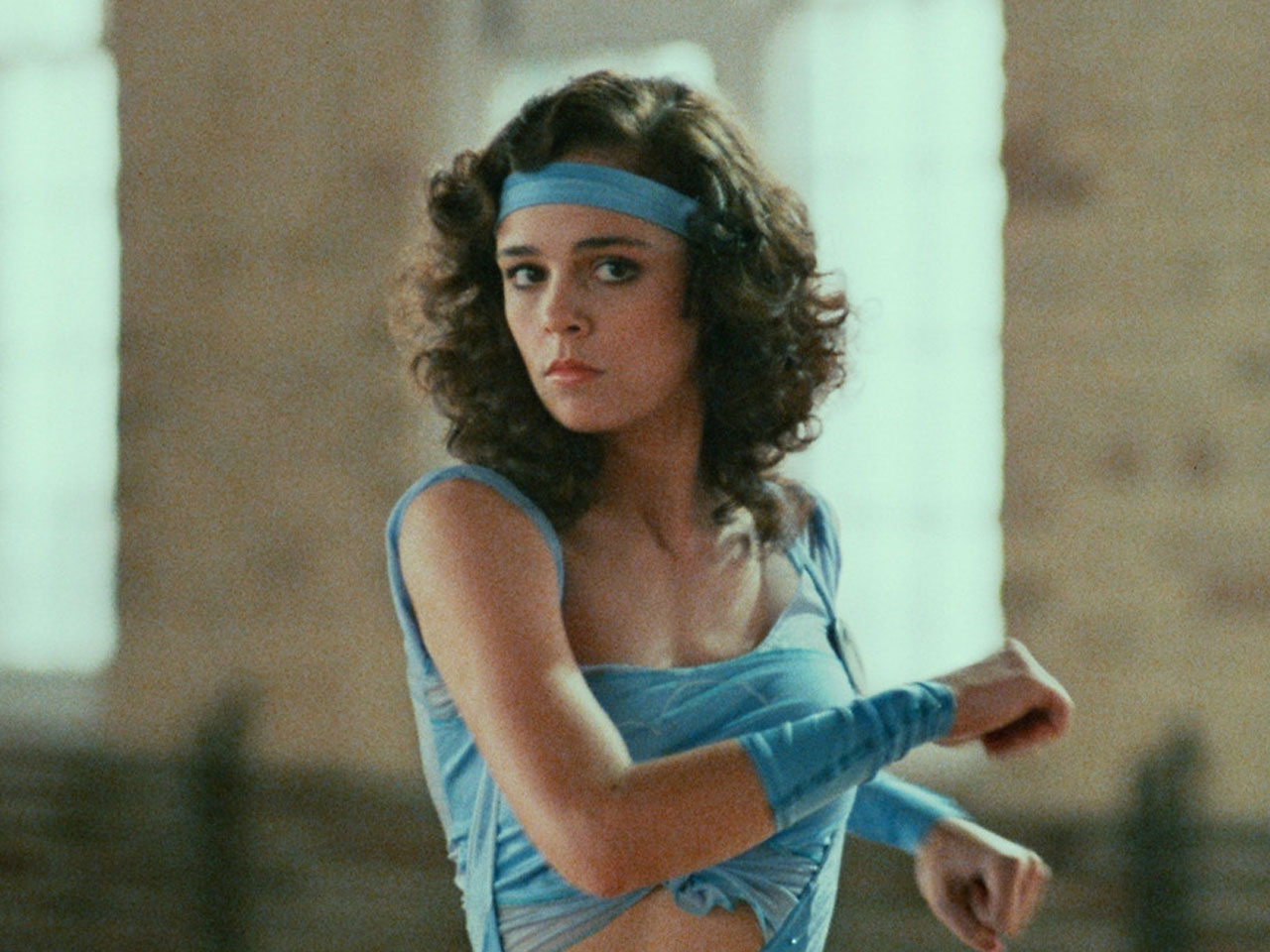
The film stars Cynthia Dale as Samantha Blair, a single mother who decides to open an aerobics studio with her friends. What follows is a battle for fitness supremacy involving rival workout clubs, corporate greed, romance, and a whole lot of people jumping around in spandex.
Critics were not kind.
Some saw a hollow Rocky knockoff. Others saw a feature-length music video. One critic called it “a jiggle epic.” Another compared it unfavorably to The 20 Minute Workout, suggesting that the movie was essentially that television program multiplied by five.
And yet, there’s something fascinating about Heavenly Bodies.
The film captures a genuine cultural phenomenon: the explosion of aerobics, the growing commercial power of women’s fitness, and the early-1980s belief that physical transformation could be the key to a better life.
It also captures something less flattering. The way Hollywood—and the film industry in general—could take a legitimate social movement, slap some neon on it, and turn it into a product.
This is the story of Heavenly Bodies, the movie that tried to make aerobics the next Flashdance.
And in the process, gave us one of the most gloriously 1980s fitness movies ever made.
The Aerobics Craze: When Exercise Became Entertainment
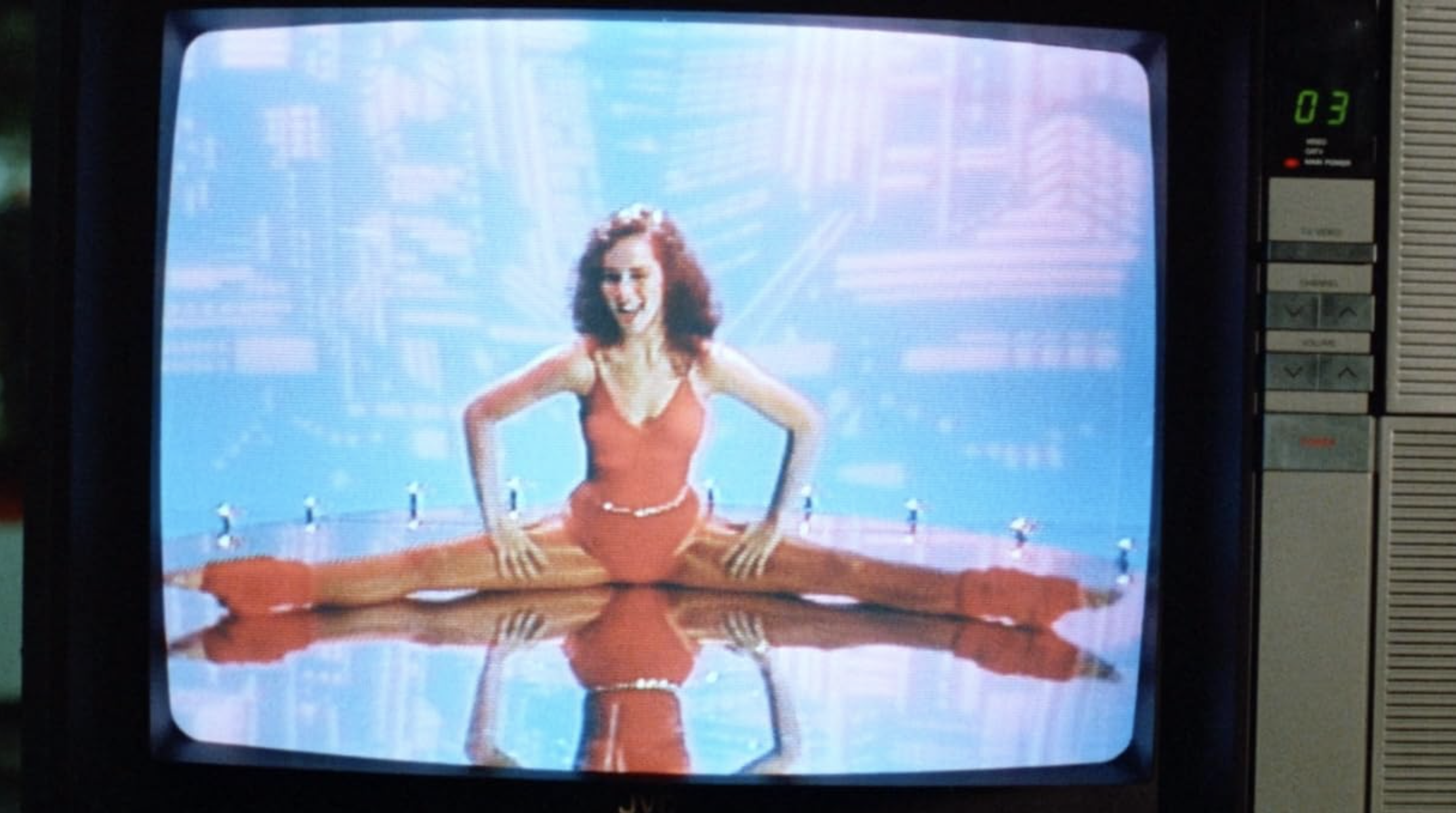
To understand Heavenly Bodies, you have to understand how big aerobics had become.
The modern fitness movement didn’t begin in the 1980s. Its roots go back to the 1960s, when physician Kenneth H. Cooper developed exercise programs designed to improve cardiovascular health. His 1968 book, Aerobics, helped popularize the idea that sustained physical activity could improve overall health.
But the aerobics craze that exploded in the 1980s was something different.
It took the science of cardiovascular exercise and turned it into a social experience.
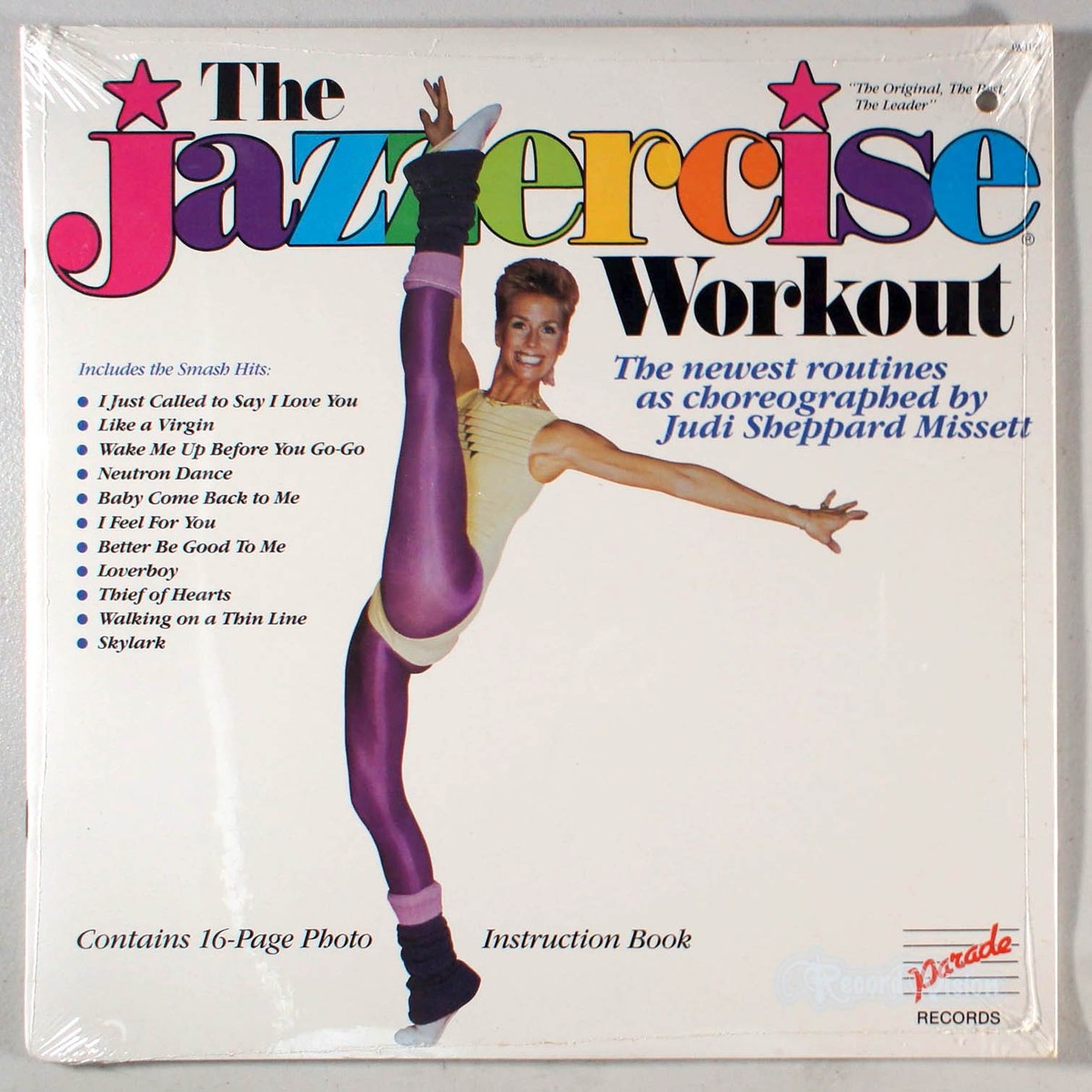
Jacki Sorensen helped popularize aerobic dancing in the late 1960s, while Judi Sheppard Missett founded Jazzercise in 1969. Both helped establish the idea that exercise didn’t have to mean running laps or lifting weights in a room full of intimidating men.
You could dance.
You could listen to music.
You could exercise with other people.
And you could do it while wearing clothes that would have been considered completely ridiculous five years earlier.
By the mid-1980s, millions of Americans were participating in aerobics. Estimates varied, but the number of people involved in some form of aerobic exercise reached well into the tens of millions.
Fitness studios opened everywhere. Community centers offered classes. Women who had never considered themselves athletes were suddenly spending their evenings doing jumping jacks to pop music.
The industry was booming.
And so was the merchandise.
Leotards. Tights. Leg warmers. Headbands. Workout shoes. Exercise tapes. Fitness magazines. Workout records.
You could buy an entire lifestyle.
Jane Fonda and the Home Workout Revolution
Then came Jane Fonda.
Fonda’s 1981 book, Jane Fonda’s Workout Book, and her 1982 exercise video helped transform home fitness. The video became a phenomenon, and the accompanying workout empire turned Fonda into one of the most recognizable faces of the fitness movement.
Her success was particularly significant for women.
For much of the 20th century, gyms and organized athletic spaces had been heavily associated with men. Fonda’s workout videos offered women a way to exercise in their own homes, on their own schedules, without needing to enter a traditionally male environment.
Of course, there was still plenty of pressure involved.
The message wasn’t simply “Get healthy.”
It was also “Get thin.”
“Get toned.”
“Look better.”
The fitness industry sold empowerment and insecurity in equal measure.
But there was something genuinely liberating about the movement, too. Women were taking up space, developing physical confidence, and discovering that exercise could be social, enjoyable, and part of their daily lives.
The aerobics studio became a kind of community.
And that community was increasingly profitable.
Jazzercise, Richard Simmons, and the Business of Feeling the Burn
Jazzercise was one of the biggest success stories of the era. By the mid-1980s, it had become a major fitness franchise, with classes operating across the United States.
Richard Simmons brought his own brand of exuberant, inclusive exercise to television and home video. His approach was less about looking like a model and more about getting people moving.
Canada had its own fitness television phenomenon in The 20 Minute Workout, which became a recognizable part of the era’s television landscape.
The format was simple: attractive instructors, upbeat music, and a series of exercises designed to get viewers sweating in their living rooms.
It was exercise as entertainment.
And if you were a filmmaker looking for a way to make a movie about the fitness craze, the ingredients were already sitting there.
A group of women.
A workout studio.
A rival business.
A soundtrack.
A little romance.
And a climactic competition.
What could possibly go wrong?
From Flashdance to Heavenly Bodies
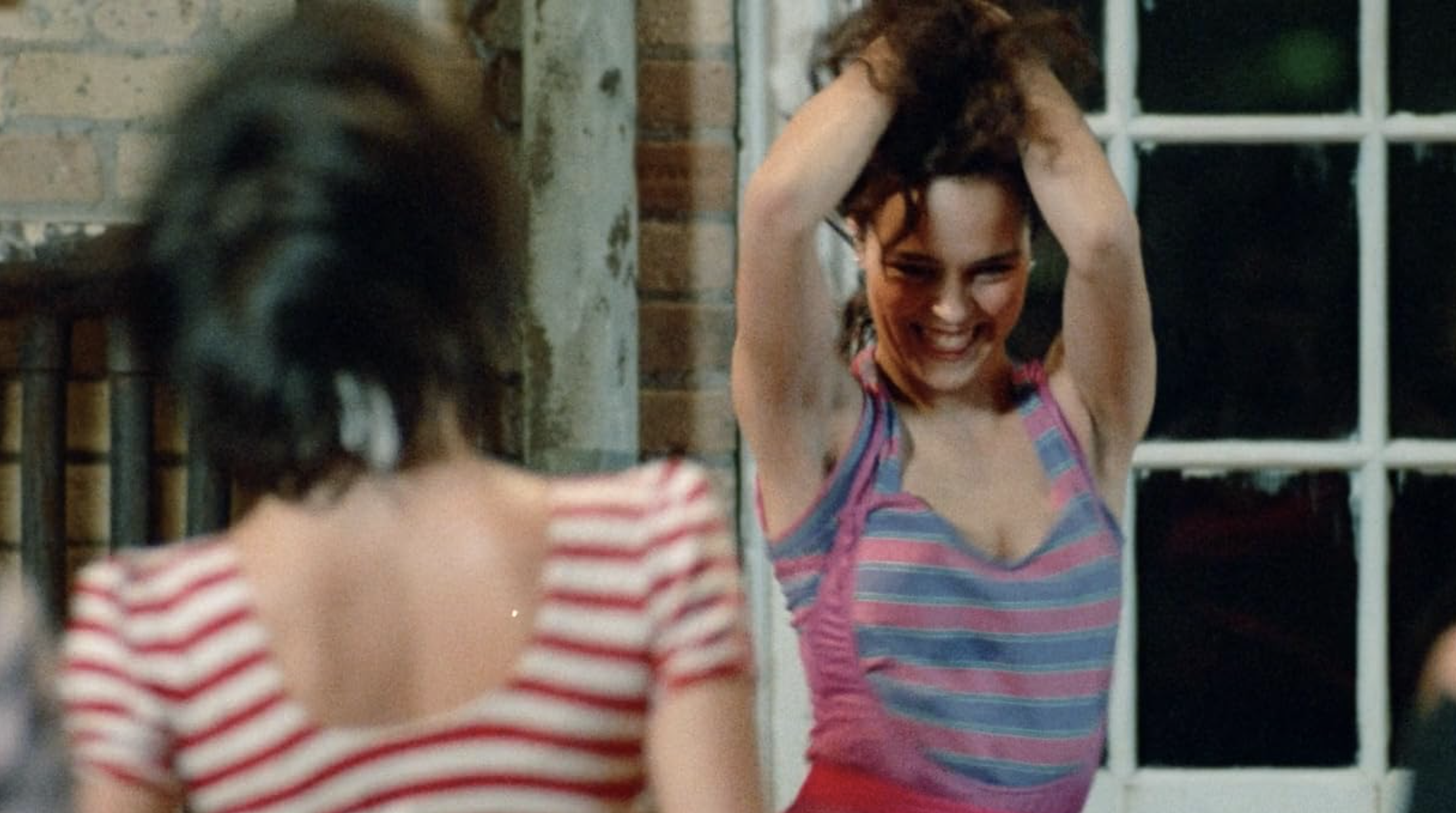
The success of Flashdance in 1983 changed the way Hollywood looked at dance movies.
Adrian Lyne’s film had been a surprise hit, turning Jennifer Beals into a star and making the image of a woman dancing in a warehouse one of the defining visual moments of the decade.
It was a movie about ambition, class, work, and self-expression.
It was also a movie with a killer soundtrack.
Hollywood saw the money.
Suddenly, every kind of physical activity was a potential movie.
Dancing. Skating. Gymnastics. Breakdancing. Aerobics.
If it involved a young person working hard while listening to music, there was probably a pitch meeting somewhere.
Heavenly Bodies emerged from that moment.
The film was conceived as a modest Canadian production about women trying to establish an aerobics business. The story was developed by actor-turned-director Lawrence Dane and journalist and critic Ron Base.
Dane, who had worked extensively as an actor, would make Heavenly Bodies his sole theatrical directorial feature.
The original concept was reportedly much smaller in scale, initially considered as a low-budget television movie.
That makes sense when you look at the story.
A group of women open a workout studio in a warehouse. They struggle to attract customers. They face competition from a flashier rival. Their business is threatened. They must fight to survive.
It could have been a television movie.
But then the 1980s happened.
And the movie got bigger.
The Canadian Production with Hollywood Dreams
Heavenly Bodies was produced by Robert Lantos and Stephen J. Roth through RSL Films.
The project also attracted involvement from Playboy Enterprises and Hollywood figures including Peter Guber and Jon Peters.
That is a fairly impressive collection of names for a movie that began as a modest Canadian production.
The reported budget was around $900,000, though the production eventually expanded beyond its original ambitions.
Reshoots were undertaken to increase the film’s production value, and there were hopes of securing major-studio distribution.
The music was also important.
The film’s soundtrack was part of its commercial appeal, with songs from artists including Bonnie Pointer, Sparks, and The Tubes helping establish the film’s pop-driven identity.
The influence of Flashdance was obvious.
Not just in the music.
Not just in the dancing.
But in the belief that a movie about physical exertion could become a cultural event.
The problem was that Flashdance had a story.
A compelling one, actually.
Heavenly Bodies had an exercise class.
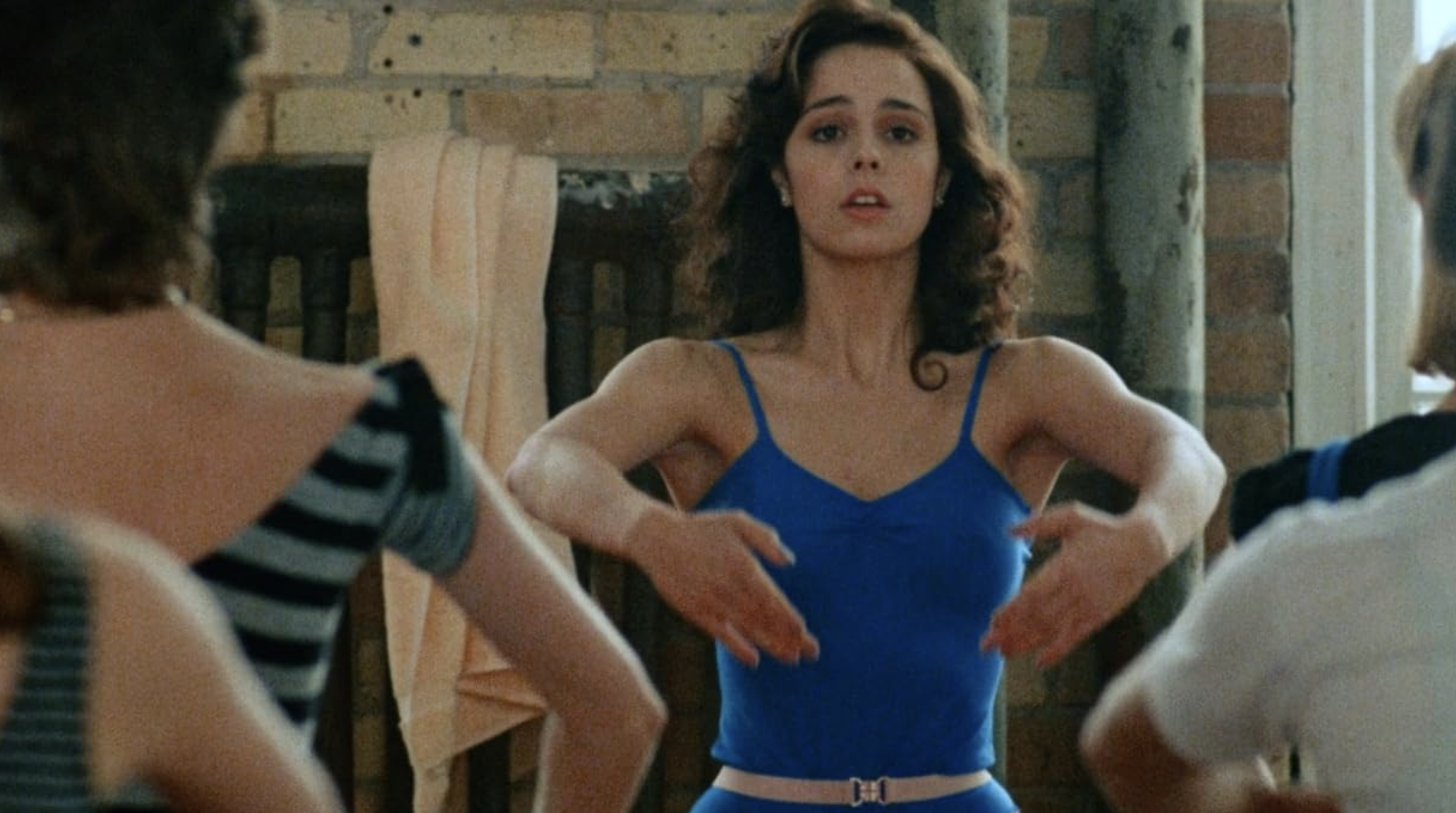
Samantha Blair and the Dream of the Perfect Workout Studio
Cynthia Dale stars as Samantha Blair, a single mother who decides to open an aerobics studio.
Samantha is not a professional athlete or a wealthy businesswoman. She is an ordinary person who sees an opportunity and decides to take a chance.
Along with her friends, she transforms a warehouse into a workout space.
The name?
Heavenly Bodies.
It’s a name that sounds like it was selected by a committee of marketing executives who had recently discovered both aerobics and the word “heavenly.”
But the studio itself is central to the movie’s appeal.
The women are not simply exercising.
They are building something.
They are taking control of their lives.
They are creating a business in a field that is becoming increasingly popular.
There is a genuine feminist undercurrent here, even if the film doesn’t always know what to do with it.
Samantha and her friends are entrepreneurs. They are working women. They are trying to make a living in a competitive industry.
They are also expected to look fantastic while doing it.
This is the contradiction at the heart of Heavenly Bodies.
The film wants to celebrate female ambition.
But it also wants to turn that ambition into a spectacle of attractive bodies moving to music.
It wants to be a story about women taking control of their lives.
But it also wants to be a workout video.
And sometimes, those two impulses don’t quite fit together.
The Rival Studio
Naturally, success attracts competition.
Samantha’s studio faces off against a rival operation led by Debbie, a flashier aerobics instructor.
The rival studio represents everything that threatens the modest, community-oriented spirit of Heavenly Bodies.
It is more commercial.
More polished.
More aggressive.
And presumably has better lighting.
The rivalry gives the movie its basic dramatic structure.
Samantha and her friends have built something meaningful. Now they have to defend it.
There is also a romantic subplot involving football player Steve, because no 1980s movie about a determined woman would be complete without a love interest.
The plot eventually builds toward a televised dance marathon that will determine the fate of the studio.
Yes, a dance marathon.
Not a legal battle.
Not a financial negotiation.
Not a business plan.
A dance marathon.
The kind of thing that makes you wonder whether the writers had ever actually watched a movie about running a business.
But this is Heavenly Bodies.
The movie is not interested in ordinary solutions.
It wants sweat.
It wants music.
It wants bodies in motion.
And it wants a finale.
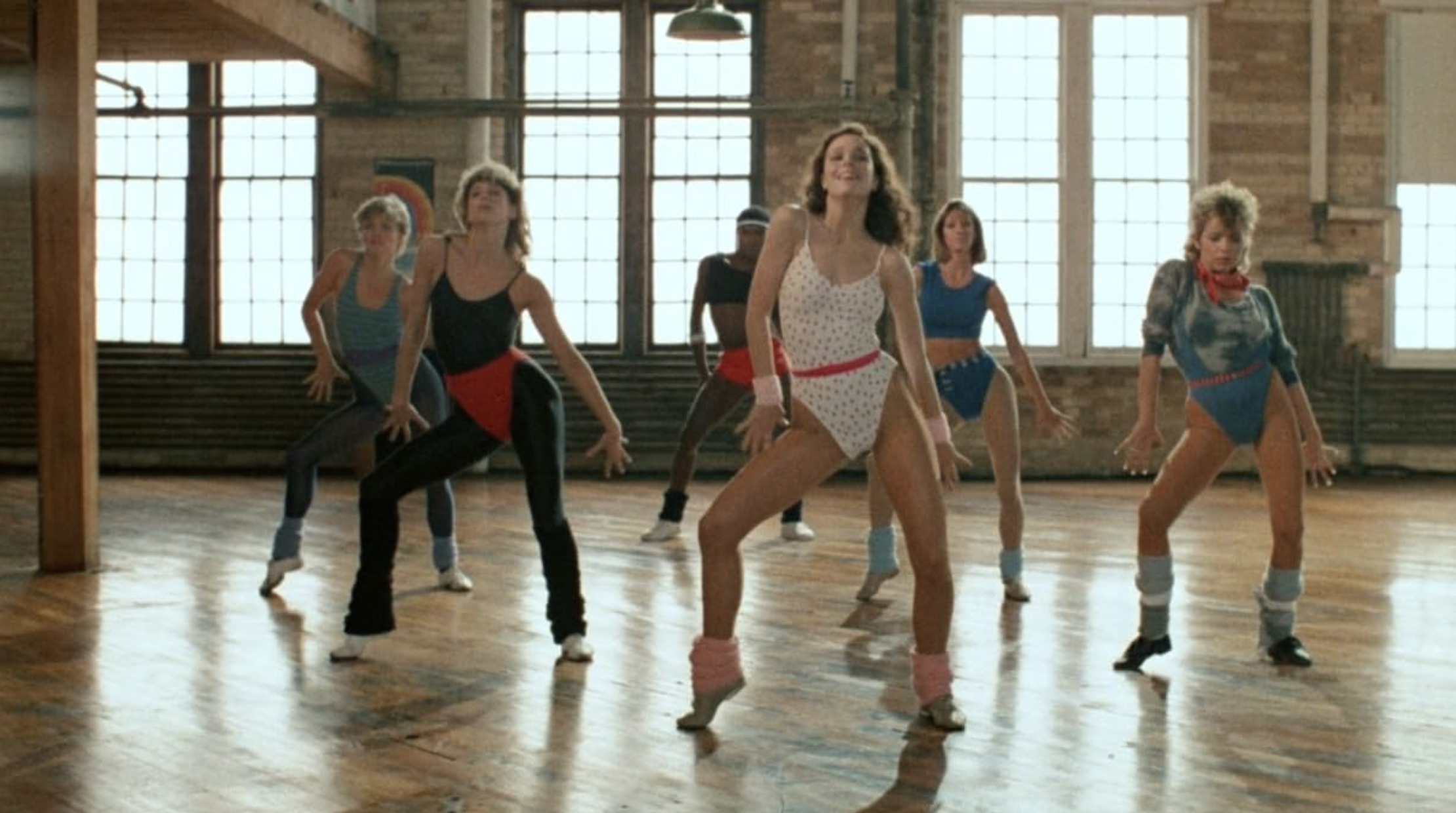
When an Aerobics Class Becomes a Movie
The biggest problem with Heavenly Bodies is that the movie doesn’t always seem to understand the difference between an exercise video and a feature film.
There are long stretches in which the plot essentially stops so that the characters can work out.
The camera lingers on bodies.
The music keeps playing.
The choreography continues.
And the audience is left wondering whether they should be watching the movie or joining the class.
This was not necessarily a bad commercial instinct.
The aerobics craze was visual.
It was colorful.
It was energetic.
It was full of movement.
A movie about aerobics should probably contain some aerobics.
But Heavenly Bodies often treats the exercise sequences as the main attraction rather than as part of a larger story.
The result is a film that sometimes feels less like a narrative and more like a workout tape with a plot attached.
And not even a particularly complicated plot.

The Rocky Formula, with More Leg Warmers
The movie’s structure is familiar.
An underdog faces a powerful rival.
The underdog struggles.
The underdog trains.
The underdog must prove herself.
The underdog enters a climactic competition.
This is the basic Rocky formula.
But instead of boxing gloves, we get leg warmers.
Instead of a boxing ring, we get an aerobics studio.
Instead of a bruising fight, we get a dance marathon.
And instead of “Eye of the Tiger,” we get a soundtrack full of early-1980s pop and disco.
The film is clearly trying to create the same emotional experience as a sports movie.
It wants us to root for Samantha.
It wants us to care about the studio.
It wants the final competition to feel like a championship fight.
But the stakes are not always convincing.
The characters are thinly drawn.
The rivalries feel manufactured.
And the movie’s emotional beats are often overwhelmed by the music and choreography.
It is difficult to become emotionally invested in a business dispute when the movie keeps cutting to people doing jumping jacks.
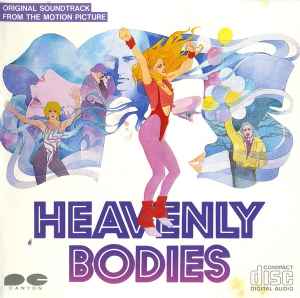
The Soundtrack Is Doing a Lot of Heavy Lifting
One of the things Heavenly Bodies gets right is the music.
The film’s soundtrack is full of the kind of upbeat, dance-oriented music that defined the era.
Bonnie Pointer.
Sparks.
The Tubes.
The music gives the movie energy.
It helps establish the period.
And it reminds us that aerobics was not just about exercise.
It was about entertainment.
The soundtrack is part of the fantasy.
You are not simply working out.
You are starring in your own music video.
This was one of the reasons the aerobics craze was so successful. It made exercise feel less like a chore and more like a performance.
You could put on a leotard, turn up the music, and imagine yourself as the star of a movie.
Heavenly Bodies understands that fantasy.
It just doesn’t always know how to turn it into a compelling film.
The Fashion Is the Real Star
If the movie has a true star, it might be the wardrobe department.
The leotards.
The leg warmers.
The headbands.
The bright colors.
The sweat.
The hair.
Everything about the film looks like a time capsule from the early 1980s.
And that’s part of what makes it so fascinating today.
The aerobics craze was not simply a fitness movement.
It was a fashion movement.
It created a visual identity that was instantly recognizable.
You could see someone in a neon leotard and know exactly what decade they belonged to.
The clothes were practical, in theory.
They allowed movement.
They were comfortable.
They were designed for exercise.
But they were also highly stylized.
And in Heavenly Bodies, the fashion becomes part of the spectacle.
The film is selling an image of fitness.
An image of health.
An image of female confidence.
And, inevitably, an image of the female body.
This is where the movie’s empowerment narrative becomes complicated.
Empowerment, Objectification, and the Business of Looking Good
There is something genuinely appealing about the idea of women building their own business.
Samantha and her friends are not waiting around for someone to rescue them.
They are taking a chance.
They are working.
They are competing.
They are trying to succeed in a male-dominated business world.
That is a good story.
But Heavenly Bodies also presents fitness through the lens of appearance.
The characters are expected to be attractive.
The camera is often interested in their bodies as much as their personalities.
And the movie’s central fantasy is not simply that exercise can make you healthier.
It is that exercise can transform you into a better-looking person.
That was a major part of the fitness industry’s appeal in the 1980s.
The language of empowerment was often tied to the language of self-improvement.
You could become stronger.
More confident.
More successful.
More attractive.
The problem is that those ideas can become tangled.
If you are not thin, are you failing?
If you are not toned, are you not trying hard enough?
If you don’t look like Jane Fonda, are you doing something wrong?
The fitness industry was selling a dream.
And like most dreams sold by commercial culture, it came with a price.
Heavenly Bodies captures that contradiction without necessarily examining it.
It celebrates women who want to take control of their lives.
But it also presents their bodies as a product.
The movie wants us to see aerobics as a form of liberation.
But it also wants us to look at the women doing it.
That tension is one of the film’s most interesting qualities.
Even if it was probably not intentional.
The Movie Opens in a Crowded Marketplace
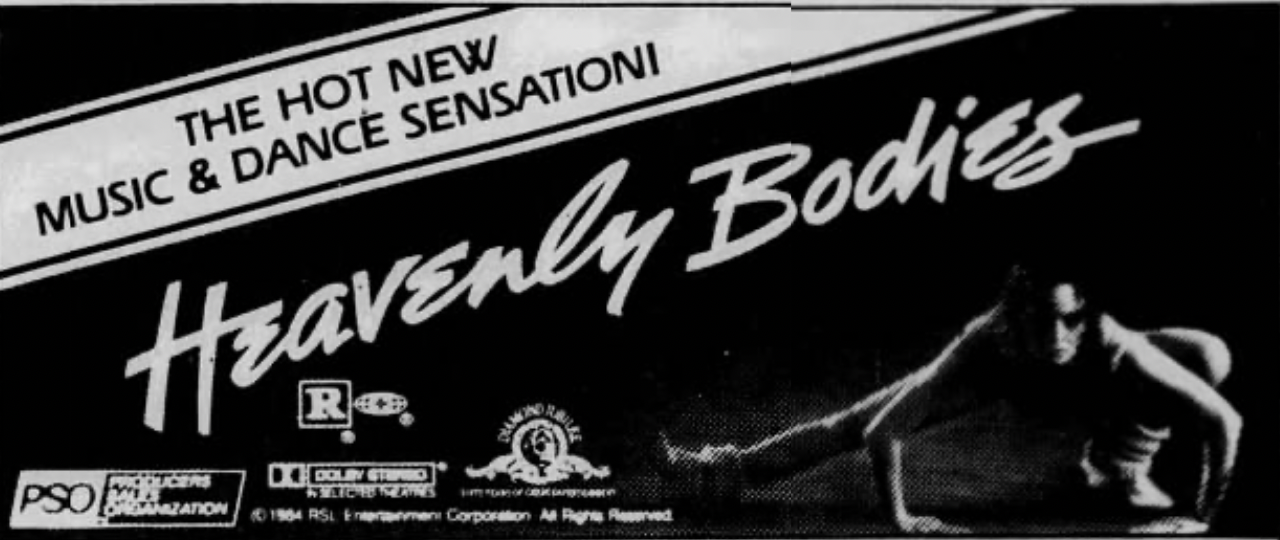
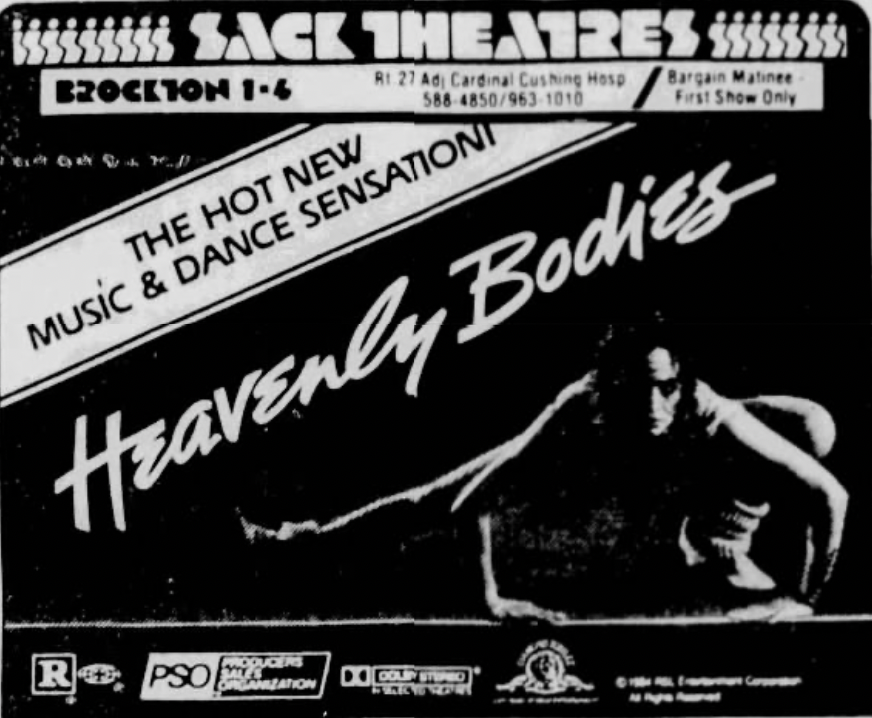
Heavenly Bodies premiered in Japan in December 1984 before receiving a North American theatrical release from MGM/UA on February 1, 1985.
The film opened on more than 1,500 screens, an ambitious rollout for a Canadian production with a relatively modest budget.
The timing made sense.
Aerobics was still a major cultural phenomenon.
Flashdance had demonstrated the box-office potential of dance-driven movies.
And the fitness industry was expanding rapidly.
But there was also a problem.
The marketplace was already crowded.
By 1985, the aerobics craze had been thoroughly commercialized.
There were workout videos.
Fitness television shows.
Exercise franchises.
Workout records.
Clothing lines.
Magazines.
And plenty of other entertainment products trying to cash in on the same audience.
Heavenly Bodies was not introducing audiences to something new.
It was arriving after the phenomenon had already been established.
And while that might have been good news for the fitness industry, it was not necessarily good news for the movie.
The film reportedly opened to around $1.1 million during its opening weekend and ultimately earned less than $2 million domestically.
It underperformed relative to the ambitions surrounding its release.
Theatrical audiences were not exactly lining up to see a movie about a workout studio.
At least not in the numbers the distributors had hoped for.
The Home-Video Afterlife
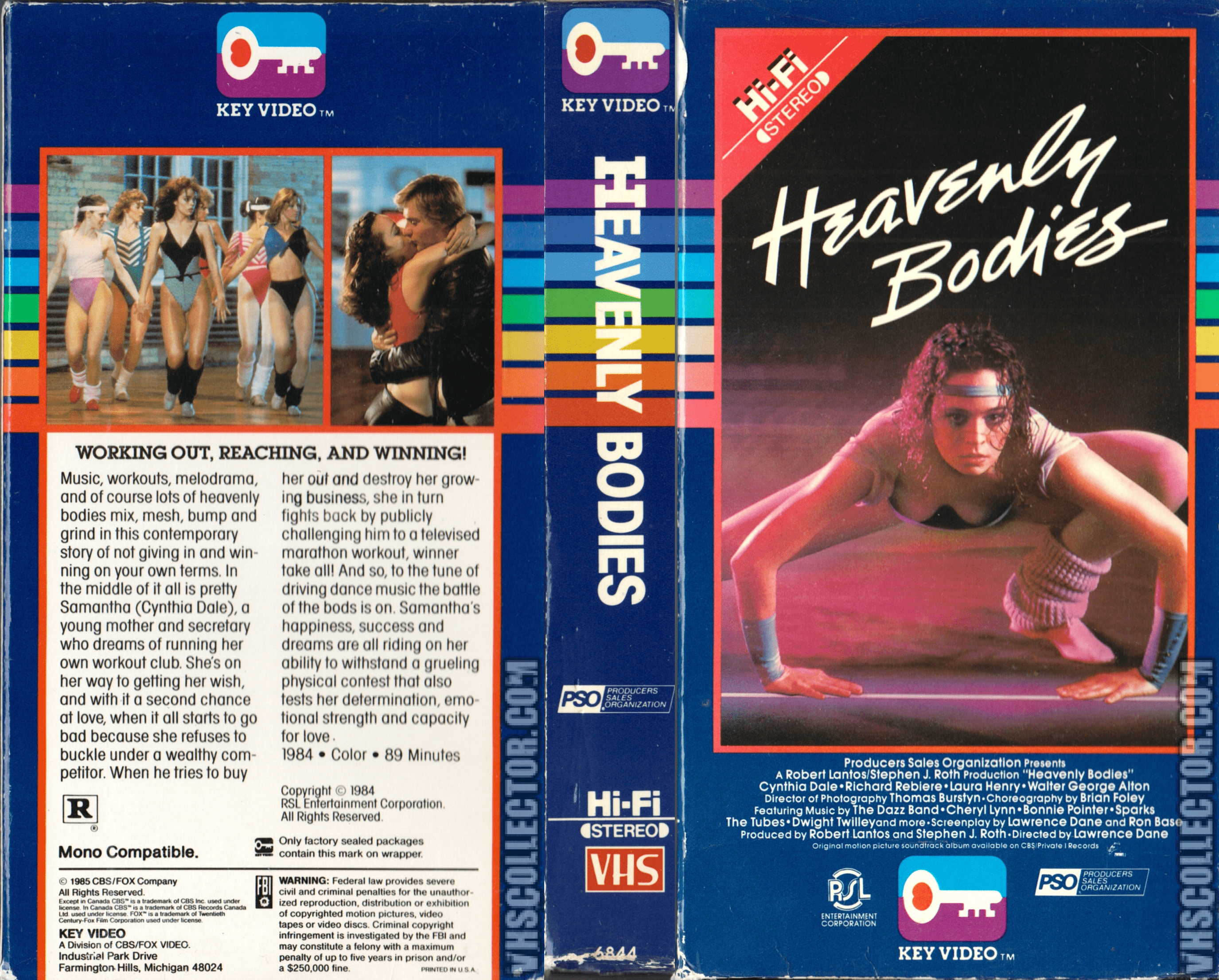
Like many 1980s movies that struggled theatrically, Heavenly Bodies found a second life on home video.
This was the era when video stores were filled with movies that had disappeared from theaters almost overnight.
A film could fail at the box office and still find an audience through VHS rentals and sales.
And Heavenly Bodies had several qualities that made it a natural fit for the video market.
It was colorful.
It had a recognizable 1980s aesthetic.
It featured a soundtrack full of period music.
And it was exactly the kind of movie that could appeal to viewers looking for a nostalgic time capsule.
The film’s video afterlife helped keep it alive.
Over time, it became one of those movies that people remembered more fondly than critics had expected.
Not necessarily because it was a great movie.
But because it was so unmistakably of its time.
The Critics Were Not Feeling the Burn
The contemporary reviews were, for the most part, brutal.
Critics saw a movie that was derivative, shallow, and more interested in bodies than characters.
They saw a film trying to capitalize on the aerobics craze without offering much of a story.
And they were not shy about saying so.
“The World’s Longest Music Video”
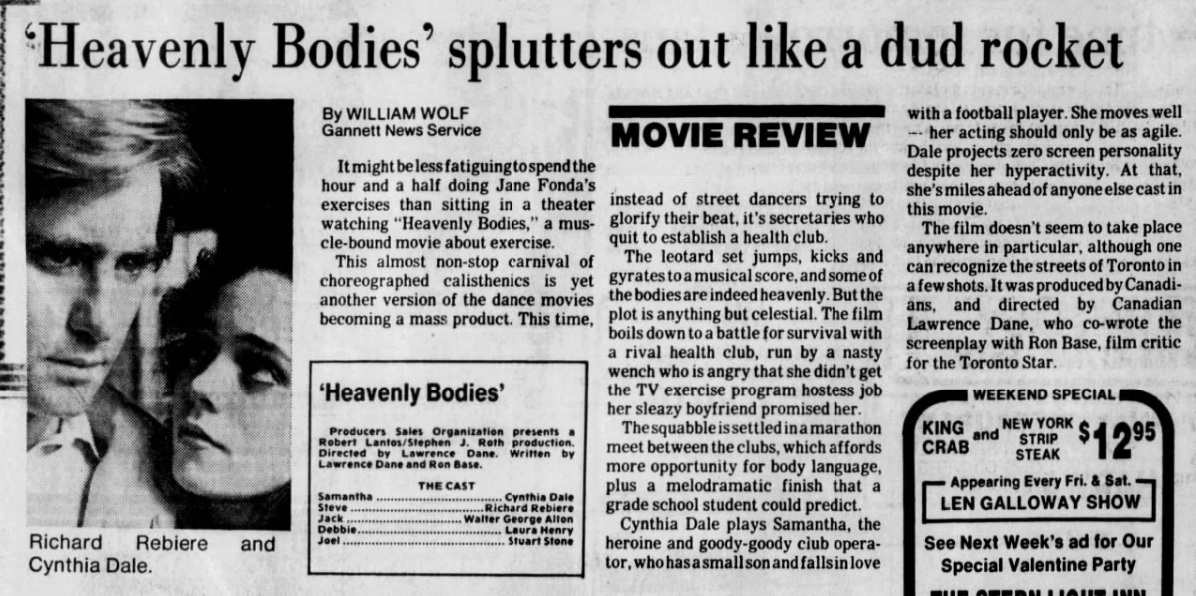
Vincent Canby of The New York Times described Heavenly Bodies as having “the manner and look of the world’s longest music video.”
That is a devastating description.
And a fairly accurate one.
Canby also noted that the movie was “not as stylish as Flashdance,” though he suggested that it was possibly funnier, especially during the climax.
That is probably the kindest way to describe the film.
It is not a stylish dance movie.
It is a movie that desperately wants to be a stylish dance movie.
And the difference matters.
Flashdance had a visual identity.
Heavenly Bodies has a collection of visual ingredients.
There is a difference between making a movie that feels like a music video and making a movie that feels like a collection of music videos.
Heavenly Bodies often falls into the second category.
“A Hollow Exercise”
Gary Curtis was even less impressed.
He described the film as “a hollow exercise” and “a dancercize-aerobics Rocky-type flick.”
He also suggested that it was essentially The 20 Minute Workout multiplied by five.
That is a particularly effective insult because it gets at the movie’s central problem.
Heavenly Bodies is not simply a bad sports movie.
It is a bad sports movie that has been stretched to feature length by adding more exercise sequences.
The film’s structure is repetitive.
The characters are predictable.
The plot is thin.
And the movie keeps returning to the same basic idea: people working out to music.
Curtis ultimately called it “an exercise to sit through.”
That’s a review that practically writes itself.
“Competitive Jumping Jacks”
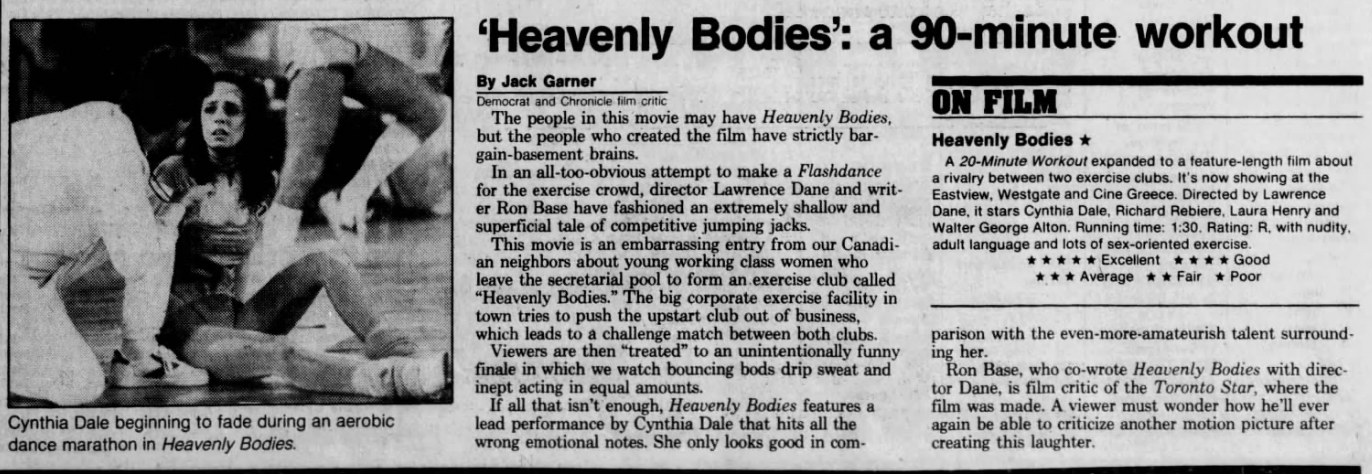
Jack Garner of the Democrat and Chronicle called the film an “extremely shallow and superficial tale of competitive jumping jacks.”
He also described it as “an embarrassing entry from our Canadian neighbors.”
That second phrase is particularly interesting.
The film was part of a broader effort to establish Canada as a viable location for commercial filmmaking.
Canadian producers were increasingly looking for projects that could cross into the American market.
But Heavenly Bodies was not exactly the kind of film that would silence skeptics.
Garner also criticized Cynthia Dale’s performance, suggesting that she hit “all the wrong emotional notes.”
That criticism may be a little harsh.
Dale is energetic and committed.
But the film gives her very little to work with.
Samantha is less a fully developed character than a collection of motivational speeches, workout routines, and determined smiles.
“Not Worth the Sweat”
Sandra Earley of the Herald was similarly dismissive.
She argued that the movie was “not worth the sweat.”
The film, she suggested, was neither dance nor drama.
And the plot was trite.
That is another fair criticism.
Heavenly Bodies wants to be a dance movie.
It wants to be a sports movie.
It wants to be a romantic drama.
It wants to be a business story.
But it never fully commits to any of those things.
Instead, it becomes a strange hybrid.
And hybrids can be wonderful.
But they can also be messy.
“Schlock from the Great White North”
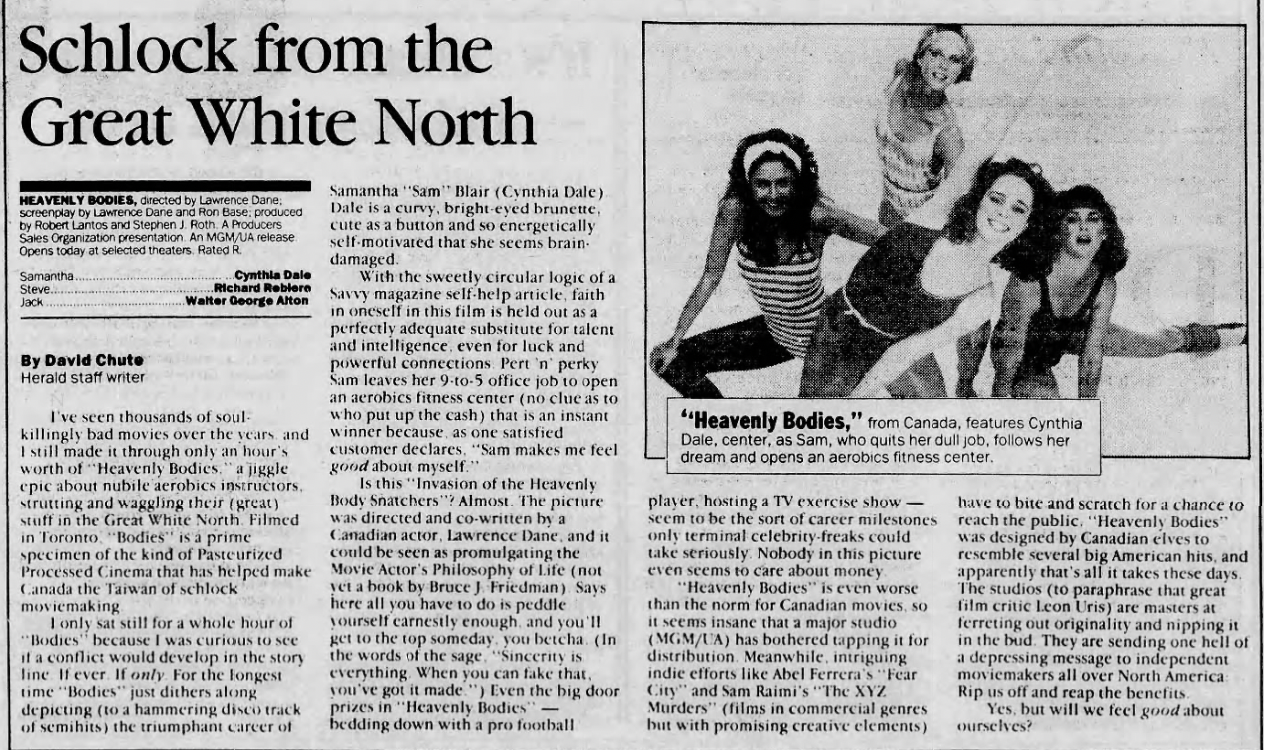
David Chute’s review was titled “Schlock from the Great White North.”
He described the film as “Pasteurized Processed Cinema” and called it a “jiggle epic.”
Those are the kinds of phrases that make you wish more movie reviews were written like they were in the 1980s.
“Jiggle epic” is a perfect description of Heavenly Bodies.
It sounds like a movie that was designed by someone who had watched Flashdance and thought, “What if we did that, but with more jumping jacks?”
The film’s emphasis on bodies in motion was not necessarily a problem in itself.
But the camera often seems more interested in the physical spectacle than in the people performing it.
And that is where the movie’s commercial opportunism becomes most obvious.
It is not simply celebrating aerobics.
It is selling aerobics.

The Ron Base Irony
There was also a certain irony in the fact that Ron Base, one of the film’s co-writers, was himself a journalist and critic.
Here was a movie written by someone who understood the language of film criticism.
And yet, the film became the subject of criticism for precisely the qualities that critics often dislike.
It was shallow.
Derivative.
Commercial.
And more interested in style than substance.
That does not mean Base was incapable of writing a good movie.
But it does make the film’s reception a little more amusing.
The movie was trying to turn a cultural phenomenon into entertainment.
The critics were trying to turn the movie into a punchline.
And in some cases, they succeeded.
Was Heavenly Bodies Really That Bad?
Well, yes.
But also, not exactly.
The movie is not good in the traditional sense.
The plot is thin.
The characters are underdeveloped.
The dialogue is often clunky.
The emotional stakes are exaggerated.
And the film’s determination to turn aerobics into a dramatic spectacle can become exhausting.
But there is something charming about its enthusiasm.
Heavenly Bodies is not cynical.
It is not trying to be ironic.
It is not making fun of the aerobics craze.
It genuinely believes that aerobics is exciting.
That fitness is empowering.
That music and movement can transform people’s lives.
And that a dance marathon can resolve a business dispute.
The movie is ridiculous.
But it is ridiculous in a way that feels sincere.
That is an increasingly rare quality.
The Unintentional Comedy of the Finale
The dance marathon is the film’s big climax.
And it is also the moment when the movie most clearly loses its mind.
The characters have to compete in an extended aerobics performance, with the fate of the studio hanging in the balance.
It is supposed to be thrilling.
It is supposed to be emotional.
It is supposed to be the equivalent of Rocky’s final boxing match.
But the whole thing is so absurd that it becomes difficult not to laugh.
The idea that the ownership or future of a workout studio would be determined by a dance marathon is already ridiculous.
But the movie commits to it completely.
There is no wink.
No acknowledgment that this is a little silly.
Just people sweating, dancing, and trying to outlast one another.
The result is a climax that is both unintentionally funny and strangely entertaining.
It is the kind of sequence that makes you understand why some viewers might enjoy the film despite its many flaws.
The Canadian Connection
One of the more interesting aspects of Heavenly Bodies is its place in Canadian film history.
During the 1980s, Canadian producers were increasingly interested in making movies that could reach international audiences.
Canada had a growing film industry.
Toronto was becoming an important production center.
And there was a desire to make films that could compete in the American marketplace.
Heavenly Bodies was part of that ambition.
It was not simply a Canadian movie about aerobics.
It was a Canadian movie trying to become an international commercial hit.
That is why the involvement of MGM/UA mattered.
That is why the production was expanded.
That is why the film was released on so many screens.
The movie was not intended to remain a small Canadian curiosity.
It was supposed to be a commercial product.
And when it failed to connect with audiences, it became another example of the difficulties Canadian filmmakers faced when trying to break into the American market.
The film’s failure was not necessarily a reflection of Canadian talent.
But it did demonstrate how difficult it was to compete with Hollywood’s increasingly sophisticated commercial machinery.
A movie could have a recognizable trend.
A popular soundtrack.
A colorful visual style.
And a cast of attractive performers.
But that did not guarantee success.
Sometimes, you still needed a good movie.
The Aerobics Craze Was Already Changing
By the time Heavenly Bodies arrived in theaters, the fitness industry was already beginning to evolve.
The high-impact aerobics craze had produced concerns about injuries.
Some participants were experiencing problems with their knees, ankles, and backs.
The constant jumping and pounding could take a toll.
Low-impact exercise became increasingly popular.
The industry began emphasizing more accessible forms of movement.
And the idea of fitness was slowly changing.
The focus was no longer exclusively on losing weight.
There was more attention to strength training.
Flexibility.
Overall health.
And long-term wellness.
The 1990s would bring new fitness trends.
Step aerobics.
Spinning.
Strength training.
And eventually, the boutique fitness industry.
The neon leotards would fade.
The leg warmers would disappear.
And the aerobics studio would become something else.
But the basic idea remained.
Exercise could be social.
Exercise could be entertaining.
Exercise could be a form of self-expression.
That legacy is still visible today.
Look at the popularity of Zumba.
Dance fitness.
Group cycling.
Boutique workout studios.
The modern fitness industry still relies heavily on the idea that exercise should be fun.
That it should be a community.
That it should be an experience.
The 1980s did not invent that idea.
But they certainly commercialized it.
And Heavenly Bodies is one of the strangest cinematic expressions of that commercialization.
Why Heavenly Bodies Still Matters
It would be easy to dismiss Heavenly Bodies as a bad movie.
And in many ways, it is.
But it is also a fascinating time capsule.
The film captures the moment when aerobics became a cultural phenomenon.
When exercise became entertainment.
When women were encouraged to take control of their bodies and their lives.
When the fitness industry became a massive commercial enterprise.
And when Hollywood began turning every popular trend into a potential movie.
That makes Heavenly Bodies more interesting than its reputation might suggest.
It is a movie about women building a business.
It is a movie about the commodification of fitness.
It is a movie about the early-1980s obsession with physical transformation.
It is a movie about the belief that success could be achieved through hard work, determination, and the right soundtrack.
And it is a movie about the limits of that belief.
Because the film’s biggest weakness is also its most revealing quality.
It does not really understand the difference between empowerment and exploitation.
It wants to celebrate women.
But it also wants to sell their bodies.
It wants to celebrate fitness.
But it also wants to sell the fantasy of looking good.
It wants to celebrate ambition.
But it also wants to turn that ambition into a product.
That is not unique to Heavenly Bodies.
It is a recurring tension in popular culture.
And the movie captures it in the most 1980s way possible.
With spandex.
Sweat.
And a lot of jumping jacks.
The Blu-ray Revival
For years, Heavenly Bodies was one of those movies that seemed destined to remain a VHS curiosity.
A film remembered by people who had rented it in the 1980s.
A title that appeared occasionally on lists of forgotten aerobics movies.
A strange relic of the era’s fitness obsession.
But the movie has received renewed attention from fans of 1980s cinema.
The 2024 Blu-ray release from Fun City Editions helped bring the film back into circulation and gave it a new audience.
That is part of the joy of revisiting movies from this period.
A film that was once dismissed as disposable can become something else decades later.
Not necessarily a masterpiece.
Not necessarily a rediscovered classic.
But a fascinating document of its time.
Heavenly Bodies is a movie that tells us a lot about the culture that produced it.
And sometimes, that is enough.
Final Thoughts: A Workout Best Approached with Low Expectations
Heavenly Bodies is not a great movie.
It is not even a particularly good movie.
But it is a fascinating one.
It captures the optimism of the 1980s aerobics craze.
The belief that exercise could transform your life.
The idea that women could build their own businesses.
The excitement of music-driven fitness.
The commercial excesses of the era.
And the way Hollywood could take a genuine cultural movement and turn it into a product.
The film is also a reminder that not every cultural phenomenon translates into a good movie.
Sometimes, you can have the fashion.
The music.
The energy.
The stars.
The commercial opportunity.
And still end up with a movie that feels like a workout video stretched to feature length.
That is Heavenly Bodies.
A movie that wanted to be the Rocky of aerobics.
A movie that wanted to be the next Flashdance.
A movie that wanted to turn jumping jacks into high drama.
And a movie that, in the end, became something far more interesting than it probably intended.
A time capsule.
A curiosity.
A little piece of 1980s madness.
And a reminder that sometimes the best way to appreciate a bad movie is to understand the world that made it.
So if you decide to revisit Heavenly Bodies, approach it with low expectations.
Bring a sense of humor.
Appreciate the soundtrack.
Enjoy the fashion.
And remember that the movie is not really about aerobics.
It is about the moment when aerobics became a cultural obsession.
When fitness became entertainment.
When empowerment became a marketing strategy.
And when the 1980s decided that the best way to tell a story about women fighting for their dreams was to make them do jumping jacks for 90 minutes.
In an era that taught millions to “feel the burn,” Heavenly Bodies remains a workout best enjoyed from the comfort of your couch.
Preferably while wearing leg warmers.
About the Creator
Movies of the 80s
We love the 1980s. Everything on this page is all about movies of the 1980s. Starting in 1980 and working our way the decade, we are preserving the stories and movies of the greatest decade, the 80s. https://www.youtube.com/@Moviesofthe80s
Enjoyed the story? Support the Creator.
Subscribe for free to receive all their stories in your feed.
Comments
There are no comments for this story
Be the first to respond and start the conversation.