
'Hammett' (1982): The Zoetrope Dream That Became a Hollywood Nightmare
Wim Wenders wanted to make a movie about the man who invented the hard-boiled detective story. Francis Ford Coppola wanted to make a movie about the birth of an American myth. Somewhere between the two, Hollywood happened.

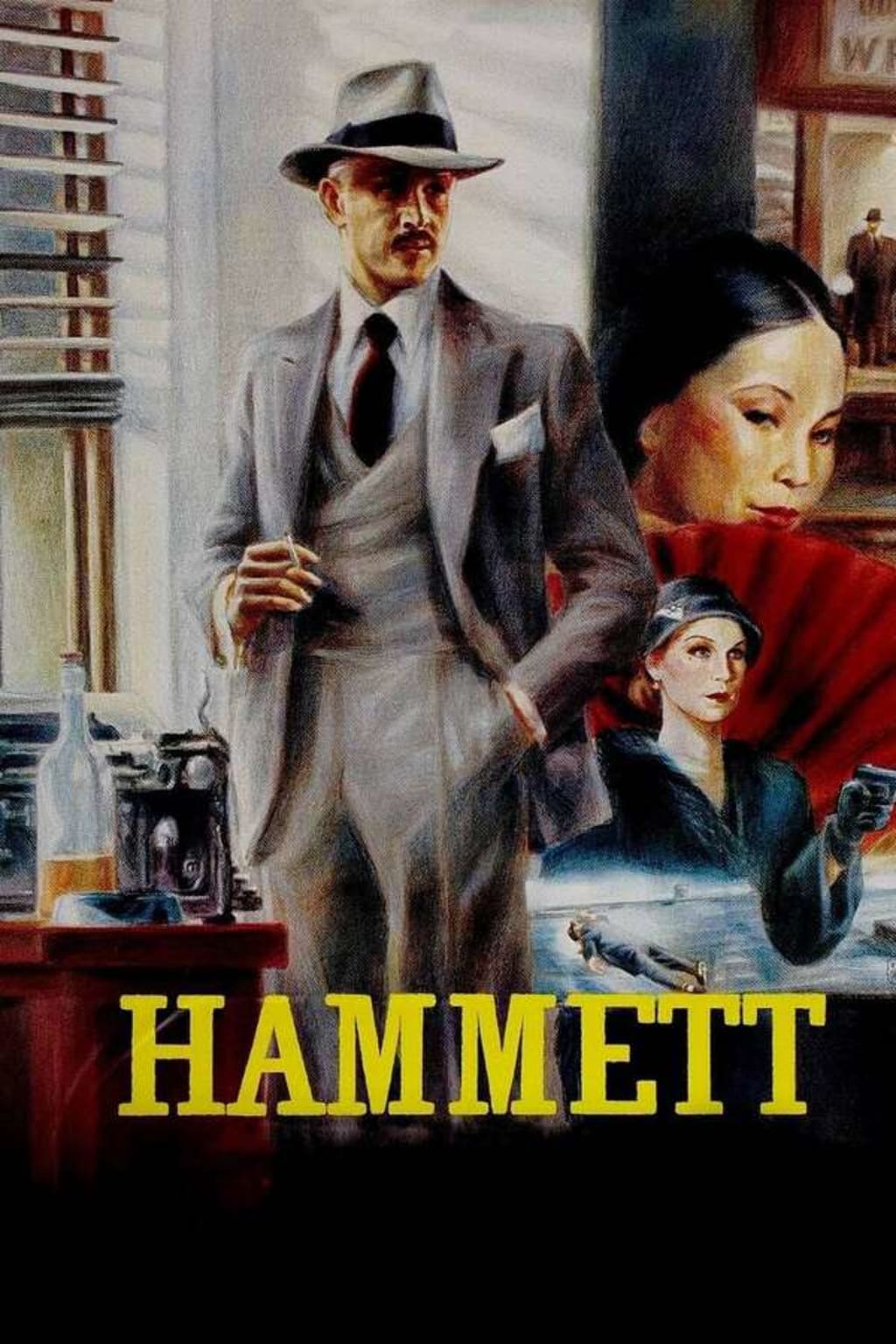
There is something wonderfully appropriate about a movie concerning Dashiell Hammett becoming a mystery itself.
Who was the real Hammett? Where did the stories end and the legend begin? And what, exactly, happened to the movie that Wim Wenders spent years trying to make?
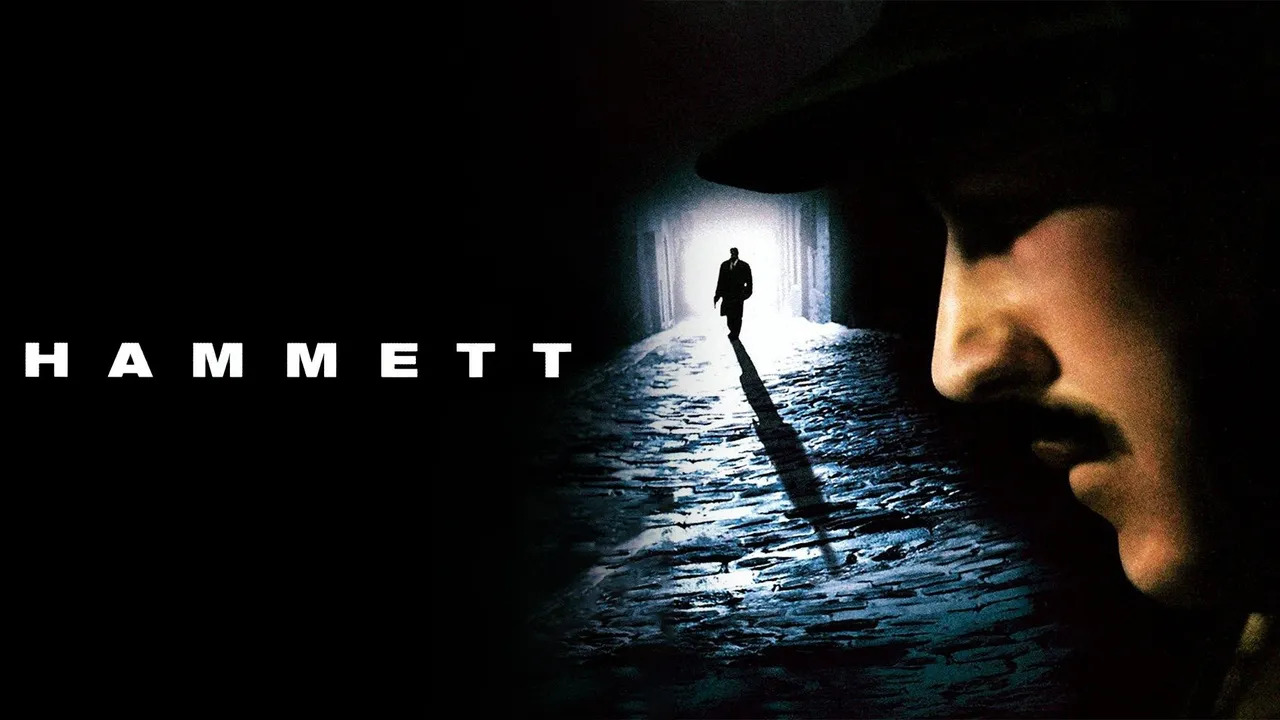
Released in 1982, Hammett is a stylish, strange, occasionally beautiful film about the author of The Maltese Falcon, The Thin Man, and the hard-boiled detective fiction that would influence generations of writers and filmmakers.
It is also a movie that almost seems to be telling two stories at once.
On the screen, Dashiell Hammett investigates a missing woman in 1928 San Francisco while writing the novel that will become The Maltese Falcon.
Behind the screen, a European filmmaker attempts to make an American movie inside Francis Ford Coppola’s ambitious American Zoetrope Studios. The production stretches across years, undergoes extensive reshoots, loses its original shape, and eventually arrives in theaters to almost no commercial response.
The result is a fascinating collision of European art cinema, Hollywood mythology, and the kind of financial chaos that tends to follow when filmmakers decide the old rules no longer apply.
Hammett is not quite the movie it was supposed to be.
But then again, neither is Hollywood.
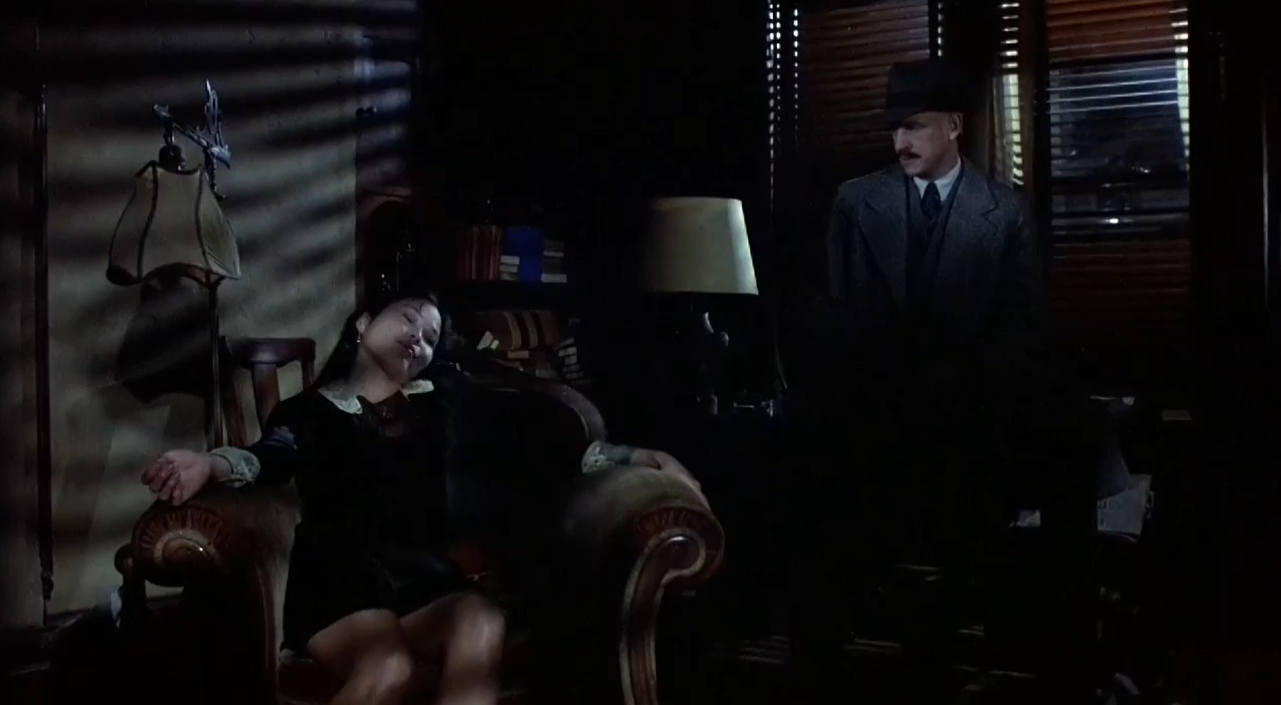
A Detective Story About the Man Who Wrote Detective Stories
Directed by Wim Wenders and executive-produced by Francis Ford Coppola, Hammett is based on Joe Gores’s 1975 novel of the same name.
The premise is irresistible.
It is 1928, and Dashiell Hammett is living in San Francisco, trying to make a living writing pulp fiction. Before becoming one of America’s most celebrated crime writers, Hammett had worked as a Pinkerton detective. His experience investigating crimes would become the foundation for his fiction.
In Gores’s novel, the real-life Hammett is drawn into a case involving a missing Chinese woman, blackmail, and corruption in San Francisco’s Chinatown.
The movie takes that fictionalized version of Hammett and places him inside the world he would eventually turn into literature.
He is not yet the famous author. He is a writer struggling to make money, dealing with illness, and attempting to put his past behind him.
But the past, as it tends to do in detective stories, has other plans.
The movie’s central idea is that Hammett is essentially investigating a mystery while writing a mystery. The case becomes material. His experiences become fiction. The people around him become characters.
The man creates the myth.
And then the myth begins to take over.
That is a terrific premise for a movie.
It is also the kind of premise that probably sounded even better inside Francis Ford Coppola’s head.
American Zoetrope: The Dream Before the Disaster
To understand Hammett, you have to understand American Zoetrope.
Following the enormous success of The Godfather, Francis Ford Coppola had the money, influence, and ambition to build something different from the traditional Hollywood studio system.
American Zoetrope was intended to be an alternative. A place where filmmakers could work with greater creative freedom, where international talent could come to America, and where ambitious projects could be developed outside the usual machinery of the major studios.
It was a beautiful idea.
It was also, in retrospect, a spectacularly difficult idea to execute.
Coppola wanted to make movies that traditional Hollywood might not understand. He wanted to work with European filmmakers, experiment with technology, and create a more artist-driven production environment.
The problem with creating your own studio is that you still have to make movies.
And movies are expensive.
Hammett became one of the major projects of this Zoetrope experiment.
Coppola acquired the rights to Gores’s novel and envisioned a film that could showcase the studio’s ambitions. The project attracted considerable talent, including German filmmaker Wim Wenders, who had become one of the leading figures of the New German Cinema.
Wenders was not an obvious choice for a conventional Hollywood detective picture.
That was probably part of the appeal.
He had made films such as Alice in the Cities, Kings of the Road, and The American Friend, movies concerned with alienation, travel, memory, and the strange emotional spaces between people.
His films were often contemplative, atmospheric, and interested in the way people experience the world rather than simply the things they do in it.
Now he was being asked to make a movie about Dashiell Hammett.
The author of The Maltese Falcon.
The man who helped define the American hard-boiled detective.
The man whose work would become synonymous with Humphrey Bogart, Sam Spade, and a particular kind of cynical American masculinity.
What could possibly go wrong?
Well, quite a bit.
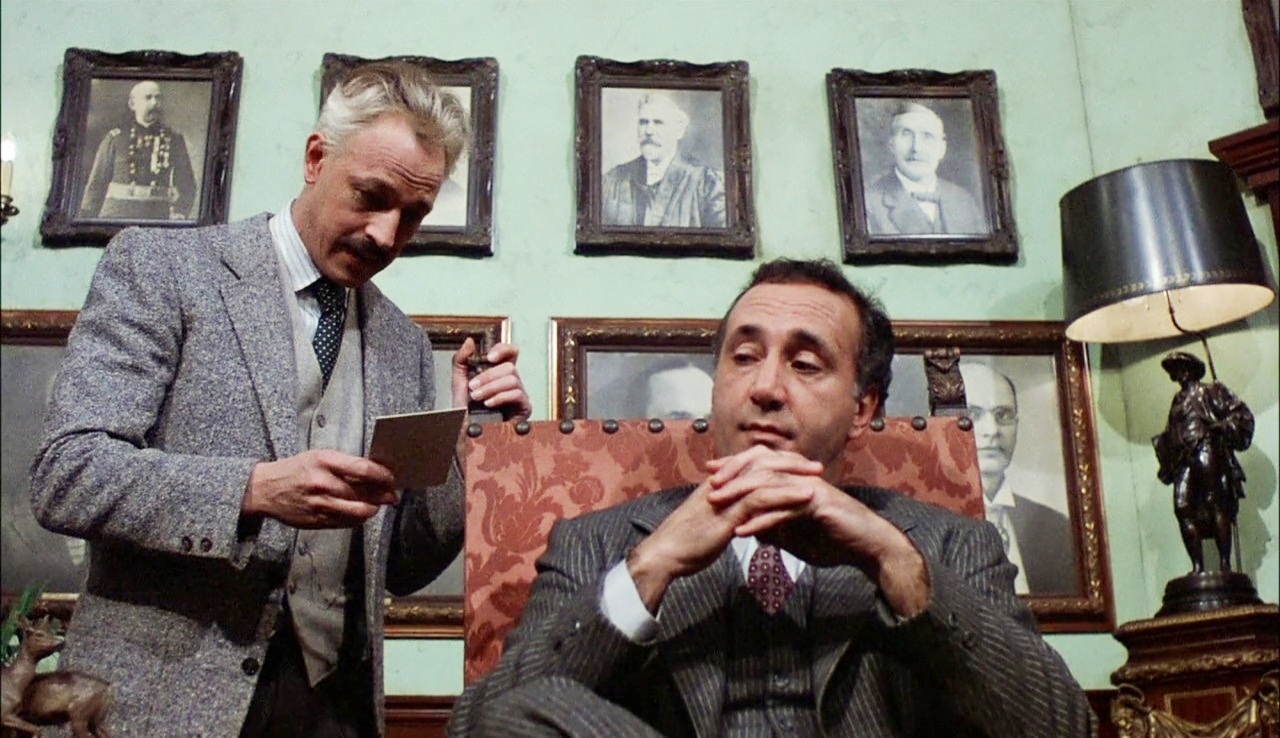
The Road to Hammett Was Paved With Drafts
The movie had been in development for years before Wenders began shooting.
Nicolas Roeg was among the filmmakers initially approached. Other writers worked on various versions of the screenplay, including Ross Thomas, Dennis O’Flaherty, and Thomas Pope.
There were reportedly dozens of drafts.
This is one of those details that makes me wonder what the original movie looked like in the minds of the people developing it.
Because a film about Dashiell Hammett could be almost anything.
It could be a straightforward literary biopic.
It could be a detective thriller.
It could be a meditation on the relationship between a writer and his material.
It could be a period piece about San Francisco.
It could be a movie about the creation of The Maltese Falcon.
Or it could be all of those things at once, which is generally where trouble begins.
Coppola and Zoetrope were interested in the movie as a showcase for the studio. Wenders was interested in Hammett himself.
Those are not necessarily the same thing.
And as production continued, the differences between those interests would become increasingly difficult to ignore.
Wim Wenders Meets Dashiell Hammett
One of the most fascinating things about Hammett is the amount of research Wenders conducted before shooting.
He did not simply read a biography, watch a few film noirs, and start pointing a camera.
He went looking for the man.
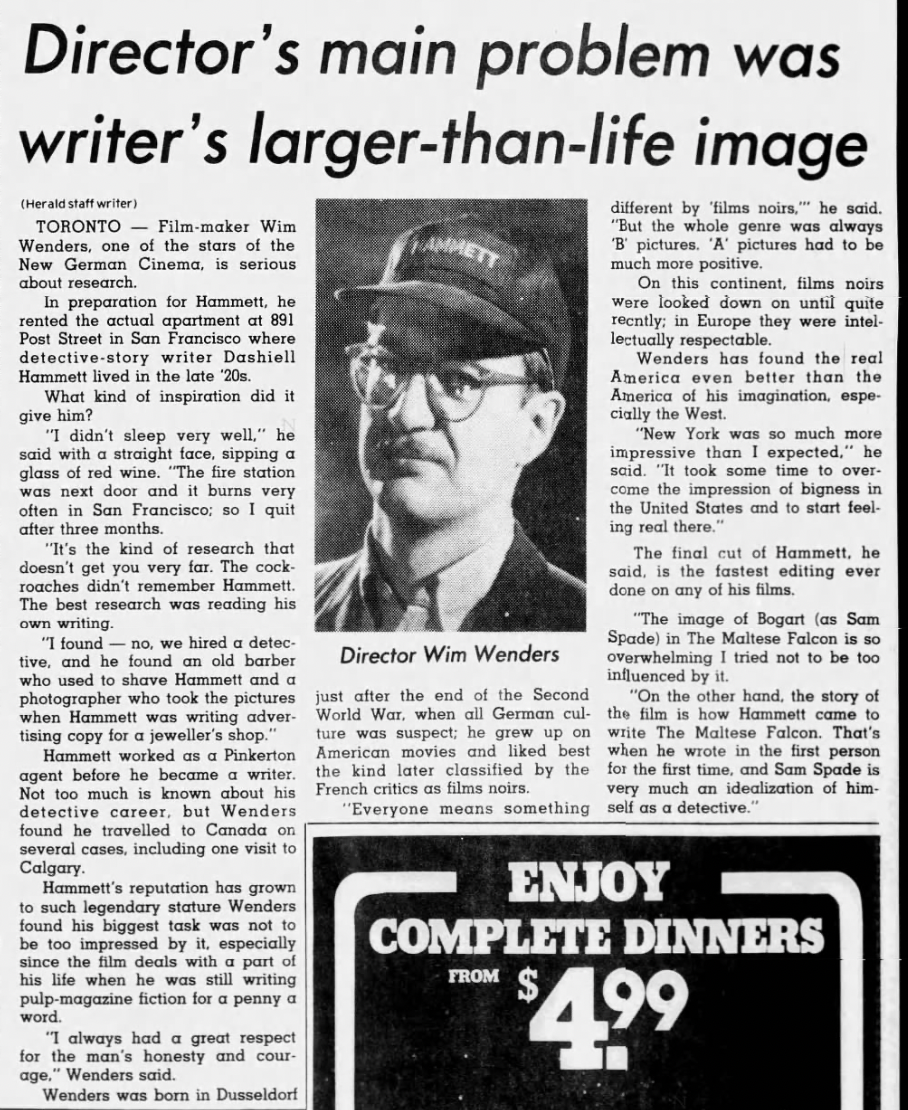
For a time, Wenders rented Hammett’s actual apartment at 891 Post Street in San Francisco, where the writer had lived during the period depicted in the film.
This sounds like the sort of thing that would make a filmmaker feel closer to his subject.
Instead, it mostly made Wenders miserable.
In an interview with the Toronto Herald, Wenders recalled:
“I didn’t sleep very well… The fire station was next door and it burns very often in San Francisco; so I quit after three months.”
There is something wonderfully anti-romantic about that anecdote.
The great Dashiell Hammett’s apartment.
The atmosphere of 1920s San Francisco.
The chance to sleep where the author of The Maltese Falcon once slept.
And then the fire station starts going off all night.
Hollywood research, everybody.
Wenders also tracked down people who had known Hammett, including an old barber who had shaved him and a photographer who had photographed him while he was writing advertising copy.
But the filmmaker eventually came to a rather important conclusion about historical research.
The people and places could only take him so far.
“It’s the kind of research that doesn’t get you very far. The cockroaches didn’t remember Hammett. The best research was reading his own writing.”
That is a terrific line.
And it gets to the heart of what Wenders was trying to do.
He wasn’t interested in recreating Hammett as some kind of literary monument. He wanted to understand the man through his work.
The writing was the evidence.
The writing was the truth.
Or at least, it was the closest thing to truth available when dealing with a man who had spent his life turning reality into fiction.
The Real Hammett Was More Interesting Than the Legend
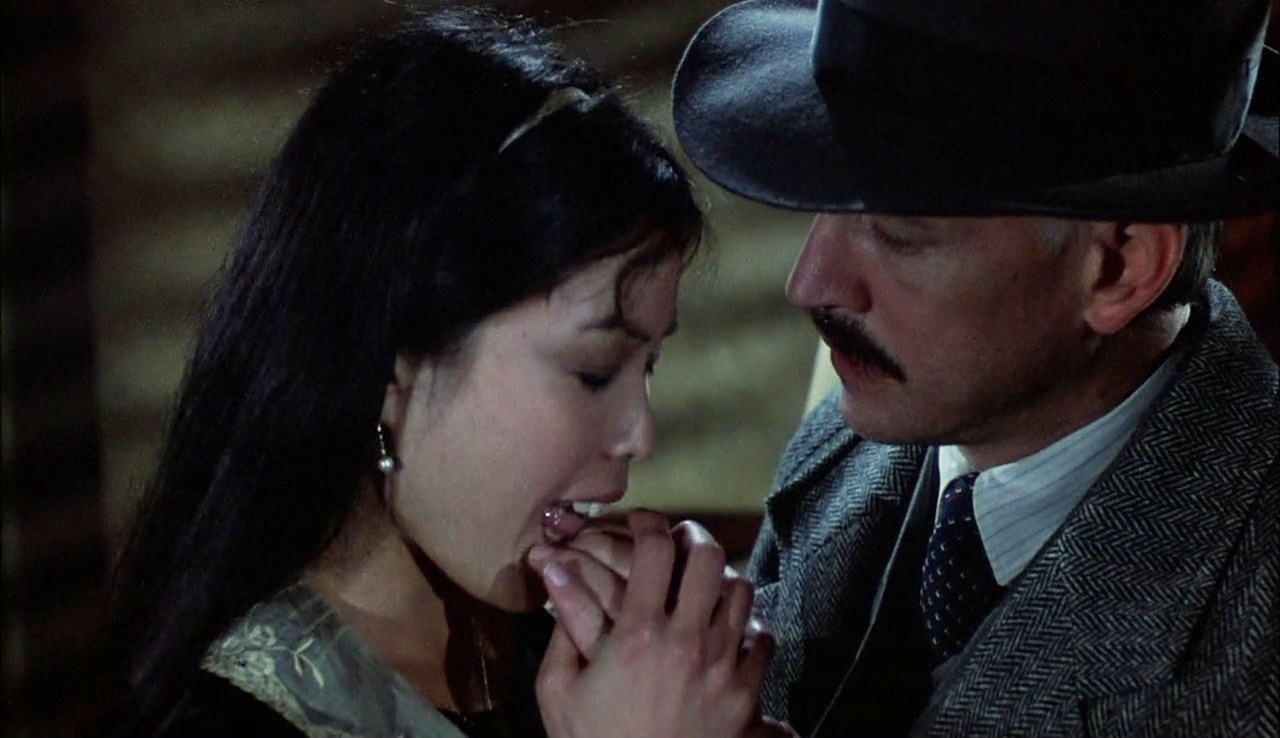
Dashiell Hammett had worked as a Pinkerton detective before becoming a writer.
His investigations included cases in the United States and Canada, including work connected with Calgary. He had firsthand experience with the criminal world, and that experience gave his fiction an authenticity that many imitators could never quite reproduce.
He knew how criminals talked.
He knew how detectives talked.
He knew how institutions worked, and how often they didn’t.
But Wenders was careful not to become overwhelmed by the legend.
In interviews, he spoke about wanting to respect Hammett’s “honesty and courage” while avoiding the larger-than-life image that had grown around him.
That image was difficult to escape.
By the early 1980s, Hammett was not simply a writer. He was an American literary icon.
His books had been adapted into famous movies. His characters had become cultural shorthand. Humphrey Bogart’s Sam Spade had become so deeply associated with The Maltese Falcon that it was almost impossible to think of the character without thinking of Bogart.
Wenders wanted to get past that.
He wanted to find the man who wrote the stories.
The Hammett who had worked for a penny a word.
The Hammett who had been a detective.
The Hammett who was writing his way into the mythology that would eventually swallow him.
As Wenders described it, the movie was essentially about how Hammett came to write The Maltese Falcon.
But there was an additional twist.
Hammett was idealizing himself as a detective.
The real man was turning himself into fiction.
And Wenders was trying to turn that fiction back into a movie about the real man.
If that sounds complicated, it is.
But it is also the movie’s most interesting idea.
The European Filmmaker in America
Wenders came to America with a particular fascination for American cinema.
His films had already been influenced by American genre movies, particularly film noir and the Western.
But there is a difference between loving American movies and actually making one.
America is a much bigger place than it looks on a screen.
Wenders talked about the experience of arriving in the United States and discovering that the real country was often more overwhelming than the movie version.
New York, he noted, was much more impressive than he expected.
That seems like a small observation, but it reveals something important about Hammett.
The movie is about an American literary figure, but it is also an outsider’s attempt to understand American mythology.
Wenders was not trying to make a conventional Hollywood detective movie.
He was trying to understand what made the American detective story work.
The lonely writer.
The corrupt city.
The missing woman.
The dangerous men.
The moral ambiguity.
The sense that everybody has a secret and nobody is telling the truth.
These are the ingredients of film noir, but Wenders approached them from a different angle.
He was interested in the atmosphere.
The spaces between people.
The way a city feels at night.
The way a writer might experience the world while turning it into fiction.
It is a very European way of looking at an American genre.
And for a while, that was exactly what Hammett was.
The First Hammett Was a Wim Wenders Movie
Production began in early 1980.
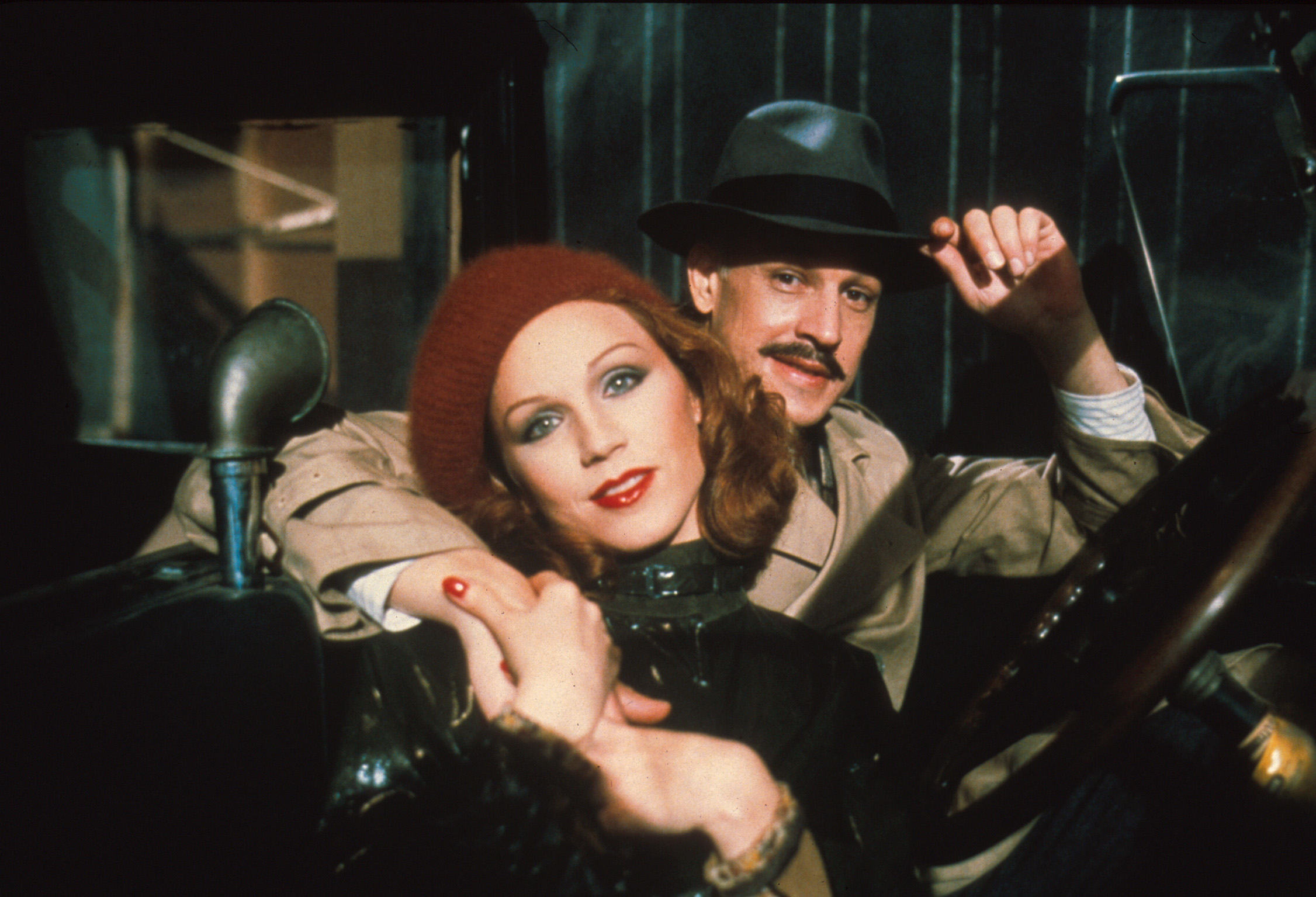
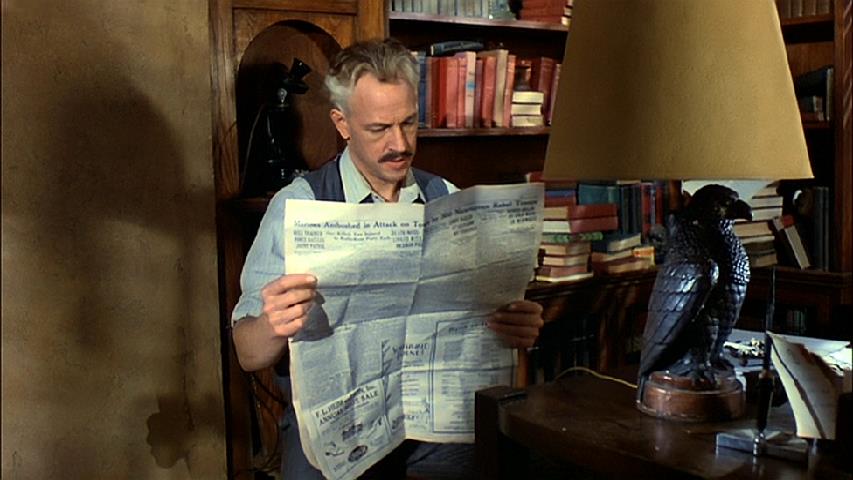
The initial version was shot primarily on location in San Francisco. It was more lyrical, more writer-focused, and more interested in the atmosphere of the period than in conventional thriller mechanics.
It was, by all accounts, a Wim Wenders movie.
Which is to say, it was probably not moving at the speed of a Humphrey Bogart picture.
And that became a problem.
After roughly ten weeks of shooting, production was shut down.
The precise details of the decision have been debated, but the central issue was that Coppola and others at Zoetrope reportedly felt the film was too slow and insufficiently action-oriented.
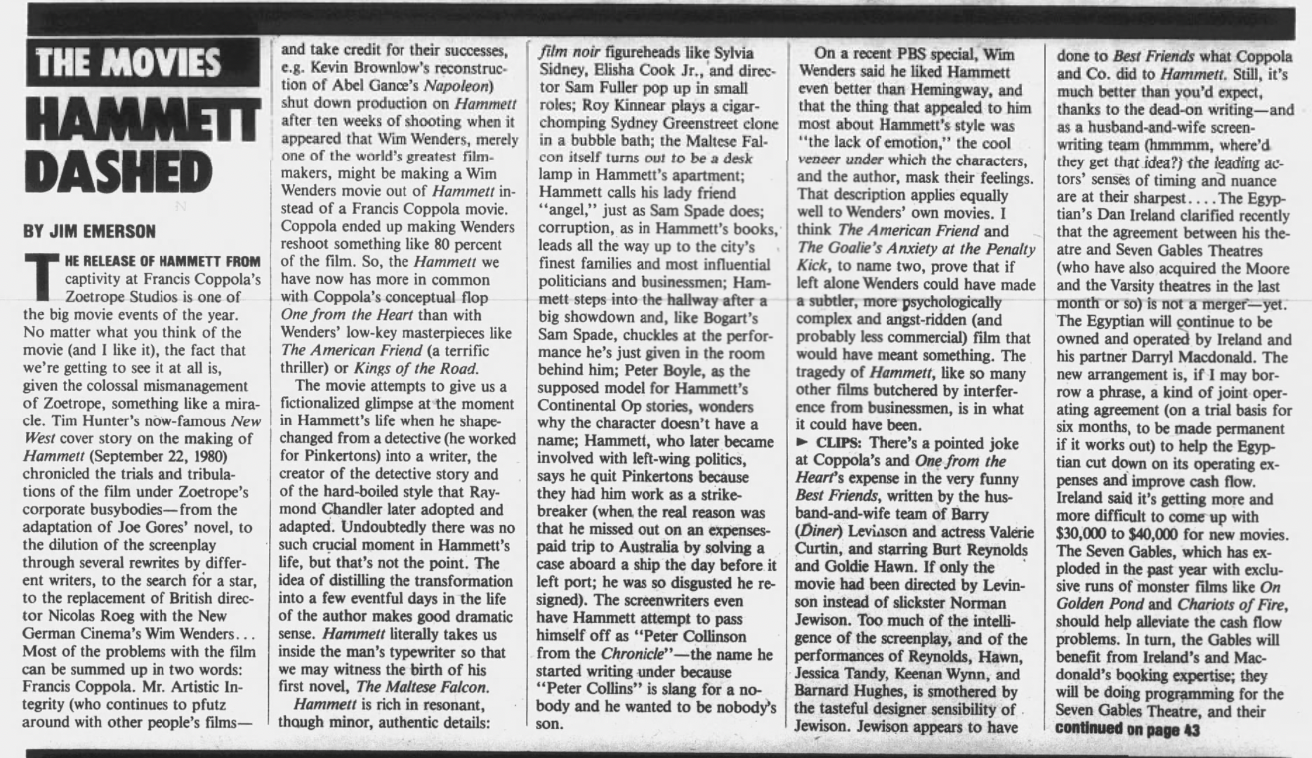
In a later discussion of the production, critic Jim Emerson summarized the conflict this way:
Coppola shut it down when it appeared Wenders “might be making a Wim Wenders movie out of Hammett instead of a Francis Coppola movie.”
That is one of those quotes that tells you almost everything you need to know.
Because, honestly, what did they think they hired Wim Wenders to make?
If you hire the director of The American Friend to make a movie about Dashiell Hammett, there is a reasonable chance you are going to get something that feels like a Wim Wenders movie.
That is not a bug.
That is the feature.
But Hollywood has never been particularly comfortable with features that do not resemble the thing it expected to buy.
A Movie Goes Into Hibernation
The shutdown was not a brief pause.
The movie effectively went into hibernation.
Coppola moved on to One from the Heart, his lavish and famously troubled musical project. Wenders went on to make The State of Things.
Meanwhile, the financial situation at American Zoetrope deteriorated.
This is where Hammett begins to feel less like a movie and more like a cautionary tale about the economics of artistic ambition.
The original production had already consumed time and money.
Now the film was sitting unfinished while the studio that had conceived it was struggling to survive.
Eventually, the decision was made to return to the project.
But it would not be the same movie.
Not even close.
The Movie Was Rebuilt in the Studio
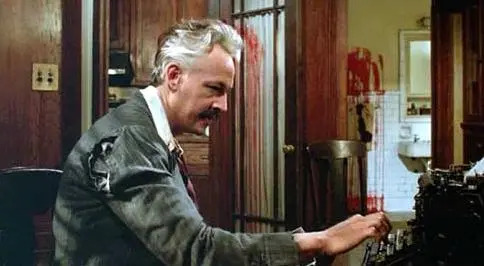
When production resumed in late 1981, Hammett underwent extensive reshoots.
The script was revised to place greater emphasis on the thriller elements. The movie moved away from its original location-based approach and was shot almost entirely on Zoetrope soundstages.
Estimates suggest that as much as 80 percent of the film was reshot.
That is a staggering amount.
Imagine spending months making a movie, stopping production, waiting more than a year, and then returning to rebuild most of what you had already shot.
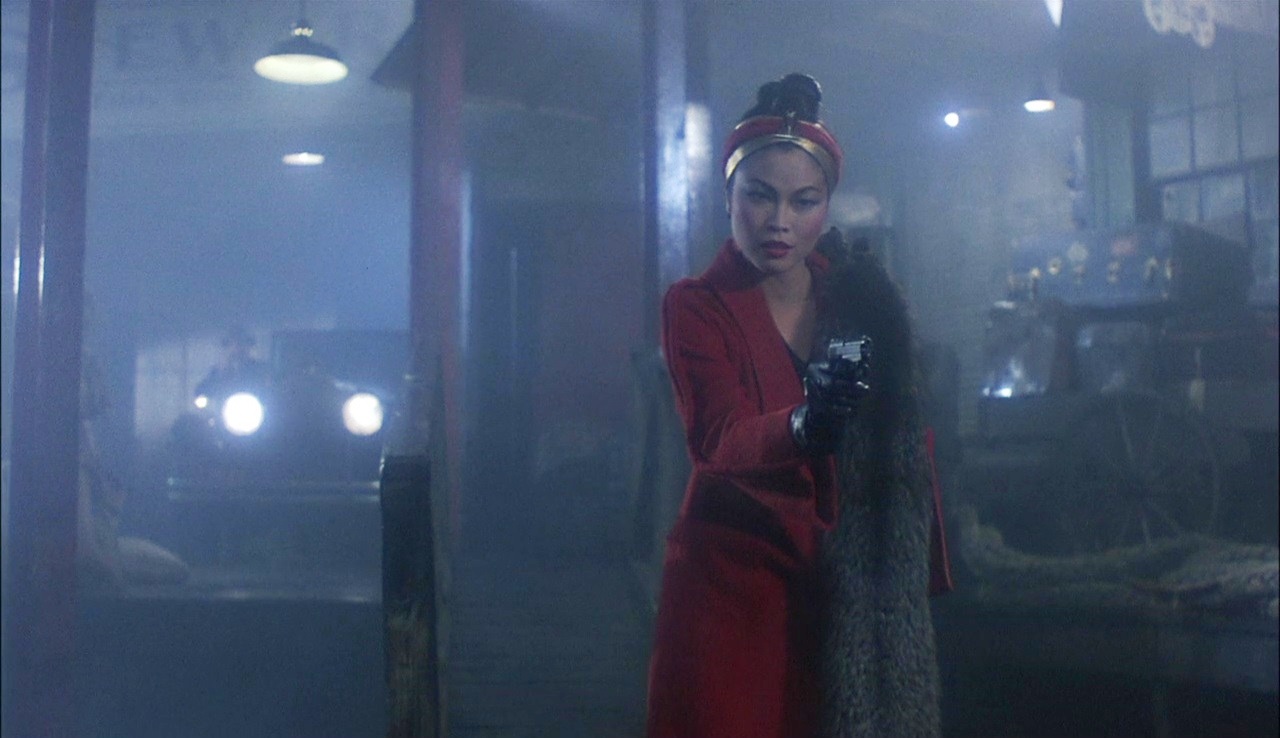
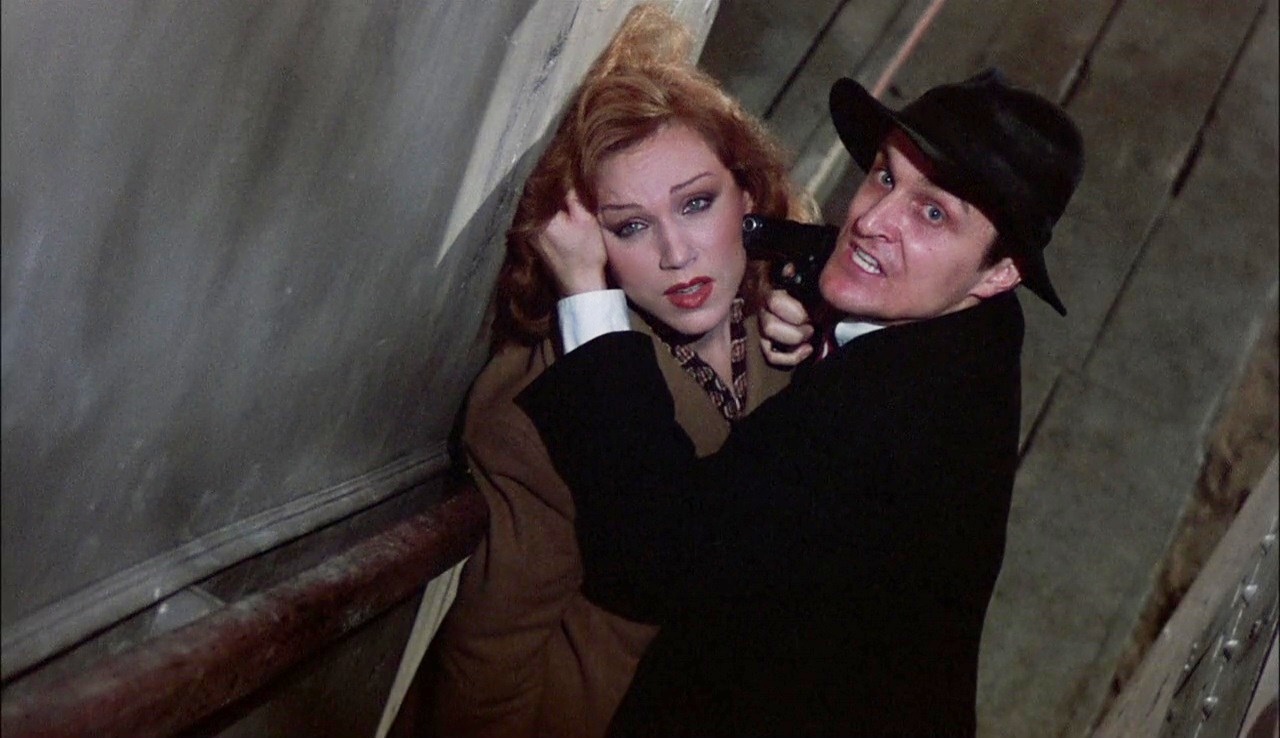
The movie that eventually emerged was much more stylized.
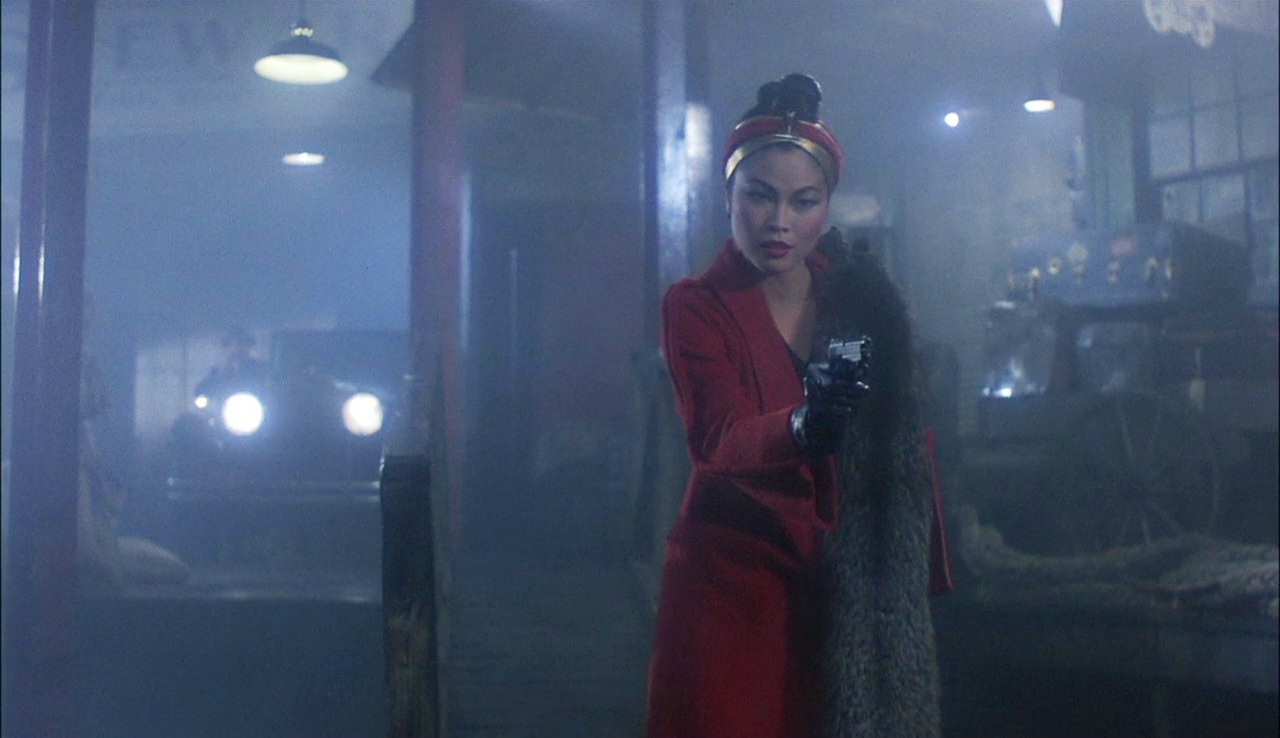
The production design, associated with Dean Tavoularis and his team, created a highly artificial version of 1920s San Francisco.
There are sets, shadows, staircases, hallways, offices, and streets that seem to exist somewhere between reality and a movie studio’s idea of reality.
Which, of course, is exactly where Hammett was being made.
The film was no longer simply trying to recreate the world in which Dashiell Hammett lived.
It was recreating the world as filtered through the movies.
And that is both its greatest strength and its greatest weakness.
The Cast Changed. The Movie Changed. Everything Changed.
The reshoots also brought changes to the cast.
Peter Boyle replaced Brian Keith.
Marilu Henner replaced Ronee Blakley.
Joseph Biroc and Philip Lathrop were credited as cinematographers, and John Barry composed the score.
The production had become something of a Frankenstein’s monster.
Parts of the original film remained.
Other parts were rebuilt.
Some performances belonged to the first version. Others were created for the second.
The original location footage was largely discarded, with only a small percentage surviving in the final film.
According to Wenders, much of the original material was later destroyed or lost.
That is particularly frustrating because the first version sounds like the more intriguing movie.
Not necessarily the better movie. We will never know.
But the more intriguing one.
A Wenders film about Dashiell Hammett, shot on location in San Francisco, focused on the writer and his relationship to the city.
That sounds like a movie I would very much like to see.
Instead, we got the movie that survived the production.
“Different Images” and the Trouble With Collaboration
Wenders later spoke about the difficulties of making Hammett without describing the relationship with Coppola as open warfare.
That is an important distinction.
The story of Hammett is often presented as a battle between the European auteur and the American studio mogul.
But Wenders himself offered a more complicated picture.
He acknowledged that he and Coppola had different visions of the film. He described the difficulty of working with a director-producer who “sees different images.”
That is probably the most accurate description of what happened.
Coppola was not some clueless studio executive who wandered into the project and demanded explosions.
He was a filmmaker.
A very ambitious filmmaker.
He had his own ideas about what Hammett should be, and he had invested heavily in the movie.
Wenders was also a filmmaker with his own ideas.
The problem was that those ideas were not necessarily compatible.
Coppola wanted a movie that could work as a thriller.
Wenders wanted to explore the inner life of a writer and the relationship between fiction and reality.
Both approaches had merit.
But the final film often feels like the result of those approaches being forced into the same room and told to get along.
They did not get along.
They compromised.
And compromise is not always a bad thing.
Sometimes it produces something wonderful.
Sometimes it produces Hammett.
The Final Cut Was the Fastest of Wenders’ Career
There is a particularly revealing detail from Wenders’ later comments about the film.
He said that the final cut of Hammett was the fastest editing process of any of his movies.
Think about that.
Wim Wenders, a filmmaker whose work is often associated with patience, atmosphere, and contemplation, found himself editing a movie that had already been through years of development, a shutdown, a major rewrite, and extensive reshoots.
And then he had to get it finished.
The movie had become a problem that needed to be solved.
Not simply a work of art that needed to be completed.
That distinction matters.
Because you can feel the production history in Hammett.
You can feel the places where the movie seems to be rushing toward the next plot point.
You can feel the seams between the more contemplative material and the more conventional thriller scenes.
You can feel the movie trying to become something it was not originally intended to be.
And you can feel the director attempting to hold it all together.
A Production That Took Its Toll
The budget was reportedly somewhere in the range of $7 million to $9 million.
For a movie that would ultimately make almost nothing at the box office, that is a substantial amount of money.
But the financial cost was not the only cost.
Wenders later described himself as being in a “pretty desperate state” during the production.
His marriage to actress Ronee Blakley, who had been involved with the film, disintegrated amid the chaos.
That is one of the more depressing aspects of the Hammett story.
Because behind all the talk of auteur conflict and studio interference, there were actual people living through this.
People who had invested years of their lives in a movie that seemed to keep changing shape.
People whose personal and professional lives were being affected by the uncertainty.
It is easy to romanticize troubled productions after the fact.
We like the idea of the doomed masterpiece.
The movie that almost was.
The film that might have changed everything if only the studio had stayed out of the way.
But the reality is often much less romantic.
It is people working too long, spending too much money, and trying to keep a project alive long after the original vision has begun to disappear.
The Movie Arrives in Cannes
Hammett premiered at the Cannes Film Festival in May 1982, where it screened in competition.
That is a pretty remarkable destination for a movie that had been through such a difficult production.
Wim Wenders was an internationally respected filmmaker.
Francis Ford Coppola was one of the most famous directors in the world.
American Zoetrope had enormous ambitions.
The film had a literary pedigree.
It had a major star in Frederic Forrest.
It had a period setting, a noir premise, and a score by John Barry.
On paper, it had everything.
And then it went to theaters.
The movie received limited U.S. openings late in 1982, with a wider release in 1983 through Orion and Warner Bros.
It ran approximately 95 to 98 minutes and was rated PG.
And then it disappeared.
The domestic box office was reportedly under $50,000.
Under $50,000.
Against a production cost of several million dollars.
That is not a disappointing result.
That is a movie arriving in theaters and discovering that almost nobody knew it existed.
Or cared.
Or both.
The film’s failure contributed to the collapse of American Zoetrope’s ambitious studio experiment.
As one contemporary account put it, Hammett “marked the beginning and the end for Zoetrope Studios.”
That is a brutal epitaph.
And it is also a reminder that the movie was never simply a movie.
It was a piece of a much larger dream.
When the dream failed, Hammett became one of the things people pointed to when explaining why.
What Did the Critics Think?
The critical response was mixed.
Some critics admired the production design, the atmosphere, and Frederic Forrest’s performance.
Others found the film artificial, fractured, and oddly lifeless.
Which, to be fair, is a pretty accurate description of the movie’s personality.
Hammett is not boring.
But it is not always clear what it wants to be.
And that is a problem when your movie is about a writer who is trying to turn his life into fiction.
Derek Malcolm: A Genuine Original With Problems
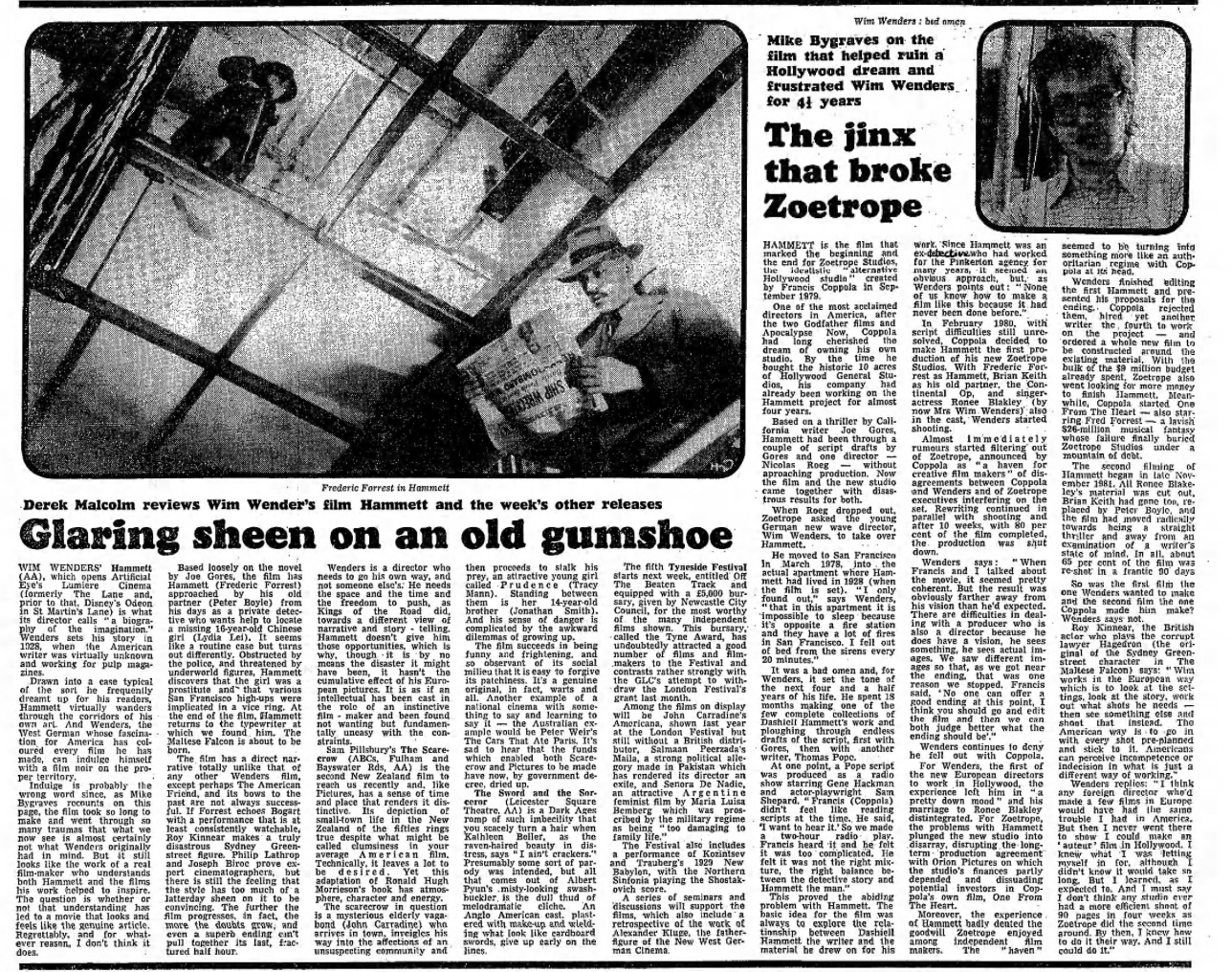
Writing in the Guardian, Derek Malcolm praised the film’s authentic details, cinematography, and social atmosphere.
He found moments that were both “funny and frightening.”
That is an interesting combination.
Because Hammett is not a straightforward noir thriller.
It is often playful.
Sometimes funny.
Sometimes dark.
Sometimes almost dreamy.
But Malcolm also criticized the film’s “glaring sheen” and artificiality.
The second half, in particular, seemed fractured.
That is a fair criticism.
The movie begins with a sense of place.
San Francisco feels like a real city.
Hammett feels like a real writer.
The film seems interested in the world around him.
But as the plot moves forward, the movie becomes more concerned with the mechanics of the mystery.
The atmosphere remains, but the emotional connection begins to weaken.
Malcolm also noted that Hammett had a direct narrative unlike many of Wenders’ other films.
Despite its flaws, he considered it a “genuine original.”
That feels right.
It is not a conventional Hollywood movie.
It is not quite a conventional Wenders movie.
It is something caught between the two.
And that is what makes it worth remembering.
Jim Emerson: The Movie That Might Have Been
Jim Emerson’s assessment is particularly interesting because he saw a strong connection between Hammett and Coppola’s One from the Heart.
Both movies were highly stylized.
Both were deeply concerned with the artifice of cinema.
Both were products of Coppola’s ambitious Zoetrope experiment.
And both seemed to exist in a world that was more artificial than real.
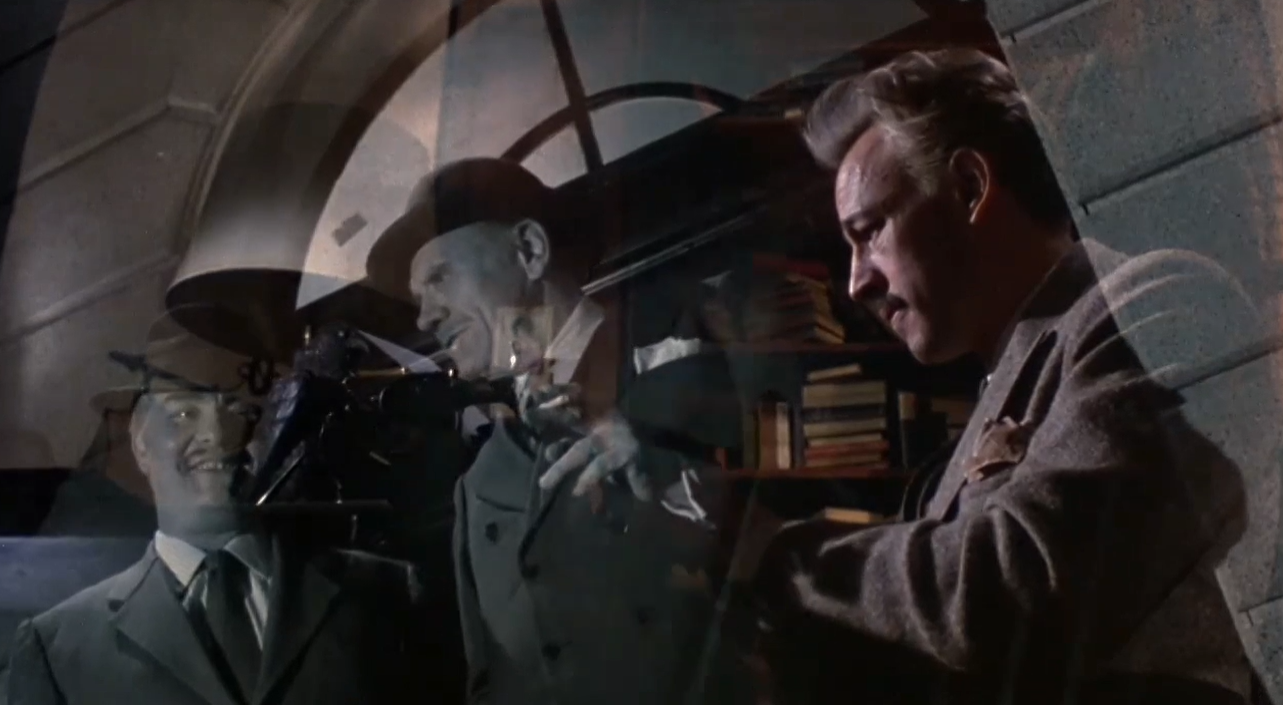
Emerson also appreciated the film’s noir cameos.
Sylvia Sidney.
Elisha Cook Jr.
Sam Fuller.
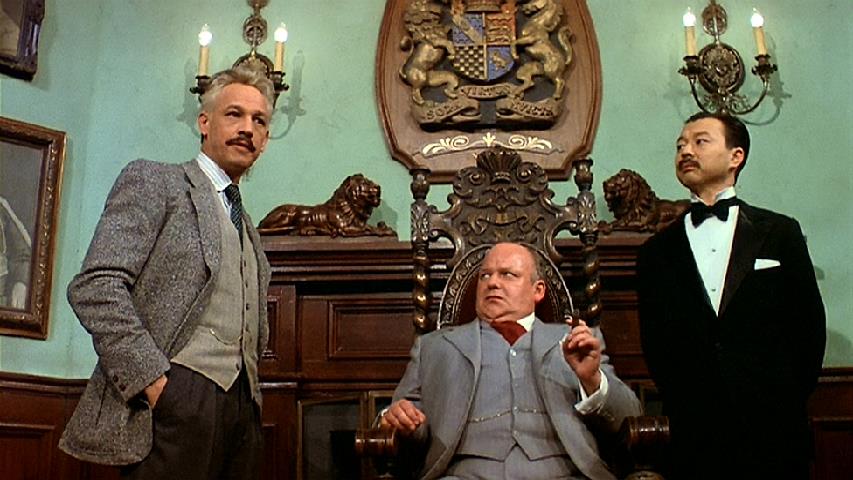
Roy Kinnear, playing a character in the Sidney Greenstreet tradition.
These appearances add a certain authenticity to the movie.
They are reminders of the cinematic tradition that Hammett is trying to engage with.
But Emerson also lamented what a freer Wenders version might have been.
And that is the question that hangs over the movie.
What would Hammett have looked like if Wenders had been allowed to finish the film he started?
We will never know.
The original footage is largely gone.
The first cut is lost.
And the movie we have is the movie that survived.
Frederic Forrest Is the Real Mystery
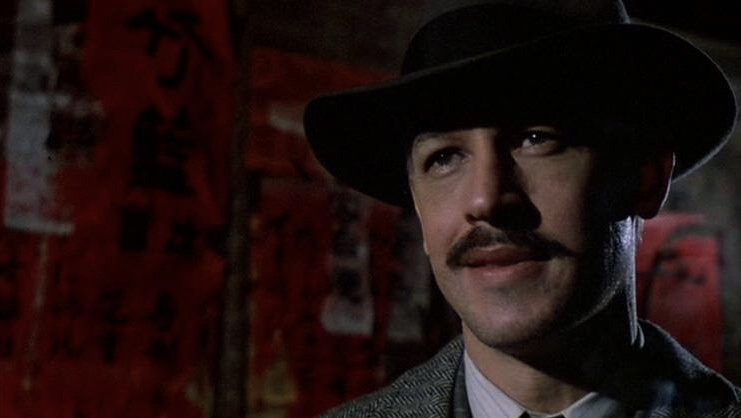
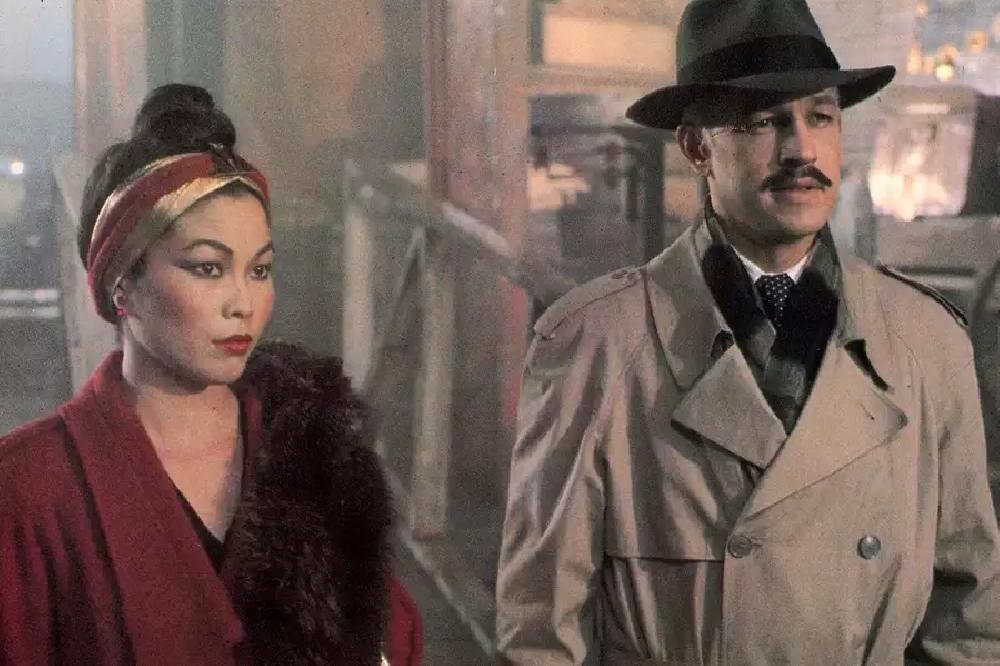
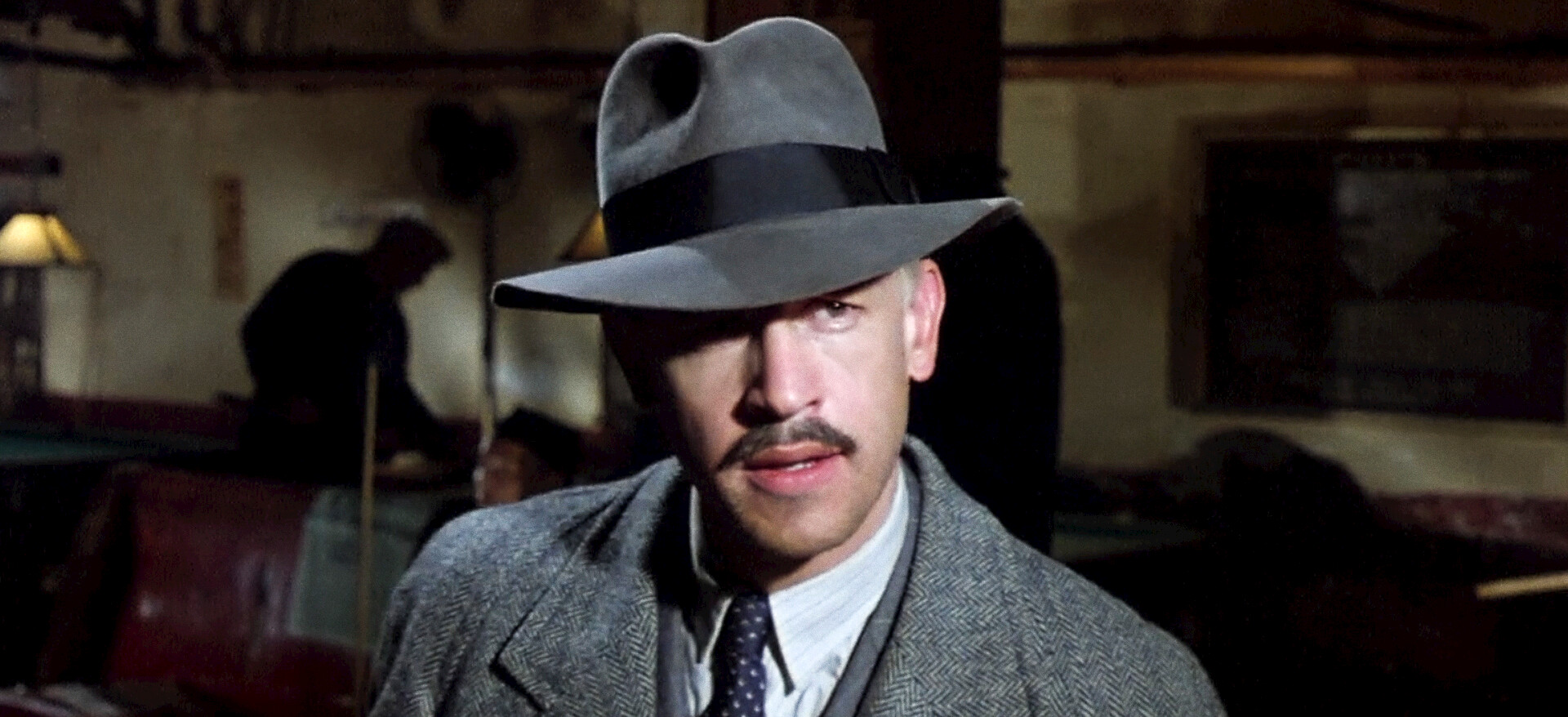
One of the best things about Hammett is Frederic Forrest.
He is not playing Dashiell Hammett as a larger-than-life literary icon.
He is playing him as a man.
A tired, sick, occasionally irritable man who has seen too much and is trying to write his way out of it.
Forrest gives the performance a kind of weary intelligence.
He is not trying to imitate Humphrey Bogart.
He is not trying to create a conventional hard-boiled detective.
He is playing a writer who has been a detective.
That distinction matters.
Hammett is not Sam Spade.
He is the man who created Sam Spade.
And the movie is most interesting when it remembers that.
Forrest’s performance gives the film a center.
Even when the plot becomes muddled, even when the production design becomes overly stylized, even when the movie seems uncertain about what it wants to be, Forrest keeps it grounded.
He is the human being inside the myth.
And that is what the movie is really about.
The Strange Beauty of a Compromised Movie
There are moments in Hammett that are genuinely beautiful.
The production design is impressive.
The cinematography creates a dreamlike version of 1920s San Francisco.
The film has a sense of place, even when that place is obviously artificial.
And there is something appealing about the movie’s attempt to recreate the world of hard-boiled fiction without simply becoming another hard-boiled detective movie.
The movie is interested in the relationship between the writer and the story.
It is interested in how Hammett turns his life into fiction.
It is interested in the way a writer creates characters out of the people around him.
And it is interested in the difference between the real world and the world of the movies.
These are all worthwhile ideas.
But the movie never quite brings them together.
The first half feels like a Wenders film.
The second half feels like a Hollywood thriller.
And the whole thing is wrapped in the kind of production design that makes every room look like it was built for a movie.
That is not necessarily a bad thing.
But it does create a strange emotional distance.
You are watching a movie about a man who is trying to understand reality through fiction.
And you are also watching a movie that seems to have lost touch with its own reality.
The Lost Hammett
There is a tendency to talk about Hammett as a failed movie.
That is understandable.
It was a financial disaster.
It was heavily reshot.
It was criticized for its artificiality and lack of emotional connection.
And it contributed to the collapse of one of the most ambitious independent studio experiments in Hollywood history.
But I think that is too simple.
Because Hammett is not a failure in the conventional sense.
It is a fascinating artifact.
A movie that exists because a group of filmmakers believed they could do something different.
A movie that was almost destroyed by the process of trying to make it.
A movie that still contains enough of its original ambition to make you wonder what the first version might have been.
That is not nothing.
In fact, it is a lot.
The lost first cut is the real mystery.
What did Wenders shoot during those first ten weeks?
How much of the original movie survived?
Was it slower?
More contemplative?
More interested in Hammett as a writer?
Was it better?
We will never know.
And perhaps that uncertainty is part of the film’s appeal.
Hammett and the Hollywood Machine
The story of Hammett fits neatly into the larger story of Hollywood in the early 1980s.
This was a period when filmmakers were being given enormous freedom.
The success of The Godfather, Star Wars, Jaws, and other major films had changed the industry’s expectations.
Studios were willing to take chances.
Filmmakers were being treated like artists.
And ambitious projects were being developed with the idea that the right combination of talent and money could produce something extraordinary.
But the system was also changing.
The traditional studio model was being replaced by a more commercial, more corporate approach.
Movies had to justify their budgets.
They had to be marketable.
They had to be understandable.
And they had to make money.
Hammett was caught between those worlds.
It was a movie made by people who believed in artistic freedom.
But it was also a movie that cost millions of dollars and needed to find an audience.
That is the contradiction at the heart of the film.
The movie is about the birth of American literary mythology.
But it was made during a period when Hollywood was becoming increasingly concerned with the business of selling mythology.
The movie’s failure was not simply the result of studio interference.
It was also the result of an ambitious independent studio trying to operate inside an industry that was becoming less interested in the kind of freedom that Zoetrope represented.
A Movie About the Birth of a Myth That Became a Myth Itself
The most interesting thing about Hammett is that its production history mirrors its subject.
Dashiell Hammett took his experiences as a detective and turned them into fiction.
The filmmakers took Hammett’s life and turned it into a movie.
And then the Hollywood system took the movie and turned it into something else.
That is the story.
The man became the myth.
The myth became the movie.
The movie became a production disaster.
And the production disaster became part of the movie’s identity.
You cannot really talk about Hammett without talking about American Zoetrope.
You cannot talk about American Zoetrope without talking about Coppola’s ambitions.
And you cannot talk about Coppola’s ambitions without talking about the changing nature of Hollywood in the early 1980s.
Everything is connected.
Which is probably appropriate for a movie about a detective.
The Legacy of Hammett
Today, Hammett is mostly remembered by cinephiles, fans of Wim Wenders, and people interested in the strange history of American Zoetrope.
It is not a movie that has entered the popular culture the way The Maltese Falcon has.
It is not a movie that most people have seen.
And it is certainly not a movie that made Frederic Forrest a major star.
But it has a small and dedicated following.
The film’s combination of noir, literary history, and production mythology makes it an intriguing artifact of the 1980s.
It is a movie about a writer who created a genre.
It is a movie about a filmmaker trying to understand that genre.
And it is a movie about the failure of an ambitious studio to make the kind of movies it wanted to make.
That is a lot of baggage for a 95-minute movie.
But it is also what makes the film interesting.
What Remains
The production history is fascinating.
The lost first cut is tantalizing.
The cast is terrific.
The production design is impressive.
And Frederic Forrest gives the movie a real center.
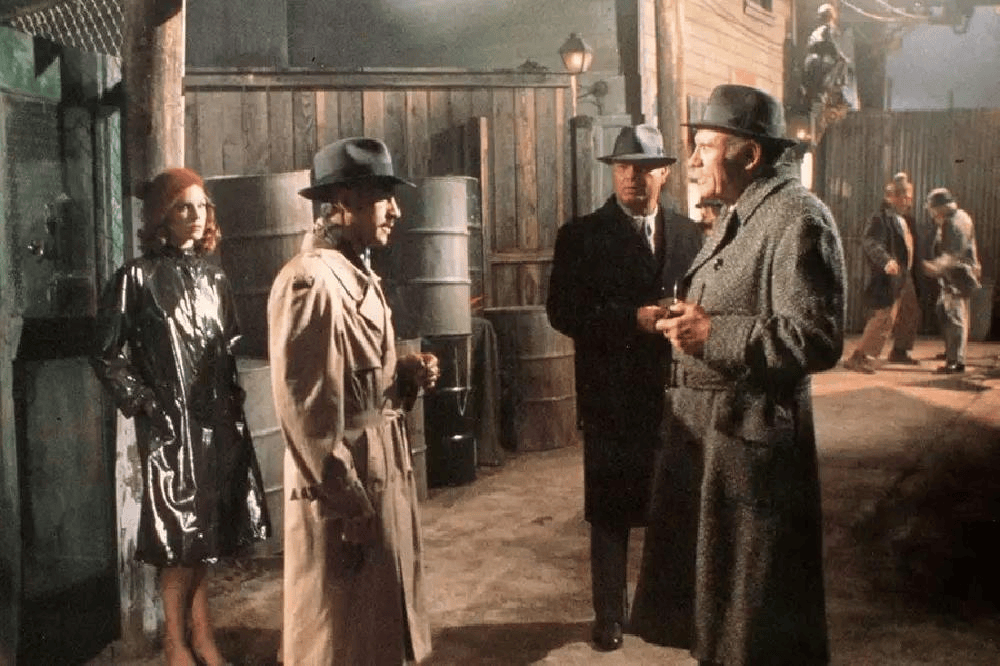
There are also the noir cameos.
Sylvia Sidney.
Elisha Cook Jr.
Sam Fuller.
Roy Kinnear.
These are the kinds of appearances that make a movie like Hammett feel connected to the history of cinema.
They remind you that the film is not simply a detective story.
It is a movie about detective stories.
And about the people who create them.
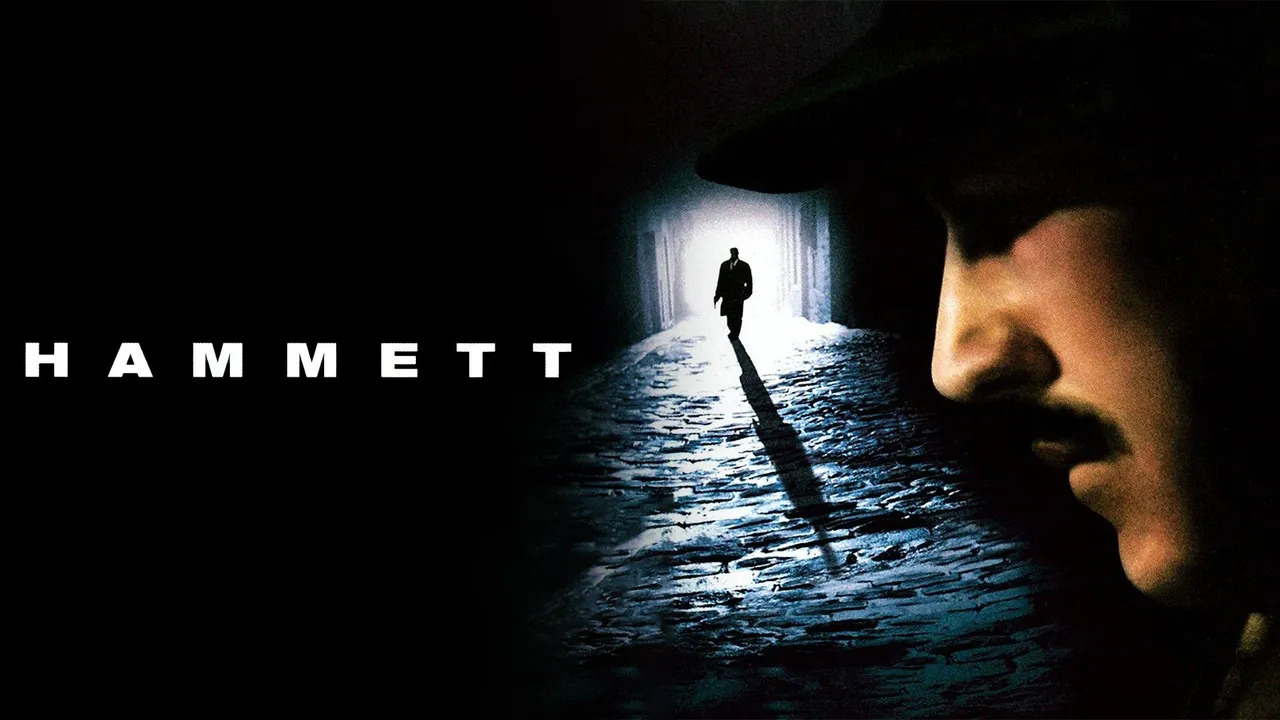
Final Thoughts
I have a soft spot for movies that are more interesting than they are successful.
Movies that have a good idea but cannot quite execute it.
Movies that are made by talented people who are trying to do something different.
Movies that fail in ways that are more revealing than the failures of conventional movies.
Hammett is one of those movies.
It is not a great movie.
It is not even a particularly successful movie.
But it is a fascinating movie.
It is a movie about a man who turned his life into fiction.
And it is a movie that, in its own way, became a story about how Hollywood turns ambitious visions into something else entirely.
The irony is hard to miss.
Dashiell Hammett created a world of hard-boiled detectives, corrupt institutions, and people trying to find the truth.
Wim Wenders tried to make a movie about that world.
Francis Ford Coppola tried to make a movie that would showcase his alternative Hollywood studio.
And the Hollywood machine did what it always does.
It took the dream and turned it into a product.
Then it sold almost none of it.
That is the real mystery of Hammett.
Not how Dashiell Hammett came to write The Maltese Falcon.
But how a movie with so much talent, ambition, and money behind it could become one of the most fascinating failures of the early 1980s.
And perhaps that is why it deserves to be remembered.
Not as a lost masterpiece.
Not as a disaster.
But as a strange, beautiful, compromised artifact of a moment when Hollywood still believed that the right combination of talent and ambition could change everything.
Sometimes it can.
Sometimes it just makes a really interesting movie.
And sometimes, if you are lucky, the movie becomes a mystery of its own.
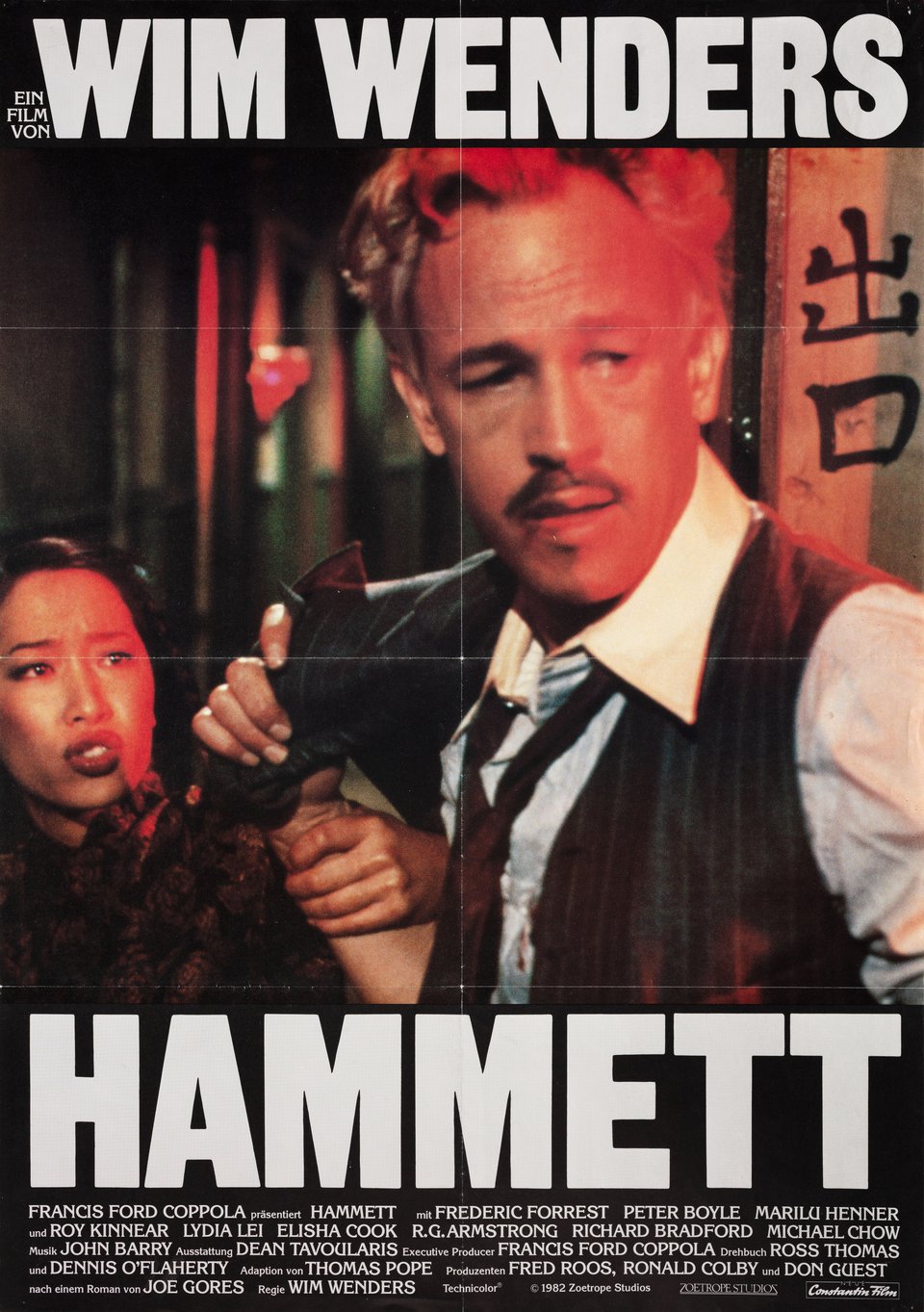
Movies of the 80s: Hammett (1982)
Director: Wim Wenders
Writer: Ross Thomas, Dennis O’Flaherty, Thomas Pope, Joe Gores (novel)
Stars: Frederic Forrest, Marilu Henner, Peter Boyle, Roy Kinnear
Release: 1982
Genre: Mystery / Neo-Noir / Literary Drama
Runtime: Approximately 95–98 minutes
Rating: PG
My Rating: ★★★½ (3.5/5)
Hammett is not a perfect movie, but it is a fascinating one. The production history is almost as interesting as the film itself, and the combination of Wenders’ sensibility, Coppola’s ambitions, and the subject of Dashiell Hammett makes it worth revisiting.
Further Reading
Joe Gores, Hammett (1975)
Wim Wenders interviews discussing the film’s production
Contemporary reviews by Derek Malcolm and Vincent Canby
Jim Emerson’s retrospective on the film and American Zoetrope
Wim Wenders’ The State of Things (1982)
Francis Ford Coppola’s One from the Heart (1982)
Where to Watch: Hammett's availability on streaming has been nebulous but, for now, you can find it streaming free on YouTube.

About the Creator
Movies of the 80s
We love the 1980s. Everything on this page is all about movies of the 1980s. Starting in 1980 and working our way the decade, we are preserving the stories and movies of the greatest decade, the 80s. https://www.youtube.com/@Moviesofthe80s
Enjoyed the story? Support the Creator.
Subscribe for free to receive all their stories in your feed.
Comments
There are no comments for this story
Be the first to respond and start the conversation.