
G.D.N Ending Explained: The Rise, Sacrifice and Legacy of G.D. Naidu, the Edison of India (Spoilers)
G.D.N follows the extraordinary journey of G.D. Naidu from a poor farm worker fascinated by machines to a visionary inventor and industrialist whose ideas, sacrifices and battles with powerful authorities changed his life forever.

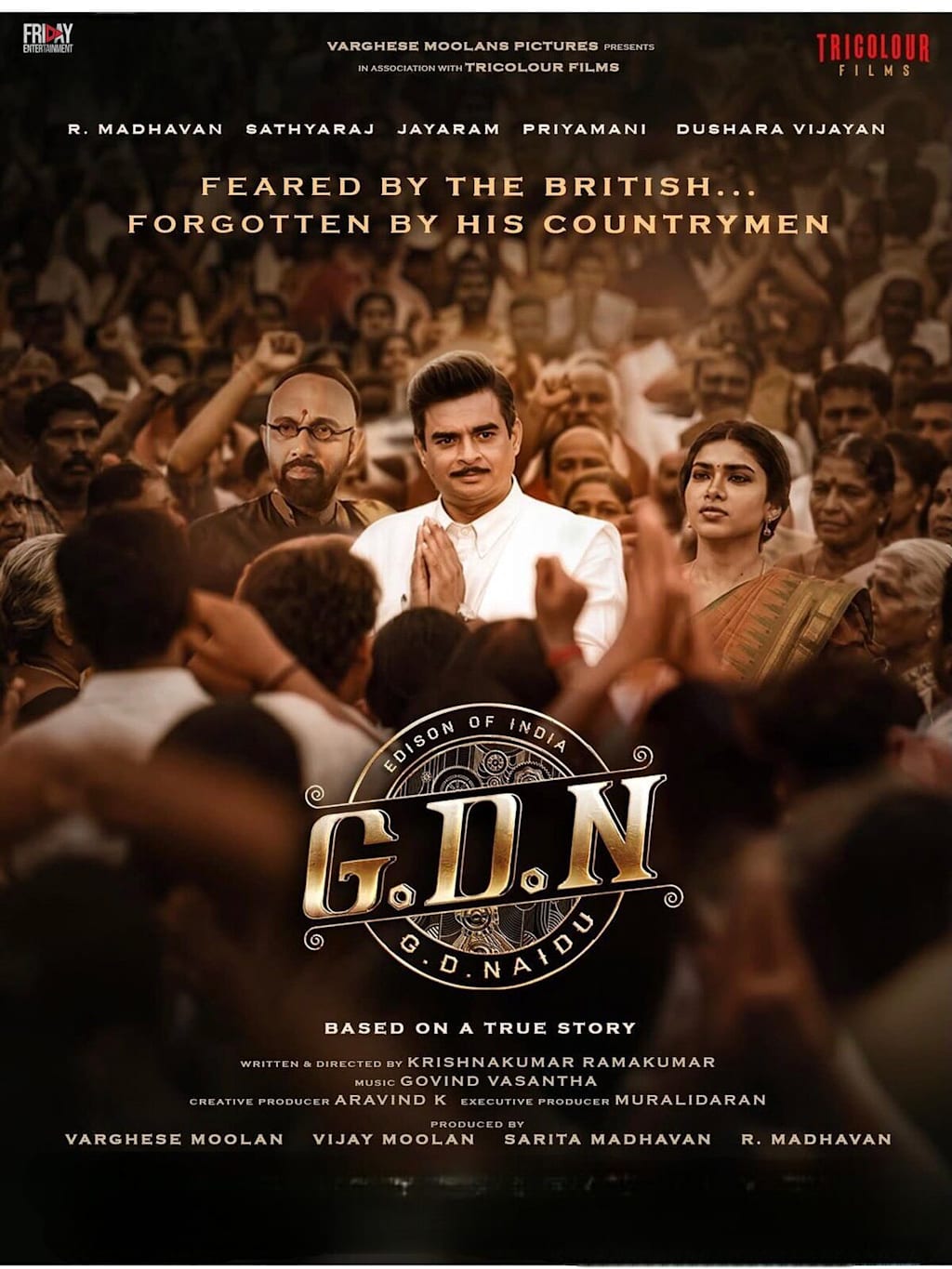
Spoiler Warning: This article contains major spoilers for G.D.N., including its complete story and ending.
G.D.N Movie Story Explained
G.D.N. is a biographical drama centered on Gopalswamy Doraiswamy Naidu, better known as G.D. Naidu. His life was filled with inventions, business successes, devastating losses and conflicts with people in power. But the film is ultimately about something bigger than wealth. It asks what happens when a man spends his entire life trying to build a better future for others, only to be misunderstood during his own lifetime.
The movie begins in 1960.
G.D. Naidu is already facing serious trouble. His trusted associate Pillai informs him that the government has sent a notice and plans to seize a huge portion of his remaining wealth.
Surprisingly, Naidu does not panic.
Instead, he calmly tells Pillai to send whatever documents the government requires.
His reaction immediately creates a mystery. Why is the government pursuing a man who has spent decades building industries and developing new technology?
The answer takes us deep into G.D. Naidu's past.
Why Was G.D. Naidu Considered a Controversial Figure?
The story then moves to 1980.
A woman approaches education department officials with an unusual request. She believes G.D. Naidu's life deserves to be included in textbooks so that future generations can learn about him.
The officials reject the idea.
According to them, Naidu had not done anything important enough to deserve a chapter in school books. Some even describe him as someone who worked against the country's interests.
Instead of arguing, the woman places a book in front of them.
She has already researched Naidu's life.
She simply asks the officials to read it before making their final judgment.
As they begin reading, the film takes us into a long flashback and reveals the man behind the controversial reputation.
G.D. Naidu's Fascination With a Motorcycle Changed His Life
As a young man, Gopalswamy Doraiswamy Naidu had almost nothing.
He worked in agricultural fields and did not have the kind of formal engineering education normally associated with great inventors.
But he had something equally powerful: curiosity.
One day, while Naidu is working near a road, a British officer passes by on a motorcycle. The motorcycle suddenly breaks down.
Naidu notices the problem and goes to help.
After some effort, the motorcycle starts again.
The incident should have ended there, but Naidu cannot stop looking at the machine.
He wants to know how it works.
What is happening inside its engine? How can a collection of mechanical parts move a person at such speed?
That curiosity becomes an obsession.
Naidu decides that he must buy a motorcycle of his own, dismantle it and understand every part of it.
The motorcycle costs around ₹250, an enormous amount for him at that time.
After considerable effort, he manages to save around ₹200. His wife Chellam gives him the remaining ₹50.
At last, his dream appears to be within reach.
Then something happens that reveals the kind of person Naidu is.
Why Did Naidu Give Away the Money Meant for His Motorcycle?
On his way to buy the motorcycle, Naidu sees agricultural workers protesting against a landlord.
The workers believe they are being exploited and paid far less than their labour deserves. Men receive more money while women are paid significantly less, despite working under extremely difficult conditions.
Naidu listens to them.
Instead of continuing toward the motorcycle he has dreamed about for so long, he gives the protesting workers the entire ₹250.
His wife is stunned.
Naidu had worked incredibly hard to collect that money, yet he gives it away almost instantly after seeing people who need it more.
His motorcycle dream has been delayed, but his curiosity has not disappeared.
For roughly another year, Naidu works wherever he can. He takes jobs, including work at a hotel, and starts saving again.
Eventually, he finally buys the motorcycle.
But he does not use it simply for travelling.
The moment he brings it home, he begins dismantling it.
Nut by nut and part by part, he studies the entire machine.
He learns by observing, experimenting and rebuilding.
Formal qualifications may be missing from his life, but the ability to understand how things work is already transforming him.
Naidu's First Major Innovation
Naidu later begins working at a textile-related business.
There he notices an inefficient process involving cotton.
A large number of workers are required to separate seeds manually, slowing down production.
Naidu begins thinking about a better solution.
Then he notices a woman using a comb to remove lice from hair.
That simple everyday action gives him an idea.
If the teeth of a comb can separate something from hair, perhaps a similar mechanism can help separate cotton seeds.
Naidu designs a large comb-like device.
When the invention is tested, the results surprise everyone.
A process that previously required dozens of workers can now be completed far more efficiently.
It is a turning point.
Naidu realizes that his purpose is not simply to have a job.
He wants to create machines that solve real problems.
From Worker to Industrialist
Naidu's rise is remarkable.
The man who once worked as an ordinary labourer eventually becomes the owner of a cotton mill.
His ability to understand machinery and business attracts attention, including from British businessmen.
They approach him with partnership opportunities.
Naidu, however, is unwilling to surrender control over what he has built.
For him, business is not only about earning money.
He wants technological and industrial progress to benefit his own country.
People around him believe refusing powerful foreign partners is risky, but Naidu remains firm.
He built the company through his own struggle, and he wants to decide its future.
Unfortunately, his professional ambitions also begin affecting his personal life.
What Happened Between Naidu and His First Wife Chellam?
Chellam gradually feels that she can no longer keep pace with Naidu's rapidly changing life.
She believes he needs someone who can accompany him through the world he is entering.
Eventually, Naidu marries Ranganayaka.
But shortly after this new chapter begins, his business suffers a massive setback.
Naidu loses almost everything.
A man who had risen from poverty to become a successful businessman suddenly finds himself almost back at zero.
Ranganayaka worries that perhaps her arrival brought misfortune into his life.
Naidu refuses to think that way.
Business, he tells her, naturally has successes and failures.
The important question is not why they fell.
It is how they will rise again.
And once again, Naidu starts over.
How G.D. Naidu Built His Transport Business
For his next venture, Naidu enters transportation.
At the time, travelling between villages and towns is far more difficult than it is today. Many people depend on slow and inconvenient means of transport.
Naidu sees an opportunity to solve another practical problem.
He borrows money and buys his first bus.
One bus gradually becomes several buses.
His reputation for discipline and reliability helps the transport business grow rapidly.
Soon, however, his success begins hurting other bus owners.
Instead of trying to destroy his competitors, Naidu invites them to a meeting.
His suggestion is surprisingly cooperative.
Why compete until everyone suffers when they could combine their buses into one organized system?
Naidu offers to take responsibility for servicing and maintaining the vehicles.
He also points out that many buses are damaged because of poor roads, meaning transport operators should collectively demand better infrastructure from the government.
Several bus owners agree.
Among them is Pillai.
How Pillai Became One of Naidu's Most Loyal Companions
Pillai owns only one bus and is already struggling financially.
His daughter's wedding is also approaching.
When Naidu learns about Pillai's circumstances, he questions whether Pillai should really give his only bus to the new company.
Naidu even offers to help with the wedding expenses.
But Pillai refuses to withdraw his bus.
He wants to become part of Naidu's mission.
Eventually, he becomes Naidu's assistant and one of his most loyal companions.
Their relationship goes far beyond employer and employee.
It is built on trust.
That loyalty becomes increasingly important as Naidu's growing success attracts dangerous enemies.
The Tax Case Against G.D. Naidu
Naidu's expanding influence begins worrying British interests.
A major German company also becomes impressed by his technological abilities and considers cooperating with him.
To those who already see Naidu as a threat, this is unacceptable.
A plan is created to target him through taxation.
An income-tax officer named Jayaram is presented as an honest official, but people working around him manipulate records.
False documents are prepared, creating the basis for action against Naidu.
Authorities raid his business.
Vehicles, buses, jewellery and other assets are seized.
Naidu insists that he has been paying his taxes honestly and challenges what is happening.
But his property is still taken and eventually placed at auction.
What happens during the auction demonstrates how strongly ordinary people support him.
Despite extremely low prices being placed on some of Naidu's property, people refuse to take advantage of his misfortune.
They believe he is being treated unfairly.
Naidu then makes another surprising move.
Using Pillai's name, he buys back the seized property himself.
His opponents are furious.
But Naidu refuses to surrender.
G.D. Naidu's Inventions and Journey to Germany
Even while facing political and financial pressure, Naidu continues inventing.
Among the devices associated with his work in the film is a shaving trimmer.
His reputation gradually travels beyond India.
During a foreign trip to Germany, Naidu witnesses Adolf Hitler's public procession and even gets an opportunity to encounter him.
More importantly for Naidu's ambitions, a German company proposes establishing a plant in Coimbatore.
For Naidu, such cooperation represents far more than another profitable business deal.
It could bring advanced technology and practical industrial knowledge to India.
After returning home, he becomes increasingly interested in practical education.
He wants children from poor families, farming communities and working-class backgrounds to gain access to technical knowledge.
Naidu himself did not become an inventor because of an impressive degree.
He learned by doing.
Now he wants others to have the same opportunity.
The Second World War Changes Everything
While Naidu is travelling abroad again, the Second World War begins.
He becomes trapped in Germany for roughly a year.
By the time he eventually returns to India, his personal life has changed considerably.
His son is older and has questions for him.
How long will Naidu continue sacrificing everything for the country?
What about his own family?
The same man who has spent his life trying to improve the future of strangers has struggled to maintain stability inside his own home.
Ranganayaka ultimately decides to leave him, and their marriage ends in divorce.
The separation deeply affects Naidu.
Why Did G.D. Naidu Destroy His Own Inventions?
Naidu's frustration is not limited to his family.
He also feels that his inventions are not receiving the recognition they deserve.
After years of experimenting, building and sacrificing, he begins to believe that society itself does not understand what he has tried to accomplish.
Naidu organizes an exhibition of his inventions.
He wants people to see the machines and devices he has created.
But instead of becoming a moment of triumph, the experience brings his disappointment to the surface.
In one of the movie's most emotional moments, Naidu begins destroying his own inventions.
It is not simply an act of anger.
It represents the exhaustion of a man who feels ignored and misunderstood after spending a lifetime creating things for others.
Through all of this, Pillai remains beside him.
The story then returns to 1960, finally connecting the flashback with the mystery established at the beginning.
G.D.N Ending Explained: Why Did the Government Seize Naidu's Property?
At the beginning of G.D.N., we are told that the government is preparing to seize a major portion of Naidu's remaining assets.
By the ending, the full situation becomes clearer.
During his divorce from Ranganayaka, Naidu had already transferred around 80 percent of his property to her.
That means the property eventually seized by the authorities represents only the portion he still owned.
The twist changes the meaning of the opening scene.
Naidu's calmness was not weakness.
By this stage of his life, material wealth no longer defined him.
He had already gained, lost and rebuilt fortunes.
Money could be taken.
Property could disappear.
But his ideas and contributions could not be seized in the same way.
Why Does Jayaram Bow Before G.D. Naidu?
Income-tax officer Jayaram gradually discovers that false records had been used against Naidu.
Once he understands how the case was manipulated, his perception of Naidu changes.
For years, Naidu had been portrayed as a difficult or controversial man.
But Jayaram begins to see something different.
Naidu was trying to build industries, develop technology, educate young people and create opportunities.
When Jayaram finally understands the truth, he bows his head before Naidu.
The moment serves as a symbolic vindication.
Naidu may not have defeated every institution that opposed him, but someone from inside that system finally recognizes what was done to him.
Does G.D. Naidu Finally Receive Recognition?
Yes.
The film returns to the education officials who initially rejected the suggestion of including G.D. Naidu's story in textbooks.
After learning about his journey, struggles and achievements, their perspective changes.
Naidu's contribution is finally acknowledged, and a chapter about his life is included in educational material.
This gives G.D.N. its emotional conclusion.
The man once dismissed and misunderstood is finally presented as someone future generations deserve to know about.
What Does the Ending of G.D.N. Really Mean?
The ending is not simply about G.D. Naidu receiving recognition.
It is about the difference between success and legacy.
Throughout the movie, Naidu repeatedly gains things and then loses them.
He saves enough money for a motorcycle and gives it away.
He builds businesses and loses them.
He creates wealth and watches authorities seize his assets.
He builds a family but struggles to keep it together.
He develops inventions and eventually destroys some of them himself.
On the surface, his life can look like a series of victories followed by losses.
But the ending argues that the most important part of his life survives all of those losses.
His curiosity survives.
His ideas survive.
His desire to make technology useful to ordinary people survives.
And eventually, his story survives.
That is why the textbook scene matters so much.
Naidu's greatest achievement was not the amount of property he owned at the end of his life. It was the influence created by the way he thought.
Final Thoughts on G.D.N.
G.D.N. presents G.D. Naidu as a complicated visionary whose greatest strength was his refusal to stop experimenting.
A broken motorcycle makes him curious about engineering.
A comb inspires a solution for cotton processing.
Transport problems lead him into the bus industry.
His experiences with foreign technology encourage him to promote practical education.
Again and again, everyday problems become opportunities for invention.
At the same time, the film refuses to present progress as painless.
Naidu's ambitions cost him financially and personally. His relationships suffer, his businesses face attacks, and his work repeatedly collides with powerful institutions.
By the final scene, however, the question is no longer how much money G.D. Naidu managed to keep.
The real question is whether the country he wanted to help will remember him.
When his story is finally accepted as something worth teaching to future generations, G.D.N. provides its answer.
His property could be seized.
His inventions could be destroyed.
His reputation could be questioned.
But his legacy could not be erased.
About the Creator
parwinder singh
🎬 Movie & Entertainment Writer sharing reviews, ending explanations, story breakdowns, plot twists and hidden details from Bollywood, Hollywood, South Indian cinema, Korean dramas and OTT releases.
Enjoyed the story? Support the Creator.
Subscribe for free to receive all their stories in your feed.
Comments
There are no comments for this story
Be the first to respond and start the conversation.