
'Full Moon High' (1981): Larry Cohen’s Werewolf Comedy About a Country That Grew Up Without Him
Four years before Teen Wolf, the filmmaker behind It’s Alive and The Stuff tried his hand at a different kind of monster movie. Beneath the goofy transformations and drive-in movie jokes was a sly comedy about sexual politics, cultural change, and the peculiar disadvantages of never getting older.

The Problem With Never Growing Up
Imagine being seventeen years old forever.
At first, it sounds pretty good. No mortgage. No receding hairline. No sudden realization that your favorite rock stars are collecting Social Security. You can keep wearing the same clothes, chasing the same dreams, and convincing yourself that adulthood is something that happens to other people.
There is, however, one small complication.
Everybody else gets older.
Your friends marry, have children, change their politics, abandon their youthful enthusiasms, and develop opinions about things they once considered hopelessly boring. The world rearranges itself while you’re busy trying to recapture the magic of Friday night’s football game.
And you? You’re still seventeen.
Unless, of course, it’s a full moon. Then you’re a werewolf.
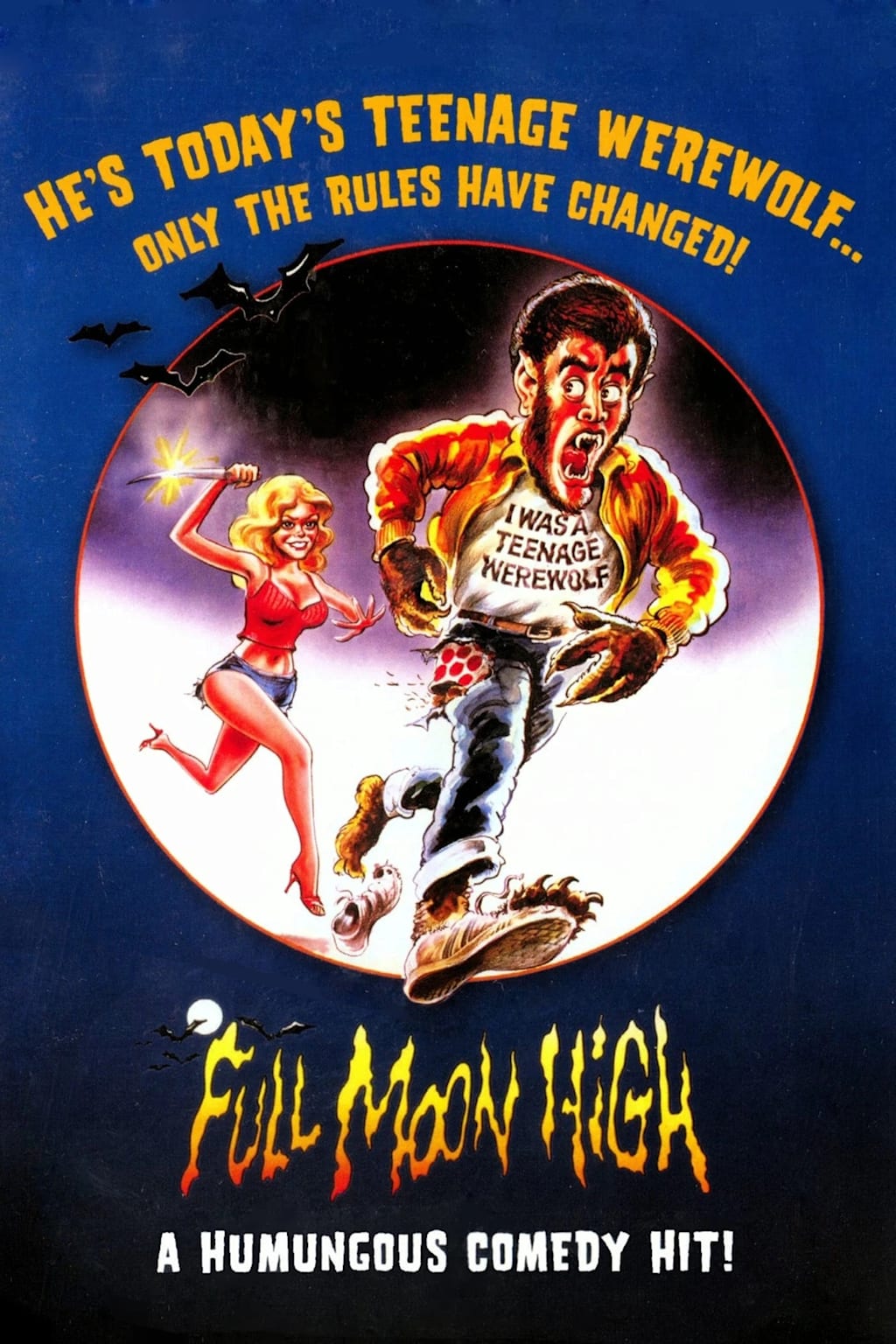
Welcome to Full Moon High (1981), the peculiar comedy written and directed by Larry Cohen, the independent filmmaker who made a career out of finding social anxieties hiding inside the cheapest, strangest, and most outrageous movie premises imaginable.
Cohen was responsible for It’s Alive (1974), about a murderous mutant baby; God Told Me To (1976), a conspiracy-minded excursion into religious fanaticism and inexplicable violence; and The Stuff (1985), a satire of consumer culture built around an addictive substance that looks suspiciously like dessert.
These were not exactly the sort of movies that made you expect a straightforward coming-of-age comedy.
But Cohen had another ambition. He wanted to make people laugh.
In a 2018 interview with Birth.Movies.Death., Cohen explained that people had encouraged him to make a comedy because of the humor he brought to his other films. He also recalled having the rights to I Was a Teenage Werewolf (1957), which gave him the opportunity to make his own comic version of the familiar monster-movie premise.
The result was Full Moon High, a movie that seems determined to make a joke out of practically everything, including itself.
Yet there is a more interesting idea hiding underneath the rubbery werewolf makeup and broad comedy.
Cohen described the picture as exploring how American life had changed sexually and politically since the early 1960s. His protagonist’s friends grow older and develop different values while he remains physically unchanged.
The werewolf curse is the gimmick. Cultural displacement is the subject.
Tony Walker can survive decades without aging, but he cannot escape the consequences of living through them.
And that’s a considerably more interesting predicament than simply having too much hair once a month.
A Teenager Walks Into the Future
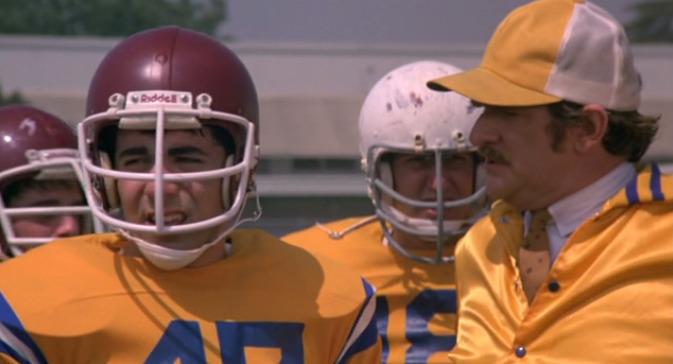
Full Moon High begins in the late 1950s, when Tony Walker, played by Adam Arkin, is a high school football player with the usual teenage priorities.
Football. Girls. Football. More girls.
His father, Colonel William P. Walker, played by Ed McMahon, takes Tony on a trip to Transylvania. It is the sort of vacation destination that makes sense if your family has a particular interest in vampires, werewolves, and the general European countryside where sensible people apparently stop traveling after sunset.
Tony encounters a werewolf and gets bitten.
The consequences are not quite what you might expect.
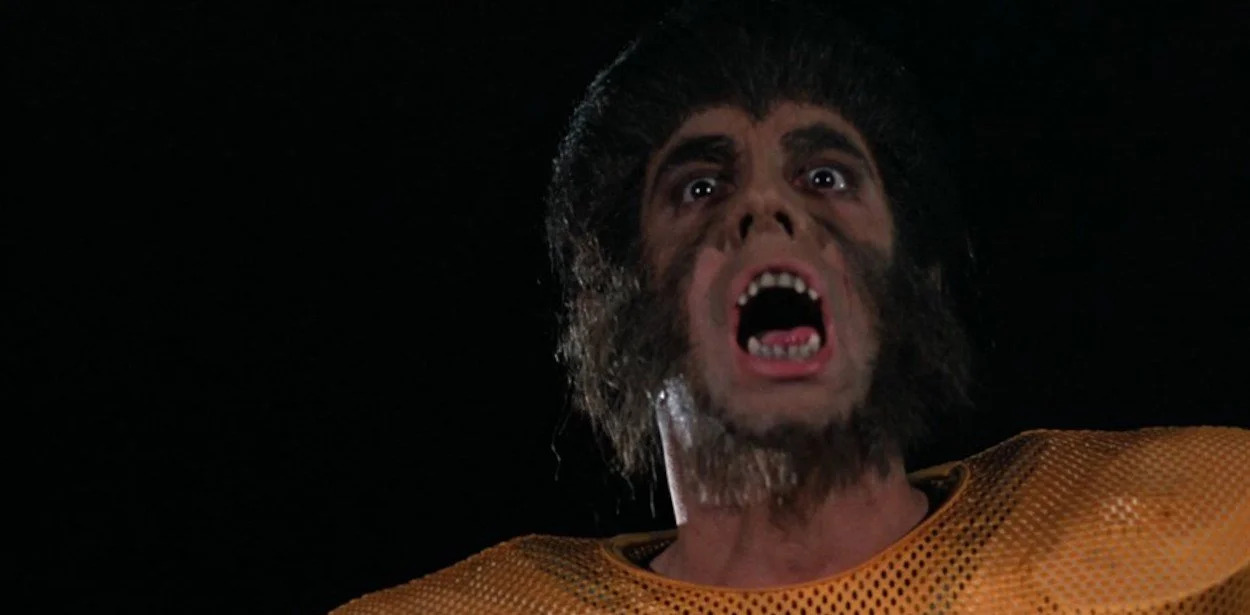
Rather than becoming a conventional movie monster, Tony discovers that his life has been placed on an unusual sort of permanent hold. He doesn’t age, although the monthly transformation into a hairy creature with a fondness for biting people remains an inconvenient feature of his existence.
For a while, this is mostly an inconvenience. Then time passes.
Tony’s old friends grow up. The country changes. The social rules that governed his adolescence begin to look like relics from another civilization.
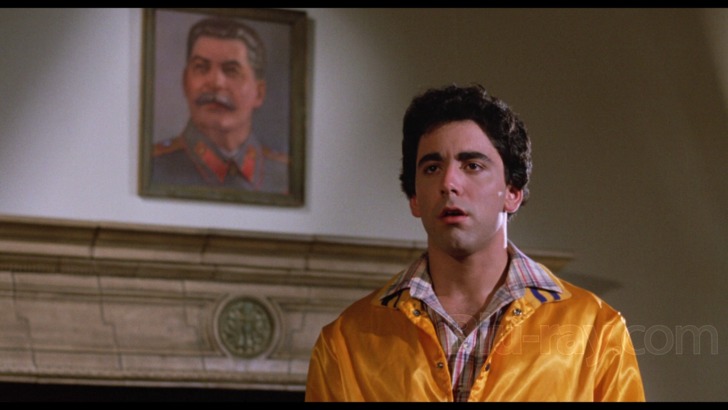
Eventually, Tony returns to high school, posing as his own son.
It’s a ridiculous premise. Cohen knows it, and the film doesn’t waste much energy pretending otherwise.
But the disguise gives the movie its central comic opportunity. Tony has returned to a world he thinks he understands, only to discover that the world has continued without his permission.
The school is familiar. The football field is familiar. The people are familiar.
The values are another matter.
Tony’s personal clock stopped in the late 1950s, but the national clock kept ticking.
This is where Full Moon High becomes more than a shaggy-dog version of I Was a Teenage Werewolf. Cohen is interested in what happens when somebody who has missed the intervening years tries to pick up where he left off.
It is a problem that can affect people who haven’t been bitten by anything in Transylvania.
Some of us never leave high school. We just acquire mortgages and better excuses.
The 1950s Were Over. Somebody Forgot to Tell Tony.
The high school monster movie has always been a convenient way to dramatize adolescence.
In I Was a Teenage Werewolf, Michael Landon plays a troubled teenager whose transformation into a monster gives physical form to the anxieties of growing up. The horror emerges from the fear that something uncontrollable is happening inside a young person’s body.
Cohen takes that basic idea and gives it a different destination.
Tony’s problem isn’t simply that he has become a monster. It’s that he has been preserved in a particular moment of American life.
The 1950s teenager is expected to function in the early 1980s, a period in which the country has experienced enormous changes in its attitudes toward sex, politics, authority, and personal freedom.
Tony’s former classmates have experienced those changes firsthand. They have lived through the intervening years. Their youthful certainties have been tested, discarded, or replaced with new ones.
Tony has skipped the entire process.
His predicament resembles that of somebody who leaves town for twenty years and returns expecting to find the same diner, the same friends, and the same social hierarchy waiting for him.
Instead, the diner is a bank, his old girlfriend has a family, and the people he remembers as teenagers have become middle-aged adults with middle-aged concerns.
The joke is that Tony looks exactly as he did before.
The more uncomfortable implication is that he thinks he should be able to resume his old life simply because he hasn’t changed physically.
Cohen’s commentary about changing sexual and political values gives this idea a sharper edge. Tony is not merely an immortal teenager. He is a walking relic of an earlier America, carrying his assumptions into a society that has begun to question them.
The film doesn’t develop this argument with the consistency or subtlety of a serious social satire. It is too busy throwing jokes at the wall, hoping something sticks.
But the underlying idea is there.
Tony has been spared the physical consequences of aging while remaining trapped in the cultural assumptions of his youth. He wants the world to accommodate him, even though he has done nothing to accommodate the world.
There is something very American about that.
We like to imagine that progress means everybody eventually arrives at the same place. We are less enthusiastic about the possibility that the world might move forward while we remain exactly where we were.
Tony’s curse makes that contradiction literal.
He doesn’t have to grow up. He simply has to figure out how to live among people who did.
The Werewolf as a Social Handicap
One of the oddest things about Full Moon High is how little interest it has in making its werewolf genuinely frightening.
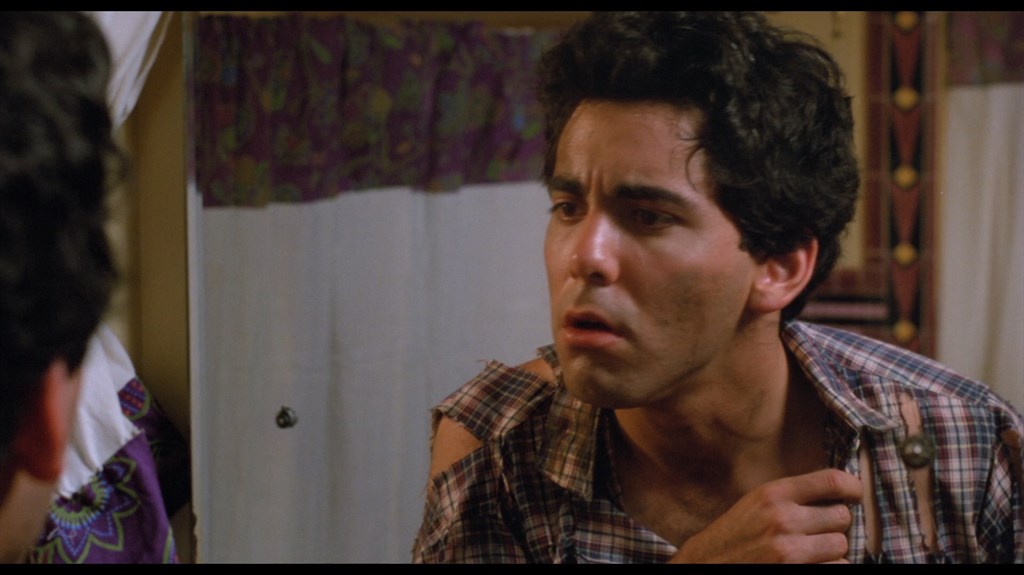
The transformation is less an existential nightmare than an inconvenient medical condition.
Tony doesn’t spend his nights stalking the countryside in search of victims. He isn’t a tragic creature of uncontrollable bloodlust. His werewolf behavior is frequently treated as a nuisance, an embarrassing complication that interrupts his attempts to live an otherwise recognizable life.
He has a secret. He has to manage it. And every so often, his body betrays him.
The setup invites comparisons with later teen-monster comedies, particularly Teen Wolf (1985). But Cohen’s film is considerably more anarchic and adult-oriented in its approach. It is less interested in turning lycanthropy into a metaphor for adolescent self-confidence than in finding increasingly absurd ways to inconvenience its protagonist.
The difference matters.
In Teen Wolf, being a werewolf eventually becomes an advantage. Scott Howard discovers that his transformation can make him popular, successful, and better at basketball. The monster becomes a vehicle for wish fulfillment.
Tony’s situation is less accommodating.
He has been given extraordinary longevity, but that longevity doesn’t make him wiser, happier, or more capable of navigating the world. He has simply been granted more time to remain the person he already was.
This is not immortality as a gift. It is immortality as a failure to develop.
The monthly transformation adds another layer to the joke. Tony may look like a teenager, but he has a recurring reminder that he cannot entirely control what he is. His body insists on making trouble just when he is trying to pass as an ordinary young man.
The horror is deliberately diminished. The social embarrassment remains.
Cohen was never a filmmaker who needed a conventional monster to make a movie work. In It’s Alive, the murderous infant becomes a way to explore parental anxiety and the fear of the unknown. In The Stuff, a seemingly harmless consumer product becomes a vehicle for attacking corporate manipulation and American appetite.
Here, the werewolf is a man who cannot move on.
It is a good idea. Whether every joke built around it works is another question.
Dad Is a Paranoid Cold Warrior. Of Course He Is.
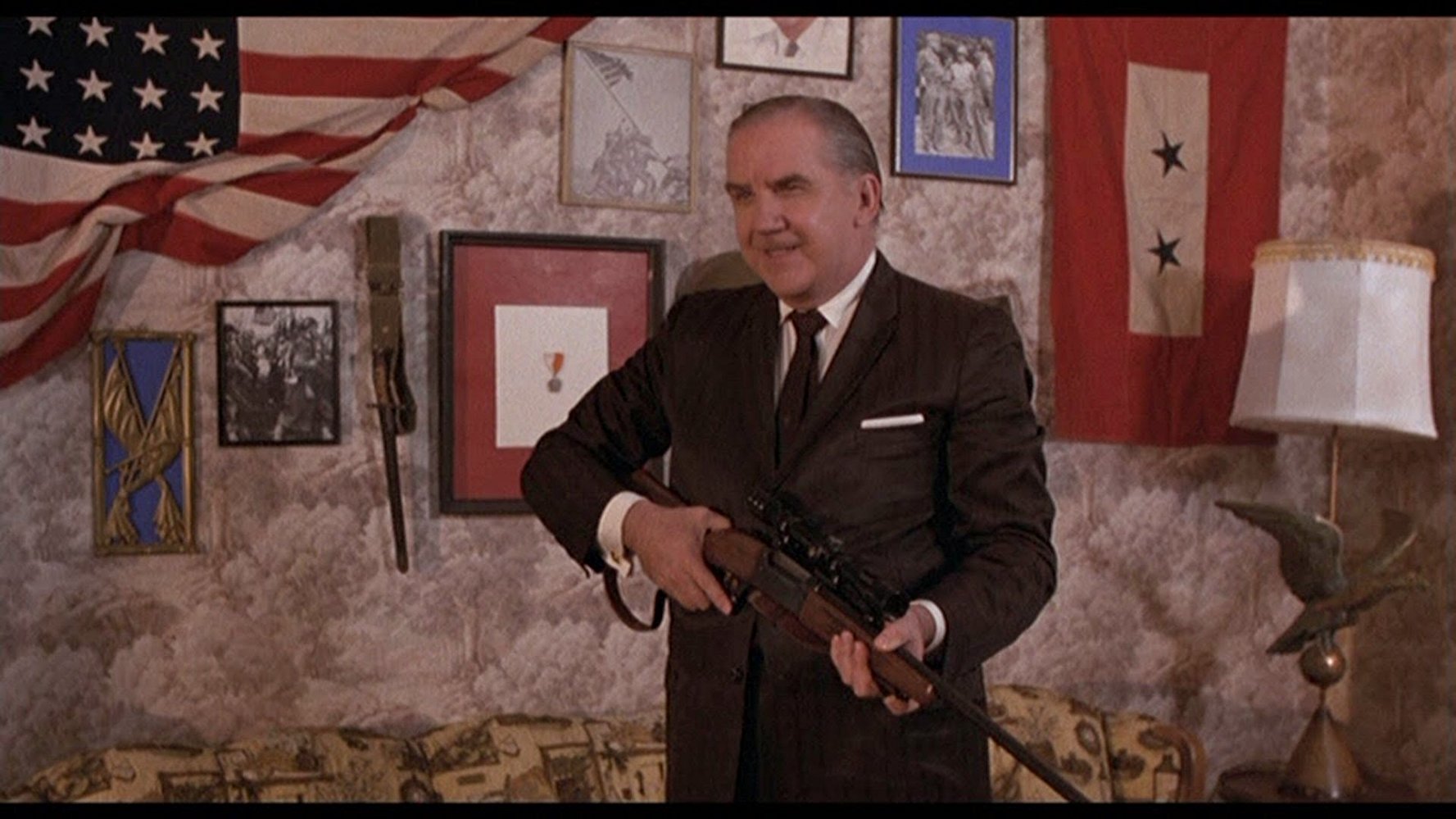
The casting of Ed McMahon as Tony’s father gives the movie an additional comic dimension.
McMahon, best known as Johnny Carson’s longtime sidekick on The Tonight Show, plays Colonel William P. Walker, a military man whose worldview is shaped by the anxieties and assumptions of the Cold War.
He’s a suspicious, paranoid authority figure, the sort of father who seems to regard the world as a collection of threats waiting to be identified, categorized, and neutralized.
The casting is inspired in its own peculiar way.
McMahon was a familiar television presence, a man audiences associated with the rituals of late-night entertainment. Here, Cohen puts him into a broad parody of American military and political paranoia, complete with a worldview that seems to have been assembled from old headlines and a well-stocked bomb shelter.
Tony’s father represents another version of the past that the film refuses to leave alone.
The son is trapped in adolescence. The father is trapped in a political outlook built around permanent suspicion. Neither seems particularly equipped to adapt to changing circumstances.
The difference is that the father has aged.
Tony has not.
The film’s humor is deliberately broad, and McMahon plays his character accordingly. The performance is less about psychological realism than the comic possibilities of watching a recognizable television personality become a ridiculous Cold Warrior.
There is also a pleasingly strange generational connection in the casting of Adam Arkin and his real-life father, Alan Arkin, who appears as Dr. Brand, a psychiatrist and supposed authority on the supernatural.
Alan Arkin brings another familiar face into Cohen’s collection of eccentrics. The movie doesn’t need to make much of the father-and-son relationship behind the camera. The casting itself is part of the pleasure.
The supporting cast is full of similar surprises. Kenneth Mars, Pat Morita, Louis Nye, Demond Wilson, and Jim J. Bullock all turn up, while Bob Saget appears as a sportscaster.
It’s an unusually eclectic collection of performers for a small, oddball comedy.
Some of them seem to be operating in entirely different movies. That is not necessarily a complaint.
In fact, it may be the most appropriate way to approach Full Moon High. Cohen has assembled a collection of comic personalities and given them a premise that allows almost everyone to take a swing.
Sometimes the swings connect. Sometimes they hit the furniture.
The movie keeps moving.
A Cast Full of Time Capsules
The most intriguing supporting performance may belong to Elizabeth Hartman, who plays Miss Montgomery.
Hartman had received an Academy Award nomination for her screen debut in A Patch of Blue (1965) and built a career that included substantial dramatic work. Her presence in a scrappy werewolf comedy is a reminder of the peculiar paths actors take through the industry.
Full Moon High was her final film appearance.
Hartman died in 1987, making the movie an especially poignant footnote in a career that began with such promise. There is no reason to force a tragic interpretation onto her performance, but knowing the circumstances gives her appearance a weight that the surrounding comedy cannot entirely erase.
She belongs to another kind of time capsule, one that has nothing to do with the film’s supernatural premise.
The rest of the cast provides its own collection of historical curiosities.
Adam Arkin carries the burden of playing a teenager who never ages, a role that requires him to be both a recognizable high school kid and a man whose life has become an increasingly absurd experiment. His comparatively restrained approach gives the movie something to hold onto amid the broader performances around him.
McMahon brings television familiarity. Alan Arkin supplies comic eccentricity. Mars contributes the sort of heightened performance that makes you wonder whether someone told him there would be a prize for the most enthusiastic overacting.
And then there is Pat Morita, who would become one of the most recognizable faces of the decade after The Karate Kid (1984).
The movie’s cast is almost as much a document of its moment as its story. Performers from different corners of American entertainment collide in a film that doesn’t seem particularly concerned with making the pieces fit neatly together.
That disorder can be frustrating.
It can also be fun.
There is something appealing about a movie that lets you discover an unexpected performer in a small role, particularly when the film itself has largely slipped out of the mainstream conversation.
Full Moon High is not an undiscovered masterpiece hiding in plain sight. But it is a surprisingly rich collection of people and ideas, assembled at a moment when American popular culture was changing rapidly.
Even the casting reinforces the film’s central subject: time passes, careers evolve, and people who once occupied one place in the culture eventually find themselves somewhere else.
Tony Walker is the only one who doesn’t get the memo.
The Wrong Werewolf Movie for 1981
There is another reason Full Moon High feels like such an oddity.
It arrived in 1981, a remarkable year for werewolf movies.
John Landis released An American Werewolf in London, combining horror, black comedy, and groundbreaking transformation effects into a film that helped redefine what a modern werewolf movie could be.
Joe Dante’s The Howling offered its own elaborate mixture of horror, satire, and body transformation. Michael Wadleigh’s Wolfen approached the supernatural from a darker, more atmospheric direction, using the premise to explore urban violence, alienation, and the limits of human perception.
These films were very different from one another, but each treated the werewolf as a serious cinematic opportunity. Even when the comedy became outrageous, the physical transformation carried weight.
Then there was Larry Cohen.
Full Moon High had been filmed in 1979, well before its October 9, 1981, theatrical release. Its arrival was delayed by financial problems at distributor Filmways, leaving the movie to emerge into a marketplace that had moved on without it.
The timing could hardly have been stranger.
Cohen wasn’t trying to compete directly with the technical sophistication of An American Werewolf in London. His film was built around a different sensibility, drawing on the teenage monster pictures of the 1950s and mixing them with broad comedy, social satire, and a deliberately scruffy style.
But audiences encountering the film in 1981 could hardly be expected to ignore the competition.
The decade’s werewolf movies were demonstrating what could be done with makeup effects, atmosphere, and carefully constructed horror. Cohen’s film seemed to belong to another tradition entirely.
Its werewolf was less a creature to fear than a comic nuisance. Its transformations were not the centerpiece of a sustained horror experience. And its jokes often depended on a kind of freewheeling absurdity that could feel exhilarating in one scene and exhausting in the next.
Steve Neill, a special-effects artist associated with Rick Baker’s circle, handled the makeup effects. Yet the movie’s priorities were never the same as those of Landis’s elaborate horror-comedy.
Cohen was interested in the premise more than the mechanics.
That distinction helps explain why Full Moon High occupies such an unusual position in the history of the werewolf movie. It is not simply a lesser version of the films released around it. It is trying to accomplish something different.
Unfortunately, trying something different does not automatically make it successful.
The movie’s comedy can be uneven, its pacing loose, and its tone difficult to pin down. Some of its jokes have aged badly. Others seem to arrive from a parallel universe where the normal rules of comic timing no longer apply.
But the film’s awkwardness is also part of its identity.
Cohen was not interested in sanding down every rough edge. He wanted to make a comedy, and he had a good time doing it. In his 2018 interview, he remembered the production fondly and praised the performers involved.
The finished film may not be as disciplined as his best work. It nevertheless offers a glimpse of a filmmaker trying to break out of the expectations surrounding his career.
That is worth something.
Larry Cohen’s Strange Little Experiment
Cohen’s career was built on a particular kind of audacity.
He could take an outrageous premise and use it to examine something recognizable about American life. His films were often inexpensive, occasionally rough around the edges, and frequently more interested in ideas than in conventional polish.
Full Moon High fits that pattern, even if its comic approach makes it a stranger entry in his filmography.
The man who made It’s Alive and God Told Me To was not abandoning social commentary. He was approaching it from a different direction.
Instead of making a horror movie about a monster that exposes the anxieties of ordinary people, he made a comedy about a teenager whose inability to age exposes the absurdity of believing that the world should remain unchanged.
The distinction is subtle, but important.
Tony is not simply a young man who has been given too much time. He is a young man who has been denied the ordinary experience of time passing. He cannot look back on his adolescence as a completed stage of life because, in a very literal sense, he has never left it.
His friends have memories, regrets, families, and political opinions formed through experience. Tony has a high school football game he still wants to play.
The film’s central joke is that he considers this perfectly reasonable.
And perhaps that’s why the premise continues to offer something to think about, even when the gags fall flat.
Growing older does not guarantee wisdom. It does not guarantee that our politics will evolve or that we will become more understanding of other people. Sometimes people simply accumulate years while remaining emotionally and intellectually parked in the same place.
Cohen takes that familiar human failing and gives it a supernatural explanation.
Tony cannot grow up because he is a werewolf.
The rest of us have fewer excuses.
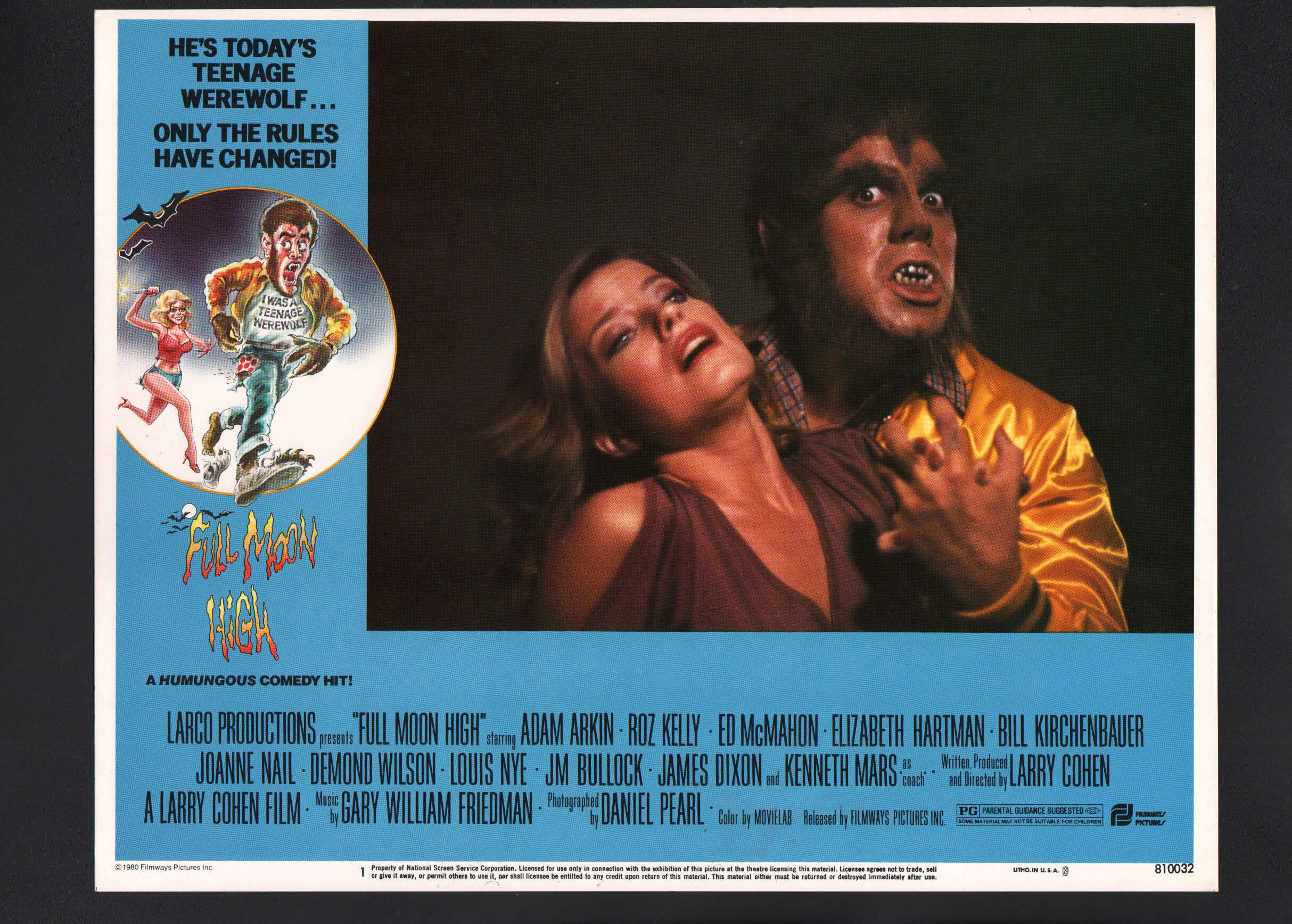
The Future Has Changed. The Werewolf Hasn’t.
There is a temptation to dismiss Full Moon High as a footnote in the history of 1980s horror comedy.
It is certainly not the most polished werewolf movie of its year. It isn’t as frightening as The Howling, as technically accomplished as An American Werewolf in London, or as commercially influential as Teen Wolf would become.
Its comedy is inconsistent. Its tone wanders. Its ideas sometimes seem to be fighting with the jokes for control of the movie.
But dismissing it as a failed Teen Wolf ignores both its origins and its ambitions.
Cohen was working from the tradition of 1950s teen-monster movies, using a familiar genre premise to examine the distance between one version of American life and another. The film’s delayed release only made that contrast more pronounced. A movie conceived and shot in the late 1970s arrived in theaters in a new decade, surrounded by werewolf films that were doing very different things.
It was a little behind the times before audiences ever saw it.
Which, of course, is exactly what the movie is about.
Tony Walker is frozen in adolescence, but the world doesn’t owe him a place in it. His friends have changed. His country has changed. The assumptions he brought with him have become historical artifacts, and his attempt to reclaim his old life becomes increasingly absurd.
The werewolf curse is the movie’s broad comic hook. The inability to move forward is its more enduring idea.
Cohen never quite turns that idea into a fully satisfying comedy. The film remains too ragged, too uneven, and too distracted by its own jokes to become the social satire it occasionally threatens to be.
Still, there is something oddly appropriate about a movie that can’t quite settle into its own time.
Full Moon High is a relic of the late 1970s that arrived in the early 1980s looking for a place to belong. Its protagonist is a relic of the 1950s who arrives decades later looking for the same thing.
Neither fits particularly well.
And maybe that’s the point.
You can freeze the body. You can preserve the memories. You can spend the rest of your life trying to return to the moment when everything made sense.
But the world keeps moving.
Eventually, even the werewolf has to face the music.

Tags
Movies of the 80s, Full Moon High, Larry Cohen, Adam Arkin, Ed McMahon, Alan Arkin, 1981 Movies, Werewolf Movies, Horror Comedy, Cult Movies, Forgotten Movies, Teen Wolf, An American Werewolf in London, The Howling, 1980s Horror
About the Creator
Movies of the 80s
We love the 1980s. Everything on this page is all about movies of the 1980s. Starting in 1980 and working our way the decade, we are preserving the stories and movies of the greatest decade, the 80s. https://www.youtube.com/@Moviesofthe80s
Enjoyed the story? Support the Creator.
Subscribe for free to receive all their stories in your feed.
Comments
There are no comments for this story
Be the first to respond and start the conversation.