
From Legend to Oblivion: How CCleaner Became a Ghost in Our Computers 🧹💻
How a gamer's essential toolkit became a relic of the past

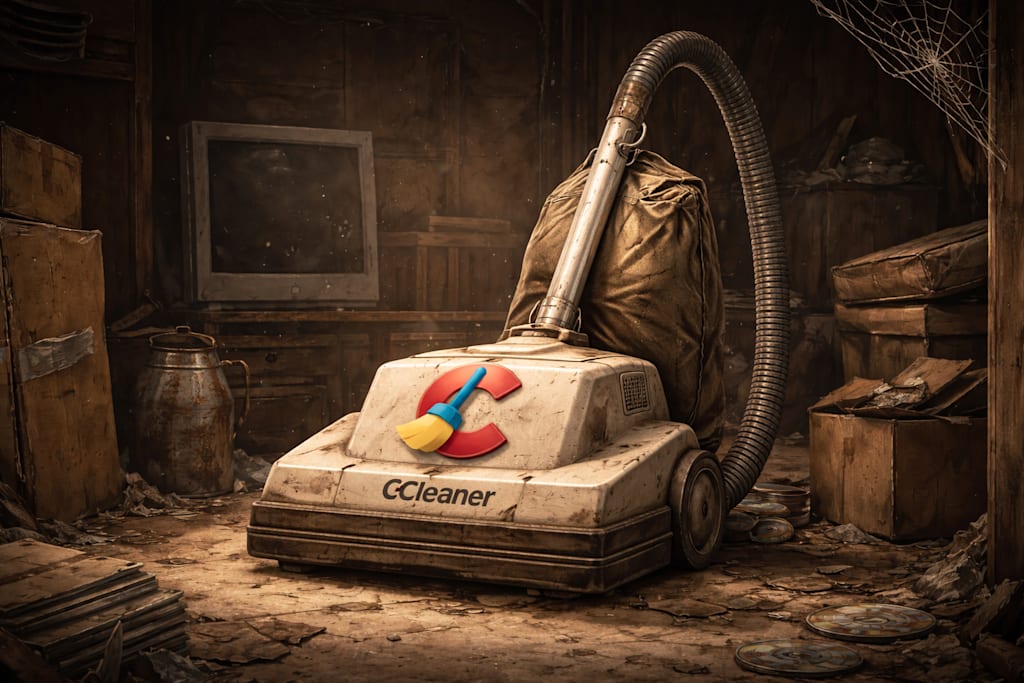
For anyone who grew up in the era of Windows XP or 7, the icon with the blue letter "C" and the red brush was practically sacred. As young boys, deeply immersed in the world of PC gaming, we treated CCleaner as an essential service tool 🛠️. Running it before a session of Counter-Strike or Gothic was a ritual—much like dusting your room before guests arrived. We did it with a firm belief that those few clicks would "declog" our hardware, add a few frames per second, and restore the system's former vigor ⚡. Today, in 2026, CCleaner is merely a technological artifact. What happened to the program that used to be on every single computer? 🤔
The Magic of "Registry Cleaning" and the Psychology of Optimization 🧠
Our fascination with CCleaner was based on a mythical belief that the Windows Registry was an engine that got clogged with carbon deposits like an old diesel motor. The program promised to "fix problems," and we watched with satisfaction as a list of hundreds of "errors" magically vanished with the push of a button ✨.
The truth, however, is that cleaning the registry almost never sped up a computer 🛑. The registry is a massive database; removing a few kilobytes of unused keys means as much to a processor as throwing a grain of sand off a semi-truck trailer. We did it for the psychological effect. A progress bar hitting 100% gave us a priceless sense of control over a complex machine. Unfortunately, that era of "manual control" over the system came to an end following a series of disastrous decisions by the manufacturer 📉.
Dark Clouds Over the Blue Icon ☁️⚠️
The downfall of CCleaner didn't start because it stopped working, but because it lost our trust. The turning point was 2017, when the British company Piriform was acquired by the antivirus giant—Avast. What happened next is a textbook example of brand destruction.
First, the world was rocked by news of a supply chain attack—hackers had swapped the official version of the program for one containing malicious software 🦠. Over two million users installed a virus, trusting the manufacturer's official website. Later, things only got worse: aggressive ads, collecting user data without consent, and attempts to install "bundled" software with every update 📢. CCleaner became exactly what it once fought against—cumbersome "bloatware" that required removal itself.
The Intelligent Successor: Storage Sense 🤖⚙️
While CCleaner was sinking in scandals, Microsoft was not idle. In Windows 10 and 11, a tool was implemented that effectively sent the old "cleaner" into retirement: Storage Sense.
It’s a built-in "silent butler." Unlike CCleaner, Storage Sense doesn't demand your attention. It works intelligently in the background, activating primarily when the disk is actually running out of space 📂. It can automatically clear temporary files, empty the recycle bin after a set time, and even delete old system installations (the Windows.old folder), which can take up dozens of gigabytes.
Its greatest advantage is cloud integration ☁️. The OneDrive "file dehydration" feature allows the system to automatically remove local copies of files you haven't opened in a long time, keeping them safe in the cloud. All this happens without the risk of damaging the registry or accidentally deleting important drivers.
Microsoft PC Manager – The Final Blow 🥊
For those users who still feel nostalgia for a "Boost" button and want a dedicated cleaning app, Microsoft prepared something else: Microsoft PC Manager 🖥️. This is the official, free answer to CCleaner. It offers file cleaning, process management, and driver updates in a modern, secure package—without ads and without spying 🛡️. This tool finally closed the gap that third-party programs once filled.
The End of an Era 🌅
The story of CCleaner is a cautionary tale of how easily trust built over years can be squandered. It went from an "essential" to a high-risk program. Although it technically still exists and receives updates in 2026, it is redundant for most tech-savvy users. Today's operating systems are like modern cars—they no longer require the user to poke under the hood with a wrench every weekend 🔧. It's enough to let them run in the background. And us? We can finally focus on gaming instead of constantly "fixing" the registry 🎮🏆.
About the Creator
Piotr Nowak
Pole in Italy ✈️ | AI | Crypto | Online Earning | Book writer | Every read supports my work on Vocal
Enjoyed the story? Support the Creator.
Subscribe for free to receive all their stories in your feed.
Comments
There are no comments for this story
Be the first to respond and start the conversation.