
From 176 Pixels to MoMA: How Shigetaka Kurita Saved Our Digital Hearts 📱
The 12-pixel revolution: How Shigetaka Kurita gave the internet its soul.

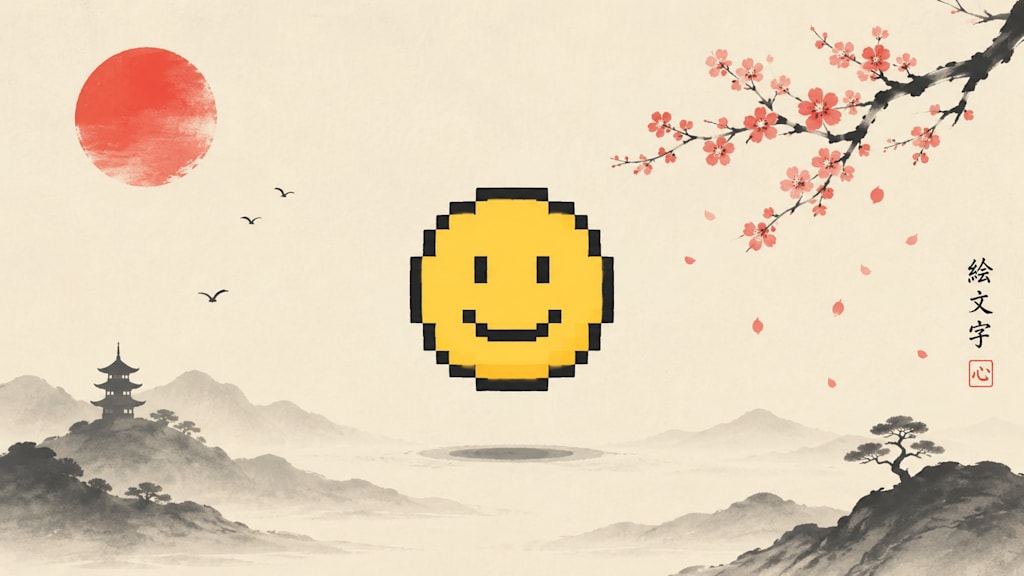
Can you imagine today’s world without that little yellow smiling face? Or without the red heart sent to someone you love? Today, when we write messages, emojis feel as natural as the period at the end of a sentence. But this story didn't begin in a massive NASA lab or a shiny Silicon Valley skyscraper. It started with 176 tiny pictures that had one single goal: to stop us from getting offended by each other on the internet.
As a technology and AI enthusiast, I often spend my time looking at powerful processors and complex algorithms. However, Shigetaka Kurita’s story teaches us something more important—that the greatest technological revolutions are often born from a human need to connect, not just from raw computing power. ✨
The Problem of "Cold" Messages 🤒
Let’s go back to Japan in the late 1990s. Imagine a phone with a black-and-white screen that could barely fit a short text message. A company called NTT Docomo introduced a system called "i-mode"—essentially "the internet in your pocket." But there was a problem: limits. An email could only be 250 characters long. That is very little space to convey emotion.
In the world of plain text, it is very easy to be misunderstood. When you write "I understand" to someone, they might think you are angry, bored, or being sarcastic. We lack the tone of voice, body language, and facial expressions. Text without emotion is like food without salt—it gives you energy, but it has no flavor. A young designer named Shigetaka Kurita was given a task: "Find a way to fix this." 🤖
Art on a Postage Stamp 🎨
Kurita wasn’t a trained artist. He was a planner with an economics background. Paradoxically, his "technical" approach was the key to his success. He had to create icons that would fit into a grid of 12 by 12 pixels.
To give you an idea of how small that is: today’s smartphone screens have millions of pixels. Kurita’s work was like trying to paint a portrait on a postage stamp using a thick marker. He had exactly 144 dots to work with. Nothing more. 📏
Where did he find inspiration? As a tech fan, I love this part: Kurita looked at Japanese comics (manga). In manga, when a character is nervous, a sweat drop appears on their forehead. When they are in love, they have hearts for eyes. Kurita brought these simple symbols into the digital world. He created 176 characters: the sun, clouds, an umbrella, a telephone, and a few basic faces. Thus, Emoji was born (from the Japanese words: e for "picture" and moji for "character").
The Genius Paradox: Why Wasn't He a Billionaire? 💸
Here comes an incredible plot twist. In today’s tech world, companies patent everything—even the rounded corners of a phone. But in 1999, NTT Docomo decided that 12 pixels was "not enough" to be considered a design worth legal protection. They thought it was just a simple add-on.
Because of this "mistake" (from a business perspective), emojis were able to spread. Other companies started creating their own versions. If Kurita had patented the emoji, we might have to pay a subscription fee for every smiley face we send today! Instead of becoming the richest man in Japan, Kurita became the father of a global language that belongs to everyone. 🏛️
From the Keyboard to the Museum of Art 🖼️
For a decade, emojis were mostly a Japanese phenomenon. Everything changed in 2011 when Apple added an emoji keyboard to the iPhone. The world went crazy for them. Suddenly, a "small thing" became giant.
Today, emojis are more than just fun. They are a powerful tool that we even analyze in the context of Artificial Intelligence. Algorithms learn to recognize our mood based on whether we use 😂 or 😭. Furthermore, in 2016, the Museum of Modern Art (MoMA) in New York acquired the original 176 icons for its permanent collection. These simple pixels now hang alongside works by Picasso and Van Gogh. Why? Because it is the most important graphic design project of our time. It is a design that changed how humanity communicates.
Digital Body Language 🌐
Looking at this through the lens of a tech enthusiast, I see emojis as "digital body language." AI can write essays for us, but emojis add the human element. Kurita didn't just create pictures—he built a bridge between cold computer code and the warm human heart.
Whether you are 5 years old sending a cake icon to your grandma, or 80 years old thanking your grandson with a heart—you are using the invention of a humble Japanese man. It’s a beautiful lesson: technology doesn't always have to be complicated to change the world. Sometimes, all it takes is 176 pixels and a desire for people to understand each other better. ❤️
So, the next time you send a "thumbs up" 👍, think of Shigetaka Kurita. It is thanks to him that your phone stopped being just a typewriter and became a tool for sharing feelings. 🚀
About the Creator
Piotr Nowak
Pole in Italy ✈️ | AI | Crypto | Online Earning | Book writer | Every read supports my work on Vocal
Enjoyed the story? Support the Creator.
Subscribe for free to receive all their stories in your feed.
Comments
There are no comments for this story
Be the first to respond and start the conversation.