
Franz Beckenbauer Biography: Career, Family and Legacy
The journey of “Der Kaiser” from Munich to world fame

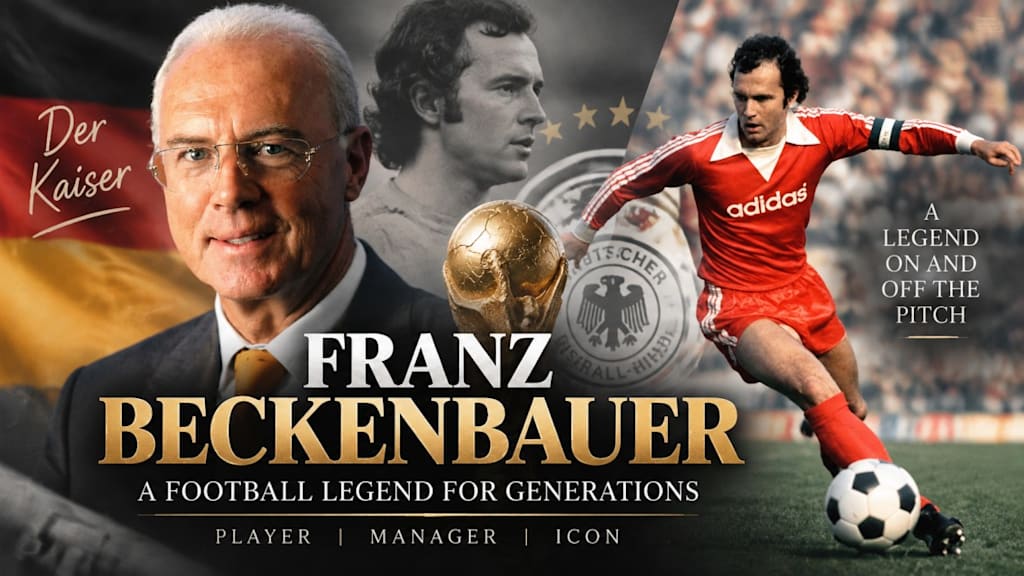
Franz Beckenbauer was more than just a football player; he was a symbol of elegance, intelligence, and leadership in the sport. Known around the world as “Der Kaiser” (The Emperor), he transformed the role of a defender by showing that a player at the back of the field could also create attacks, control matches, and influence the entire game.
Born in Munich, Germany, in 1945, Beckenbauer became one of the rare football personalities who achieved greatness both as a player and as a manager. He won the FIFA World Cup as captain in 1974 and later lifted the same trophy as a coach in 1990.
His journey from a young boy in post-war Germany to an international football icon remains one of the most remarkable stories in football history.
Early Life in Munich
Franz Anton Beckenbauer was born on 11 September 1945 in Munich, Germany, just months after the end of World War II. He grew up in the working-class area of Giesing, where football became an important part of his childhood.
Unlike many young players who begin their careers with dreams of fame and fortune, Beckenbauer’s early years were shaped by simplicity, discipline, and a strong connection with his local community.
As a child, he developed a passion for football and joined local clubs before entering the youth system of Bayern Munich, a decision that would eventually change both his life and the history of German football.
Family Background and Childhood
Beckenbauer was raised in a modest German family. His father, Franz Beckenbauer Sr., worked as a postal official, and his childhood reflected the realities of Germany’s rebuilding period after the war.
His family supported his interest in football, although becoming a professional athlete was not an obvious path at the time. His determination and natural talent helped him move from local football to one of the biggest clubs in Europe.
Information about his siblings is limited in public records, but his family environment played an important role in shaping his calm personality and strong work ethic.
The Beginning at Bayern Munich
Beckenbauer joined Bayern Munich’s youth system in 1959 and made his professional debut in 1964. At the beginning of his career, he did not immediately play as the legendary defender the world would later know.
He started as a midfielder and even played on the wing before gradually moving into a deeper position.
This tactical change became one of the most important moments in football history. From his defensive position, Beckenbauer found new ways to influence the game by carrying the ball forward, making accurate passes, and helping his team build attacks.
The Birth of “Der Kaiser”
The nickname “Der Kaiser” represented Beckenbauer’s commanding presence on the pitch. He played with confidence, elegance, and authority.
Unlike traditional defenders who mainly focused on stopping opponents, Beckenbauer controlled matches through intelligence and creativity. He read the game several steps ahead and often acted like a midfielder while starting attacks from defense.
His style created a new vision of the sweeper or libero role and influenced generations of defenders who followed him.
Bayern Munich’s Golden Era
During the 1970s, Franz Beckenbauer became the leader of Bayern Munich’s greatest generation.
With teammates such as Gerd Müller and Sepp Maier, Bayern became one of Europe’s strongest clubs.
Beckenbauer helped Bayern win:
Multiple Bundesliga titles
Four German Cups
Three consecutive European Cups (1974–1976)
His leadership was central to Bayern’s rise from a successful German club into a European football powerhouse.
International Success with West Germany
Beckenbauer’s international career made him a national hero in Germany.
He represented West Germany in major tournaments and became captain of the national team. His greatest achievement as a player came in the 1974 FIFA World Cup, held in West Germany.
Leading the team as captain, he lifted the World Cup trophy after West Germany defeated the Netherlands in the final.
Before that, he had already won the 1972 UEFA European Championship, making him one of the most successful international players of his generation.
Ballon d’Or Achievements
Winning individual awards as a defender is extremely rare, but Beckenbauer achieved something historic.
He won the Ballon d’Or twice:
1972
1976
These victories showed that his influence went far beyond traditional defensive statistics. He was recognized as one of the best footballers in the world, regardless of position.
His ability to combine defensive strength with creativity made him unique among football legends.
Life Beyond Germany
After achieving legendary status with Bayern Munich, Beckenbauer moved to the United States to play for New York Cosmos.
During his time in America, he played alongside famous football stars and helped increase interest in the sport.
He later returned to Germany and played for Hamburger SV, adding another chapter to his remarkable career.
Although his playing career eventually ended, his influence on football continued.
A New Challenge as a Manager
After retiring as a player, Beckenbauer successfully moved into football management.
His greatest managerial achievement came in 1990, when he guided West Germany to victory in the FIFA World Cup.
This achievement placed him among the few people in football history who won the World Cup both as a player and as a manager.
His understanding of tactics, leadership, and team management helped him succeed in a completely different role.
Personal Life and Family
Away from football, Beckenbauer lived a private but interesting life.
He was married three times and had five children. His family remained an important part of his life outside the football spotlight.
One of his sons, Stephan Beckenbauer, was also involved in football and worked with Bayern Munich’s youth development system.
Despite worldwide fame, Beckenbauer was often described as someone who valued family, friendship, and a quieter lifestyle away from the stadium.
Lifestyle and Interests
After football, Beckenbauer remained connected to sports and public life.
He enjoyed activities such as:
Golf
Travel
Football development
Spending time with family
His public image was associated with elegance and professionalism. Many fans admired not only his football ability but also his calm and respectful personality.
Later Years and Passing
In his later years, Beckenbauer reduced his public appearances and spent more time away from the spotlight.
He passed away on 7 January 2024 at the age of 78. The football world remembered him as one of Germany’s greatest sporting figures and a player who changed how the game was understood.
Tributes came from clubs, players, and football organizations around the world, recognizing his extraordinary contribution to the sport.
Legacy of Franz Beckenbauer
Franz Beckenbauer’s legacy is not only measured by trophies but by the way he changed football.
He showed that defenders could be creative leaders. He proved that intelligence and technique were just as important as physical ability.
His achievements include:
World Cup winner as player
World Cup winner as manager
Two-time Ballon d’Or winner
Bayern Munich legend
Pioneer of modern defending
Even after his passing, Franz Beckenbauer remains one of football’s most respected figures. His story represents talent, innovation, leadership, and a lifelong connection with the beautiful game.
Conclusion
Franz Beckenbauer’s journey from the streets of Munich to global football fame is a story of determination and vision.
He was not only a great player but also a person who changed the way football was played and understood. His nickname “Der Kaiser” was not just about his success; it reflected his elegance, intelligence, and influence.
For generations of football fans, Franz Beckenbauer will always remain a true legend of the game.
About the Creator
MUHAMMAD SHAFIE
Muhammad Shafie is a writer and blogger passionate about digital culture, tech, and storytelling. Through insightful articles and reflections, they explore the fusion of innovation and creativity in today’s ever-changing world.
Enjoyed the story? Support the Creator.
Subscribe for free to receive all their stories in your feed.
Comments
There are no comments for this story
Be the first to respond and start the conversation.