
Father, Mother, Sister, Brother (2026)
Maybe, the slowness is the point?

When I got home from the pictures yesterday, my partner asked me what I thought of the film.
I replied:
“It’s a 30-minute play squashed into an hour and a half of screen time.”
Oof. I know. Quite damning. But I did have an eventful time at the cinema.
On the way up to the screen, I got in a lift with Ian (m) and Chris (f). (I make the m/f distinction because my partner assumed they were a gay couple and although, I sort of love it when people make assumptions against the norm, they weren’t and I don’t want to misrepresent them.)
Ian was very chatty. I learned, over the course of our acquaintance, that he is a tour guide for Manchester City and loves football and cinema. I recommended Twinless. We discovered we were sitting next to each other in the cinema, having booked back row centre seats like proper cinema goers do.
The lights went down, but no film came on. The cinema started to fizz with chatter as Chris went out to talk to staff. When she came back it was Ian that announced to the audience that staff knew about the problem and were trying to fix it. I can’t remember how he worded it, but it made the audience laugh. Then a member of staff told us that they had to reboot the projector. Ten minutes later the film started – no advert, no trailers, no sound.
It was Ian, this time, who chased a member of staff to get the sound into the auditorium.
And so, the film began, again.
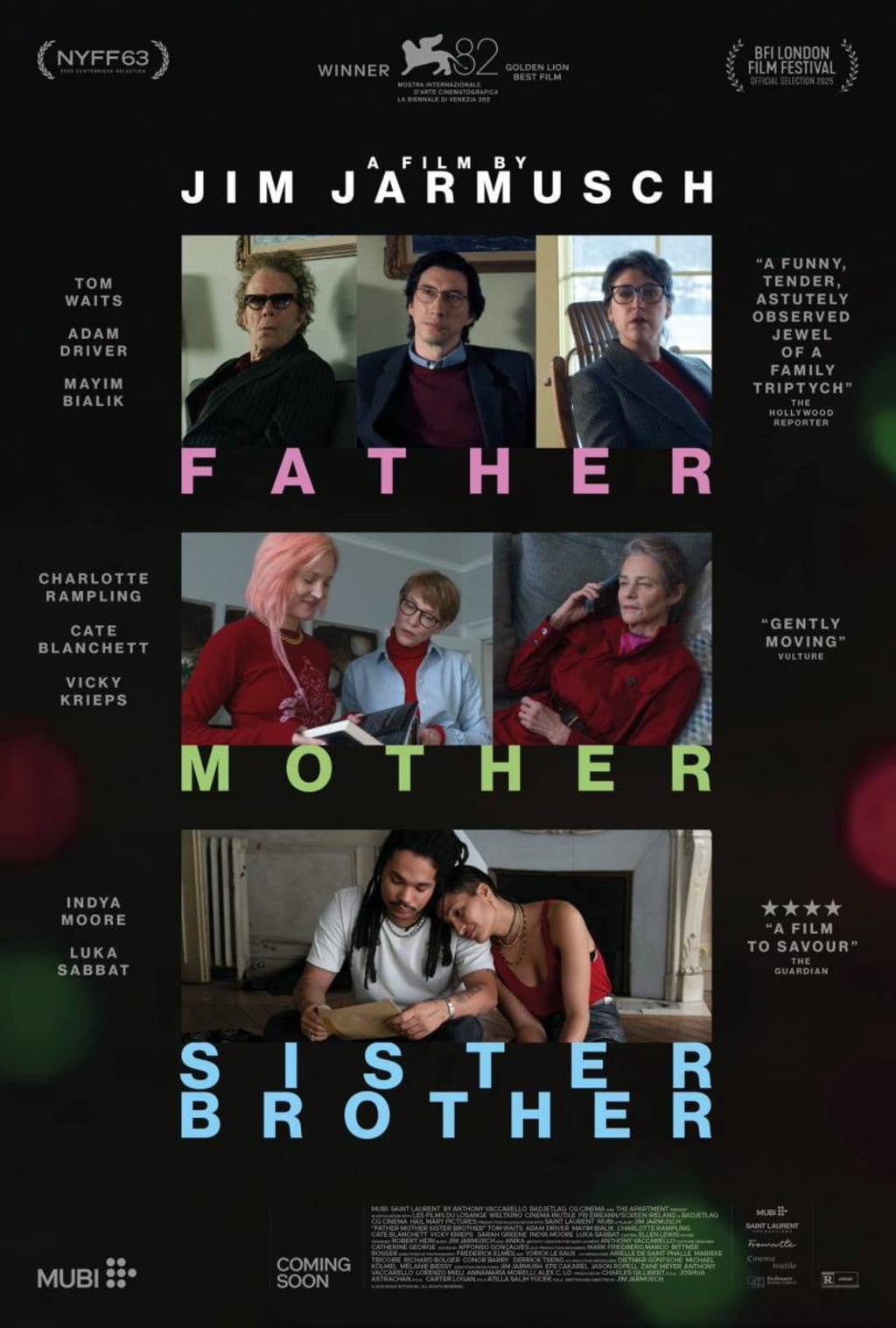
Father, Mother, Sister, Brother is billed as a comedy-drama, written and directed by Jim Jarmusch.
It offers three vignettes of family life. Unconnected, the three stories share common themes and leitmotifs – balletic skateboards, a Rolex watch, Bob’s your uncle.

Father has Tom Waits as the dishevelled Dad to Jeff (Adam Driver) and Emily (Mayim Bialik) meeting up in a snowy, Northern US state for an awkward reunion at Dad’s house. The family skirt around issues of money, their Dad’s health, their estrangement, their mother’s funeral.

Mother is set in Dublin with Charlotte Rampling playing successful author and mother to Timothea (Cate Blanchett) and Lilith (Vicky Krieps). A socially painful afternoon tea ensues with lies from Lilith about her finances and romance.

For Sister Brother, we move to Paris with Skye (Indiya Moore) and Billy (Luka Sabbat) cast as twins, looking through the remnants of their dead parents’ life in a Parisian flat, including fake IDs and a fake marriage certificate.
There is much stillness and silence in the film. It drags. Ian managed to stay awake, but only just. I talked with Ian and Chris until staff told us they needed to get ready for the next showing. We agreed the final vignette was the most compelling and Chris and I both loved the chic Parisian apartment. I was least fond of the middle section. Three excellent actresses miscast and implausible as a family. Amidst the awkwardness of strained relationships, Mayim Bialik’s comic timing shone in the first section.
And what I realised is that this was a film that was more fun to talk about than to watch. At times, the pace is so achingly slow, the action barely visible. But three audience members still found conversation in the details. Maybe, the slowness was the point…
If you've enjoyed what you have read, consider subscribing to my writing on Vocal. If you'd like to support my writing, you can do so by leaving a one-time tip or a regular pledge. Thank you.
About the Creator
Rachel Robbins
Writer-Performer based in the North of England. A joyous, flawed mess.
Please read my stories and enjoy. And if you can, please leave a tip. Money raised will be used towards funding a one-woman story-telling, comedy show.
Enjoyed the story? Support the Creator.
Subscribe for free to receive all their stories in your feed. You could also become a paid subscriber, letting them know you appreciate their work.
Comments
There are no comments for this story
Be the first to respond and start the conversation.