
Fallout-Too Sweet
A wasteland story about sarsaparilla, broken emblems, and the choices that stick to your boots.
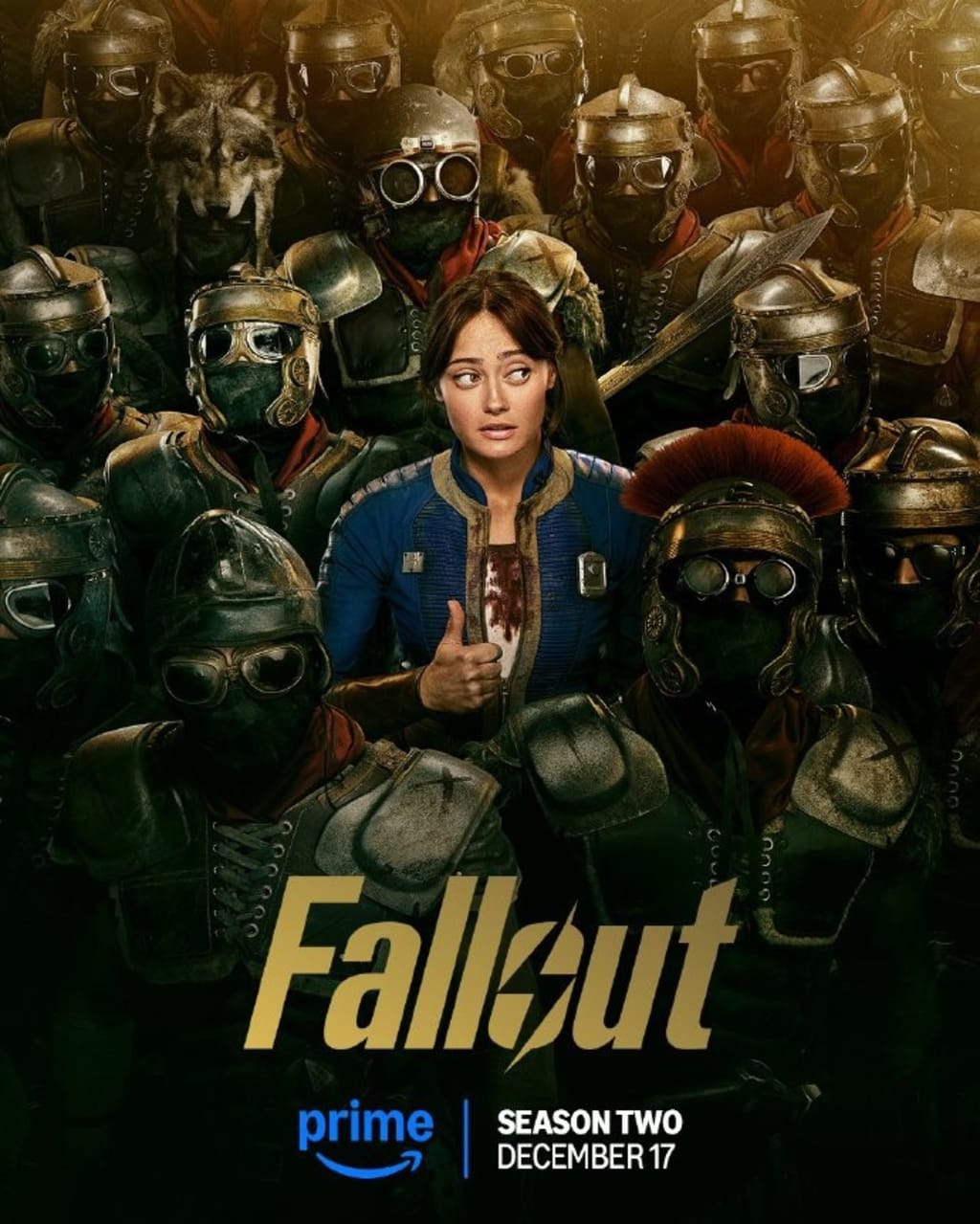
The whistle came from beyond the dunes, sporadic and ragged, like a dying iron beast wheezing its last. Cooper Howard crouched beneath the remains of a wind-scoured billboard, wiping the lenses of his binoculars with his sleeve. In the distance lay the Legion’s camp, the forward position, to be precise. Torches lined the sand in two columns, and in the open space between them, a man was tied to a post. From the uniform, he was NCR.
Deserter, or scout, or just unlucky. In the Mojave, those three things often overlapped.
Cooper lowered the binoculars. At the camp’s eastern edge, an M3 anti-tank gun was set up, its muzzle pointed north, toward Brotherhood territory. A gray towel hung over the barrel; when the wind caught it, it fluttered like a flag at half-mast. Ammo crates were stacked beside the gun, stamped with the RobCo logo, House’s merchandise. House’s stuff had been scattered across the wasteland for years, some released by him, most stolen by others. Robots and cannons alike broke down without maintenance, and a broken House robot was easier to steal than a working one.
By the central fire, two Legionaries were playing cards. A crate of Sunset Sarsaparilla sat at their feet, half the caps already pried off. One of them, younger, losing the hand, tossed an empty bottle behind him without looking. It hit the sand, rolled twice, and stopped between the ribs of a brahmin skeleton. Cooper looked at the bottle, amber glass, label faded to a vague star outline, then looked away.
He didn’t drink that stuff. Too sweet.
A centurion stepped out of a tent, barked something in Latin. The two card players rose: one went to untie the NCR prisoner from the post, the other to fetch a torch. The torch fuel was sarsaparilla, because it was cheap, because it was everywhere, because when it burned it gave off a caramelized smell that could mask the stench of scorched meat.
Cooper folded his binoculars away. He rose from the shadow of the wall, brushed the sand off his knees, and walked toward the water tower on the north side of the camp. The tower was pre-War relic, its iron skin rusted through in a dozen places, but the main pipe was still intact. The Legion had pitched camp here for that water. In the Mojave, whoever controlled water controlled the roads. Whoever controlled the roads lived.
His fingers found the pipe joint at the tower’s base. Rust had built up in layers, like tree rings. He slid his knife into the seam and twisted slowly. Water began to seep out slowly, a drop at first, then a thin trickle that vanished into the sand as soon as it hit. He pushed a signal flare into the loosened joint and secured it with two loops of wire.
Done, he didn’t leave.
He leaned against the shadowed side of the tower and fished out a pack of cigarettes. Pre-War stock; the paper had yellowed, the tobacco crumbled to dust. He put one between his lips, unlit. Through the iron shell, he could hear the camp’s sounds: the torch going up, the centurion speaking, the NCR deserter coughing. The cough came in fits, like the whistle before.
Cooper spat out the cigarette. He looked down and saw an unopened sarsaparilla bottle at his feet, probably dropped by some soldier. The cap was still tightly crimped, the label more intact than the last one, enough to read “Sunset Sarsaparilla.” A small line of print on the bottle read: “The Golden Spirit, in every sweet sip.”
He’d shot that commercial.
That was pre-War. He’d taken the job, good pay. The director put him on a fake desert set, green screen behind him, sunset to be composited later. The director said: “Smile, Howard. Smile Golden Spirit.” He’d smiled all day, fourteen NGs, because the director said he was “playing hope too lightly.” The fifteenth take was the one they used because he remembered his daughter waiting at home for him to wrap, and he wanted to get back early. In the shot, he was beaming, holding up a bottle.
He’d never drunk the stuff back then. Not a single sip.
Cooper picked up the bottle. Amber liquid sloshed inside, bubbles crawling up the glass. He pressed his thumb against the cap, pried it off with a sharp pop, the cap flipped into the sand. He brought the bottle to his nose and sniffed. The sweetness hit him like a chemical reagent, thick and cloying.
He took a sip.
Held it in his mouth, didn’t swallow.
Too sweet. Bitter-sweet. Sweet enough to make him want to retch. Sweet enough to recall that director, the green screen, the fourteen NGs, and the one usable smile.
He spat the mouthful into the sand. The amber liquid soaked in; bubbles burst little craters on the surface, then nothing remained.
He turned the bottle upside down and let the rest drain slowly. The empty bottle turned once in his hand, and he set it on the tower’s base, neck down, like a small grave marker.
Then he pulled the flare’s igniter.
Maximus saw the fire from the Vertibird.
The engine was too loud; he couldn’t hear anything else. All he could see was Paladin Zander’s back—the man sat just ahead in the cockpit, his Power Armor helmet wedged between his knees, wiping dust off his hammer with a rag. The hammer head had been chipped the night before, smashing a robot, leaving a white scar. Zander kept rubbing that scar, as if more wiping would restore the metal to its original shine.
“Hot Dog!” Zander said. He never smiled when he said it; it sounded like a password.
The Vertibird cleared a ridge, and Maximus glanced down. The HELIOS One solar array caught the sunset, reflecting in silver scales across the desert, like fish scales spread on sand. He’d seen fish scales as a child, back in Shady Sands—a long time ago. NCR caravans sometimes brought dried seafood from the west; his mother bought some once, deep-fried it, salted it, crispy. He’d eaten it slowly that day, bite by tiny bite, because he didn’t know when he’d have it again.
Then Shady Sands was gone. Then he joined the Brotherhood. The Brotherhood’s mess hall had no fish scales.
The Vertibird began to descend. Maximus gripped the seat edge. Zander glanced back at him—helmet hid his expression, but Maximus could feel the look: appraisal, measurement, like inspecting a piece of equipment.
“Stay close,” Zander said. “Don’t get any ideas.”
The Vertibird settled on flat ground. Rotor wash kicked up sand that peppered Maximus’s armor with a crackling sound. He jumped down, boots sinking past the ankles. Zander walked ahead; the hydraulics of his armor hissed softly, each step leaving a deep crater.
“What’s the target?” Maximus asked.
“Robot signal source,” Zander said without turning. “Elder Council determined the factory’s bot systems are going rogue. Must be neutralized.”
“What factory?”
Zander didn’t answer. He raised his hammer and pointed ahead. Maximus followed the direction—beyond the dune, a giant billboard emerged, painted with a bottle of Sunset Sarsaparilla pouring into a glass. Most of the paint had flaked away, but a few words remained on the bottle: “…Spirit.”
Sunset Sarsaparilla factory.
Maximus followed Zander over the dune. The factory’s outer wall had collapsed halfway, exposing the production line—conveyor belts still, stacked with empty bottles and uncapped cans. Lights glowed from the second-floor control room—not electric, but some phosphorescent afterglow, greenish, making the glass bottles look like moldy bones.
“Guard,” Zander said, stopping.
Maximus saw it too. A House robot stood at the end of the production line, “Mark II” printed on its torso, but its armaments were clearly Mark I—a 9mm submachine gun mounted on one arm, a grenade launcher on the other. Its optical sensors glowed red in the dim light, scanning the whole space every few seconds.
“You circle left,” Zander said, hefting the hammer onto his shoulder. “I’ll take the front.”
“Wait—”
Zander was already moving. The jetpack on his back burst with blue flame, launching him three meters off the ground. He twisted midair, hammer head down, crashing onto the robot like a giant metal weight. The robot’s sensors acquired target; the 9mm barrel began to spin, rounds sparking off Zander’s chest plate—the sound like hail on a tin roof.
Maximus didn’t watch the rest. He circled left, hugging the wall, sand filling his boots with every heavy step. Behind him, the metallic clang of Zander’s hammer connecting—then a second, a third. The robot’s grenade launcher fired once; the round skimmed past Zander’s helmet and detonated against the wall. Zander didn’t dodge—he stepped in, swinging the hammer upward, ripping the robot’s arm clean off.
The severed arm fell onto the conveyor belt, fingers still twitching. Maximus ran past it, stepped on a bottle cap, slipped, caught himself against the wall.
A sound from upstairs.
He looked up. A face peered out from the second-floor control-room window—small, thin, eye sockets dark as smoke stains. A child. The child saw him and ducked back. Then an adult appeared behind the window—a ghoul, skin stretched over bone, a silhouette of starvation. The ghoul made a gesture at Maximus—quiet—and pulled the child away.
Maximus froze.
Behind him, Zander’s shout: “Hot Dog! Neutralized!”
Maximus turned. The robot lay on the floor, torso split open, internal wiring exposed, sparks crawling like a miniature lightning system. Zander stood beside it, hammer planted, three 9mm slugs embedded in his chest plate—none had penetrated.
“There’s something upstairs,” Zander said. Not a question.
“N—” Maximus started to say “nothing,” but Zander was already coming over. His steps were heavy, each one thudding against the concrete floor, echoing through the empty hall like a night watchman’s beat.
At the second-floor window, the ghoul’s face reappeared. This time he didn’t gesture. He stared straight at Zander, his mouth moving—Maximus could read the shape from two stories away.
Go.
Zander didn’t go. He looked up, pulled the hammer from the floor, and shouldered it again. “Clear survivors,” he said. “Elder Council directive: Mutants and ghouls, kill on sight.”
“They’re children,” Maximus said.
Zander stopped. He tilted his head, helmet visor fixing on Maximus. “What did you say?”
“There are children up there.” Maximus repeated, his voice louder than he’d intended.
Zander paused two seconds. Then: “A mutant’s child is still a mutant.” He strode toward the stairs.
Maximus stood still. He felt his feet nailed to the sand—no, not the sand, his boots themselves. His armor itself. The skin of Brotherhood-issued gear stamped with the gear-and-sword emblem. He looked down at the emblem on his chest, then up at the stairway. Zander’s back was rising step by step, each joint of the Power Armor clicking softly.
From the second floor came a child’s cry—muffled, like a hand over a mouth.
Maximus moved. He hadn’t planned what to do; his feet just moved, pulling out of the sand, step after step toward the stairs. He ran slower than Zander, but he kept running. He passed the robot’s wreckage, kicked something—a metal shard, bearing the gear emblem, broken off the robot’s torso, the edge still hot.
He bent and picked it up.
He reached the top of the stairs. The second-floor floor was covered in broken glass—from those empty bottles—crunching underfoot like thin ice. Zander stood at the end of the hallway, facing a closed iron door. Behind the door, silence—like the door itself.
“Move,” Zander said, raising his hammer.
Maximus stepped in front of the iron door.
He didn’t know why. Images flashed through his mind: fried fish scales by the roadside in Shady Sands, his mother’s hands, NCR rangers standing on a field berm, the mutant child’s skull on the Elder Council table. They stacked together like the quick-cut montages from Nuka-Cola ads he’d seen as a kid.
Zander’s hammer didn’t fall. He tilted his head, reevaluating the man in front of him.
“Do you know what you’re doing?” Zander asked.
Maximus didn’t answer. He squeezed the metal shard in his hand; its edge cut through his glove, stinging. He raised the shard to his own eye level. The gear emblem was missing two teeth, the sword broken halfway.
“This isn’t Paladin gear,” he said. “It’s scrap.”
Zander’s hammer moved. But Maximus was faster—or just closer. He clenched the shard, palm outward, and swung it at the seam between Zander’s helmet and chest plate.
The motion was ugly. Nothing like any training-ground technique. Like two children fighting over a bottle cap in the sand.
Zander couldn’t turn in time. The shard’s point struck the rubber seal between visor and faceplate with a dull thump. Zander lurched backward, his armor’s back slamming into the hallway wall—a crash, a brick falling loose. The hammer slipped from his grip, hit the floor, bounced once, and rolled into the broken glass, motionless.
Zander didn’t pass out. He slumped against the wall, helmet askew, one arm braced trying to stand—but his hydraulics seemed stuck; the braced arm twitched twice and gave out.
Maximus didn’t look at him. He turned and kicked the iron door open.
The room reeked of sweet sarsaparilla—thick, choking. Several children huddled in the corner, the oldest maybe eight or nine, the youngest cradled in the ghoul attendant’s arms. The ghoul stood, face scarred—old wounds, scabbed over. He looked at Maximus, said nothing.
“Go,” Maximus said.
The ghoul looked at him, then at Zander sprawled in the hallway, then pulled the children up one by one. One little girl’s toe was bleeding—cut on broken glass. The ghoul lifted her onto his back and said to the others, “Stay close.”
The children filed out past the iron door. As they passed Zander, one little boy paused, looking down at the Paladin slumped against the wall. Zander was still moving, fingers scrabbling through the glass shards. The boy watched for two seconds, then moved on.
Maximus was the last to leave. At the end of the hallway, he looked back—Zander against the wall, head tilted, using his good hand to feel his helmet. When his fingers touched the shattered visor, they stopped.
“Hot—” Zander’s throat made a sound like a laugh choked by a cough. He didn’t finish. He couldn’t move anymore.
Maximus went down the stairs. The shattered bottles still lay everywhere, amber liquid seeping into the floor’s cracks, patch after patch, like reflections of sunset. His boots picked up the sticky residue, every step like pulling his feet out of syrup.
When he walked out the factory gate, the sky was completely dark. But there was a glow in the distance—not moonlight, not starlight. Firelight. The direction of the Legion camp.
Cooper Howard walked out of that glow.
He was covered in sand, one boot torn, his knife still dripping, not blood but caramel-colored sarsaparilla. He saw Maximus, saw the line of children behind him, saw the blood-stained metal shard in his hand.
Cooper looked for several seconds. Then he reached into his pocket and pulled out a bottle cap—Sunset Sarsaparilla, a faded star at its center. He flicked it; the cap spun through the air twice and landed in the sand at Maximus’s feet.
“Hold on to that for me,” Cooper said. His voice was like sandpaper on iron pipe.
“What?” Maximus asked.
Cooper didn’t answer. He turned and walked a few steps toward the fire, then stopped. The wind carried the smell of burnt sweetness from the Legion camp—gunpowder too, rust, and something else.
“You know the way?” Cooper asked without turning.
“What way?”
“West,” Cooper said. “Past that ridge, there’s a stretch of ground. Someone used to grow things there. No one now. But the ground can still grow.”
Maximus didn’t speak. He looked down at the cap by his foot—the star was faded but still visible.
Cooper started walking. His shadow stretched long in the firelight, trailing across the sand like a broken hand.
“Too sweet,” he added a few steps later, quieter, as if to himself. “That stuff.”
Then he disappeared behind the dune.
Maximus stood at the factory gate, the cap in one hand, the scrap metal in the other. The children were already far away, the ghoul leading the smallest by the hand, looking back every few steps, heading west. The distant fire still burned, but dimmer now; occasional gunshots drifted from that direction, scattered, like someone taking apart a house.
He looked at the two things in his hands. The star on the cap faced his palm. The gear on the scrap was missing two teeth.
The whistle sounded again, farther and lighter this time, like smoke blown away.
Maximus stuffed both objects into his pocket. Then he took a step after the children—boot sank into the sand, pulled out. Another step.
Nothing was resolved. The Legion was still fighting, the Brotherhood Elders were still debating, House’s robots were still malfunctioning in other factories. Cooper didn’t know where he was going; NCR rangers were still waiting futilely for reinforcements that would never come.
But Maximus was walking. Westward. The sand on his soles was sticky with sarsaparilla, each step tacky. Each step reminded him what he’d stepped on, what he held in his hand, what he’d left behind.
That was all.
About the Creator
Jin
Writer of reamstories
https://reamstories.com/jin
Enjoyed the story? Support the Creator.
Subscribe for free to receive all their stories in your feed. You could also become a paid subscriber, letting them know you appreciate their work.
Comments
There are no comments for this story
Be the first to respond and start the conversation.