
Everyone’s Making AI Short Dramas. Almost No One Is Watching.
Cheap tools made production easy. They did not make anyone watch.
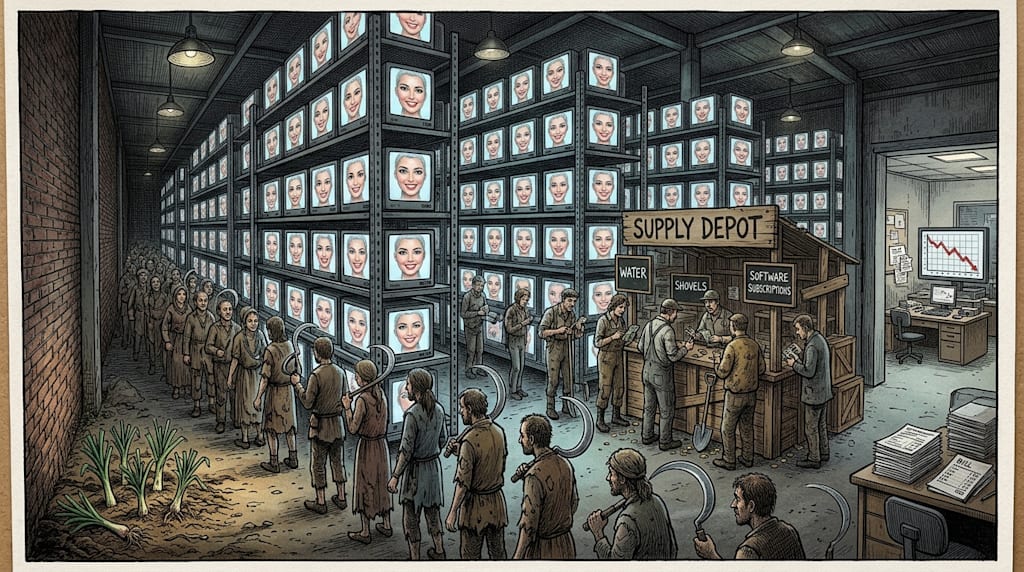
A rumor has been going around: Shou Zi Chew looked at TikTok’s backend and found more people posting AI videos than watching them. There is no reliable public source for that claim. TikTok does not publish that kind of backend number. Treat it as a fable. The fable gets one thing right. The production side is growing. The attention side is not.
The offline version is more shops than shoppers. The leek-harvesting version is a line of sickles with not enough leeks to go around. AI short dramas lose money because supply runs far ahead of demand. Production got cheaper. Being seen did not. Supply exploded. Click-through rates thinned out. Distribution costs money. The platform takes the profit.
Low Cost Still Costs Money
One person and one computer sounds like zero cost. The bills say otherwise.
At 2 a.m., you revise prompts. Dud clips fill the hard drive. The CapCut Super VIP quota runs out, and a pop-up offers the next tier. Model tokens are billed per run. One version disappoints, so you run another. Voiceover, music, asset-library memberships, cloud storage: each one renews. If you run a team, writers, editors, operations staff, paid-traffic buyers, and business staff need salaries. Rent comes monthly. If you work alone, time is a cost. Eating is a cost.
Production costs have fallen. Time, compute, software quotas, and paid traffic remain. Low cost lowers the entry barrier. It does not lower the visibility barrier. More makers mean more supply. More supply splits attention. Per-video completion and click-through rates fall. What you save in production, you spend twice in promotion. AI short dramas make production easier. They do not make being seen easier.
The Volume Strategy Turns Creation Into a Lottery
Many AI short-drama operations that currently work run a team. Every day the team dissects hit videos, copies structures, produces in bulk, and bets on probability.
Spreadsheets list genres, hooks, reversals, and release times. Asset-library files get names like “CEO_misunderstanding_v3.” The group chat says “20 today, test paid traffic tomorrow.” A genre catches fire today, and a crowd follows tomorrow. A reversal works, and the whole internet has the same reversal the day after. On the surface this looks like industrialized content production. In practice it turns creation into a lottery. A lottery has low odds. When everyone buys tickets the same way, the odds get worse.
The volume strategy has another cost. The team loses judgment. Every day runs analyze, copy, produce, review, produce again. Diligence stays at the tactical level. No one answers who the work is for or why anyone should remember it. Hits depend on topic, emotion, rhythm, persona, distribution, and luck. Copy the form and you get copies. The more copies, the less each one is worth.
Traffic Is the Platform’s Paid Product
When supply runs far ahead of demand and content has no strong difference, users watch whoever gets pushed in front of them.
Livestream commerce works this way. The goods are similar, so the key question is which livestream a target customer enters. Pushed traffic becomes the platform’s paid product. Short dramas work the same way. The genres are similar. The AI faces are similar. The plots use the same few moves. Users will watch anyone. Why should the platform let you be seen? Buy promotion. Buy paid traffic. Buy exposure. More makers mean higher bidding. Worse ROI means the team dares not stop spending. More spending means thinner profit.
Production consumes. Promotion consumes. Click-through rates stay dismal. The platform owes no one traffic. The platform runs a traffic business. You grind on production, and it collects on advertising. You gamble on content, and it collects rent on bidding. That is attention-market arithmetic.
Audiences Still Watch Videos
Teams mistake “can produce” for “there is demand.” That mistake, more than immature technology, explains the failures.
You can make ten a day. The market may not need ten. You can generate a hundred scripts. Maybe no one finishes one. Audiences still watch videos. They swipe past videos with no reason to watch. Attention is split across more platforms and more entertainment. Homogeneous content has no entry point. Throttling, copyright, compliance, and platform rules also shape the outcome. A team copies a hit after the window has passed. By release, the audience is tired of it.
The Water Sellers and Shovel Sellers Collect Certain Income
In a gold rush, the money often goes to the people selling water, shovels, and jeans.
In the AI short-drama chain, the water is model APIs and compute. The shovels are editing software, AI tools, and asset libraries. The jeans are courses, agency operations, paid-traffic agents, and training. Content teams bet on hits. Tools and service providers collect steady money. Shovel selling is crowded too. The winners have channels, brand, repeat purchase, and delivery. Profit flows from production to scarcity. The scarce resources are attention, trust, and control over distribution. AI made generation cheap. It did not make attention larger or traffic cheaper.
The Bill
Why AI short dramas lose money is not mysterious. Low production costs cannot beat a supply explosion. One person and one computer cannot save eating and time. The volume strategy, however diligent, cannot fight attention scarcity. Paid traffic, however aggressive, shifts profit from content to platform. Production spend is huge. Promotion spend is huge. Clicks are dismal. Losing money is the result.
Outsiders cannot see the backend data. Every team’s bill arrives monthly.
About the Creator
Jin
Writer of reamstories
https://reamstories.com/jin
Enjoyed the story? Support the Creator.
Subscribe for free to receive all their stories in your feed. You could also become a paid subscriber, letting them know you appreciate their work.
Comments
There are no comments for this story
Be the first to respond and start the conversation.