
'Endangered Species' (1982): When Cattle Mutilations Met Hollywood Conspiracy
Alan Rudolph’s forgotten thriller turned a very real rural mystery into a paranoid tale of government experiments, biological warfare, and the things hiding just beyond the edge of the highway.


There are certain stories that seem almost designed for the movies.
A rancher walks into a field and finds one of his cattle dead.
There is little blood.
There are strange cuts.
Certain organs appear to have been removed with almost surgical precision. There are few tracks around the carcass. No obvious explanation for how the animal died. And then it happens again. And again.
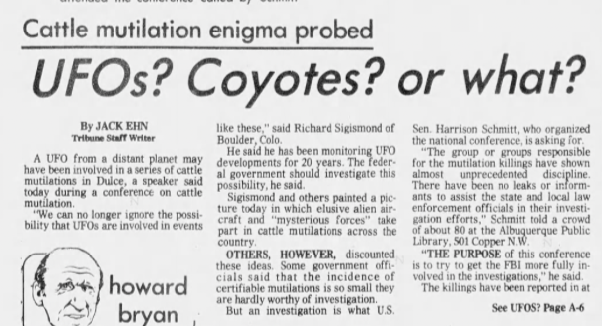
By the 1970s, cattle mutilations had become a genuine American phenomenon. Reports were coming from ranches across the West and Midwest, and the numbers being cited in newspapers sometimes reached into the thousands. The subject became a strange national obsession, mixing rural folklore with UFO sightings, Satanic cult rumors, government experiments and the growing suspicion that somebody, somewhere, knew more than they were telling us.
It was exactly the kind of story that could thrive in the America that came after Watergate.
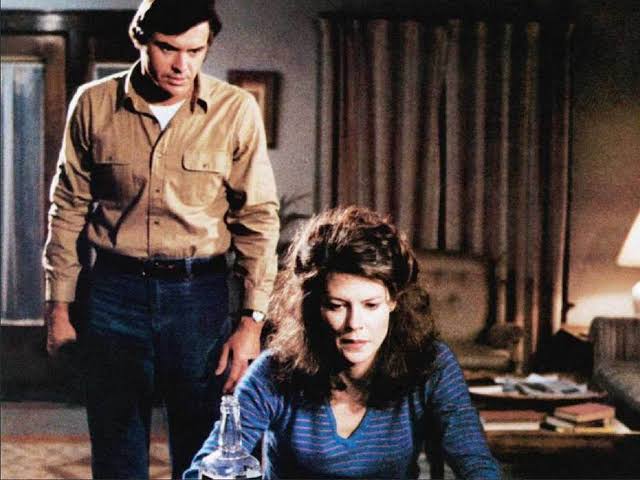
In 1982, director Alan Rudolph took those headlines and made Endangered Species, a peculiar, atmospheric conspiracy thriller starring Robert Urich and JoBeth Williams.
It wasn’t a hit.
It wasn’t even particularly well received.
But more than four decades later, it has become something much more interesting: a cinematic time capsule of a moment when a dead cow could represent almost anything an increasingly suspicious America was afraid of.
The Mystery Was Real
The story behind Endangered Species begins several years before the movie.
Reports of mysteriously mutilated animals had been circulating since the late 1960s. One of the most famous early cases involved a horse named Lady, nicknamed “Snippy,” whose carcass was discovered in Colorado’s San Luis Valley in 1967. The bizarre condition of the animal helped ignite a phenomenon that would eventually spread far beyond a single ranch.
By the middle of the 1970s, cattle mutilations were making national headlines.
And these weren’t simply stories invented by Hollywood.
Ranchers genuinely discovered dead animals in strange condition. Investigators genuinely examined the carcasses. Newspapers genuinely reported the phenomenon. The question was what, exactly, was causing it.
There were plenty of theories.
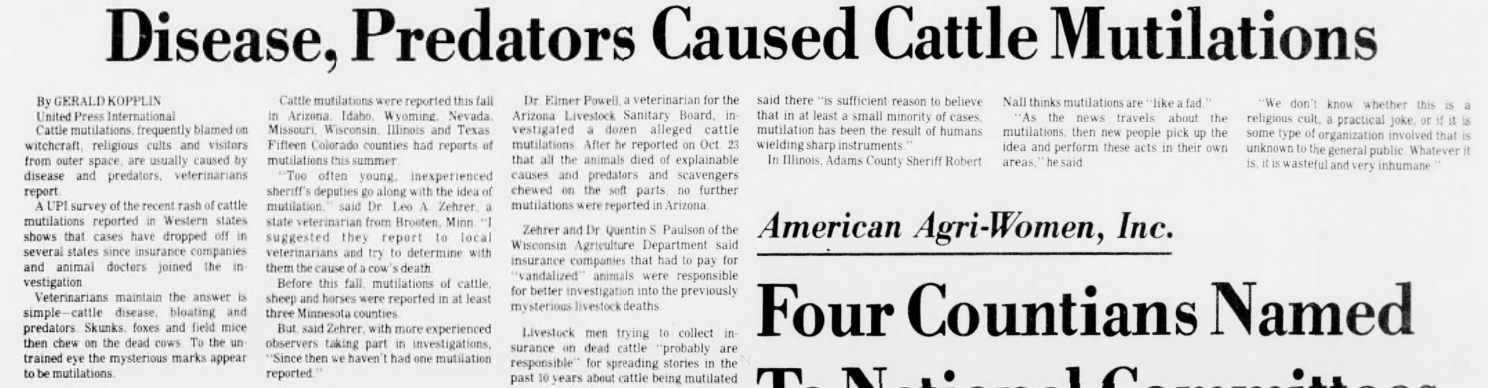
Predators and scavengers were the most mundane explanation. UFOs were considerably more exciting. Some suspected cults. Others imagined secret government programs. There were theories involving radiation, extraterrestrials and biological experiments.
The government, naturally, did not help calm anybody down.
An investigation led by New Mexico State Police officer Kenneth Rommel, known as Operation Animal Mutilation, ultimately concluded that many of the apparent mutilations could be explained by natural decomposition, scavenging and other ordinary processes occurring after an animal had already died.
That explanation was considerably less cinematic.
Hollywood chose the other one.
From Cattle to Conspiracy
Endangered Species grew out of producer Zalman King’s interest in the phenomenon. Journalists Judson Klinger and Richard Clayton Woods spent years researching reported cases across several states before the story reached Alan Rudolph.
Rudolph was coming off Roadie, but Endangered Species offered him something considerably darker.
Working with screenwriter John Binder, Rudolph reshaped the material into something that went beyond the mystery of mutilated animals. The film became a story about institutional power, biological warfare and the possibility that the government itself might be involved.
That was a very 1970s idea making its way into the 1980s.
The Watergate scandal had permanently damaged the notion that government institutions were necessarily acting in the public interest. The Vietnam War had left another scar. And fears about nuclear power, chemical contamination and biological weapons were hardly confined to science-fiction movies.
The film’s conspiracy therefore doesn’t need flying saucers to make people nervous.
It only needs the government.
And maybe a few black helicopters.
Robert Urich Goes Rural
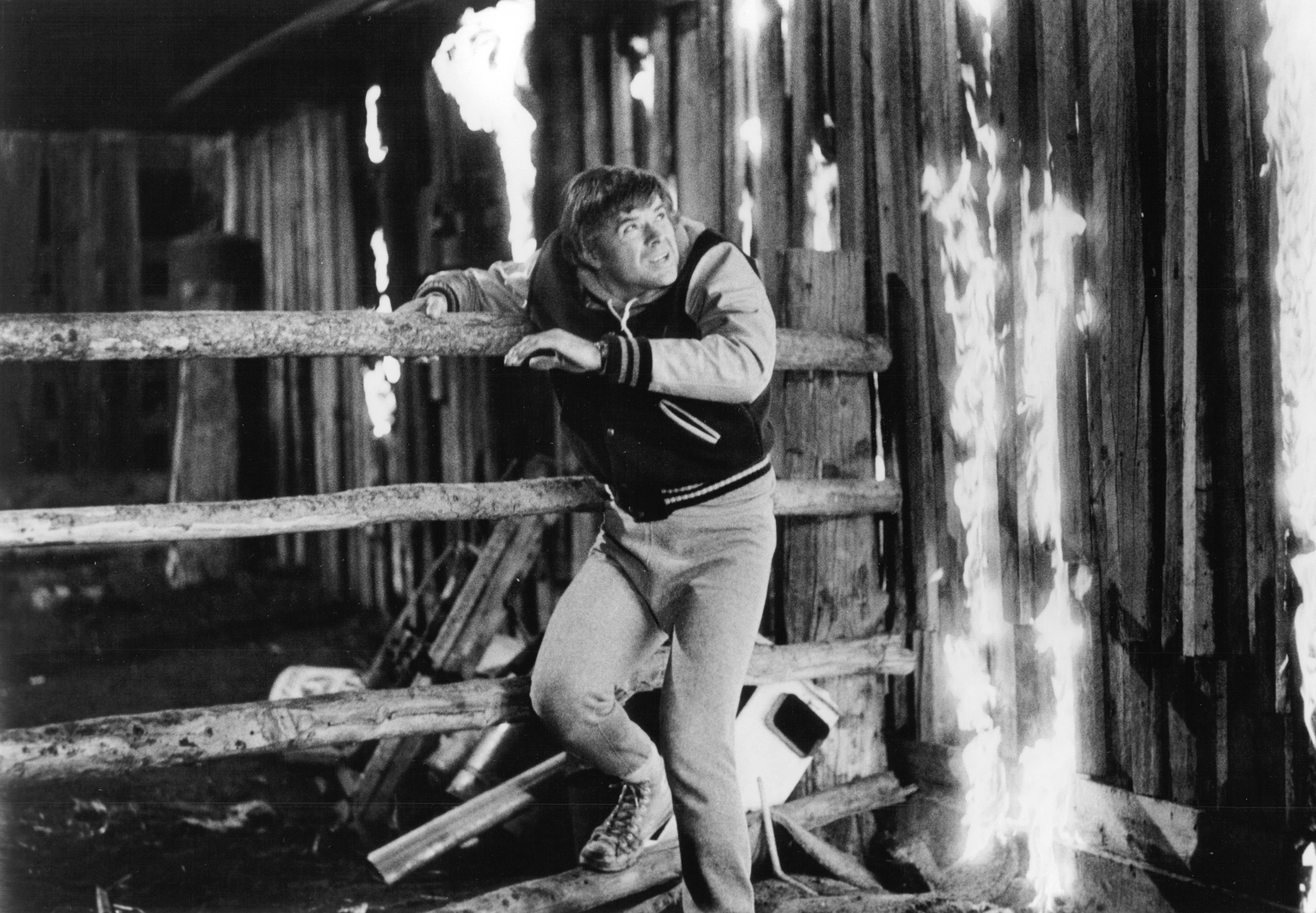
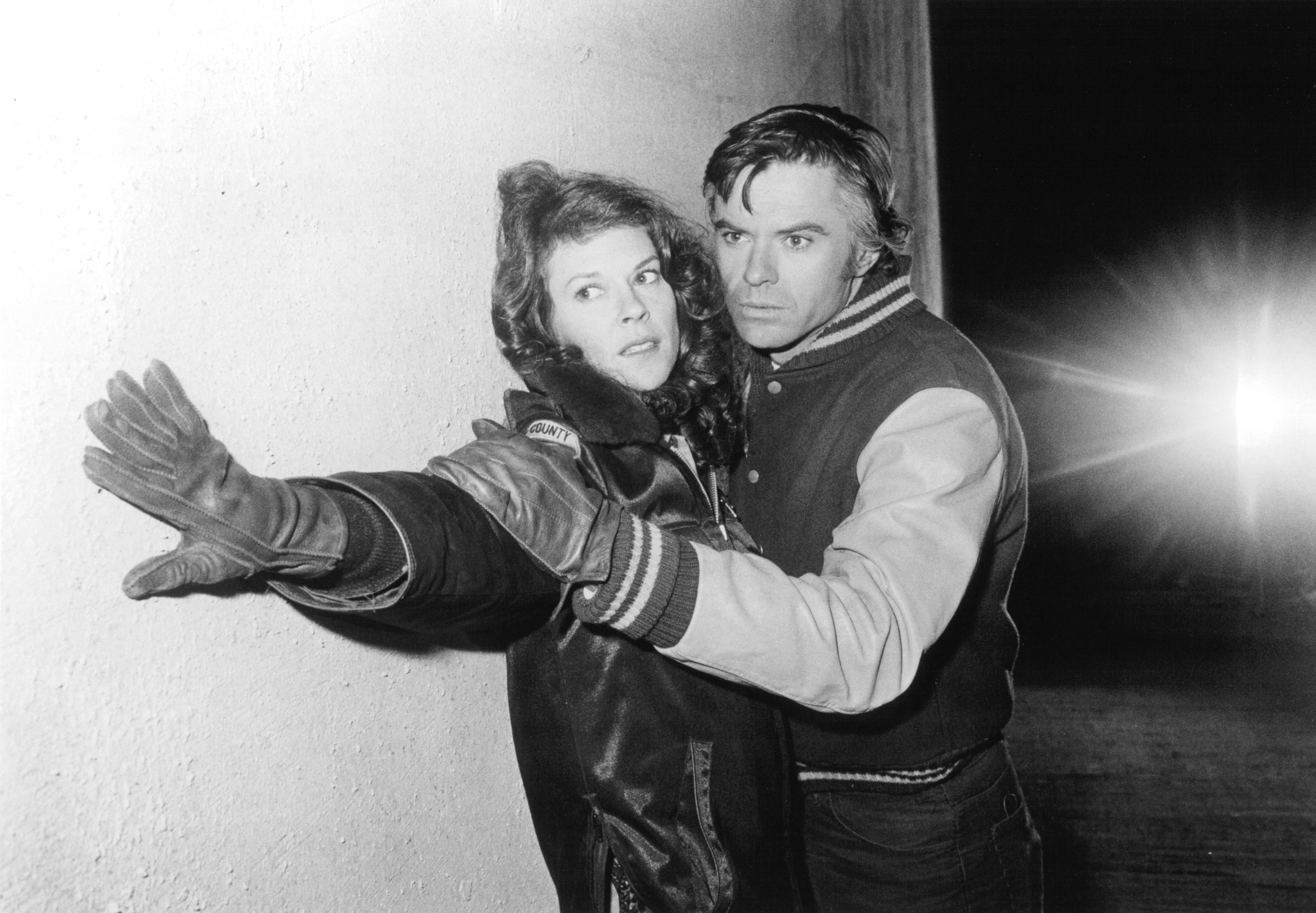
Robert Urich plays Ruben Castle, a burned-out New York ex-cop and recovering alcoholic who relocates to the rural West with his teenage daughter.
Urich was best known at the time for television’s Vega$, and he makes an interesting choice for this kind of movie. Ruben isn’t some polished action hero who arrives in town knowing exactly what to do.
He’s damaged.
He’s trying to start over.
And then he finds himself pulled into a mystery involving dead cattle and people who would clearly prefer that he stop asking questions.
JoBeth Williams, meanwhile, plays Harriet Perdue, a newly elected sheriff who becomes Ruben’s partner in the investigation.
Williams had recently appeared in Poltergeist, and Endangered Species gave her a very different sort of role. Harriet isn’t simply there to provide romantic interest. She’s competent, practical and willing to investigate the increasingly strange things happening around her.
The supporting cast is one of the film’s real pleasures.
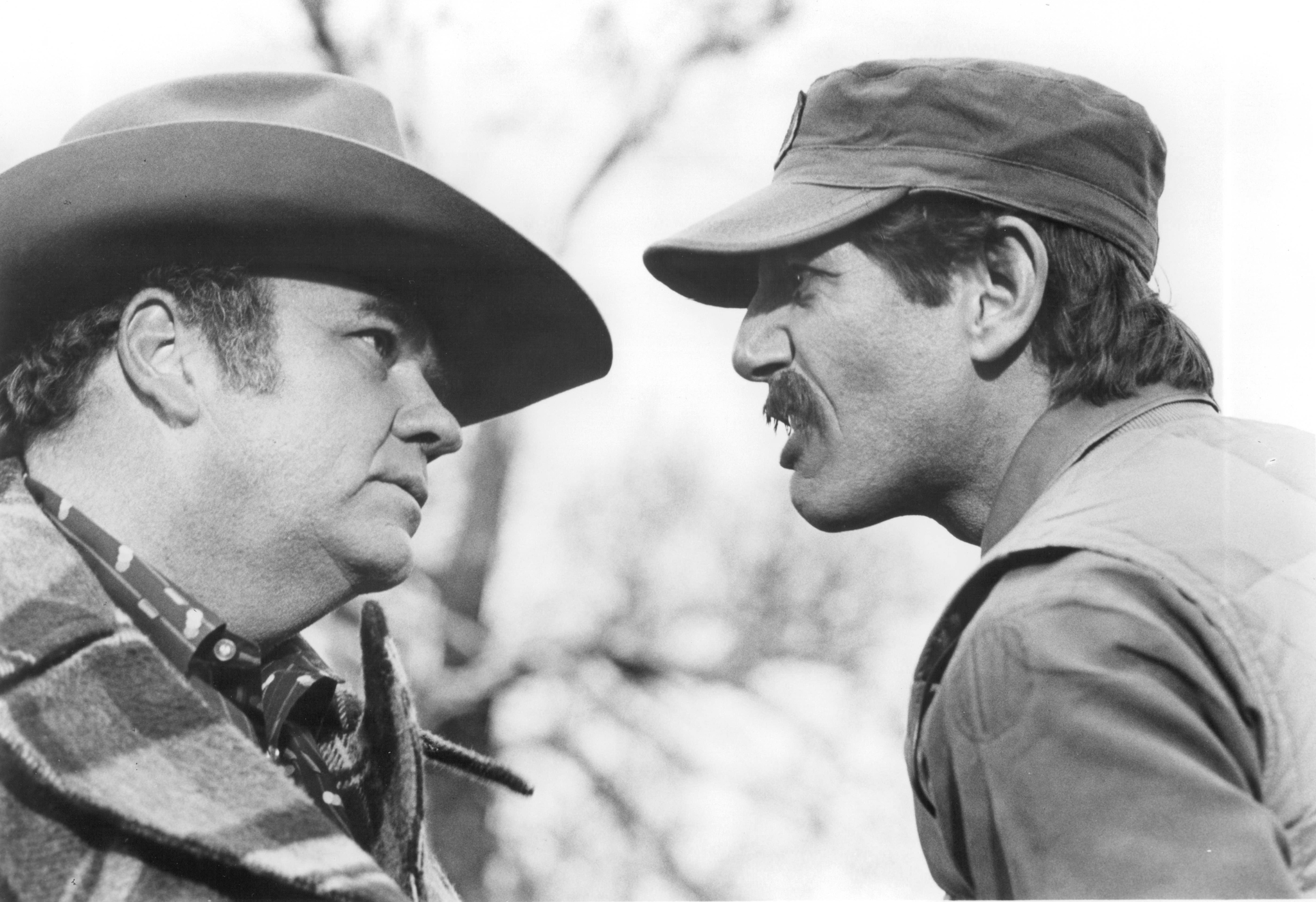
Paul Dooley plays newspaper editor Joe Hiatt. Hoyt Axton appears as cattle baron Ben Morgan. Peter Coyote brings his familiar air of intelligent menace to the proceedings, and Marin Kanter plays Ruben’s daughter.
Even Heather Menzies, Urich’s real-life wife, turns up in a small role.
This is a movie populated by people who look as though they actually live in the places where the story is happening.
And that matters.
Making the Strange Feel Ordinary
Rudolph’s biggest gamble was to make Endangered Species feel less like a traditional Hollywood thriller and more like something that might have been filmed outside your window.
The movie was shot primarily around Buffalo, Wyoming, during the fall of 1981, with additional work in Colorado and on studio sets.
The production itself quickly became nearly as troubled as the story.
There were delays connected to the Writers Guild strike. MGM went through executive changes. The studio reportedly became unhappy with the film’s naturalistic appearance and temporarily shut down production. Post-production brought further interference, including changes to Rudolph’s preferred ending.
Rudolph would later describe the experience as one of his worst filmmaking experiences.
That tension is visible in the finished film.
Endangered Species is never quite sure whether it wants to be a character drama, a rural mystery, an art film or a paranoid political thriller.
Sometimes that’s frustrating.
Sometimes it’s exactly what makes it interesting.
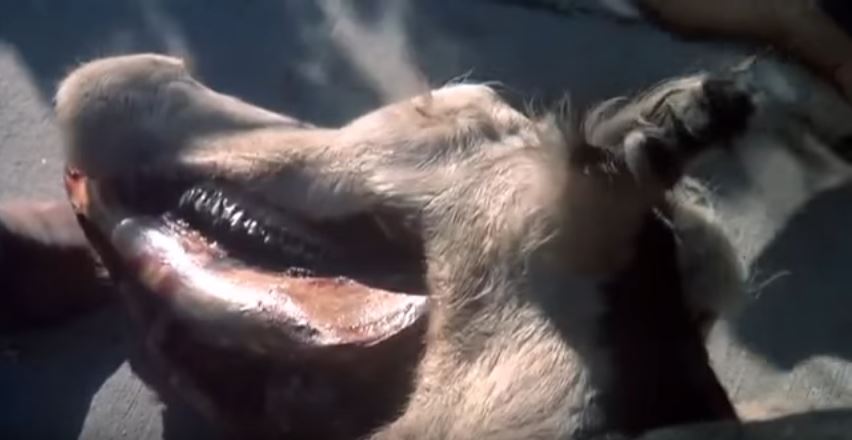
Even the cattle mutilations were handled practically. The production used real cattle carcasses, dressed to resemble the photographic evidence that had circulated in contemporary reports.
There is something almost perversely appropriate about that.
Rather than making the mystery look like a Hollywood fantasy, Rudolph wanted it to look like something you might actually discover in a field.
And that makes the movie’s stranger moments considerably creepier.
“Very Real—and That’s Why It Works”
Contemporary critics were all over the map.
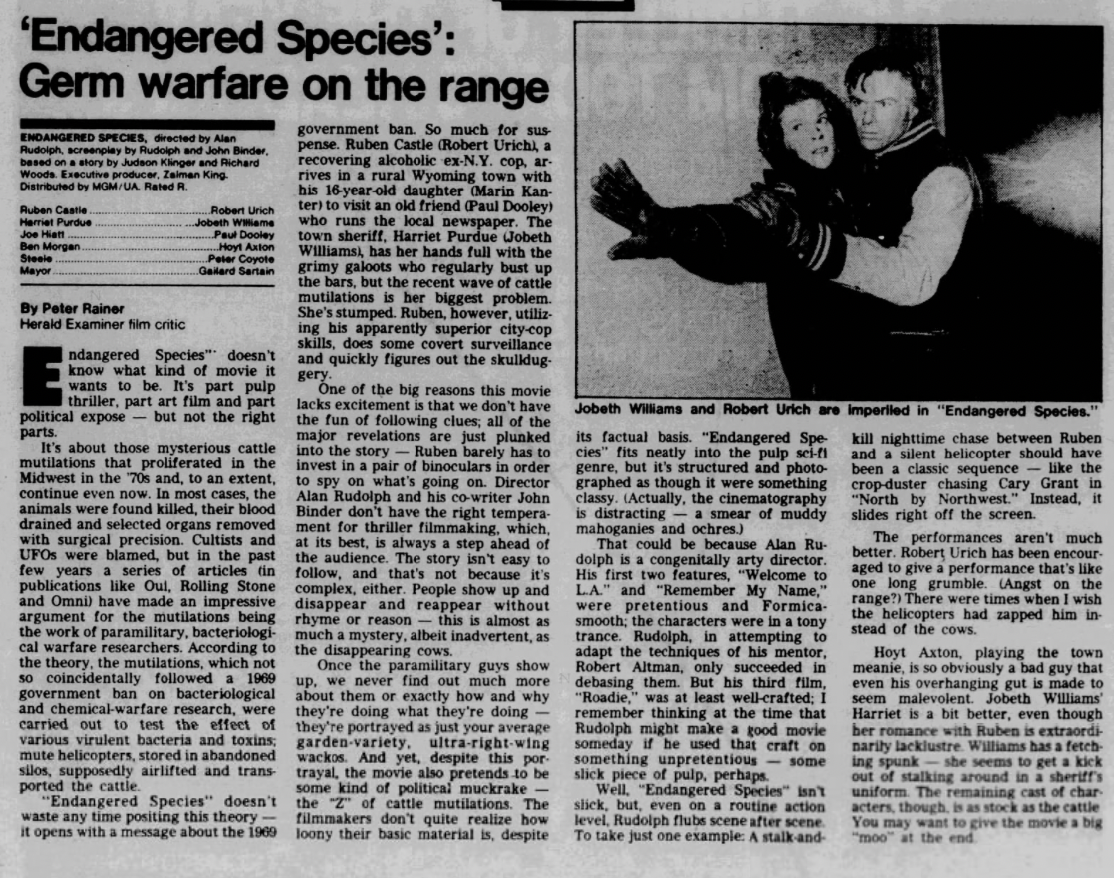
Cathy Cassinos of the Sacramento Union, writing in September 1982, embraced the movie’s realism, calling it “a real thriller” and “very real—and that’s why it works.”
She particularly praised the natural dialogue and characterizations, along with Gary Wright’s appropriately strange score.
Cassinos also emphasized the real-world phenomenon behind the movie, noting that thousands of butchered cattle had reportedly been discovered since the late 1960s.
Tom Jacobs of the Albuquerque Journal was similarly enthusiastic, headlining his review:
”‘Endangered Species’ Effective, With Good Thriller Elements.”
Jacobs appreciated the timing of the movie, particularly because reports of cattle mutilations were still appearing in New Mexico. He praised its tightly written script, well-defined characters and taut direction.
Patrick Taggart of the American-Statesman also found plenty to like, describing the movie’s combination of contemporary anxieties as a well-spiced mixture.
And he singled out Urich’s performance, calling it a “multi-colored, heartfelt portrait.”
But not everybody was buying what Rudolph was selling.
“What Kind of Movie It Wants to Be”
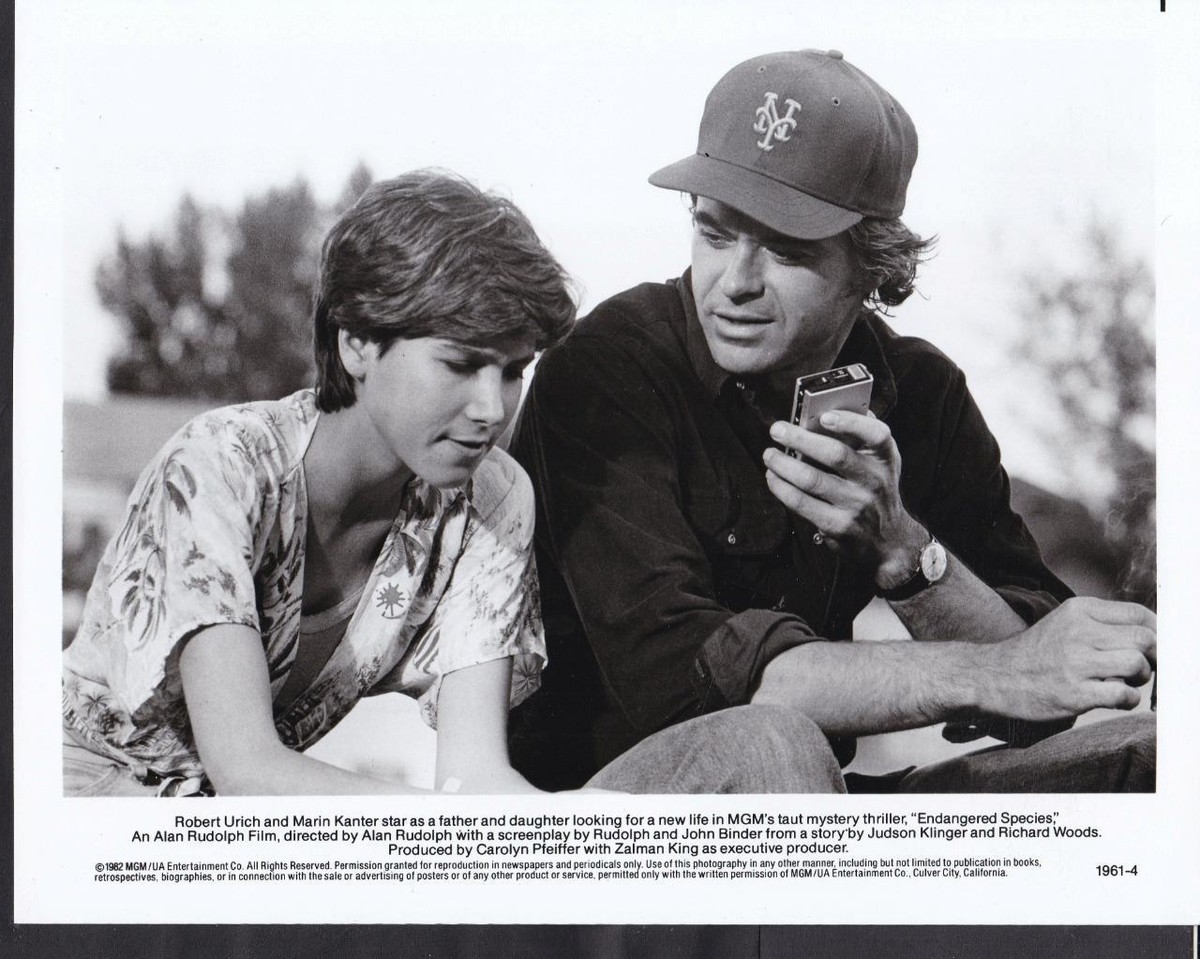
Peter Rainer of the Herald Examiner had a very different reaction.
His headline told you exactly where he stood:
”‘Endangered Species’: Germ warfare on the range.”
Rainer’s central complaint was that the film didn’t seem to know what it wanted to be.
Was it a pulp thriller?
An art film?
A political exposé?
He thought Rudolph stumbled repeatedly trying to balance all three.
George Bouwman was even harsher, giving the film one star under the headline “Audience true victim in ‘Endangered Species.’”
He found the story dull, arguing that it was heavy on innuendo and veiled references while being short on legitimate action. The storyline, he argued, felt strained and artificial.
Vincent Canby of The New York Times was similarly dismissive, finding the movie “dumb” despite the intriguing real-world phenomenon behind it.
Then there was Kevin Thomas of the Los Angeles Times, who went in almost completely the opposite direction, calling Endangered Species a “taut political thriller” and finding it as chilling as it was persuasive.
That split is revealing.
The movie wasn’t failing because nobody understood what it was trying to do.
People understood it perfectly well.
They just couldn’t agree on whether what it was doing worked.
The Problem With the Conspiracy
This is where Endangered Species becomes particularly fascinating as a piece of 1980s cinema.
The cattle mutilation phenomenon existed in that uncomfortable space between documented fact and speculative explanation.
The dead animals were real.
The investigations were real.
The unanswered questions were real.
But the leap from strange carcasses to secret biological warfare required a much bigger leap of faith.
The movie makes that leap because movies need answers.
Reality doesn’t.
That distinction is important when looking back at Endangered Species today. You don’t have to believe that cattle were being harvested for secret government experiments to appreciate what the story tells us about the people who believed it might be happening.
There was a tremendous appetite for explanations that placed frightening events inside a larger conspiracy.
And in 1982, America had plenty of reasons to be suspicious.
Endangered Species simply put those suspicions in a Wyoming field and left a dead cow in the middle of it.
A Movie That Never Became a Hit
For all the attention surrounding its subject, Endangered Species disappeared quickly.
The movie premiered in Buffalo, Wyoming, on September 9, 1982, before MGM/UA released it more broadly the following day.
It earned only around $1.47 million domestically.
That is a remarkably small return for a movie made on a reported budget somewhere in the $7–10 million range.
Part of the problem appears to have been the movie’s troubled relationship with MGM and the changes in studio leadership surrounding its release. Whatever the reasons, Endangered Species never received the kind of marketing push that might have turned its bizarre premise into a genuine theatrical event.
And perhaps that was the final irony.
The movie arrived at precisely the right cultural moment to be somebody’s conspiracy thriller.
But it wasn’t sold like one.
Why We Remember the Weird Ones
There are better Alan Rudolph movies.
There are better Robert Urich movies.
There are certainly better conspiracy thrillers.
Endangered Species is an uneven movie. Its competing tones don’t always fit together, the production problems seem to have left scars, and its conspiracy becomes considerably more conventional once the mystery begins to unravel.
But I find the movie difficult to dismiss.
Because the weirdness is the point.
This is what an early-1980s conspiracy movie looked like before the genre became slicker and more formulaic. It still carries the dust of the 1970s with it. It has Watergate paranoia, rural isolation, biological-warfare fears, UFO culture and distrust of government institutions all mashed together.
And somewhere in the middle of it all is Robert Urich, trying to figure out why the cows are dying.
That’s a very specific kind of 1980s movie.
It’s also the kind that tends to disappear.
Endangered Species isn’t remembered alongside The Parallax View, All the President’s Men or the more celebrated conspiracy thrillers of its era. It didn’t become a blockbuster or a cultural touchstone.
Instead, it became one of those strange little movies you stumble across years later and wonder how you missed it.
Maybe that’s appropriate.
The cattle mutilation phenomenon itself existed on the margins between fact and folklore, between something that happened and something nobody could quite explain.
Endangered Species occupies much the same territory.
It isn’t entirely successful.
It isn’t entirely conventional.
And it isn’t entirely forgotten.
For a movie about things lurking just outside the accepted explanation, that feels almost fitting.

About the Creator
Movies of the 80s
We love the 1980s. Everything on this page is all about movies of the 1980s. Starting in 1980 and working our way the decade, we are preserving the stories and movies of the greatest decade, the 80s. https://www.youtube.com/@Moviesofthe80s
Enjoyed the story? Support the Creator.
Subscribe for free to receive all their stories in your feed.
Comments
There are no comments for this story
Be the first to respond and start the conversation.