
Douyin quietly changed how traffic works. Most creators are still playing the old game.
The platform is no longer rewarding everyone equally. It is building a separate lane for creators who can hold attention, build an IP, and survive the AI flood.
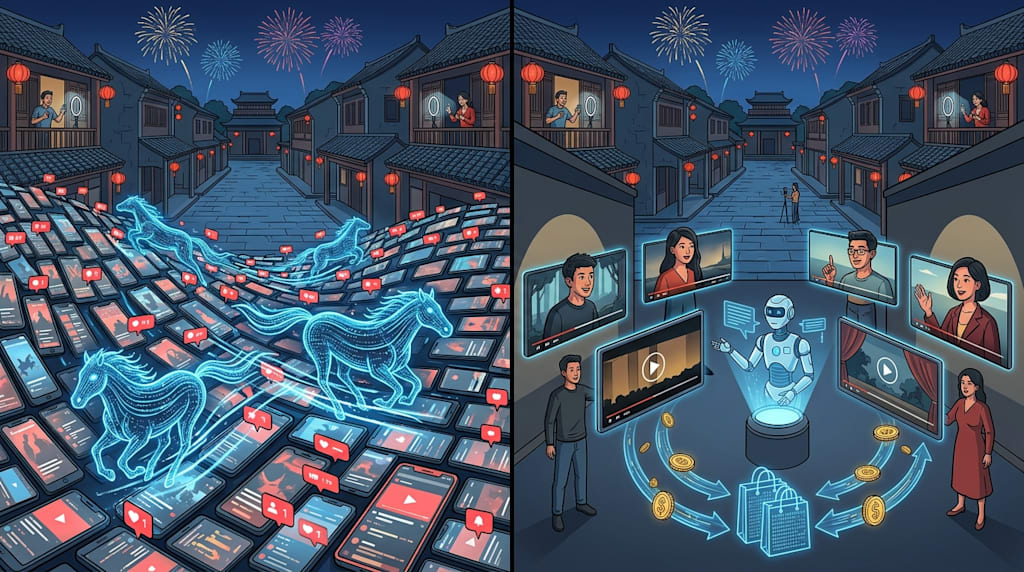
In late September, Yanguan Ancient Town turned into a carnival for the 2026 Douyin Creators Conference. People livestreamed from bluestone streets. Red carpets, stand-up sets, concerts, and fireworks filled the night.
Behind that noise, Douyin executives released numbers that pointed to one shift: traffic allocation is splitting.
For years, Douyin ran on algorithmic inclusiveness. Every video entered the same pool. Completion rate, likes, comments, and shares decided whether it moved up. Outperform the data and you had a hit. That rule created grassroots stars and kept Douyin on top of short video in China.
Now the scale is tilting toward high-quality content. A separate Selected pool, a rebuilt recommendation model, and tiered support programs all point to the same conclusion: the old rules are gone.
The broad pool race is over
During the wild-growth years, Douyin used a broad-pool race. All content competed in one place. Only e-commerce and ads had small differences. The algorithm pushed content upward based on completion, likes, comments, and other signals.
The system did not understand meaning. It used collaborative filtering, two-tower recall, Wide&Deep, and similar models to match behavior. It simulated neural connections, trained on massive data, guessed what users would prefer, and ranked content accordingly.
It worked. It was fast. It was open. If a video made people stay, click, or share, it had a chance. Ordinary people changed their lives with one clip. Brands launched with one hit.
Then the problems showed up. When everyone chased the algorithm, traffic moved toward emotional shocks and data tricks. Clickbait, borderline content, conflict, reversal, and shock value became formulas. Content that needed time got buried.
Douyin no longer wants to be only that machine.
The platform now puts high-quality content into a separate sub-queue. When that content merges into the main pool, it gets targeted traffic. Douyin is not just letting everything race. It is building an internal zone where quality gets a longer life, a more precise audience, and better monetization.
Douyin Vice President Chen Duyao shared three numbers:
High-quality content gets 27 times more active recommendations than the platform average.
High-quality creators gain followers 4.2 times faster than average.
Seven days after posting, high-quality work gets 45% more traffic than the broad pool. Many pieces keep breaking out a year or two later.
The message is direct: traffic no longer only rewards what runs fast. It also rewards what lasts.
Douyin is building a content zone inside itself
The Selected business now runs more independently. Douyin launched a separate app, an iPad version, and a Selected channel inside the main app. It supports lossless Dolby Vision uploads. It puts AI summaries and AI Q&A on the playback page. Inside Douyin, this is a content zone.
More than 72% of content in the main pool now carries the Selected tag. More than 55% of traffic for high-quality videos longer than three minutes comes from Selected. Total plays for high-quality content grew 160% year over year. Users watch a single piece 17 times longer than broad-pool content.
Those numbers show a new standard for value.
The old system turned viewer interest and video traits into numbers, then found similar numbers. Looking similar is not the same as liking something. The head of Selected’s recommendation algorithm said the main model’s parameter count grew tenfold in a year. Distribution moved from tag matching to a large-model generation approach.
The algorithm now narrows from broad category to sub-track to specific content type. It tries to read structure, style, context, and the creator’s personal traits.
The bigger change is who judges quality. Selected uses knowledgeable users. The vote of professionals in a field carries more weight. The old path of chasing trends, memes, and mass emotion is fading. The new path runs through expertise, community influence, and a recognizable style.
The algorithm no longer only asks what you like. It asks who knows better.
Creators split: newcomers get a springboard, veterans build IP
Douyin built a new-creator growth system that covers discovery, resource support, and account operations.
Over the past year, plays for high-quality new creators grew more than 40%. Young newcomers gained followers six times faster than similar creators. The number of creators who passed one million followers within a year grew 40%.
Chen Duyao said more than 90% of new creators start on Douyin. The platform is now the first step for most of them. It works one-on-one with promising newcomers. Creator Chen Lewei had 1,000 followers. Douyin saw his directing sense and pacing. The platform kept investing. Today he is a top creator in his lane, and his single videos became a series.
Mature creators are splitting too. Douyin gave resources to 318 benchmark creators across more than 40 verticals. That produced many hits. 66% of those creators made a creative breakthrough.
Every vertical is moving toward professional, serial, and IP-driven work. Creators have to build a personal IP, run a fan community, and close the loop with monetization.
In food, Gordon Ramsay and other top chefs joined. Douyin built the exclusive show Gordon Saturday. It passed 300 million plays and gained one million followers in 24 hours. Niche lanes like AIGC food recreation, stop-motion, and farmer miniatures got targeted support and became new creative schools.
In fashion, the platform tuned its algorithm to connect users with quality creators through trends and products. More than 300 fashion and beauty styles appeared in a year. When Jiang Chenglan returned after three years away, Douyin launched a makeup tutorial campaign. Creators followed along. The platform also brokered hundreds of offline collaborations.
In knowledge, young researchers entered labs and explained hard ideas in fun ways. 38 universities launched 346 national first-class courses. Total views hit 680 million. AI tools pushed AI knowledge plays up 102%, taking science content out of its niche.
The reality is simple. Competition keeps rising. To avoid running out of topics and to extend a content life, serialization and IP work are the best value.
That helps creators who play the long game. For people who just record daily life, the bar is higher. They now need shooting, planning, operations, interaction, and monetization skills.
Douyin still welcomes ordinary people. It no longer only rewards them.
AI lowers the barrier and raises the human bar
AI is everywhere. Douyin is pushing AI creation tools to lower the technical barrier.
Over the past year, AIGC opened new space. AI-native creation grew fast. It covers art shorts, narrative shorts, and daily records. Themes include original worlds, apocalypse, sci-fi fantasy, and urban reality.
The first Douyin AI Creation Competition produced more than 500 million-view hits. 13 works left Douyin and were shortlisted for the Hundred Flowers Awards, Cannes, and Pingyao.
AI-native creators with story skills are emerging. 22-year-old director Li Rang taught himself AIGC. In less than four months, he made an AI short with 4.87 million likes.
AI knowledge creators grew 133% year over year. In one vibe coding event, 44,000 creators posted work in two months. Total plays passed 1.4 billion.
Computer science student Wan Keli turned tens of thousands of ancient Chinese poems into a 3D galaxy. Each star is a poet. Click and read. Two Cornell computer science PhDs built a college application simulator. It turns six years of admission data from nearly 1,600 Chinese universities into a map. An art creator made a 3D music player with AI. It gave music visuals for the first time. Followers went from zero to 190,000 overnight.
AI also runs creator services. Douyin’s upgraded AI creation assistant handles 95% of data queries and analysis. It helps with account unbinding and chat repair. It also works proactively. The problem resolution rate rose from 45% to 61%.
AI is cutting the barrier across creation, operations, and service. More people can make content.
That raises a hard question: when AI can mass-produce acceptable content, what is scarce?
The head of Selected’s recommendation algorithm said AI magnifies each creator’s differences. The Selected algorithm is built to give better traffic to creators with human touch and personality. In the future, it will read aesthetic preferences, expression style, and personal voice. It will capture what makes creators different under the same topic and push them to the right audience.
When AI can mass-produce acceptable content, human touch, personality, and personal style become the standard.
One Douyin product manager said: “Creators who stay with users for a long time have a clear personality. Creation comes from feeling. It is taking your sense of the world, your understanding and imagination, filtering it, shaping it, and expressing it.”
To break filter bubbles, Douyin added exploration to its multi-objective modeling.
For existing interests, it uses diversity splitting, multi-interest recall, and support for niche long-tail content to control repeats and push more variety.
For new interests, it uses random recommendations, social graph expansion, search-recommendation linkage, and a stop-push option when users mark “not interested.” User action feeds the system. Distribution becomes more personal and more diverse.
Creators still worry: can the algorithm tell a soulful piece from an AI assembly-line product? AI-generated content often knows what the algorithm wants. It hits keywords. It can produce perfect completion data.
Douyin’s answer is manual screening on top of the algorithm. It is improving its ability to spot AI assembly-line content. It wants traffic to go to work that has value.
This is a new contest. AI explodes supply. The platform has to upgrade its filter. The winner will not be the person best at using AI. The winner will be the person who keeps human touch in the AI era.
Traffic rules reshape money
The traffic shift reaches monetization. Douyin e-commerce data shows the logic of tiered operations.
Douyin e-commerce has more than 12 million creators. More than 4.56 million new active-selling creators joined in the past year. 70,000 creators went from zero to one million yuan in annual transaction value. Among new active sellers, ordinary small and medium creators are 99%. Douyin e-commerce averages more than one million livestream rooms per day, more than 85 million new e-commerce content items per day, and nearly 14.9 billion daily views.
That is a huge pool. Tiered operations are needed to find strong sellers and raise conversion. Douyin e-commerce launched support plans. Qualifying content and creators get tens of billions of traffic, millions of merchant resources, and exclusive services. Selected participants get traffic boosts, merchant matching, one-on-one operations, and up to 100% rebates on technical service fees.
Support now covers content evaluation, merchant coordination, operations, and cost incentives. It is not just traffic.
Douyin also redefined commercial orders into three types:
Seeding: first-hand experience that sparks interest.
Review: tests, comparisons, and specs that help decisions.
Creative: brand stories with strong ideas that build emotional connection.
It upgraded its influencer service system across supply, fulfillment, distribution, and review. The goal is lower cooperation cost and better matching.
This is the logic behind the traffic shift. In the growth phase, the platform needs many creators and videos to attract and keep users. Traffic is open. Everyone has a chance. In the mature phase, the platform needs better monetization. Traffic splits. Resources go to high-value content and creators. That maximizes ARPU per unit of traffic.
Douyin is following the same path as other mature platforms: open access first, tiers later.
The hidden opportunity is the traffic shift itself
If someone asks what Douyin’s next opportunity is, the answer may not be food, fashion, knowledge, AI, or e-commerce.
The opportunity is the change in how traffic is allocated.
It means:
Selected: get the tag and enter the separate pool.
Professional: build depth, recognition, and community influence.
IP: make serial content, show personality, stay long enough to matter.
AI: use it for speed, but keep human touch.
E-commerce integration: connect content, fans, commercial orders, and sales.
For creators, this is a hard but clear reshuffle. The era of chasing trends, memes, and mass emotion is ending. The era of expertise, community influence, and personal style has started.
The platform will still give newcomers a chance. The chance will not be evenly spread. Traffic will still reward hits. The definition of a hit is moving from good data to lasting value.
For brands and merchants, this is a chance to relearn Douyin. Douyin is not only a traffic market. It is a tiered content business system. Whoever finds quality creators faster, enters the Selected pool earlier, and connects seeding, review, creativity, and e-commerce will catch the next wave.
In late September in Yanguan Ancient Town, fireworks lit the sky. Creators held up phones to record it. After the fireworks faded, people on the bluestone streets kept livestreaming. The numbers on their screens were moving under new rules.
About the Creator
Jin
Writer of reamstories
https://reamstories.com/jin
Enjoyed the story? Support the Creator.
Subscribe for free to receive all their stories in your feed. You could also become a paid subscriber, letting them know you appreciate their work.
Comments
There are no comments for this story
Be the first to respond and start the conversation.